Note: This is an original, publication-ready SEO article synthesized from publicly available U.S. government information, NASA materials, congressional records, Space Force doctrine, AARO reporting, ODNI reports, and reputable American news coverage.
The phrase “Space Force and UFOs” sounds like it was cooked up by a late-night comedy writer with a strong coffee and a weak sense of restraint. Put “Space Force” next to “UFOs,” and the public imagination immediately launches past satellites, missile warning systems, orbital debris, and national security. Suddenly everyone is picturing chrome saucers, secret hangars, glowing triangles, and a Guardian standing at a podium saying, “We come in peace, but please stop asking us about Area 51.”
That is exactly why the United States Space Force has never seemed eager to become America’s official UFO desk. The service was created to protect U.S. and allied interests in space, not to become the federal government’s cosmic customer service department. Its actual work is serious, technical, and deeply tied to modern life: tracking objects in orbit, supporting satellite communications, enabling GPS, helping with missile warning, protecting space-based systems, and ensuring the U.S. can operate in, from, and to space.
Yet UFOsnow more formally called unidentified anomalous phenomena, or UAPkeep drifting into the conversation like a balloon over restricted airspace. The reason is understandable. If something weird appears in the sky, people look upward. If it looks really weird, they look beyond the sky. And if it might be beyond the sky, they ask, “Isn’t that Space Force territory?”
The answer is: not exactly. In fact, the better answer is: please do not make the newest military branch wear the alien hat.
Why Everyone Assumes the Space Force Should Handle UFOs
On the surface, the connection seems obvious. Space Force has “space” in the name. UFO lore is full of claims about extraterrestrial visitors. The branch uses space surveillance technology. It tracks objects above Earth. It has a futuristic logo. Case closed, right?
Not so fast. That logic is a little like saying the Coast Guard should investigate every mysterious puddle because it has “coast” in the name. The Space Force’s mission is not “investigate anything strange that someone saw overhead.” Its job is to organize, train, and equip forces that support space operations and protect national interests in the space domain.
That means the Space Force cares deeply about objects in orbit, satellites maneuvering unexpectedly, space debris, adversary spacecraft, sensor data, launch ranges, communications networks, and the operational systems that make modern military and civilian life function. It is not built primarily to interview pilots about strange lights, analyze cellphone videos from backyard barbecues, or determine whether a shaky clip is Venus, a drone, a weather balloon, or a very dramatic seagull.
Still, the public link between Space Force and UFOs became stronger after the Pentagon began treating UAP reports more seriously. Military pilots reported encounters. Congress demanded transparency. The intelligence community released assessments. NASA convened an independent study team. The Department of Defense created a dedicated office for anomalous phenomena. Suddenly, the subject moved from tabloid territory into hearing rooms, agency reports, and national security discussions.
That did not mean aliens had arrived. It meant the government finally admitted a practical problem: sometimes trained observers and advanced sensors detect things they cannot quickly identify. That is not automatically science fiction. It is an airspace safety, intelligence, and data-quality problem.
The Space Force Has a Real Job, and It Is Already Complicated
To understand why the Space Force is not thrilled about becoming synonymous with UFOs, you have to understand what it actually does. The service is responsible for space capabilities that support the joint force and national objectives. In plain English, that includes the satellite systems that help troops communicate, navigate, detect missile launches, monitor weather, and operate across the globe.
Space is not empty. It is crowded, contested, and increasingly commercial. Thousands of active satellites share orbit with spent rocket bodies, fragments of debris, defunct spacecraft, and objects that require constant tracking. Some satellites maneuver. Some behave unpredictably. Some may belong to competitors or adversaries. A small object traveling at orbital speed can become a very expensive problem very quickly.
This is where Space Domain Awareness, or SDA, comes in. SDA is the military’s effort to identify, characterize, understand, and predict factors in space that could affect operations. That includes natural hazards, debris, commercial systems, and potential threats. Space Force units track tens of thousands of space objects, including active payloads and orbital debris. This is less “little green men” and more “little gray spreadsheets,” though the spreadsheets are attached to some of the most advanced surveillance systems in the world.
When Space Force doctrine talks about abnormal activity or unknown origins in the space domain, it does not automatically mean flying saucers from Zeta Reticuli. It may mean an object whose ownership is unclear, a piece of debris with uncertain behavior, an adversary satellite doing something suspicious, or a sensor return that needs better classification. In space operations, “unknown” is a technical status, not a movie trailer.
AARO: The Office That Actually Handles UAP
The federal office most directly connected to UAP is not the Space Force. It is the All-domain Anomaly Resolution Office, better known as AARO. Established within the Department of Defense, AARO was designed to synchronize government efforts to detect, identify, attribute, and, when necessary, mitigate anomalous objects that may affect military operations or national security.
The key phrase is “all-domain.” UAP reports are not limited to outer space. They can involve airborne objects, objects near military installations, items detected over training ranges, things observed near the ocean, or reports that cross traditional categories. In recent years, the government’s vocabulary has shifted from “unidentified aerial phenomena” to “unidentified anomalous phenomena” because not every report is neatly confined to the air.
That broader scope makes AARO a better institutional fit than Space Force. AARO can coordinate with the military services, intelligence agencies, NASA, the Federal Aviation Administration, and other organizations. It can review sensor data, collect reports, assess threats, and apply a scientific and intelligence-driven framework. The Space Force may contribute data when the issue involves space objects or space sensors, but that does not make it the lead detective in every mystery with a blinking light.
This distinction matters. If the Space Force were publicly framed as the government’s UFO command center, it could distort public understanding of both UAP and the Space Force. It would imply that the phenomena are mainly space-based or extraterrestrial, even when most cases may involve drones, balloons, aircraft, atmospheric effects, sensor artifacts, or insufficient data.
The Stigma Problem: Why the Space Force Is Careful
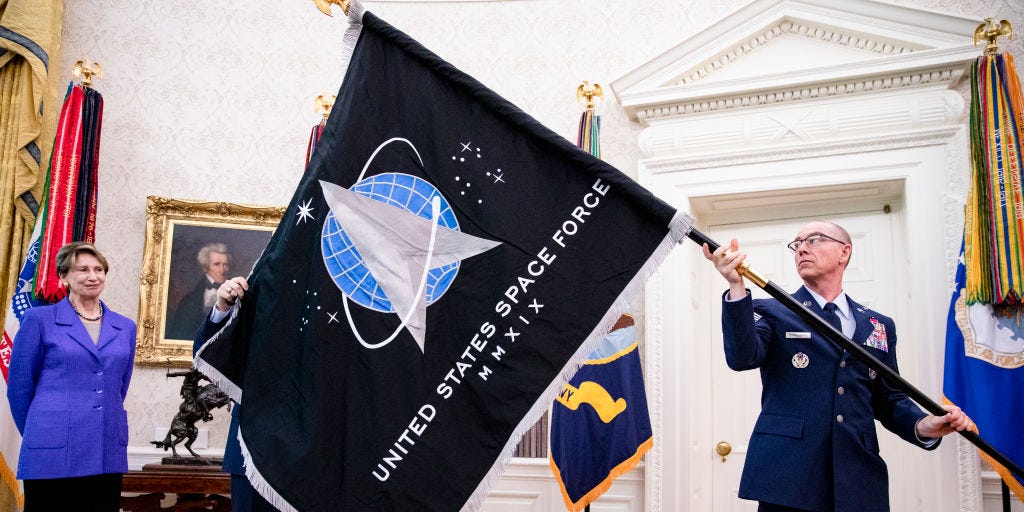
There is another reason the Space Force is cautious: reputation. The service was born in 2019 and immediately became a pop-culture punchline. Even before it had fully developed its identity, uniforms, organizational structure, and public role, it was being roasted online by people who assumed it existed to fight moon goblins with laser swords.
That was unfair, but public perception is not always known for wearing sensible shoes. The Space Force needed to establish itself as a serious military branch focused on real strategic needs. Getting labeled “the UFO branch” could have undercut that effort. It would be like launching a new cybersecurity agency and having everyone ask whether it can also fix their Wi-Fi.
In 2021, reporting suggested that Pentagon officials considered whether the Space Force should take on a larger UAP role. The idea made some sense on paper: the Space Force had advanced tracking capabilities, no geographic boundary in the traditional sense, and a mission connected to the space domain. But Space Force leaders reportedly worried that inheriting the UFO portfolio would damage credibility at exactly the moment the branch was trying to be taken seriously.
That concern was not silly. UFO culture is a crowded neighborhood. It contains serious pilots, skeptical scientists, defense analysts, hobbyist skywatchers, conspiracy influencers, documentary producers, and at least one uncle at Thanksgiving who insists he “knows things.” For a new military service trying to explain orbital mechanics and national security space architecture, being dragged into every alien meme is not exactly strategic communications heaven.
UAP Are Real Reports, Not Automatically Alien Spacecraft
One of the biggest mistakes in public discussion is treating “unidentified” as a synonym for “extraterrestrial.” It is not. Unidentified means the available information is not enough to confidently classify the object or event. That could happen because the object was too far away, the sensor angle was poor, the recording lacked context, the witness saw it briefly, or the data needed for analysis is classified, incomplete, or unavailable.
Government reports have repeatedly emphasized that many UAP cases remain unresolved because of data limitations. That is much less glamorous than “aliens,” but it is far more useful. Good investigation depends on sensor calibration, time stamps, metadata, range, speed, weather, radar correlation, witness accounts, and comparable known objects. Without those details, even experts can end up squinting at pixels like everyone else.
NASA’s independent UAP study reached a similar conclusion: the topic deserves a scientific approach, but there is no conclusive public evidence that UAP are extraterrestrial. NASA’s role is not to hype the mystery. It is to improve data collection, reduce stigma, apply scientific methods, and help the public understand what evidence can and cannot show.
AARO has also stated that it has not found verifiable evidence that UAP represent extraterrestrial technology. That does not mean every case is solved. It means the leap from “unexplained” to “interstellar visitors” is a leap, not a conclusion. In science and intelligence work, a leap without evidence is less a breakthrough and more a sprained ankle.
Why Congress Keeps Pushing the Issue
Congressional interest in UAP has grown because the subject touches several serious concerns: flight safety, national security, government transparency, reporting stigma, and public trust. In 2023, a House Oversight hearing brought testimony from former military aviators and intelligence personnel who argued that UAP reports deserve more serious attention and better reporting channels.
The point of that public debate was not simply “Are aliens real?” It was also: Are pilots seeing unknown objects in controlled airspace? Are reports being collected consistently? Are agencies sharing information properly? Are military personnel discouraged from reporting unusual encounters? Are lawmakers getting accurate briefings? Those are legitimate oversight questions, even if nobody has parked a saucer on the National Mall.
Lawmakers have also introduced transparency measures designed to collect, review, and release UAP-related records. The goal is to prevent important information from disappearing into agency silos or being dismissed because the topic sounds embarrassing. In 2026, the government continued rolling out UAP-related records under a transparency initiative, while noting that unresolved cases can remain unresolved because the available data is not sufficient for a final determination.
That phrase“not sufficient”is the quiet engine of the whole debate. It is the gap between a blurry mystery and a defensible answer. Closing that gap takes better instruments, better reporting systems, better interagency coordination, and less stigma. It does not require assigning every strange sky event to the Space Force.
What the Space Force Should Do About UAP
The smartest role for the Space Force is not to become the UFO police. It should contribute what it is uniquely equipped to contribute: space-domain data, orbital tracking expertise, sensor context, and analysis of objects that may be in or near the space environment. If a case involves a satellite, debris, reentry event, unusual orbital behavior, or a sensor track connected to space operations, Space Force expertise is highly relevant.
But if a pilot sees an object in restricted airspace, that may involve the Air Force, Navy, FAA, intelligence agencies, AARO, or other organizations. If the object is a drone, it may raise domestic security and airspace questions. If it is a balloon, it may be a tracking and identification problem. If it is an atmospheric effect, scientists may be better suited to explain it. If it is adversary technology, intelligence agencies and combatant commands need to know. A one-size-fits-all UFO office would be clumsy. An all-domain coordination model makes far more sense.
Space Force can be part of the answer without owning the whole circus. Think of it as the highly trained technician who can tell whether the mysterious object was actually a satellite reentry, not the ringmaster who has to introduce every act under the big tent.
The Public Wants Wonder, But Agencies Need Evidence
Part of the Space Force and UFO tension comes from a mismatch between public imagination and institutional responsibility. The public wants wonder. Agencies need evidence. The internet wants a headline by lunch. Analysts want raw data, calibration records, chain of custody, multiple sensors, and enough context to avoid embarrassing mistakes.
That difference can frustrate everyone. UFO believers may see government caution as secrecy. Skeptics may see public interest as gullibility. Military officials may see the whole debate as a communications minefield covered in glitter. But the responsible middle ground is clear: take reports seriously, avoid sensational conclusions, improve data, and communicate honestly.
That is also why the Space Force wants distance from the alien narrative. Its mission is already difficult without being turned into a meme factory. It must protect satellites, support military operations, track objects in orbit, and prepare for a future where space is increasingly crowded and contested. Those are real problems. They affect banking, navigation, weather forecasting, communications, emergency response, and national defense.
In other words, the Space Force is not avoiding UFOs because the subject is necessarily fake or foolish. It is avoiding the role of “UFO headquarters” because that label would be misleading. UAP require a serious, multi-agency, evidence-based approach. The Space Force is one contributor, not the mascot.
Specific Examples That Explain the Confusion
Example 1: Navy Pilot Encounters
Some of the most famous modern UAP cases involved Navy aviators, not Space Force personnel. The widely discussed videos associated with Navy aircraft helped push the issue into mainstream conversation. These cases raised questions about training ranges, sensor data, and airspace safety. They did not automatically make the phenomena space-based.
Example 2: Orbital Tracking
If an unknown object is detected in orbit, Space Force tracking systems and space surveillance experts may be central to identifying it. That object could be debris, a satellite, a launch-related item, or something maneuvering unexpectedly. This is where Space Domain Awareness matters. But again, “unknown object” in orbit is not the same as “alien spacecraft.” It may simply be a cataloging, attribution, or sensor challenge.
Example 3: Public Record Releases
Recent UAP transparency efforts have released documents, videos, and historical records to the public. These releases can increase trust, but they also create a flood of interpretation. A blurry image may become ten viral theories before an analyst has finished breakfast. This is why agencies emphasize context and caution. Public access is valuable, but raw material is not the same as proof.
Experience Notes: What It Feels Like to Follow the Space Force and UFO Debate
Following the Space Force and UFO conversation is a strange experience because it forces two very different worlds into the same room. On one side, you have the disciplined language of military space operations: domain awareness, orbital debris, launch ranges, payloads, tasking, attribution, and command relationships. On the other side, you have decades of cultural mythology: saucers, cover-ups, whistleblowers, secret programs, alien bodies, and enough dramatic background music to power a streaming service.
The first experience most readers have is confusion. They see the words “Space Force” and “UFO” together and assume the connection is direct. Then they discover that the U.S. government has created AARO, NASA has studied UAP from a scientific perspective, ODNI has issued reports, Congress has held hearings, and the Space Force is mostly trying to track satellites and keep orbital traffic from becoming a demolition derby. The picture becomes less cinematic, but much more interesting.
The second experience is realizing how much of the UAP debate is really about data. A mysterious object can sound incredible in a witness account, but without range, speed, sensor settings, weather context, and corroboration, it remains hard to analyze. That does not mean the witness is lying. It means the event may not be scientifically useful yet. Many people find this unsatisfying because mysteries feel like they should come with a dramatic answer. In real investigations, they often come with a folder labeled “insufficient information,” which is accurate but emotionally rude.
The third experience is noticing how stigma shapes the conversation. Pilots, service members, and officials may hesitate to report unusual events if they think they will be mocked. Scientists may avoid the topic because they fear reputational damage. Military leaders may worry that public interest in UFOs will drown out practical concerns about drones, surveillance, adversary technology, and flight safety. The result is a topic that attracts intense curiosity but often lacks the clean data needed for serious conclusions.
The fourth experience is appreciating why the Space Force keeps its distance. A young military branch has to build credibility. It has to explain why space matters to daily life and national security. It has to recruit technical talent, define doctrine, support combatant commands, and protect systems that most people use constantly without thinking about them. If every public conversation becomes “So, about the aliens,” the real mission gets buried under a mountain of memes.
Finally, following this issue teaches patience. The most responsible answer is not always the most exciting one. UAP deserve investigation because unknown objects in sensitive areas can matter. Space Force deserves to be understood because space operations are vital. The public deserves transparency, but transparency works best when paired with evidence, context, and humility. The truth may be out there, as the famous slogan says, but sometimes “out there” means in a sensor database, an orbital catalog, a weather report, or a misidentified drone videonot necessarily parked behind a hangar door waiting for a dramatic violin cue.
Conclusion: Space Force Is Not the UFO Branchand That Is Probably Good
The Space Force wants nothing to do with UFOs in the pop-culture sense because that is not its mission. It is not an alien investigation bureau. It is not a flying saucer help desk. It is a military service built to protect U.S. and allied interests in space, support joint operations, track orbital objects, and help maintain freedom of action in a domain that is becoming more important every year.
UAP, meanwhile, deserve serious attention when they affect flight safety, military operations, national security, or public trust. That attention is best handled through AARO, ODNI, NASA, Congress, and interagency cooperationnot by turning the Space Force into a punchline with a classified inbox.
The real story is not that Space Force is hiding from UFOs. The real story is that the U.S. government is slowly building a more formal system for handling unexplained observations, while the Space Force stays focused on the space mission it was created to perform. That may disappoint people hoping for a dramatic alien reveal, but it is good governance. And in a topic famous for blurry footage, good governance is a surprisingly refreshing special effect.