There are ordinary photographs, and then there are drone photographs that make your brain whisper, “Wait, are we birds now?” The 2021 Drone Photo Awards delivered exactly that kind of visual magic: landscapes turned into abstract paintings, wildlife seen from impossible angles, human stories reduced to tiny but unforgettable patterns, and a flock of pink-footed geese flying over snow like nature had just opened a luxury wallpaper store.
The annual Drone Photo Awards, part of the Siena Awards visual arts program, celebrates aerial photography and video from around the world. In 2021, the competition drew tens of thousands of submissions from photographers in 102 countries, proving that once people learned drones could fly with cameras, the sky basically became one giant tripod.
The overall winner was Norwegian photographer Terje Kolaas with Pink-Footed Geese Meeting the Winter, a breathtaking image of thousands of geese crossing snowy ground in central Norway on their migration toward breeding grounds in Svalbard. It is beautiful, yes, but also quietly alarming: the birds are believed to be arriving earlier each year, possibly because of climate change. So while the photo looks like a dream, it carries the emotional weight of a weather report that learned poetry.
Why the 2021 Drone Photo Awards Felt So Powerful
The best drone photography does more than show us familiar places from above. It rearranges reality. A beach becomes a color field. A road becomes a brushstroke. A herd of animals becomes geometry. A volcano becomes a glowing wound in the Earth. The 2021 Drone Photo Awards were powerful because they did not rely on spectacle alone. They used distance to create intimacy, which sounds impossible until you see it happen.
From the sky, humans often look small. But that smallness can be moving. A fisherman in a pale winter mangrove forest, surfers facing enormous waves, a couple standing at the edge of the sea, boats crossing a river during the pandemic all of these images remind us that daily life is dramatic when viewed from the right height. Apparently, the right height is somewhere above our usual complaints about parking.
The Photo of the Year: Pink-Footed Geese Meeting the Winter
Terje Kolaas’s winning photo is the kind of image that stops scrolling thumbs in their tracks. Thousands of pink-footed geese sweep across a snow-covered landscape, some close to the drone, others fading into the white distance. The composition feels wild and organized at the same time, like the birds held a planning meeting and agreed to look majestic for exactly one second.
The story behind the image gives it even more depth. Pink-footed geese roost in central Norway in spring before heading toward Arctic breeding grounds. Because they tend to follow similar routes, Kolaas could anticipate their movement and wait in the air with his drone. The result is not just luck; it is patience, knowledge of animal behavior, technical skill, and probably a strong tolerance for cold fingers.
What makes the photograph unforgettable is its tension. The geese are full of motion, but the snowy ground feels still. The birds suggest seasonal rhythm, but the early arrival hints at environmental imbalance. In one frame, the image manages to be graceful, scientific, emotional, and slightly unfair to every vacation photo ever taken from an airplane window.
Category Winners That Turned the World Into Art
Urban: Metaphorical Statement About City and Winter
In the Urban category, Sergei Poletaev won with Metaphorical Statement About City and Winter, an image showing a 500-year-old monastery in the Moscow region with a large power plant rising in the background. Dense steam from the cooling towers creates a striking contrast between history and industry. It is the kind of image that says, “Civilization is complicated,” without needing a single caption in dramatic italics.
The power of this photo comes from its layered meaning. The monastery represents endurance, faith, and old architecture. The power plant suggests modern energy, pollution, and industrial scale. The frost amplifies the atmosphere, making the entire scene feel both beautiful and uneasy.
Wildlife: Back to Adventure
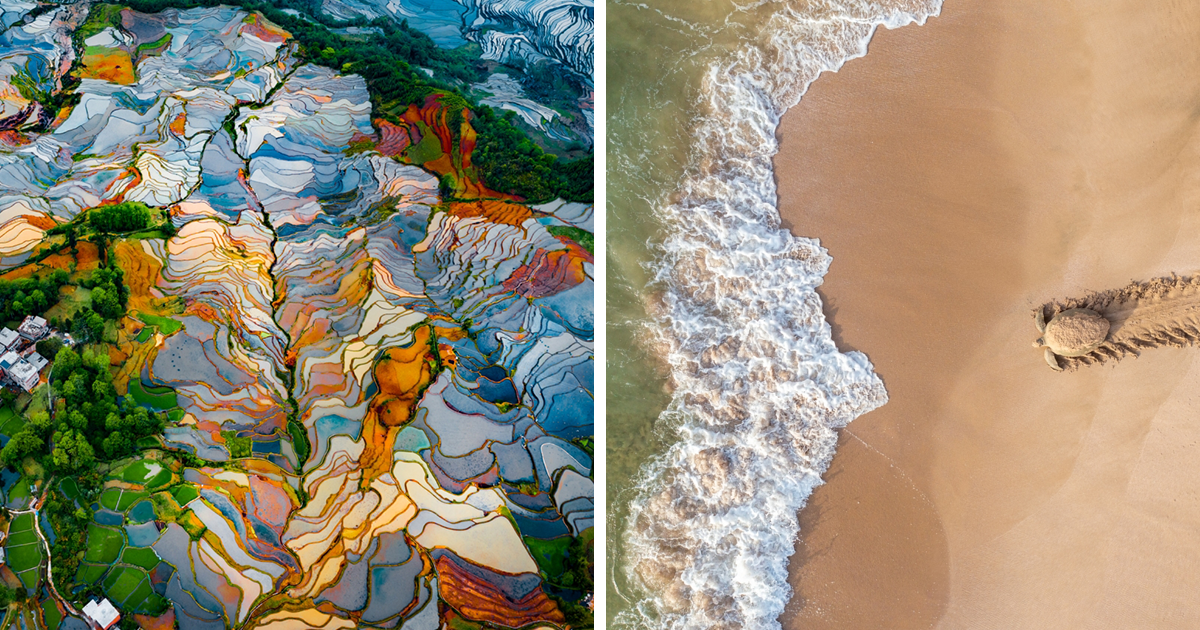
Qasim Al Farsi’s Back to Adventure won the Wildlife category. The image shows a green turtle returning to the ocean after laying eggs on the coast of Oman between Ras Al Jinz and the Rashad turtle reserve. From above, the turtle’s path through the sand becomes a visual sentence: fragile, determined, and perfectly written by flippers.
Drone photography is especially effective in wildlife storytelling when used responsibly. It can reveal movement, habitat, and scale without needing to crowd the subject. In this case, the turtle’s journey back to the water becomes both intimate and universal. It is one turtle, one beach, one moment and somehow it feels like the entire ocean is waiting.
Sport: Gold at the End of the Rainbow
Phil De Glanville took first place in Sport with Gold at the End of the Rainbow, capturing surfer Ollie Henry escaping a huge wave off the coast of southwestern Australia. The title sounds cheerful, but the scene itself has serious “please do not try this unless your hobbies include negotiating with Poseidon” energy.
The drone perspective makes the image work. From the waterline, a wave can look huge. From above, it becomes a sculptural force, a moving wall of energy with the surfer placed inside the drama. The photo captures athletic courage, natural danger, and a splash of rainbow color that makes the ocean look like it hired a lighting designer.
People: Fishing in Mangrove Forest
Vietnamese photographer Trung Huy Pham won the People category with Fishing in Mangrove Forest. The photo shows a fisherman beginning his day in the mangrove forest of Tam Giang Lagoon in Hue province, Vietnam. During winter, the mangroves lose their leaves and turn pale, creating an almost ghostly pattern around the small human figure.
This is one of the most quietly powerful images of the awards. Nothing explodes. No giant wave attacks. No volcano glows. Instead, the image honors work, routine, and environment. The fisherman appears small, but not insignificant. He is the emotional center of the frame, navigating a landscape that looks delicate enough to be made of breath.
Nature: Extragalactic
Martin Sanchez won the Nature category with Extragalactic, an aerial view of an erupting volcano in Iceland. The image looks almost cosmic, as though the drone accidentally wandered into the universe’s furnace room. Lava, smoke, texture, and scale combine to create a scene that feels both ancient and futuristic.
Drone photography has changed how volcanic eruptions are documented. From a safe distance and dramatic height, a drone can reveal the shape and movement of an eruption in ways ground photography cannot. Sanchez’s image captures the violence of nature, but also its strange elegance. The Earth is clearly doing something intense, and somehow still has excellent composition.
Abstract: Poisoned River
Gheorghe Popa’s Poisoned River won the Abstract category, and it may be one of the most unsettlingly beautiful images in the group. The photograph is part of a personal project about environmental damage in the Apuseni Mountains of Transylvania, where chemical waste from mining created vivid patterns in waterways.
That is the uncomfortable brilliance of the image: it is visually stunning because something has gone wrong. The colors pull you in before the story makes you pause. Great environmental photography often works this way. It does not lecture first. It seduces the eye, then hands the brain a bill.
Wedding: Verso l’Infinito Insieme a Te
Matteo Originale won the Wedding category with Verso l’Infinito Insieme a Te, photographed in Marina di Pisa during a late summer sunset. The couple appears small within a sweeping coastal scene, positioned toward the horizon and the clouds. It is romantic without being sugary, cinematic without requiring anyone to run through a vineyard in slow motion.
Drone wedding photography can sometimes feel gimmicky, but this image works because the aerial perspective supports the emotion. The landscape becomes part of the vow. The couple is not just posing; they are placed inside a visual metaphor of distance, future, and shared direction.
Series: Blanketed in Fire Retardant
Adrees Latif won the Series category with Blanketed in Fire Retardant, a sobering body of work documenting Talent, Oregon, after the Almeda fire. The images show the town covered in red flame retardant dropped by aerial firefighting crews. The series tells a story of destruction, displacement, emergency response, and survival.
Unlike single-image categories, a series can build emotional pressure over multiple frames. Latif’s work uses aerial photography not for novelty but for evidence. The red-coated streets and structures become symbols of both devastation and attempted protection. It is a reminder that drone photography is not only for pretty coastlines and suspiciously photogenic forests. It can also document crisis with clarity and force.
Why These 30 Drone Photos Still Matter
The 30 highlighted pictures from the 2021 Drone Photo Awards remain compelling because they show how aerial photography can balance beauty and meaning. A good drone image is not automatically good because it was taken from the sky. Height alone is not art. Otherwise, every security camera on a parking garage would be in a museum.
What separates these winning and commended images is intention. The photographers use altitude to reveal patterns, relationships, and stories that are hidden at ground level. The view from above can make a crowded beach look like a mosaic, a herd of animals look like a living diagram, or a polluted river look like an abstract painting with a tragic footnote.
The awards also show how global drone photography has become. The 2021 winners and finalists span Norway, Oman, Vietnam, Iceland, Russia, Italy, Romania, Australia, Bangladesh, the United States, and beyond. The result is a visual atlas of Earth from a perspective that still feels new, even though drones have become common enough that your neighbor might own one and use it mostly to inspect gutters.
The Bigger Message: The Overview Effect in Everyday Images
Astronauts often describe the “overview effect,” a shift in awareness that comes from seeing Earth from space. Drone photography offers a smaller, more accessible version of that feeling. It does not show the whole planet, but it does show enough distance to change our relationship with the scene.
From above, borders can disappear. Patterns emerge. Human routines look fragile and connected. Environmental damage becomes visible. Wildlife movement gains context. Even leisure surfers, swimmers, wedding couples, beach crowds becomes part of a larger design.
That is why the 2021 Drone Photo Awards feel powerful rather than merely pretty. They invite us to look again. They say the world is full of shapes we cannot see from where we normally stand. They also gently suggest that perhaps we should stand somewhere else once in a while, ideally not on a chair while holding an expensive camera.
Experience: What These Drone Photos Teach Anyone Who Loves Visual Storytelling
Looking through the best pictures of the 2021 Drone Photo Awards feels like taking a masterclass in perspective. The first lesson is simple: distance can create emotion. That sounds backward because most of us think closeness equals feeling. A portrait shows eyes, wrinkles, expression, mood. But drone photography proves that emotion can also come from scale. A lone fisherman in a white mangrove forest can feel just as human as a close-up face. A turtle returning to the sea can feel heroic because the wide view shows how far it has traveled and how vast the ocean appears.
The second lesson is that patterns are everywhere, but daily life hides them. At street level, boats are boats, sheep are sheep, roads are roads, and fields are fields. From above, they become rhythm. Boats cluster into color blocks. Sheep gather into living texture. Roads slice through snow like ink lines. Fields become quilts. The drone does not invent the design; it reveals it. That is why strong aerial photography often feels surprising. It shows us that the world has been making art behind our backs.
The third lesson is patience. Many of these images look effortless, but the best drone photos require timing, planning, weather awareness, legal responsibility, technical skill, and restraint. A drone photographer must think about wind, battery life, light, subject movement, safety, permissions, and composition all at once. Meanwhile, the rest of us struggle to keep a phone camera level while photographing lunch. Respect is due.
The fourth lesson is responsibility. Drone photography can be magical, but it must be practiced carefully. Wildlife should not be disturbed for the sake of a dramatic shot. People deserve privacy. Restricted areas should be respected. Natural sites should not become playgrounds for reckless flying. The best aerial photographers understand that access is a privilege, not a license to buzz around like a mechanical mosquito with artistic ambitions.
The fifth lesson is that beauty and discomfort can exist in the same frame. Poisoned River is beautiful, but its subject is environmental harm. Blanketed in Fire Retardant is visually striking, but it documents disaster. Pink-Footed Geese Meeting the Winter is breathtaking, but it also hints at climate disruption. These images remind us that powerful photography does not always provide easy pleasure. Sometimes it asks us to admire and worry at the same time, which is basically the emotional equivalent of looking at a gorgeous cake and then learning it is on fire.
For writers, designers, photographers, travelers, and anyone who loves visual culture, the 2021 Drone Photo Awards offer a practical takeaway: change the angle, and the story changes. The subject may be the same, but the meaning can become richer. A beach is not just a beach. A river is not just a river. A flock of geese is not just a flock of geese. From above, each scene becomes part of a larger system ecological, social, emotional, or visual.
That is the lasting charm of these 30 pictures. They do not simply say, “Look how high the camera was.” They say, “Look what you missed from the ground.” And honestly, that is the kind of reminder the internet needs more often: not louder images, not faster scrolling, but a better view.
Conclusion
The best pictures of the 2021 Drone Photo Awards prove that aerial photography is more than a technical trick. It is a storytelling language. In the hands of talented photographers, a drone becomes a quiet observer, a painter, a witness, and occasionally a very expensive bird with excellent eyesight.
From Terje Kolaas’s unforgettable geese over Norway to Martin Sanchez’s volcanic drama in Iceland, from Trung Huy Pham’s fisherman in Vietnam to Adrees Latif’s haunting Oregon wildfire series, these images show the planet as beautiful, fragile, busy, wounded, funny, romantic, and strange. In other words: exactly like Earth, only with better framing.