Note: This article uses “Quercus Design” to refer to the Bar Harbor photography practice associated with artist Jennifer Steen Booher, whose work is now also presented under her own name.
Some places practically beg to be photographed. Bar Harbor, Maine, is one of them. It has the kind of scenery that makes even a hurried phone snapshot look suspiciously competent: rocky shoreline, silver-blue water, seaweed with the swagger of couture fabric, and light that seems professionally supervised. But the most interesting artists in coastal Maine do not just point a camera at pretty views and call it a day. They look closer. Much closer.
That is what makes Quercus Design memorable. The work associated with Jennifer Steen Booher does not treat Bar Harbor as a postcard rack with better weather. Instead, it treats the coast like a living archive. Shells, sea glass, barnacled fragments, seaweed, feathers, rope, and the odd man-made remnant become subjects in carefully arranged photographs that feel at once intimate and expansive. In other words, this is not “look, a nice beach” photography. This is “look what the tide knows” photography.
For readers interested in art, photography, and the creative identity of Mount Desert Island, Quercus Design offers a compelling lens on Bar Harbor. It connects the region’s visual beauty with its ecology, history, and culture, turning shoreline finds into works that feel both elegant and investigative. The result is a body of work that belongs naturally in Maine’s long conversation about landscape, place, and artistic observation.
What Quercus Design Is Really About
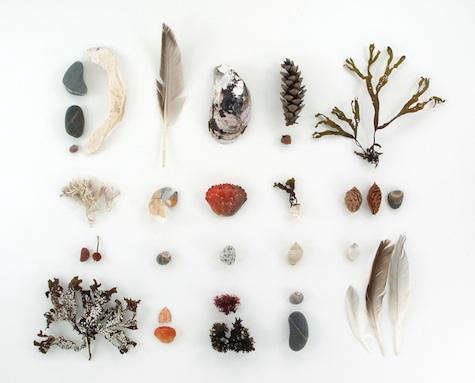
Quercus Design first drew wider design-world attention through its still-life photographs of objects collected along the Bar Harbor shoreline. That origin story matters, because it explains why the work has always felt different from standard coastal photography. Instead of chasing the grand scenic sweep alone, the practice focused on the small things washed in, left behind, eroded, tangled, or transformed by the ocean. Booher’s photography gave those materials a second life through arrangement, composition, and close attention to texture.
What sounds simple on paper becomes surprisingly rich in practice. A shell is never just a shell here. A shard of sea glass is never just a lucky find. In Booher’s larger artistic language, these objects become evidence: evidence of tidal motion, weather, human use of the shore, marine ecosystems, and time itself. The photographs are beautiful, yes, but they also behave like visual essays. They ask what the coastline is made of, who has moved through it, and what stories collect where land and sea keep negotiating the terms of their relationship.
That intellectual side is not an afterthought. Booher has described her work as exploring the intersection of science and history, and that phrase is useful because it keeps the work from being flattened into “decorative coastal art.” There is design discipline here, certainly. There is also field observation, curiosity, and a slightly obsessive respect for the intertidal zone. The effect is equal parts artist’s studio, naturalist’s notebook, and detective board without the red string and conspiracy energy.
Why Bar Harbor Is the Perfect Setting
Bar Harbor is not just a pretty backdrop for Quercus Design; it is part of the work’s DNA. The town is the gateway to Acadia National Park and the largest community on Mount Desert Island, a place where ocean cliffs, rocky beaches, forest, and mountain views exist within a compact geography that feels almost unfairly photogenic. The local landscape has inspired artists for generations, and the town’s own cultural identity openly acknowledges that tradition.
That context helps explain why an artist like Booher could build a serious visual practice around beachcombing and coastal observation. In Bar Harbor, walking is part of seeing. The Shore Path begins near the Town Pier and Agamont Park, where the water, weather, and shifting light are impossible to ignore. The famous Bar Island route appears at low tide and invites people to literally walk across the exposed sea floor. Sunrise glows over downtown. Sunset warms the harbor. The town gives photographers spectacle, but it also gives them repetition, variation, and access to the little details that only emerge when a place becomes part of your routine rather than your vacation itinerary.
That routine matters. Quercus Design is rooted in returning to the shore again and again, in all seasons, and noticing how a familiar place is never truly the same twice. The coast is altered by storms, cold snaps, tide cycles, tourist traffic, fishing activity, erosion, and marine life. On one day it offers eelgrass, smooth stones, and delicate translucence. On another it throws up rope, weathered wood, or evidence of human carelessness. Bar Harbor is visually generous, but it is also honest. It shows beauty and residue in the same frame.
The Signature Appeal of the Beachcombing Series
The most revealing way to understand Quercus Design is through Booher’s Beachcombing Series. In this body of work, each photograph documents what was found on a particular beach on a particular day. That approach sounds almost scientific, and in a way it is. But the resulting images are not clinical records. They are structured, balanced, and deeply intentional compositions that transform gathered fragments into artworks with rhythm, contrast, and emotional tone.
One of the smartest things about this series is its refusal to separate natural beauty from human impact. The shoreline does not sort itself into neat categories for our convenience. Seaweed can land beside plastic. A feather can rest near worn ceramic. A shell can sit beside an aluminum tab that has stubbornly outlasted several human trends and probably a few political administrations. Booher’s photographs do not moralize loudly, but they do not look away, either. They show the littoral zone as a place where ecosystems, memory, industry, accident, and weather all mingle.
That gives the work unusual range. From a distance, the photographs read as elegant design objects. Up close, they become layered studies in material, place, and time. For collectors or viewers, that means the images reward repeat attention. You can first notice color, then texture, then pattern, then the quiet narrative hidden in the mix of organic and man-made elements. The work behaves almost like reading coastal history through arrangement.
Design, Texture, and the Drama of Small Things
Plenty of photographers can make a dramatic mountain look dramatic. Congratulations to them for defeating gravity and scale. The harder trick is making viewers care about a tangle of seaweed, a cracked shell, or a smooth piece of drift-polished detritus. Quercus Design succeeds because it understands composition at a deep level. Negative space matters. Shape matters. Repetition matters. Even the humble curve of kelp can become architectural when placed in relation to shells, stones, and fragments with different weights and surfaces.
That design intelligence is why the work sits comfortably in conversations about interiors as well as fine art. These are photographs you can imagine on a wall, but they are not merely “wall-friendly.” They earn their aesthetic impact through observation rather than trend-chasing. They feel calm without being sleepy and refined without becoming sterile. In a world overflowing with mass-produced coastal decor that screams “beach house” as if volume were a design principle, Quercus Design has the confidence to whisper.
More Than Coastal Beauty: Art as Archive
What makes Quercus Design especially interesting in Bar Harbor is the way it mirrors a larger Acadia-area tradition: seeing the natural world through both artistic and interpretive frameworks. Acadia National Park has long supported that connection through its Artist-in-Residence program, which invites artists to help visitors experience the park through the arts. That formal link between place and creative practice reinforces something local artists have known for a long time: this landscape does not just provide scenery, it generates inquiry.
Booher’s broader Coast Walk work makes that even clearer. Her approach to the shoreline includes history, ecology, interviews, and local knowledge. The coast becomes not just a source of form and color, but also a site of stories: fishing histories, public access questions, environmental changes, and the accumulated traces of human use. Seen through that lens, Quercus Design is not just making art about the Maine coast. It is participating in a record of how the coast is lived, studied, remembered, and interpreted.
That matters in Bar Harbor, where art exists alongside tourism, conservation, and community life. The town has a long history of attracting visitors because artists helped popularize its beauty in the first place. Today, the relationship continues in a more varied and democratic form. Downtown and nearby Mount Desert Island communities support galleries, artisan shops, workshops, and year-round arts programming. The visual culture is not an accessory to the place; it is one of the ways the place explains itself.
How Quercus Design Fits Into Bar Harbor’s Creative Scene
Bar Harbor’s art world is more active than many visitors expect. Within a short downtown walk, there are numerous galleries, studios, and craft-oriented shops connecting artists with locals and seasonal visitors. That lively environment gives context to Quercus Design. The work belongs to a region that values making, looking, collecting, and talking about art, whether that takes the form of fine photography, painting, craft, or community classes.
At the same time, Bar Harbor’s cultural identity is not limited to one aesthetic lane. The Abbe Museum, for example, centers Wabanaki art, history, and living cultures, reminding visitors that Maine is not merely “Vacationland” but homeland. That is an important corrective in any serious discussion of art in Bar Harbor. It broadens the cultural frame beyond scenic nostalgia and encourages a more grounded understanding of place. In that richer context, Quercus Design reads less like an isolated boutique brand and more like one thoughtful voice in a larger regional conversation about land, coast, identity, and observation.
Maine as a whole has also built a strong reputation as an arts destination, from museums and artist colonies to gallery networks and photography education. For a photographer working in Bar Harbor, that is not background noise; it is infrastructure. It means there is an audience for visual nuance, a tradition of landscape engagement, and a public willing to see creative work as something deeper than souvenir material.
Why This Work Still Feels Fresh
The coastal aesthetic is easy to overdo. Give it five minutes and someone will put a starfish on a pillow and call it a concept. Quercus Design stays fresh because it avoids cliches at the source. It does not borrow the coast as a style package; it studies the coast as a living system. That difference changes everything.
It also helps that the work is grounded in patience. In an era of instant images and algorithm-friendly sameness, there is something quietly radical about sustained attention. Booher’s photographs suggest that familiarity sharpens vision instead of dulling it. The same beach revisited over months and years becomes more mysterious, not less. You notice seasonal shifts, recurring materials, and subtle patterns. You start to understand that the shoreline is not static scenery but an active collaborator.
That is why Quercus Design resonates beyond Maine. Even viewers who have never set foot in Bar Harbor can feel the logic of the work. It invites them to slow down, to read materials closely, and to appreciate that beauty can emerge from fragments, traces, and leftovers. The coast, in this telling, is not just a place of scenic perfection. It is a place of process.
What the Experience Feels Like in Real Life
To understand the emotional pull of Quercus Design, imagine starting early in Bar Harbor before the town fully wakes up. The harbor is still stretching. The light is thin and cool. Somewhere between the Town Pier and the Shore Path, the air has that clean salt edge that feels like nature politely slapping your face awake. You are walking without much agenda, which is usually when the best visual discoveries happen.
At first, the coastline presents itself the way guidebooks like to describe it: handsome water, granite ledges, distant islands, and boats doing their photogenic best. But then your eye drops lower. There is a piece of seaweed draped over stone like green calligraphy. A shell catches the light from the side and suddenly looks engineered instead of grown. A fragment of blue sea glass sits beside a rough pebble as if some exacting minimalist arranged it before dawn. This is the moment when Quercus Design starts to make perfect sense.
The experience is not about chasing a single grand vista. It is about tuning your attention to the shoreline’s smaller intelligence. Bar Harbor rewards that kind of looking. The exposed route to Bar Island at low tide feels theatrical, yes, but it also reminds you that the land itself changes on a schedule bigger than yours. The Shore Path is lovely, but it is also a lesson in repetition: walk it enough times and you begin to notice not just the view, but the materials, the weathering, the residue of storms, and the personality of light from one hour to the next.
Seen through that lived experience, Quercus Design feels less like a brand and more like an invitation to practice a different kind of attention. The photographs take what many people would step over and show why it deserves a second look. They train you to see texture, evidence, and accident. They also make you wonder how many stories are quietly collecting at your feet while you are busy looking at the horizon like a dramatic nineteenth-century painter.
There is also a humbling side to the experience. The coast is beautiful, but it is not tidy. You may find shells and kelp, but you may also find plastic, rope, rusted bits, and weathered trash that has traveled farther than some airline passengers. That contrast gives the work its honesty. It does not sell a fantasy of untouched perfection. It recognizes the shoreline as a place where ecology and human behavior collide in plain view.
And yet the mood is not bleak. If anything, Quercus Design makes Bar Harbor feel more alive. The photographs suggest that wonder does not require perfection; it requires attention. A cracked shell can be exquisite. A strand of eelgrass can be lyrical. A small collection of found objects can reveal an entire coastal system when arranged with care. That is the magic here. It is not flashy. It is observant.
By the time you leave the harbor, your idea of coastal photography may have shifted a little. You still appreciate the sweeping views, of course. You are only human. But you also start scanning the edges of the path, the tide line, the places where details accumulate. Bar Harbor becomes more than a scenic destination. It becomes readable. And Quercus Design, at its best, teaches exactly that kind of reading.
Conclusion
Art & photography in Bar Harbor often begin with landscape, but Quercus Design proves they do not have to end there. Through Jennifer Steen Booher’s careful, concept-driven approach to found coastal materials, the shoreline becomes a site of beauty, evidence, and inquiry all at once. The work is distinctly Maine, distinctly Bar Harbor, and yet broad enough in meaning to speak to anyone interested in how places leave marks on the things they touch.
In a town where natural grandeur can easily steal the spotlight, Quercus Design succeeds by turning the spotlight downward, toward the tide line, the fragment, the overlooked detail. That move is what makes the work memorable. It reminds us that art does not always need a bigger subject. Sometimes it just needs a better question, a sharper eye, and a willingness to let the coast talk back.