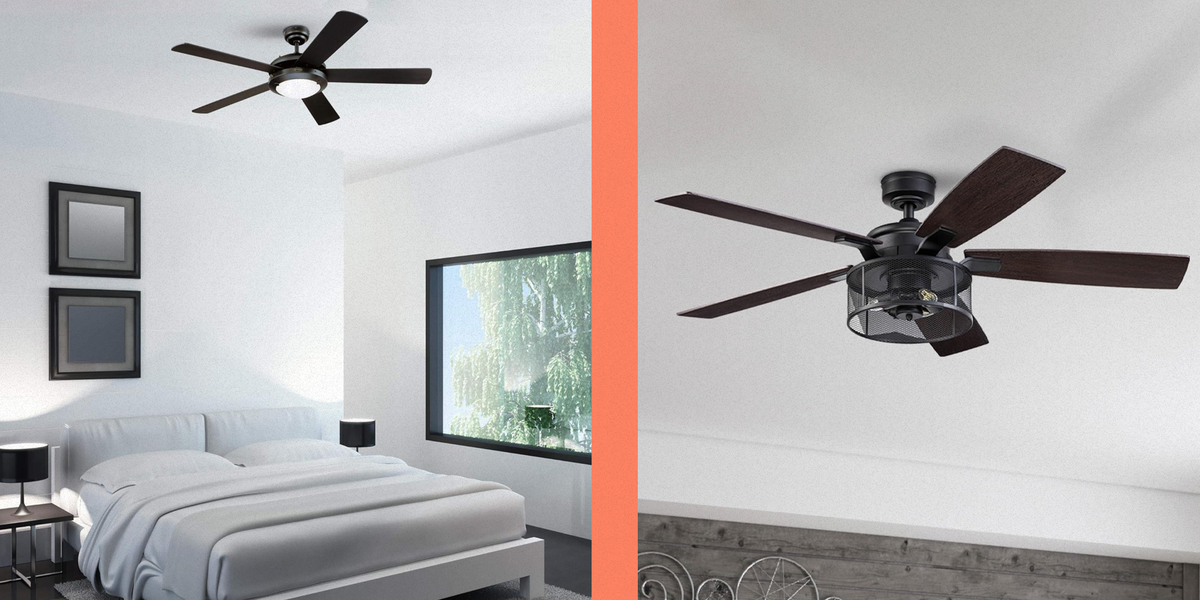
A ceiling fan will not actually lower the temperature of a room, but the breeze helps moisture evaporate from your skin, making the space feel noticeably cooler. Used alongside air conditioning, a good fan may also let you raise the thermostat by approximately 4 degrees Fahrenheit without sacrificing comfort. That is a small adjustment with potentially welcome consequences when the electric bill arrives wearing its supervillain cape.
The best ceiling fans of 2025 combine strong airflow, quiet operation, efficient motors, reliable controls, and designs that no longer resemble leftovers from a 1980s motel lobby. Smart controls, dimmable LED lighting, reversible motors, and low-profile mounting options are now available at several price levels.
For this guide, we compared hands-on testing from major home publications with manufacturer specifications, retailer documentation, energy-efficiency guidance, and installation recommendations. We then selected five models for distinctly different situations: the best all-around smart fan, the best value, the best premium fan for large rooms, the best low-profile design, and the best choice for a covered outdoor area.
Best Ceiling Fans of 2025 at a Glance
| Ceiling Fan | Best For | Blade Span | Maximum Airflow | Controls |
|---|---|---|---|---|
| Dreo Smart Ceiling Fan 712S | Best overall | 52 inches | Up to 6,040 CFM | Remote, app, and voice |
| Hunter Builder Deluxe | Best value | 52 inches | About 4,339 CFM | Pull chains |
| Minka-Aire Barn | Large rooms and premium design | 65 inches | Up to 9,155 CFM | Remote and app |
| Sofucor Flush-Mount Fan | Low ceilings | 52 inches | Up to approximately 5,128 CFM | Remote |
| Wind River Willow | Covered outdoor spaces | 60 inches | Up to approximately 6,131 CFM | Remote and smart app |
Airflow figures can vary by finish, configuration, testing method, and product revision. Always verify the current specification sheet for the exact model number before purchasing.
1. Dreo Smart Ceiling Fan 712S: Best Overall
Why It Earned Our Top Spot
The Dreo 712S offers the most balanced combination of airflow, convenience, modern styling, lighting, and attainable pricing in this group. Its 52-inch span fits many living rooms, family rooms, and primary bedrooms without making the ceiling look as though it is preparing for takeoff.
Dreo rates the 712S for airflow of up to 6,040 cubic feet per minute. It provides six physical fan speeds, multiple wind modes, adjustable white-light temperatures, six brightness levels, and an RGB accent-lighting ring. The app adds schedules, timers, lighting scenes, and remote operation, while Alexa and Google Assistant support enable voice commands.
The fan also distinguishes itself through installation details. Each blade uses a simplified attachment system, reducing the amount of overhead wrestling required during assembly. Independent testing praised its smooth setup, strong airflow, quiet performance, stable operation, and responsive smart controls.
What We Like
- Powerful airflow for a standard 52-inch fan
- Quiet DC-motor operation
- Remote, smartphone, and voice controls
- Dimmable main light with adjustable color temperature
- RGB accent lighting for bedrooms and entertainment spaces
- Useful schedules and sleep-oriented settings
What Could Be Better
The app includes enough options to require a little exploration, especially for someone who wants a fan to have three buttons: on, off, and “please stop making me sweat.” The RGB ring may also feel unnecessary in a traditional room, although it can be switched off.
Who Should Buy It?
Choose the Dreo 712S when you want a feature-rich smart ceiling fan for a medium or large indoor room. It is especially appealing for tech-friendly households, bedrooms, home offices, and living spaces where adjustable lighting matters.
2. Hunter Builder Deluxe 52-Inch: Best Value
Dependable Cooling Without an App Tutorial
The Hunter Builder Deluxe proves that a ceiling fan does not need Wi-Fi, a user account, and permission to send notifications before it can move air. This traditional 52-inch model uses a three-speed reversible motor, pull-chain controls, a short downrod, and a multi-light fixture.
Hunter describes the Builder Deluxe as an indoor fan for larger rooms such as bedrooms and living rooms. It includes the company’s WhisperWind reversible motor, a 3-inch downrod, LED bulbs, and a limited lifetime motor warranty. Testing reported quiet operation, straightforward installation, solid construction, and airflow of approximately 4,339 CFM at maximum speed.
The design is familiar rather than fashionable, but that can be an advantage. Its conventional blade shape and glass light shades blend easily with transitional, casual, and traditional interiors. It is unlikely to become the room’s main attraction, which is exactly what many homeowners want from a fan.
What We Like
- Strong value from an established ceiling-fan brand
- Quiet three-speed reversible operation
- Integrated lighting with replaceable bulbs
- Simple pull-chain controls
- Multiple finishes and reversible blade options
- Suitable for common living-room and bedroom layouts
What Could Be Better
A remote control is not normally included, and smart-home integration requires additional accessories or a different model. The traditional appearance may also look too busy in a minimalist interior.
Who Should Buy It?
The Hunter Builder Deluxe is ideal for homeowners who prioritize dependable operation, recognizable styling, accessible replacement parts, and reasonable cost over advanced technology. It is the ceiling-fan equivalent of a reliable pickup truck: not especially mysterious, but usually ready to work.
3. Minka-Aire Barn 65-Inch: Best for Large Rooms
Premium Airflow With Farmhouse Character
The Minka-Aire Barn is the heavyweight of this roundup. Its 65-inch blade span, ten-blade design, integrated LED light, six-speed control, and smart connectivity make it suitable for expansive living rooms, open-concept spaces, and rooms with tall or sloped ceilings.
Published testing recorded an airflow range of approximately 3,712 to 9,155 CFM. Testers also reported exceptionally quiet performance, stable operation without noticeable wobbling, and an assembly time of under an hour despite the large number of blades. The included downrod helps provide clearance on sloped ceilings, while the Bond Home platform allows smartphone operation and compatibility with popular voice assistants.
A 65-inch fan is not appropriate for every room. In a compact bedroom, it may look less like a home appliance and more like a helicopter trying to blend in. In a great room, however, its broad sweep can circulate air effectively at lower, quieter speeds.
What We Like
- Exceptional maximum airflow
- Smooth and notably quiet operation
- Six fan speeds
- Smartphone, remote, and voice-control compatibility
- Integrated dimmable LED lighting
- Strong visual presence for farmhouse and transitional interiors
What Could Be Better
The Minka-Aire Barn is significantly more expensive than the value-oriented fans in this guide. Its large diameter also demands careful measurement, adequate wall clearance, and a properly supported electrical box.
Who Should Buy It?
This is the best ceiling fan for shoppers furnishing a large indoor room who want premium styling and serious airflow. It makes the most sense when the fan will be used regularly and treated as a permanent architectural feature rather than a temporary fixture.
4. Sofucor 52-Inch Flush-Mount Fan: Best for Low Ceilings
A Low-Profile Fan That Does Not Look Builder-Grade
Flush-mount ceiling fans are often practical but visually uninspiring. The Sofucor 52-inch model improves the formula with sculpted solid-wood blades, a contemporary motor housing, a reversible DC motor, adjustable LED lighting, six speeds, and remote operation.
Depending on the exact configuration, Sofucor lists airflow around 4,500 CFM, while the independently tested version reached approximately 5,128 CFM at its highest setting. The model evaluated by Bob Vila was approved for indoor or protected damp locations and provided three selectable light temperatures. Testing also found smooth operation and a noticeably quieter motor than typical inexpensive AC-motor fans.
The flush mounting system keeps the fixture closer to the ceiling, making it useful where a standard downrod would place the blades too low. ENERGY STAR guidance notes, however, that hugger fans may move less air than comparable downrod models because the blades have less space above them to draw in air.
What We Like
- Space-saving low-profile installation
- Real-wood blade options
- Quiet and efficient reversible DC motor
- Six fan speeds
- Remote control with timer functions
- Selectable warm, neutral, and cool light settings
What Could Be Better
The integrated light is adequate for everyday bedroom or living-room use, but it may not replace strong task lighting. Model specifications also differ across Sofucor’s visually similar 52-inch fans, so buyers should carefully confirm the motor, rating, airflow, and light included with the exact listing.
Who Should Buy It?
Choose this Sofucor fan for a room with an approximately 8-foot ceiling, especially when you prefer modern wood blades to the bulky appearance of traditional low-profile fans.
5. Wind River Willow 60-Inch: Best for Covered Outdoor Spaces
Big Airflow for Patios and Open Living Areas
The Wind River Willow combines a 60-inch span, three aerodynamic blades, six speeds, integrated LED lighting, remote operation, and Bond smart-home controls. Its clean silhouette fits contemporary patios, covered porches, sunrooms, and large indoor living areas.
The Willow has a published maximum airflow of approximately 6,131 CFM. Product information lists an integrated LED producing approximately 1,368 lumens, while smart control allows adjustments through the Bond platform. The fan was included among the strongest smart outdoor-oriented models in 2025 testing.
Outdoor placement requires more attention than indoor placement. A damp-rated fan is intended for humid or protected locations, while a wet-rated fan is designed for areas where direct water exposure is possible. Never assume that “outdoor style” equals “rainproof.” Confirm the rating of the exact Willow model and install it only in a location permitted by its documentation.
What We Like
- Wide 60-inch coverage
- Strong airflow for open spaces
- Six-speed remote control
- Smart operation through the Bond platform
- Integrated LED lighting
- Minimal three-blade design
What Could Be Better
The Willow costs more than many basic patio fans, and its integrated light is better for general illumination than detailed outdoor tasks. Buyers must also verify whether their specific finish and model are approved for damp, wet, or covered-outdoor use.
Who Should Buy It?
The Wind River Willow is suited to a large covered patio or contemporary indoor space where a standard 52-inch fan would look undersized or struggle to distribute air broadly.
How to Choose the Best Ceiling Fan
Match the Fan Size to the Room
Room size matters more than marketing adjectives such as “powerful,” “turbo,” or the always exciting “extreme breeze technology.” ENERGY STAR sizing guidance suggests fans between 29 and 36 inches for rooms up to 75 square feet, 36 to 42 inches for rooms between 76 and 144 square feet, approximately 44 inches for rooms between 144 and 225 square feet, and 50 to 54 inches for rooms up to 400 square feet.
For very large or unusually long rooms, two appropriately positioned fans may distribute air more evenly than one enormous fan placed in the center. The Department of Energy specifically recommends considering multiple fans in rooms longer than approximately 18 feet.
Look Beyond Blade Count
More blades do not automatically produce more airflow. Motor capability, blade pitch, blade shape, rotational speed, and the distance between the blades and ceiling all affect performance. Tested buying guides recommend comparing CFM ratings instead of judging a fan solely by its appearance.
For a frequently used living room, airflow around 5,000 CFM or higher can be a useful target, provided the fan is appropriately sized for the room. A bedroom may benefit more from quiet low-speed performance than from the highest possible CFM number.
Choose the Correct Mounting Style
Flush-mount fans work well with lower ceilings. Standard downrod fans generally provide better airflow when there is adequate height above and below the blades. Extended downrods are used for vaulted or tall ceilings, while sloped-ceiling installations may require an angled adapter.
Ceiling-fan blades should remain at least 7 feet above the floor, with approximately 8 to 9 feet often considered the ideal operating height. ENERGY STAR also recommends maintaining at least 18 inches between the blade tips and surrounding walls.
Consider Motor Type and Efficiency
DC motors are generally lighter, quieter, and more energy-efficient than traditional AC motors. They also commonly provide more speed settings and remote-control functions. AC-motor fans remain worthwhile when affordability, simple controls, and easy serviceability are more important than maximum efficiency.
ENERGY STAR-certified ceiling fans use improved motors and blade designs and can be substantially more efficient than conventional models. Efficiency is expressed using airflow relative to energy consumption, commonly measured as cubic feet per minute per watt.
Do Not Ignore the Electrical Box
A ceiling fan must be attached to a fan-rated electrical box or directly supported by an approved structural mounting system. A standard lightweight box intended only for a lamp may not safely support the fan’s weight and movement. Hunter notes that fan-rated boxes are commonly marked as approved for ceiling fans or rated for a specified weight.
Turn off power at the circuit breaker before installation, confirm that the circuit is de-energized, and hire a qualified electrician when the existing wiring, ceiling support, or switching arrangement is uncertain.
Frequently Asked Questions
Which Direction Should a Ceiling Fan Turn?
During warm weather, run the fan counterclockwise when viewed from below so it creates a downward cooling breeze. During colder weather, reverse it to clockwise at a low speed to help circulate warm air that has collected near the ceiling.
Are Three-Blade or Five-Blade Fans Better?
Neither blade count is automatically better. Three-blade fans often have a modern appearance and can move air efficiently, while five-blade fans may create a more traditional look. Motor quality and blade engineering have a greater effect on performance.
Should a Ceiling Fan Be Left Running All Day?
A ceiling fan cools people rather than empty rooms. Turn it off when nobody is present unless it is being used for a specific circulation or moisture-control purpose. Smart schedules and timers make this easier.
How Quiet Should a Bedroom Ceiling Fan Be?
Noise specifications are not always published consistently, so independent testing and owner reports are useful. In a bedroom, pay particular attention to low-speed motor hum, clicking from light components, remote-receiver buzz, and wobbling rather than focusing only on maximum-speed noise.
Final Verdict
The Dreo Smart Ceiling Fan 712S is our best overall ceiling fan of 2025 because it combines powerful airflow, quiet operation, excellent lighting controls, smart features, and a room-friendly 52-inch size. It gives most homeowners the useful parts of a premium fan without requiring a premium-remodel budget.
The Hunter Builder Deluxe is a stronger fit for buyers who want traditional styling and uncomplicated controls. The Minka-Aire Barn is the performance leader for large indoor rooms, while the Sofucor Flush-Mount solves the low-ceiling problem with considerably more style than the average hugger fan. For a large covered patio or open contemporary space, the Wind River Willow offers broad coverage and smart convenience.
The right model is ultimately determined by room dimensions, ceiling height, location rating, desired controls, and tolerance for installation complexity. Measure first, compare exact model specifications second, and admire the decorative blade finish third. Reversing that order is how people end up returning a 65-inch fan in a compact hatchback.
Extended Ownership Experience: What Living With a Ceiling Fan Is Really Like
The most noticeable difference between an average ceiling fan and a good one often appears after bedtime. In a store or during a quick daytime demonstration, nearly every fan seems acceptably quiet. At 2 a.m., however, a faint motor hum, loose glass shade, clicking pull chain, or poorly balanced blade can sound like a tiny mechanic repairing a bicycle above your pillow. For bedrooms, smooth low-speed performance is more valuable than a dramatic maximum-airflow figure.
Control style also matters more in daily life than it does on a specification sheet. Pull chains are reliable and difficult to misplace, but they are inconvenient over a bed, dining table, or tall furniture. Remotes are comfortable until they disappear between sofa cushions. Wall controls are dependable but may require additional wiring. Smart apps are excellent for schedules and automation, although a physical remote remains important when the Wi-Fi network is misbehaving or a guest simply wants to turn on the light without downloading software.
Lighting is another frequent source of surprises. An integrated LED can look sleek and eliminate exposed bulbs, but its brightness and beam angle may differ from the fixture it replaces. A ceiling fan light is often excellent for general illumination and less successful for reading, cooking, or detailed work. Adjustable color temperature helps: warm white creates a relaxed bedroom atmosphere, neutral white works well in living areas, and cooler white can make a home office feel brighter. Still, a fan light should usually be part of a layered lighting plan rather than the only light in the room.
Airflow feels different depending on where furniture is placed. A fan centered according to the room’s dimensions may not be centered over the area where people actually sit. In a bedroom, placing the fan over the main sleeping zone can matter more than aligning it perfectly with an architectural feature. In a living room, a slightly larger fan running at a lower speed often feels calmer and sounds quieter than a small fan operating at maximum speed.
Seasonal direction changes are useful, but expectations should remain realistic. Counterclockwise summer rotation creates a direct breeze. Clockwise winter rotation gently redistributes warm air without blasting occupants. The fan does not create heat, cool the room’s air, or perform wizardry on the utility meter. It improves how comfortable the existing temperature feels.
Maintenance is usually simple. Dust the blade tops periodically, tighten visible hardware when the power is off, inspect the light cover, and watch for new wobbling. Dust buildup can make blades unbalanced and may eventually fall in decorative clumps during dinner, which is one way to learn who at the table is paying attention. Outdoor and damp-location fans should also be checked for corrosion, moisture damage, and swollen or warped blades.
Installation quality determines much of the long-term experience. A well-designed fan attached to an unsuitable box can wobble, vibrate, or become unsafe. A properly supported, carefully balanced midpriced fan may feel better than an expensive model installed hurriedly. Before selecting decorative finishes or smart features, confirm the ceiling structure, wiring, blade clearance, ceiling slope, and mounting height.
Finally, the best ceiling fan is usually the one you barely notice. It starts without shaking, moves enough air at a comfortable speed, responds immediately to its controls, provides useful light, and remains quiet enough to disappear into the background. That may not sound exciting, but dependable comfort is a feature that becomes more impressive every hot afternoon.