For most people, cryptography sounds like something that happens in a locked basement where mathematicians drink black coffee and argue with prime numbers. But every day, ordinary users rely on it without thinking: logging in to work laptops, signing documents, protecting hard drives, authenticating with security keys, and trusting that a little digital lock icon actually means something. Then along came a flaw known as ROCA, and suddenly millions of supposedly strong RSA keys looked a lot less muscular.
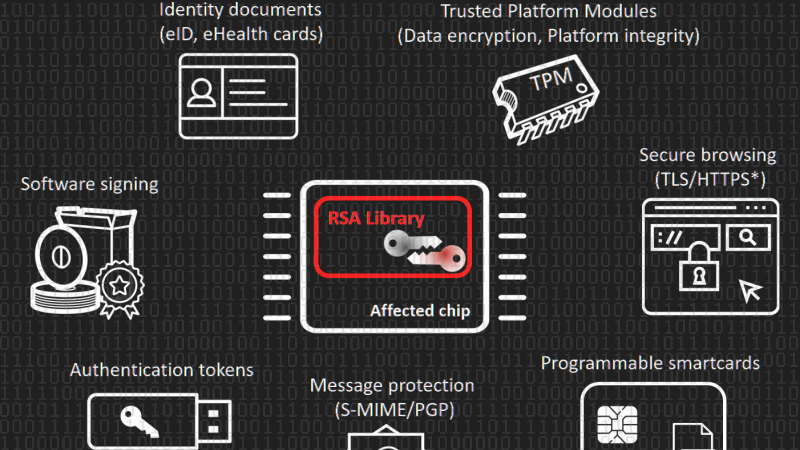
The issue, tracked as CVE-2017-15361, centered on a flawed RSA key-generation library used in Infineon cryptographic chips. These chips appeared in Trusted Platform Modules, smart cards, security tokens, identity cards, and other secure hardware. The scary part was not that attackers had discovered a new way to “break RSA” in general. RSA itself did not wake up one morning and forget how math works. The problem was that one widely used implementation generated RSA primes with a detectable mathematical structure, making some keys much easier to factor than they should have been.
In plain English: the keys wore fake mustaches, but attackers could still recognize them in a crowd.
What Happened With the Bad RSA Library?
RSA security depends on a simple but powerful idea: it is easy to multiply two huge prime numbers together, but extremely hard to reverse the process and discover those original primes. That difficulty is what protects private keys. If someone can factor the public RSA modulus, they can calculate the private key. At that point, the private key is no longer private; it is more like a diary left open on a coffee shop table.
The vulnerable Infineon RSALib did not generate RSA primes in a fully ordinary way. Researchers found that keys produced by the affected library had a special mathematical fingerprint. That fingerprint allowed vulnerable public keys to be detected quickly and, for key sizes such as 1024-bit and 2048-bit RSA, made targeted factorization practical under certain conditions.
The vulnerability became known as ROCA, short for “Return of Coppersmith’s Attack.” The name may sound like a lost Indiana Jones sequel, but it refers to a serious cryptographic technique related to finding small roots of polynomial equations. Researchers from Masaryk University’s Centre for Research on Cryptography and Security, Enigma Bridge, and Ca’ Foscari University of Venice analyzed large sets of RSA keys and discovered that a particular pattern was tied to Infineon-generated keys.
Why “Millions of Keys Vulnerable” Was Not Clickbait
The phrase “millions of keys vulnerable” can sound dramatic, like a movie trailer narrated by a man with gravel in his throat. In this case, the concern was real. The affected library was not tucked away in one obscure app used by six people and a printer in Ohio. It was embedded in hardware found across enterprise laptops, smart cards, national identity systems, authentication tokens, and secure elements.
Confirmed vulnerable keys were found in multiple areas, including electronic citizen documents, authentication tokens, trusted boot devices, software signing systems, TLS/HTTPS certificates, and PGP keys. Researchers initially confirmed around 760,000 vulnerable keys, while warning that the real number could be far larger. Some reports and national responses suggested the global impact reached into the tens of millions of keys and potentially more than a billion affected chips when counting hardware using the vulnerable component.
That distinction matters. Not every affected chip automatically meant an exposed public key, and not every exposed key was equally easy or valuable to attack. Still, the vulnerability landed in exactly the places where people use cryptography because the stakes are high. A weak key protecting a demo website is one thing. A weak key protecting a government ID system, corporate laptop fleet, or software signing process is a different flavor of headache.
The Technical Problem, Without the Math Migraine
Every RSA key pair begins with prime numbers. Good RSA implementations choose those primes with enough unpredictability and mathematical safety checks to make factorization infeasible. The Infineon library’s shortcut produced primes with a recognizable structure. Once that structure was identified, attackers could test whether a public key was vulnerable before spending serious computing resources trying to factor it.
This created a two-step danger:
1. Vulnerable Keys Could Be Identified Quickly
Because affected keys had a recognizable fingerprint, attackers did not need to blindly attack every RSA key on the internet. They could scan public keys and sort the suspicious ones into a neat little pile labeled “interesting.” That made the vulnerability useful not only to defenders but also to patient attackers with a shopping list.
2. Some Keys Became Economically Attackable
Researchers estimated that 1024-bit vulnerable keys could be factored at relatively low cost, while 2048-bit vulnerable keys required much more computing power but were still within the reach of determined attackers. That does not mean every teenager with a gaming PC could crack a bank’s key during lunch. It does mean targeted attacks against valuable keys became realistic for well-funded adversaries.
The attack also did not require physical access to the affected device. If the attacker had the public key and that key was generated by the vulnerable library, the private key could potentially be recovered through computation. In cybersecurity terms, “only needs the public key” is the kind of phrase that makes incident responders put down their sandwich.
What Systems Were Affected?
The vulnerable library appeared in hardware from Infineon and products built around those chips. The impact varied depending on how a device generated and used RSA keys. Affected or potentially affected technologies included TPMs, smart cards, secure elements, national ID cards, authentication tokens, and some enterprise security features.
Trusted Platform Modules and BitLocker
Trusted Platform Modules, or TPMs, are small hardware security components used to protect cryptographic secrets. In Windows environments, TPMs can help protect BitLocker disk encryption and other security mechanisms. Microsoft issued guidance because certain TPM-based scenarios could be affected, especially in enterprise settings. The vulnerability was firmware-related, not a Windows bug, but the practical cleanup still landed on administrators’ desks. As usual, the help desk did not ask to be included in the drama.
YubiKey 4 RSA Key Generation
Yubico disclosed that some YubiKey 4 platform use cases were affected when RSA keys were generated on-device for PIV smart card or OpenPGP functionality. Importantly, not every YubiKey feature was affected. ECC keys, FIDO U2F, Yubico OTP, and OATH functions were not impacted in the same way. Yubico changed its key-generation implementation and recommended regenerating affected RSA keys, preferably using ECC or generating RSA keys off-device before importing them.
National ID Cards
Estonia’s national ID card system became one of the most visible real-world examples. Hundreds of thousands of certificates were suspended or updated because the affected chips were used in ID cards issued during a specific period. Estonia’s response became a case study in how a highly digital society handles a cryptographic supply-chain emergency. The short version: very carefully, very publicly, and with a lot of people suddenly learning what RSA means.
Smart Cards, Signing Keys, PGP, and TLS
The vulnerability also mattered for smart cards, software signing, PGP, TLS certificates, and authentication systems. Any environment that allowed affected hardware to generate RSA keys had to ask a difficult question: “Do we know where all our keys came from?” For many organizations, the answer was a nervous cough.
Why This Was a Supply-Chain Security Wake-Up Call
ROCA was not just a cryptography story. It was also a supply-chain security story. Modern devices are built from layers of hardware, firmware, libraries, vendor components, and inherited assumptions. A laptop maker may use a TPM from one supplier. A security token vendor may rely on a secure element from another. An enterprise may buy the finished product and never see the tiny library buried inside it.
That is how one flawed implementation can travel far beyond its original source. The library was not necessarily visible to the end user. It was not sitting in an obvious folder named “bad-rsa-do-not-use.” It lived inside trusted hardware, sometimes inside products that had security certifications. That made the discovery uncomfortable: even certified secure devices can contain implementation flaws.
The lesson is not “never trust hardware.” The lesson is “trust, but inventory.” Organizations need to know which cryptographic components they use, which vendors supply them, how keys are generated, how updates are delivered, and what happens when a secure component turns out to be less secure than advertised.
Is RSA Broken?
No. This is where the internet sometimes gets excited and throws furniture. ROCA did not prove that RSA as a cryptographic algorithm was broken. Properly generated RSA keys remained secure against this attack. The weakness came from one flawed key-generation method in a specific library.
Think of RSA as a strong safe. The bad library did not destroy all safes. It made a batch of safes where the combination was chosen in a predictable-looking way. The safe design was still good; the person setting the combination needed a performance review.
RSA remains widely used, although modern systems increasingly favor elliptic curve cryptography for many authentication and key-exchange tasks because ECC can provide strong security with smaller keys and better performance. The practical takeaway from ROCA is not “panic about RSA.” It is “never assume the algorithm name alone guarantees safety.” Implementation quality matters.
How Organizations Could Detect Vulnerable RSA Keys
One helpful aspect of ROCA was that vulnerable keys could be detected. The research team released offline and online testing tools capable of checking public RSA keys for the mathematical fingerprint associated with the flawed library. These tools supported common formats such as X.509 certificates, certificate signing requests, SSH public keys, PGP keys, and RSA PEM files.
That detection capability was a double-edged sword. Defenders could scan their own assets and prioritize remediation. Attackers could scan public datasets too. Security tools often work this way: the same flashlight that helps you find the leak can help someone else find the unlocked window.
Recommended Response Steps
Organizations dealing with possible ROCA exposure generally needed to:
- Identify devices using affected Infineon chips or firmware.
- Apply vendor firmware and software updates where available.
- Scan public keys and certificates for ROCA fingerprints.
- Generate replacement keys using unaffected libraries or algorithms.
- Reissue certificates tied to vulnerable keys.
- Re-enroll affected services such as BitLocker, smart card authentication, PGP, or device credentials.
- Retire old keys instead of merely patching devices and hoping history politely disappears.
The last point is crucial. If a vulnerable RSA key had already been generated and exposed, patching the device did not magically heal that key. A bad key does not become good because the firmware went to therapy. The key had to be replaced.
Why Key Rotation Is Not Optional
Many organizations treat cryptographic keys like office furniture: set them up once, forget they exist, and only notice them when someone moves departments. ROCA showed why that approach is risky. Keys have life cycles. They are generated, distributed, used, monitored, rotated, revoked, and eventually destroyed. Skipping those steps creates a museum of future incidents.
When a key-generation flaw is discovered, the right question is not only “Are we patched?” It is also “Which keys were born during the dangerous period, where are they used, and who still trusts them?” That can involve certificate authorities, identity providers, VPN systems, laptop encryption, code-signing pipelines, email encryption, SSH access, and smart card login.
A mature organization should be able to answer those questions quickly. An immature one may discover that its key inventory is maintained in a spreadsheet named “final-final-security-list-v7.xlsx,” which is how auditors develop eye twitches.
Specific Example: BitLocker and the TPM Problem
BitLocker commonly uses TPM-based protection to secure encryption keys for Windows devices. When certain TPM chipsets were affected, Microsoft guidance focused on identifying vulnerable systems, applying firmware updates, clearing or resetting TPM state where needed, and re-establishing protections. This process was not as simple as clicking “update” and going for coffee.
Administrators had to be careful because TPM changes can affect encrypted drives. Suspending BitLocker, updating firmware, clearing TPM contents, and re-enabling protection had to be handled in the right order. Done correctly, the process reduced risk. Done carelessly, it could turn a laptop fleet into a modern art installation titled “Why Won’t This Boot?”
Specific Example: Estonia’s Digital ID Response
Estonia is famous for its advanced digital government services, which made the ROCA issue especially sensitive. Its national ID card infrastructure relied heavily on cryptographic authentication and digital signatures. When vulnerable chips were found in hundreds of thousands of cards, Estonia had to balance public transparency, technical mitigation, legal trust, and service continuity.
The country moved toward certificate suspension, remote updates, and replacement strategies. The incident became a useful lesson for every government and enterprise: the more digitally advanced you are, the more important your cryptographic foundations become. Digital transformation is wonderful, but if the keys are weak, the castle has a very shiny drawbridge and a suspiciously flimsy lock.
Lessons for Developers and Security Teams
Use Well-Reviewed Cryptographic Libraries
Do not invent custom cryptography unless your day job involves publishing papers with scary equations. Even then, get external review. Cryptographic code fails in ways that are not obvious during normal testing. A program can pass every functional test and still produce weak keys.
Separate “Works” From “Secure”
A bad RSA key can still encrypt, decrypt, sign, and authenticate. It behaves like a normal key until someone attacks it. Security testing must go beyond “does the feature work?” and ask “does the implementation meet the mathematical assumptions the security model requires?”
Track Cryptographic Assets
Organizations need a living inventory of certificates, signing keys, hardware tokens, TPM versions, smart cards, and cryptographic libraries. Without inventory, incident response becomes archaeology. You are not fixing a system; you are digging through layers of forgotten decisions while muttering at old procurement records.
Plan for Revocation and Replacement
Every important key should have a replacement plan before there is an emergency. Certificate revocation, key rotation, device re-enrollment, and user communication should be rehearsed. Waiting until a vulnerability goes public is a great way to discover that your emergency process depends on Bob, and Bob is on a fishing trip.
Experiences and Practical Reflections on Bad RSA Libraries
The ROCA incident is one of those security stories that feels technical at first but becomes very human once you look at the cleanup. Anyone who has worked around enterprise security knows the uncomfortable truth: the hardest part is rarely understanding that a vulnerability exists. The hardest part is finding where it lives, proving who owns it, and convincing everyone that “we should probably rotate these keys” is not optional.
One practical experience from incidents like this is that cryptographic assets often hide in places nobody expects. A team may know about public TLS certificates but forget about SSH host keys, smart card certificates, test signing keys, internal certificate authorities, device authentication keys, VPN certificates, and keys baked into old deployment workflows. The more successful an organization has been over the years, the more little security barnacles it may have collected.
Another experience is that vendor dependency becomes very real very fast. With a normal software bug, an organization may be able to patch an application, restart a service, and move on. With a hardware-rooted cryptographic issue, remediation can involve firmware from the chip vendor, BIOS updates from the laptop manufacturer, operating system guidance from Microsoft or another platform provider, and service-level fixes from internal teams. That is not a patch cycle; that is a group project, and we all remember group projects.
Communication also matters. Saying “RSA keys generated by certain Infineon libraries may be factorable through a Coppersmith-style attack” is accurate, but it may not help executives, users, or help desk teams understand what to do next. A better message is: “Some devices generated weak security keys. We need to update the affected devices and replace any keys they created.” Clear language prevents both panic and complacency.
For website owners, the lesson is straightforward: know how your TLS keys are generated. If keys are generated on a hardware security module, smart card, token, or embedded device, verify that the vendor has not issued advisories related to key generation. For developers, the lesson is even sharper: never treat cryptographic libraries as interchangeable black boxes. Performance shortcuts in key generation can become security shortcuts, and security shortcuts have a habit of becoming headlines.
For IT administrators, ROCA reinforces the value of automation. Manually checking a handful of certificates is fine. Manually checking thousands of laptops, tokens, and user certificates is how a person begins speaking fluent spreadsheet. Automated inventory, vulnerability detection, certificate discovery, endpoint management, and key lifecycle tools can turn a nightmare into a difficult but manageable project.
For security leaders, the biggest experience-based takeaway is to design systems assuming replacement will someday be necessary. Keys will expire. Algorithms will age. Vendors will publish advisories. Hardware will reveal flaws. The organization that can rotate keys quickly survives these moments with bruises. The organization that cannot rotate keys quickly gets a calendar full of emergency meetings and a fresh appreciation for coffee.
Finally, ROCA is a reminder that trust is not a sticker on a box. A device can be marketed as secure, certified as secure, and still contain a flawed implementation. That does not make certification useless, and it does not mean every vendor is careless. It means real security requires defense in depth: independent testing, responsible disclosure, asset visibility, rapid patching, and the humility to admit that even very smart people can make very mathematical mistakes.
Conclusion
The bad RSA library behind ROCA left millions of keys vulnerable because it weakened the foundation on which RSA depends: unpredictable, properly generated prime numbers. The vulnerability did not destroy RSA as an algorithm, but it did prove that implementation details can make or break cryptographic security. A public key should be safe to share. In ROCA-affected systems, that public key could become the first clue an attacker needed.
The best response was not panic; it was disciplined remediation. Detect affected keys, update firmware, replace vulnerable keys, revoke old certificates, and improve cryptographic inventory. In other words, do the boring work. Security is often boring right up until it is not. ROCA became famous because a hidden implementation choice turned trusted hardware into a global cleanup project. That is a lesson worth remembering before the next “tiny library issue” arrives wearing a fake mustache.
Note: This article is based on publicly documented information from security researchers, vulnerability databases, vendor advisories, national cybersecurity guidance, and real-world remediation cases related to ROCA and CVE-2017-15361.