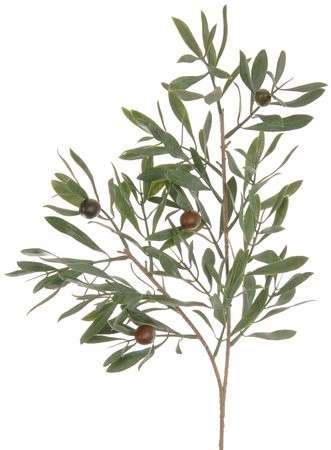
Polyester olive branches are the home-decor equivalent of a friend who arrives looking polished, asks for no snacks, and never complains about the thermostat. They bring the silvery green color, airy shape, and relaxed Mediterranean character of real olive foliage into a room without requiring sunlight, watering, pruning, or an emergency call to a plant-savvy neighbor.
Despite the simple name, most polyester olive branches are not made from polyester alone. The leaves are commonly fabric, while the stem may combine molded plastic, foam, and an iron-wire core that allows the branch to bend and hold its shape. Some designs also include artificial olives made from foam or plastic. Major U.S. home retailers describe similar mixed constructions, confirming that “polyester” generally refers to the visible leaf material rather than the entire decorative stem.
This guide explains what makes a faux olive branch look convincing, how to choose the right size, where to display it, how to clean it, and which styling mistakes can turn peaceful Mediterranean greenery into something resembling a forgotten craft-store aisle.
What Are Polyester Olive Branches?
Polyester olive branches are artificial botanical stems designed to imitate the narrow leaves and loose, irregular structure of an olive tree. They may be sold as single stems, multi-stem sprays, bundles, wreath components, or branches with dark faux olives attached.
The polyester leaves are typically cut, printed, or molded to create a soft surface and subtle color variation. A plastic or coated stem supplies structure, while interior wire makes the branch adjustable. Better products use more than one shade of green, a muted underside, visible leaf veins, and branch tips that taper naturally instead of ending like green drinking straws.
Polyester is lightweight, shape-stable, and able to hold printed color and fine surface details. Retailers may still use “silk” as a broad label for faux plants, so the material description is more useful than the marketing name.
Why Olive Branches Work So Well in Interior Design
Olive foliage has an unusually cooperative color palette. Its gray-green leaves soften bright white rooms, complement warm woods, and sit comfortably beside black metal, stone, linen, rattan, and aged brass. The shape is open rather than bulky, so a tall arrangement can add height without visually blocking a mirror, artwork, or conversation across a table.
The olive branch also carries a long cultural association with peace, making it a natural fit for calm, welcoming interiors. In American civic symbolism, the olive branch explicitly represents the power and intention of peace.
They Create Height Without Heavy Visual Weight
A flowering bouquet can feel formal or seasonal. Olive branches feel quieter. Their long stems draw the eye upward, while the small leaves leave plenty of open space. Designers frequently use branches to create drama in entryways and centerpieces, especially when varying heights and natural-looking angles are preserved.
They Stay Consistent All Year
Fresh branches dry, shed, or change color. Artificial olive stems remain available for everyday styling, rental properties, offices, windowless rooms, and second homes. Tested faux-plant guides consistently identify realism, durability, adjustability, and easy dust removal as the features that matter most in long-term use.
How to Choose Realistic Polyester Olive Branches
The difference between convincing greenery and school-play scenery usually comes down to five details.
1. Look for Layered Color
Real olive leaves are not one flat shade. Choose branches with medium green, gray-green, and slightly lighter or silvery undersides. A few brown or burgundy notes near the stem can help. Avoid neon-green fabric and perfectly identical leaves; nature is not known for synchronized uniforms.
2. Prefer Matte Texture Over Shine
High-gloss leaves reflect light like plastic packaging and reveal the illusion immediately. A soft matte or lightly textured surface is usually more believable. Design experts commonly recommend irregular forms, varied color, and less-than-perfect symmetry because realistic plants do not look machine-polished.
3. Check the Branch Silhouette
A good stem should have a loose, asymmetrical outline. The leaves should point in several directions, with some clusters close to the stem and others reaching outward. If every side branch is the same length and angle, the result may resemble a bottle brush wearing leaves.
4. Choose a Wired Stem
Wire lets you open the branch after shipping, introduce gentle bends, and tailor its height to a vase. It also helps multiple stems interlock instead of standing separately like strangers in an elevator.
Bend each section gradually rather than making sharp right angles. Severe bends can crease the stem coating, detach leaves, or expose the internal wire.
5. Match the Scale to the Room
Short stems belong on shelves, vanities, and breakfast tables. Branches around three feet tall work well on consoles and dining surfaces. Extra-long stems can anchor a floor vase or fill an empty corner.
Retail examples range from modest tabletop sprays to oversized branches measuring more than five feet long, so measure both the vase and display area before ordering.
How Many Olive Branches Should You Use?
One oversized branch creates a minimalist statement, three medium stems make an airy arrangement, and five to seven stems produce a fuller centerpiece. Odd numbers often feel relaxed, but branch shape matters more than arithmetic. Start with fewer pieces, turn the vase as you work, and add only where the silhouette feels empty.
A single branch should look deliberately sculptural, not lonely. Give it a slight sideways bend and place it in a vase with enough personality to carry the composition.
For a fuller bundle, vary the heights rather than lining up all the branch tips. Position the tallest stem slightly off-center, let another extend horizontally, and use shorter pieces to fill the lower portion.
Choosing the Right Vase
The vase should support the stems physically and visually. A narrow neck gathers the branches and helps them fan outward. A wide opening produces a looser arrangement but may require floral foam, pebbles, glass beads, or a smaller container hidden inside the decorative vessel.
For Tall Branches
Use a heavy floor vase made from ceramic, stoneware, thick glass, or metal. Add clean stones at the bottom if the arrangement feels top-heavy. Tall faux plants and branches should be stabilized so they cannot tip when bumped, particularly in homes with children or pets.
Natural materials such as preserved moss, bark, or stones can conceal artificial bases and improve realism.
For Dining Tables
Keep the arrangement low enough for conversation or narrow enough that guests can see around it. A few sideways-reaching stems often look more graceful than a dense vertical bundle.
For a long table, consider several small vases instead of one botanical skyscraper standing between everyone and the mashed potatoes.
For Clear Glass
A clear vase exposes the stem ends, so trim or wrap them neatly. Some stylists place faux stems in water to strengthen the illusion, but this should be done only when the manufacturer permits it. Water can affect coatings, adhesives, foam fruit, and exposed wire.
A safer alternative is clear acrylic “water,” glass pebbles, or an opaque inner tube that hides the base while leaving the outer vase visible.
Styling Ideas for Polyester Olive Branches
Create an Entryway Statement
Place three tall branches in a substantial vessel on a console. Let one branch lean toward the mirror, one rise above it, and one extend into the room. The arrangement should feel discovered, not saluting.
Pair the branches with a shallow tray, a small lamp, or one stack of books. Avoid surrounding them with too many little accessories, which can weaken the clean silhouette.
Soften a Kitchen
A short olive spray can balance hard surfaces such as tile, stone, stainless steel, and painted cabinetry. An aged ceramic pitcher or simple white vase makes a natural partner.
Keep artificial foliage away from active burners, toaster vents, and greasy splash zones. In a kitchen, smaller arrangements are easier to move and clean.
Warm Up Shelves
Use one bent stem in a compact vase beside books, framed art, or pottery. Avoid filling every shelf with greenery. One or two botanical moments create rhythm; twelve can make the bookcase look as though it is losing a slow argument with a hedge.
Mix Faux and Natural Materials
Pair polyester leaves with real wood, stone, linen, dried seed pods, terracotta, or preserved moss. Mixing greenery types can create a more natural, muted arrangement, while varied lengths and spontaneous angles prevent the bunch from looking manufactured.
Build a Seasonal Arrangement
Olive branches are neutral enough to remain in the same vase throughout the year. Add white blossoms in spring, pale grasses in summer, rust-colored berries in fall, or evergreen tips during the holidays.
Keep the additions restrained. The olive leaves should remain visible rather than disappearing inside a seasonal jungle.
Care and Cleaning
Polyester olive branches require little maintenance, but “maintenance-free” is not the same as “immune to household dust.” Fine leaves collect particles along their edges and around their attachment points.
- Remove the branches from the vase.
- Take them outdoors or place them over a clean towel.
- Use a microfiber cloth for broad surfaces and a soft makeup brush for small clusters.
- Blow loose dust away with a hair dryer on its cool, low setting.
- Return each branch to the vase and reshape it gently.
Retail care instructions commonly recommend a soft, dry cloth, and some specifically allow cool air from a hair dryer. Avoid abrasive cleaners and strong solvents. Regular light dusting is safer than repeatedly soaking fabric leaves, especially when adhesives, printed finishes, foam olives, or internal wire are present.
Can Polyester Olive Branches Be Washed?
Some artificial greenery can tolerate gentle damp cleaning, but the safest method depends on the product. Before using water, test one hidden leaf with a barely damp white cloth. Stop if color transfers, the fabric wrinkles, or adhesive begins to soften.
Never place wired artificial branches in a washing machine or dishwasher. Do not soak foam olives, wrapped stems, or branches with exposed metal.
Protect Them From Sunlight and Weather
Keep indoor-rated branches out of prolonged direct sunlight, which may fade the color and make some materials brittle over time. Do not assume artificial greenery is suitable for a porch, patio, or outdoor wedding unless the product is labeled for exterior or covered use.
Several major retailers specify indoor-only placement or sheltered outdoor conditions for faux olive products.
Advantages and Limitations
The main benefits are year-round color, adjustable stems, no watering, and reliable performance in dim rooms. They can be reused for seasonal displays, home staging, photography, parties, and special events.
The tradeoffs are equally clear. Cheap leaves may look shiny, fine foliage collects dust, sunlight can fade non-UV-rated materials, and mixed polyester-plastic construction is difficult to recycle. Artificial greenery also cannot provide fragrance, natural growth, or the subtle movement of a living plant.
Sustainability and Safety Considerations
An artificial branch is not automatically an environmentally friendly purchase. Polyester, plastic, foam, and mixed-material construction can be difficult to recycle. The strongest sustainability argument is longevity: buy fewer, better branches, use them for years, repair loose leaves when possible, and donate intact décor rather than sending it directly to a landfill.
Some current faux olive products contain recycled or upcycled material, showing that construction varies by manufacturer. Check the product description instead of assuming every artificial stem has the same environmental profile.
Keep polyester foliage away from open flames, hot bulbs, radiators, candles, and cooking heat. Do not use decorative branches to cover electrical cords, lamps, or ventilation openings.
For event installations, confirm local fire rules and venue policies, particularly when artificial foliage will be installed overhead or close to lighting equipment.
A Practical Experience With Polyester Olive Branches
The following is a representative decorating scenario based on common product characteristics and established faux-greenery styling practices.
The first surprise when opening a box of polyester olive branches is usually not how realistic they look. It is how thoroughly they have been flattened for shipping. The stems may arrive pressed together, with every leaf facing the same direction like passengers staring at an elevator door. Judging them at that moment is unfair. The real transformation begins with about ten minutes of shaping.
Start at the main stem and work outward. Bend the larger offshoots into a loose fan, then rotate individual leaf clusters so they catch light from different angles. A few leaves should face forward, several should turn sideways, and some should expose their paler undersides. The arrangement improves quickly once it stops looking perfectly obedient.
In a medium ceramic vase, three branches often create the best first attempt. One stem can rise high, one can arc left, and one can extend slightly forward. The instinct is to make the arrangement symmetrical, but that usually produces a stiff result. Shifting the tallest branch away from the center makes the silhouette feel more natural.
A small bend near the vase opening also prevents the stems from appearing to launch straight upward from one mechanical point. When several stems overlap, separate their upper sections and allow a little empty space between the leaf clusters.
The second lesson is that the vase can make inexpensive branches look betteror make excellent branches look suspicious. A vessel with a narrow neck holds the stems securely and hides their lower plastic sections. In a wide vase, the branches may collapse against the rim.
A handful of clean stones, floral foam, or a hidden jar inside the main vessel solves the problem. Adding weight is especially helpful on an entry console where bags, keys, and elbows pass nearby. A strip of floral tape around the lower stems can also hold the arrangement together while remaining hidden inside the vase.
After a week, the branches usually fade into the room in the best possible way. They fill an empty vertical area without constantly demanding attention. In morning light, matte leaves look softer and more convincing. Under a harsh overhead bulb, shiny seams and repeated patterns become easier to see.
That makes placement important. A few feet of viewing distance and gentle side lighting are kinder than a spotlight worthy of a police interview. Positioning the arrangement close to a window can make it appear more plausible, but intense direct sunlight may shorten the life of its color.
Dust becomes noticeable first on the upper leaves. A quick pass with a cool hair dryer removes loose particles, while a microfiber cloth handles the most visible surfaces. The job is easier when the arrangement is not overcrowded. This is one reason three well-shaped branches can be more satisfying than a packed bundle of nine.
Seasonal changes are simple. In spring, pair the olive stems with white blossoms. In summer, leave them alone for a dry Mediterranean look. In fall, add warm brown grasses or rust-colored berries. During the holidays, weave in a few evergreen tips or a narrow velvet ribbon.
The olive branches remain the quiet base while the accent materials do the seasonal talking. When the season ends, remove the additions, reshape the original stems, and the arrangement returns to its neutral everyday appearance.
The most useful experience is learning when to stop adjusting. Faux greenery invites endless tweaking because every wire can bend. After the branch heights are varied, the leaves are opened, and the overall shape feels balanced, step away. View the arrangement from the doorway rather than six inches away.
From normal room distance, minor imperfections often create realism. Perfection, ironically, is the feature most likely to expose the fake.
Conclusion
Polyester olive branches offer an easy way to add graceful height, soft gray-green color, and Mediterranean character to a home. The best examples combine matte fabric leaves, natural color variation, irregular branching, and flexible wired stems.
Choose the right scale, shape each branch carefully, anchor it in a supportive vase, and remove dust before it becomes part of the décor scheme. A thoughtfully selected arrangement can remain attractive through busy schedules, dim rooms, long trips, and repeated seasonal updateswithout dropping a single leaf in protest.