Research basis: feline environmental enrichment, secure vertical territory, wall-mounted shelf installation, anchoring methods, and the o
Most cats are perfectly satisfied with a cardboard box, a sunny windowsill, and the occasional opportunity to sit directly on the keyboard during an important meeting. Our cat, however, seemed to believe he had been hired as the chief archaeologist of the living room.
He climbed bookshelves. He balanced on doorframes. He stared down at us from the refrigerator as though we were trespassing in his ancient kingdom. Ordinary cat furniture was not going to satisfy this tiny adventurer. He needed danger, drama, elevation, and preferably a route that made him look like the feline star of an action movie.
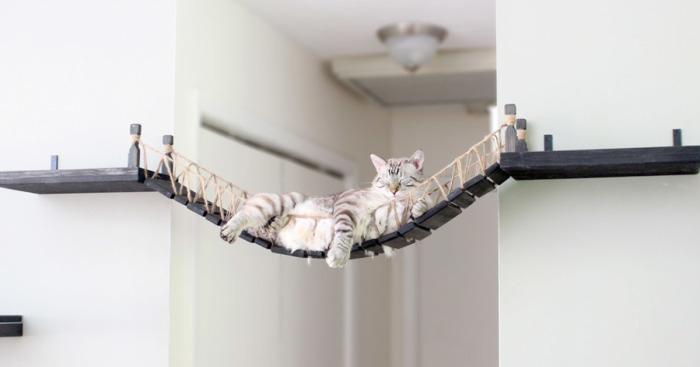
That was how we ended up creating an Indiana Jones cat bridge: a handmade rope bridge suspended between two wall-mounted platforms. It looked slightly perilous, moved just enough to feel exciting, and transformed an unused stretch of wall into a private jungle expedition.
The project started as a joke. Then we bought lumber. Once lumber enters the house, the joke has officially become home improvement.
Why We Built a Rope Bridge for Our Cat
Our original goal was not simply to decorate the wall. We wanted to create useful vertical territory that would encourage climbing, observation, exercise, and independent play. Indoor cats benefit from secure elevated resting areas, climbing opportunities, and ways to survey their environment from above. Vertical features can also make a room feel larger to a cat without taking away valuable human floor space.
That last point mattered because our home did not have room for another giant carpet-covered cat tower. We already owned one that looked like a beige apartment complex designed by someone who had recently discovered cylinders. It worked, but it was not exactly a conversation piece.
A wall-mounted cat bridge offered a more creative solution. It connected two elevated perches, gave our cat a pathway across the room, and added movement to his daily routine. The bridge also created a destination rather than a dead-end shelf. He could climb up one side, cross the suspended walkway, rest on the opposite platform, and descend without having to reverse awkwardly.
That continuous route was important. Cats often feel more comfortable using elevated spaces when they have more than one practical way to enter or leave. We therefore designed the bridge as part of a complete climbing path rather than hanging it in isolation and expecting our cat to teleport onto it.
Designing Our Indiana Jones Cat Bridge
The movie-inspired appearance came from a classic suspended footbridge: individual wooden slats, thick rope rails, darker wood tones, and a little controlled movement underfoot. We wanted it to look adventurous without actually functioning like a collapsing temple trap.
The difference between a cinematic bridge and a cat bridge is that the cinematic version is supposed to fail dramatically. Ours needed to remain attached to the wall despite repeated charges from an animal who occasionally achieved highway speeds at 3:00 a.m.
Choosing the Location
We selected a quiet wall between two stable landing platforms. The route was away from the stove, television, ceiling fan, breakable decorations, and frequently opened doors. We also checked that the bridge would not pass above a place where people regularly sat or walked.
Before drilling, we used a stud finder and checked for possible wiring or plumbing behind the wall. Wall shelves and brackets are generally strongest when fastened directly to structural framing. Suitable heavy-duty anchors may be used where studs are unavailable, but the hardware must be selected for the wall material and expected load.
A cat does not apply weight like a decorative vase. A vase rarely launches itself onto a shelf from four feet away. Dynamic movement creates additional force, so we treated every platform, bracket, rope connection, and screw as load-bearing.
Planning the Dimensions
Our bridge needed to be wide enough for comfortable walking but narrow enough to retain its adventurous appearance. We based the width on our cat’s body rather than copying a decorative miniature bridge. He had to be able to stand naturally, turn his paws slightly, and recover his balance if a board shifted.
We kept the gaps between the slats small so that paws could not slip through easily. The side ropes were positioned where they offered visual boundaries without forming loops that could catch a leg, collar, or curious head.
The bridge was installed with only a modest sag. A deep curve might look dramatic in photographs, but it would increase instability and make the first and last steps unnecessarily steep. Our objective was “ancient jungle crossing,” not “feline carnival ride.”
Materials and Tools We Used
Our supplies were simple, but we chose each item with durability in mind:
- Solid wood boards for the bridge slats
- Two larger wooden landing platforms
- Strong, low-stretch rope
- Wall brackets rated above the expected load
- Structural screws and appropriate wall anchors
- Washers, knots, or mechanical rope stops
- Sandpaper in several grits
- A pet-conscious, fully cured wood finish
- A drill, drill bits, level, tape measure, and stud finder
- Eye protection and a vacuum for sawdust
We avoided weak decorative rope, splintered wood, exposed staples, sharp metal edges, and finishes that remained sticky or produced a strong odor. Cats investigate new construction with their noses, paws, and occasionally their teeth, so every surface had to be smooth and fully cured before installation.
How We Built the DIY Cat Bridge
Step 1: We Made a Full-Size Mockup
Before cutting anything, we marked the proposed bridge and platform positions with painter’s tape. This helped us evaluate the height, angle, walking route, and relationship to nearby furniture.
We watched our cat approach the area and noted where he naturally jumped. He contributed no formal design comments, but he did sit on the tape, which we interpreted as conditional approval.
Step 2: We Cut the Wooden Slats
We cut a series of matching wood pieces for the bridge deck. Consistency mattered because uneven slats would cause the walkway to twist. Each board was checked for cracks, knots near the drilled areas, sharp corners, and rough grain.
After cutting, we rounded the edges and sanded every surface. This was the least glamorous part of the project and possibly the most important. A rustic appearance should come from color and design, not from actual splinters.
Step 3: We Drilled the Rope Holes
Each slat received matching holes near both ends. We created a drilling template so the holes stayed aligned from board to board. The hole diameter was slightly larger than the rope, allowing assembly without leaving excessive room for the slats to wobble.
We drilled into scrap wood beneath each board to reduce tear-out, then sanded the inside edges of the holes. Rope rubbing repeatedly against a sharp wooden edge can wear faster than expected, so smooth openings were essential.
Step 4: We Finished the Wood
To achieve the Indiana Jones aesthetic, we chose a warm, aged-looking finish. We applied it evenly, allowed it to cure completely, and aired out the pieces before bringing them back into the cat’s space.
We did not add fake moss, loose vines, dangling fabric, tiny skulls, plastic snakes, or a motion-activated boulder. Creative restraint is an underrated form of pet safety.
Step 5: We Threaded the Bridge
Two main ropes ran through the slats to form the walking surface. We added secure spacing between the boards so they could move slightly without sliding into a pile. Depending on the design, spacing can be maintained with knots, sleeves, wooden separators, or other fixed stops.
The finished bridge had a little flexibility, but the boards remained consistently positioned. We tested the assembly on the floor first, pressing and shifting every slat to identify loose connections.
Step 6: We Built Stable Landing Platforms
A suspended bridge is only as useful as the places at either end. We installed broad, rigid platforms that allowed our cat to pause before crossing. Their surfaces provided traction, and their edges were smooth.
The approach shelves were arranged in a step pattern rather than requiring one heroic leap. This made the route more accessible and gave our cat time to examine the bridge. Secure, stepwise climbing options are especially important for kittens, larger cats, seniors, and cats with limited mobility.
Step 7: We Anchored Everything Securely
We located the wall studs, marked their centers, leveled the brackets, drilled pilot holes, and used hardware appropriate for the wall construction. Where direct stud placement was not possible, we used properly rated anchors rather than the mysterious plastic leftovers found in the kitchen junk drawer.
We tightened each connection, checked the brackets for movement, and tested the platforms gradually with weight greater than our cat’s body weight. We also pulled downward and outward to simulate the force of jumping.
After attaching the bridge, we checked that the rope could not slide free and that no knot could loosen under repeated motion. Every rope end was secured and trimmed so there were no large dangling loops.
Step 8: We Let the Cat Make the Final Decision
We did not place him in the middle of the bridge. That would have been an excellent way to teach him that the new structure was suspicious and that his humans could not be trusted.
Instead, we allowed him to investigate at his own pace. We placed treats on the lower approach shelves, then near the bridge entrance. A favorite toy helped attract his attention, but we never pushed, pulled, or cornered him.
His first inspection involved several minutes of sniffing, one cautious paw, and a retreat to reconsider his life choices. On the second attempt, he crossed halfway. On the third, he marched over the entire bridge as though he had personally commissioned it.
Did Our Cat Actually Use the Bridge?
Yes, although not according to our schedule.
For the first day, he treated the bridge like an archaeological artifact that should not be disturbed. He sat beneath it. He stared at it. He watched us watching him stare at it. Then, late that evening, he crossed it without ceremony and settled on the far platform.
Within a week, the DIY cat bridge became part of his regular patrol route. He used it to reach a window perch, escape the vacuum cleaner, supervise dinner preparation, and conduct surprise attacks on feather toys.
The slight movement seemed to make the bridge more engaging. He learned how to adjust his paws as the slats shifted beneath him. Sometimes he crossed slowly with the seriousness of an explorer entering a forbidden temple. At other times he sprinted across it because an invisible enemy had apparently breached the perimeter.
Safety Lessons From the Project
Building wall-mounted cat furniture requires more caution than creating a decorative shelf. The structure must tolerate jumping, landing, scratching, repeated vibration, and occasional misuse. We learned to inspect the entire installation regularly rather than assuming it would remain perfect forever.
Our inspection routine includes checking:
- Whether any bracket moves under pressure
- Whether screws or anchors have loosened
- Whether the rope shows fraying or stretching
- Whether knots and rope stops remain secure
- Whether any slat has cracked or warped
- Whether the walking surfaces still provide traction
- Whether nearby furniture creates a new collision risk
We also reassess the route as our cat ages. A bridge that suits a young, athletic cat may need lower access steps, a firmer walking surface, or an alternate path later. Pet furniture should adapt to the animal rather than demanding that the animal adapt forever.
Mistakes We Would Avoid Next Time
Making the Bridge Too High
Height is exciting, but higher is not automatically better. The safest placement depends on the cat’s age, coordination, health, confidence, and available landing areas. We would rather build an enjoyable moderate-height bridge than an impressive structure our cat avoids.
Using Slippery Boards
Beautiful polished wood can become a tiny skating rink. A bridge needs paw-friendly grip. Light texture, securely attached nonslip material, or another safe traction solution can make the crossing more comfortable.
Relying on One Exit
A single elevated platform can become a trap in a multi-pet household if another animal blocks the route. Multiple access points and escape options help cats move without confrontation.
Assuming Every Cat Wants a Wobbly Bridge
Some cats love movement. Others consider a shifting floor a serious violation of building codes. A more cautious cat may prefer rigid wall shelves connected by short steps. The Indiana Jones theme should never matter more than the cat’s comfort.
What the Indiana Jones Bridge Taught Us About Living With a Cat
The bridge changed more than an empty wall. It changed the way we thought about our cat’s experience of the house.
Humans typically organize rooms horizontally. We think about floor plans, walking paths, chairs, tables, and storage. Cats evaluate the same room in three dimensions. The top of a cabinet is usable territory. The back of a couch is a highway. A shelf is a lookout tower. An open doorway may be both an entrance and an observation post.
Once we recognized that difference, we began noticing routes our cat had already invented. He moved from the couch to the side table, from the side table to the windowsill, and from the windowsill to a narrow cabinet top. We had previously viewed these movements as random acts of cat. They were actually a transportation network.
The bridge allowed us to improve that network deliberately. Instead of constantly telling him where not to climb, we created a place where climbing was encouraged. This did not eliminate every unauthorized expedition. The kitchen counter remains a source of forbidden knowledge. However, giving him an appealing legal route reduced some of his interest in less suitable locations.
We also learned that cats do not measure a gift by its price or by the number of hours spent building it. After completing the bridge, we expected immediate amazement. Our cat responded by sleeping in the cardboard box that had contained the hardware.
That moment was humbling, but it reminded us to introduce enrichment without expectations. Cats often need time to investigate unfamiliar objects. Their initial hesitation does not mean the project has failed. New smells, textures, sounds, and movement can require several calm encounters before a cat feels comfortable.
The first successful crossing was therefore more satisfying than we expected. He placed one paw on the first slat, shifted his weight backward, and studied the bridge again. Then he stepped forward. The ropes moved slightly. His tail rose for balance. He paused in the middle and looked down at us with an expression that suggested we had finally produced something acceptable.
Living with the bridge also taught us that enrichment works best when it connects activities. One end led toward a resting platform, while the other connected with a window view and additional shelves. The bridge was not merely an object; it was part of a route involving climbing, watching, resting, and playing.
We occasionally hid a few treats along the path or guided a wand toy across the platforms. These small changes kept the route interesting without turning every crossing into a feeding event. On quiet afternoons, the far platform became a favorite sleeping location. During energetic periods, the bridge became a racetrack.
Our maintenance habits improved too. At first, we checked the hardware every few hours because new-project anxiety had transformed us into nervous suspension-bridge inspectors. Eventually, the checks became less dramatic but remained regular. Rope and wood are durable, not immortal. A quick inspection is easier than repairing a failed installation.
Visitors usually noticed the bridge before they noticed anything else in the room. Some asked whether it was decorative. At that exact moment, our cat would often appear, cross above their heads, and answer the question personally. He understood timing better than most professional performers.
The project also encouraged us to stop buying generic pet furniture simply because it was labeled for cats. Safe cat enrichment can complement a home’s design. It can be rustic, modern, minimal, colorful, or delightfully ridiculous. The key is to begin with feline behavior and structural safety, then add the visual theme.
Most importantly, the experience reminded us that a home shared with an animal should contain places designed from that animal’s perspective. Our bridge may have been inspired by an adventure movie, but its real value came from giving our cat more choice, movement, and control over his surroundings.
He did not need a movie prop. He needed a secure place to climb. The fact that it made him look like a whiskered action hero was simply an excellent bonus.
Conclusion: An Adventure Worth Building
Creating an Indiana Jones bridge for our cat turned an unused wall into an interactive climbing route and gave us a memorable introduction to DIY cat furniture. The project combined woodworking, home improvement, feline enrichment, and the mild panic of watching a cat test something we had attached to the wall ourselves.
The finished bridge was successful because we designed it around our cat rather than around a photograph. We considered his size, confidence, preferred routes, landing habits, and need for secure exits. We anchored the platforms carefully, minimized dangerous gaps and loops, tested the structure thoroughly, and allowed him to explore voluntarily.
A rope bridge for cats can be playful and visually dramatic, but safety must remain the leading character. Use strong materials, appropriate hardware, smooth surfaces, stable platforms, and a layout suited to your individual pet. When uncertain about the wall structure or installation, consult a qualified contractor or experienced carpenter.
Our cat now crosses his bridge with the confidence of an explorer escaping a collapsing temple. There are no snakes, rolling boulders, or priceless artifacts on the other sideonly a window perch and occasional treats. Judging by his enthusiasm, that is treasure enough.