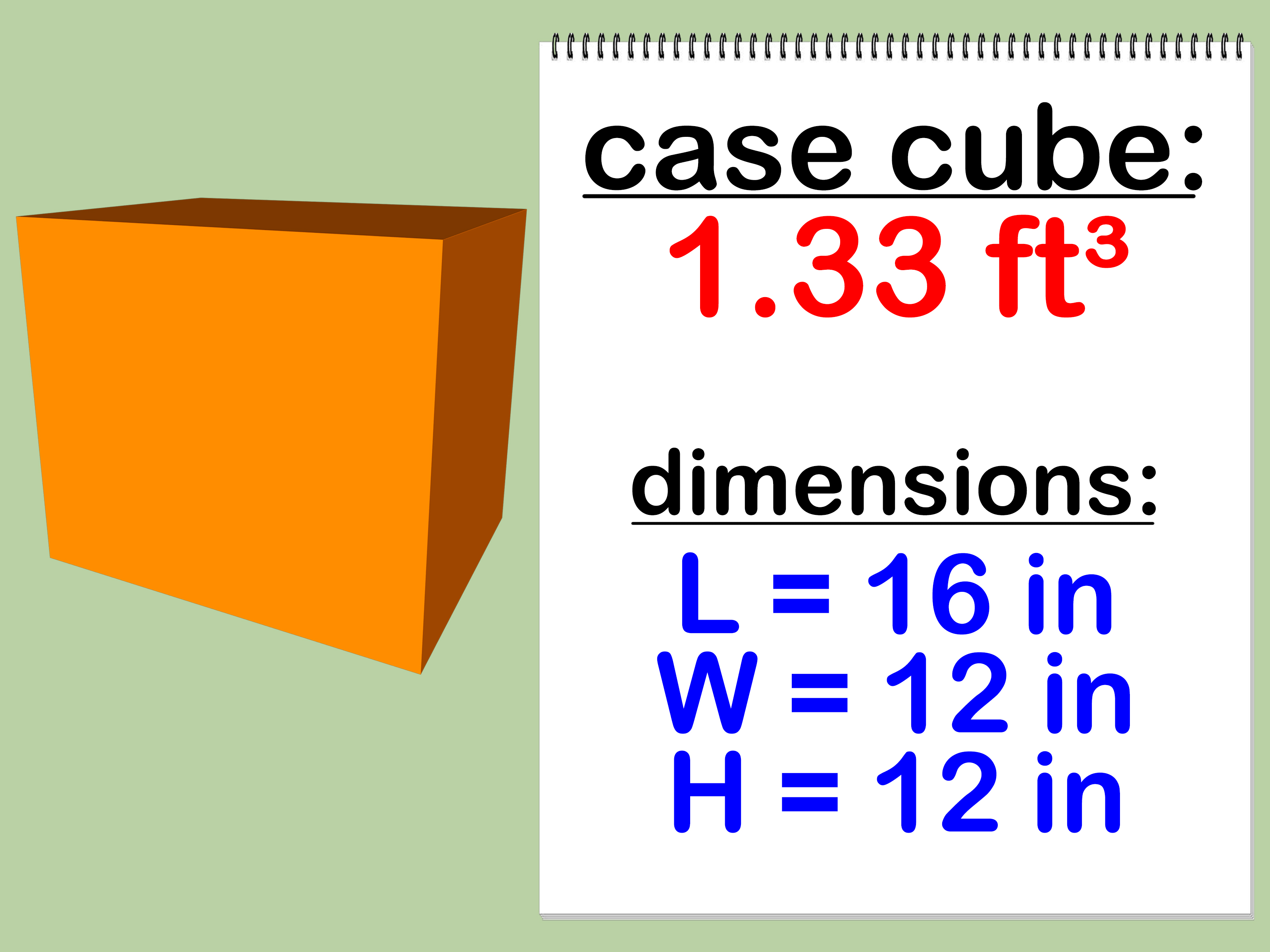
Boxes are excellent at hiding how much space they occupy. A carton may look harmless sitting on a desk, but multiply it by 500 cases, load those cases onto pallets, and suddenly your “small shipment” needs its own zip code.
That is why manufacturers, wholesalers, warehouse operators, retailers, and freight carriers use a measurement called the case cube. It expresses the three-dimensional volume of a box, usually in cubic feet. With one simple calculation, you can estimate warehouse capacity, pallet requirements, freight density, shipping costs, and how many cases may fit inside a truck or storage area.
The basic case cube formula is pleasantly uncomplicated:
Length × Width × Height = Volume
However, accurate results depend on measuring the correct part of the box, using consistent units, applying the right conversion factor, and avoiding several surprisingly common mistakes. Let us walk through the process before a tiny decimal point causes a very large freight invoice.
What Is the Case Cube of a Box?
The case cube of a box is the total amount of three-dimensional space occupied by the case. In American warehousing and freight operations, case cube is commonly expressed in cubic feet, abbreviated as cu. ft. or ft³.
A rectangular box has three dimensions:
- Length: Usually the longest horizontal side
- Width: The shorter horizontal side
- Height: The vertical distance from bottom to top
Multiplying these three dimensions produces the box’s volume. If the measurements are taken in inches, the first result will be in cubic inches. You then divide by 1,728 because one cubic foot contains 1,728 cubic inches.
Carrier and packaging guidance consistently uses length multiplied by width multiplied by height to determine cubic size. Measurement conventions may vary slightly by purpose, so warehouse calculations normally use the exterior dimensions of the closed shipping case, while box manufacturers often list a carton’s interior dimensions.
The Case Cube Formula
Formula When Measurements Are in Inches
When length, width, and height are measured in inches, use this formula:
Case cube in cubic feet = (Length × Width × Height) ÷ 1,728
The number 1,728 comes from cubing 12 inches:
12 × 12 × 12 = 1,728 cubic inches
This conversion is important because dividing by 12 only once converts a linear measurement, not a three-dimensional volume. Volume has three dimensions, so the conversion factor must account for inches in the length, width, and height. NIST guidance describes volume as a three-dimensional measurement and explains the use of conversion factors when changing measurement systems.
Formula When Measurements Are in Feet
If every dimension is already measured in feet, the calculation is even easier:
Case cube in cubic feet = Length × Width × Height
For example, a box measuring 2 feet long, 1.5 feet wide, and 1 foot high has a case cube of:
2 × 1.5 × 1 = 3 cubic feet
Do not mix feet and inches in the same equation. Mathematics may tolerate many things, but it draws the line at unit chaos.
How to Calculate the Case Cube of a Box Step by Step
Step 1: Prepare the Finished Shipping Case
Measure the box in the same condition in which it will be stored or shipped. Close the flaps, seal the carton if necessary, and include any bulging, protective corners, straps, or exterior packaging that increases the shipment’s overall dimensions.
For inventory planning, measuring an empty carton may be sufficient if every packed case remains square and uniform. For freight quoting, however, measure the fully packed case. A carton that gains an inch around the middle after loading is no longer the size printed in the supplier catalog.
Step 2: Measure the Exterior Length
Place a tape measure along the longest side of the closed case. Record the greatest outside-to-outside distance.
If the shipment has handles, protrusions, bowed panels, or irregular edges, measure between its farthest points. Carriers generally treat an irregular package as though it were enclosed inside the smallest rectangular box that could contain it.
Step 3: Measure the Exterior Width
Measure the shorter horizontal side from its outermost points. Keep the tape straight rather than wrapping it around the carton.
Length and width can switch places without changing the mathematical volume, but maintaining a consistent length × width × height order makes product records, warehouse spreadsheets, and carrier forms easier to understand.
Step 4: Measure the Exterior Height
Measure vertically from the lowest point of the case to the highest point. Include any lid, cap, top pad, or packaging component that travels with the shipment.
If the top is uneven, use the maximum height. Measuring a low corner while ignoring a bulging center may produce a lovely number, but not an accurate one.
Step 5: Round According to Your Purpose
For internal warehouse analysis, you may retain measurements to the nearest eighth or quarter inch if your equipment is sufficiently accurate.
For parcel-shipping estimates, follow the carrier’s measurement rules. Major U.S. carriers instruct customers to use whole-inch measurements when calculating cubic or dimensional size, although their precise rounding practices and divisors should always be checked before purchasing postage.
Step 6: Multiply the Dimensions
Multiply length by width by height to obtain cubic inches:
Cubic inches = Length × Width × Height
Step 7: Divide by 1,728
Convert the cubic-inch result to cubic feet:
Cubic feet = Cubic inches ÷ 1,728
Step 8: Record the Result Consistently
For operational use, case cube is often recorded to two or three decimal places. For example:
1.111 ft³
Avoid rounding too early. A difference of 0.01 cubic foot seems minor for one carton, but across 20,000 cases it becomes 200 cubic feet of mysteriously missing warehouse space.
Case Cube Calculation Examples
Example 1: A Box With a Whole-Number Result
Suppose a shipping case measures:
- Length: 24 inches
- Width: 18 inches
- Height: 12 inches
First, calculate cubic inches:
24 × 18 × 12 = 5,184 cubic inches
Then convert to cubic feet:
5,184 ÷ 1,728 = 3 cubic feet
Case cube: 3.00 ft³
Example 2: A Box With a Decimal Result
Consider a carton measuring 16 × 12 × 10 inches:
16 × 12 × 10 = 1,920 cubic inches
1,920 ÷ 1,728 = 1.111 cubic feet
Case cube: approximately 1.11 ft³
Example 3: Calculating the Total Cube for Multiple Cases
If 30 identical cases each occupy 1.111 cubic feet:
1.111 × 30 = 33.33 cubic feet
The shipment therefore has a theoretical total case cube of approximately 33.33 cubic feet.
This represents the combined volume of the cases themselves. The actual space required may be larger because of pallet footprints, gaps between cartons, load overhang, stacking limits, or oddly arranged products.
How to Calculate Case Cube Using Metric Measurements
Companies working with international suppliers may receive carton dimensions in centimeters. Keep all three measurements in centimeters, calculate cubic centimeters, and then convert the result.
Case Cube in Cubic Meters
Use this formula:
Cubic meters = (Length in cm × Width in cm × Height in cm) ÷ 1,000,000
For a case measuring 60 × 40 × 30 centimeters:
60 × 40 × 30 = 72,000 cubic centimeters
72,000 ÷ 1,000,000 = 0.072 cubic meter
Convert Cubic Meters to Cubic Feet
Multiply cubic meters by approximately 35.3147:
0.072 × 35.3147 = 2.5427 cubic feet
Case cube: approximately 2.54 ft³
For reporting and billing, use the conversion precision required by your warehouse management system, customer agreement, or carrier rather than repeatedly converting rounded numbers.
Case Cube Versus Dimensional Weight
Case cube and dimensional weight are related, but they are not interchangeable.
Case cube measures volume. It tells you how much physical space the case occupies.
Dimensional weight, sometimes called DIM weight or volumetric weight, converts package volume into a theoretical billing weight by dividing cubic size by a carrier-specific divisor.
The general formula is:
Dimensional weight = (Length × Width × Height) ÷ DIM divisor
Carriers may compare dimensional weight with actual scale weight and charge according to the greater figure. The divisor and eligibility rules can vary by carrier, service, rate agreement, package size, and date. Current UPS, FedEx, and USPS guidance therefore should be checked whenever a shipping quote is prepared.
A fluffy comforter and a box of steel bolts may occupy identical cubes. The comforter may trigger dimensional pricing, while the bolts are more likely to be billed according to their substantial actual weight. The boxes look equally innocent; the scale knows better.
Using Case Cube to Calculate Freight Density
Case cube also helps calculate freight density, especially for less-than-truckload shipments.
The basic freight density formula is:
Density in pounds per cubic foot = Shipment weight ÷ Shipment volume in cubic feet
Suppose a packed case weighs 42 pounds and occupies 3 cubic feet:
42 ÷ 3 = 14 pounds per cubic foot
Density may help determine freight classification and transportation pricing, although handling, stowability, and liability can also affect classification. For multi-piece shipments, calculate the total packaged volume and total shipment weight rather than using only the dimensions of an individual product.
How to Calculate the Cube of a Palletized Load
Adding the case cubes can help with product analysis, but freight carriers frequently need the overall dimensions of the complete palletized unit.
Measure:
- The longest total palletized length
- The widest total palletized width
- The full height from the floor to the top of the load
Include the pallet, corner boards, stretch wrap, straps, braces, and any overhang.
For a load measuring 48 × 40 × 60 inches:
48 × 40 × 60 = 115,200 cubic inches
115,200 ÷ 1,728 = 66.67 cubic feet
Pallet cube: approximately 66.67 ft³
The pallet cube may exceed the sum of the individual case cubes because rectangular cases do not always fill the palletized envelope perfectly.
Why Accurate Case Cube Matters
Warehouse Capacity Planning
Case cube helps planners estimate how much inventory can fit into reserve storage, shelving, pick locations, trailers, or containers. It also provides a useful starting point for comparing product volume with available warehouse capacity.
Transportation Planning
A shipment can reach a trailer’s space limit before reaching its weight limit. Accurate cube data helps transportation teams estimate equipment needs and compare parcel, LTL, partial-truckload, and truckload options.
Packaging Optimization
Right-sized packaging reduces unused space, protective filler, and unnecessary shipping volume. Even a modest increase in each dimension can create a much larger percentage increase in total cube because all three dimensions are multiplied together. Packaging specialists commonly emphasize that excess box volume can increase material use and reduce the number of packages that fit into transportation equipment.
Inventory and Cost Analysis
Businesses may use case cube to allocate storage costs, compare suppliers, evaluate packaging changes, calculate cube utilization, or identify products that consume a disproportionate amount of space relative to their sales or profit.
Common Case Cube Mistakes
Using Interior Dimensions for Shipping
Interior dimensions tell you what may fit inside a carton. Exterior dimensions tell you how much room the packed carton occupies. Shipping, freight, and storage calculations generally require the latter.
Mixing Inches, Feet, and Centimeters
All dimensions must use the same unit before multiplication. A calculation involving 24 inches, 1.5 feet, and 30 centimeters is not innovative; it is simply wrong.
Dividing by 12 Instead of 1,728
Dividing by 12 converts inches to feet in one dimension. A cubic-foot conversion must account for all three dimensions, which is why cubic inches are divided by 1,728.
Measuring an Unpacked or Unsealed Carton
The final case may bulge, bow, or gain height after packing. Measure the finished shipping unit whenever accuracy matters.
Ignoring Pallets and Protective Materials
For pallet freight, the pallet and associated packaging are part of the shipment’s occupied space. Leaving them out produces an artificially small cube.
Rounding Too Early
Retain the unrounded result through intermediate calculations. Round only the final number according to your operational policy.
Assuming Case Cube Equals Usable Capacity
A warehouse with 10,000 cubic feet of theoretical volume cannot necessarily hold 10,000 cubic feet of cases. Aisles, rack beams, sprinklers, clearances, columns, handling equipment, and imperfect stacking all consume space.
Practical Experiences and Lessons From Real Shipping Workflows
One of the most common experiences in warehouse operations is discovering that a supplier’s carton dimensions are technically correct but operationally useless. The dimensions may describe the inside of an empty box, while the warehouse team needs the outside measurements of a loaded, taped, slightly bulging case. The difference may be less than an inch per side, yet that difference can change the calculated cube, pallet pattern, and transportation estimate.
A useful practice is to measure several production cases rather than trusting one sample. Corrugated boxes have manufacturing tolerances, and flexible products can settle differently inside each carton. Measuring five or ten finished cases provides a more realistic picture. Teams can then record the maximum verified dimension or establish a controlled average, depending on how the data will be used.
Another recurring lesson involves spreadsheets. A case-cube formula may be mathematically correct but reference the wrong cells, mix centimeters with inches, or divide by 1,728 twice. These errors can survive for months because the resulting numbers still look believable. Adding columns for the original unit, cubic inches, cubic feet, quantity, and total cube makes the calculation easier to audit. A simple reasonableness check also helps: a box measuring roughly 12 inches on every side should occupy approximately one cubic foot.
Palletization creates another surprise. A planner may multiply the individual case cube by the number of cartons and assume that figure represents the freight cube. In practice, unused space between cases, pallet overhang, stacking patterns, slip sheets, and the pallet itself can create a noticeably larger shipping envelope. Measuring the completed pallet is therefore safer when requesting an LTL quote.
Seasonal products provide an especially memorable lesson. Artificial wreaths, pillows, promotional displays, and other lightweight items may weigh very little but occupy enormous amounts of space. Their transportation cost can be driven more by cube than by scale weight. Reducing one box dimension or using compressible packaging can produce meaningful savings across thousands of units.
Warehouse teams also learn that measurement discipline matters more than fancy software. Dimensioning machines, warehouse management systems, and freight calculators are valuable, but none can rescue bad source data. A crooked tape measure or an unclosed box still creates a bad numberonly now the bad number travels automatically through purchasing, inventory, billing, and forecasting systems at impressive speed.
The best operational habit is to treat carton dimensions as controlled product data. Record who measured the case, when it was measured, whether the dimensions are internal or external, whether the box was fully packed, and which unit of measure was used. Recheck the data whenever packaging, case count, product configuration, or supplier changes. Case cube is simple arithmetic, but maintaining reliable cube data is an ongoing business process.
Conclusion
To calculate the case cube of a box, measure the finished exterior length, width, and height, multiply the three dimensions, and convert the result into the required volume unit. When measurements are in inches, divide the cubic-inch total by 1,728 to obtain cubic feet.
The formula may be simple, but the result supports important decisions involving storage capacity, packaging design, freight density, dimensional pricing, pallet planning, and transportation costs. Measure the actual shipping case, use consistent units, preserve sufficient decimal precision, and distinguish case cube from dimensional weight. Follow those rules and your box calculations should remain pleasantly boringwhich is exactly what logistics math ought to be.