Modern flirting is already weird enough. We send a carefully curated meme, stare at three blinking dots like they’re a prophecy, and pretend “haha wow” is a complete emotional language. Then along comes cartoonist Ben Hed, creator of Pet Foolery, with a gloriously absurd question: what if humans flirted the way animals do? Suddenly the dating world gets much simpler, much stranger, and infinitely funnier. No vague texting. No fake-casual “just checking in.” Just one pebble, one dance move, one dramatically extended neck, and a whole lot of biological confidence.
That is exactly why the concept works. Hed’s comic idea is funny on the surface because it swaps human social rules for blunt animal courtship rituals. But it also sticks because the joke is uncomfortably close to reality. Human beings may wear jackets, use dating apps, and pretend they are above the chaos, yet our own courtship habits are still full of signaling, performance, gifts, display, timing, and the occasional public humiliation. In other words, the line between “civilized romantic interest” and “male bird doing jazz-hands on a branch” is thinner than we would like to admit.
Why Ben Hed’s Premise Lands So Perfectly
Ben Hed’s animal-centered humor thrives because he understands two things extremely well: first, animals are naturally entertaining; second, people are one missed coffee invitation away from becoming a wildlife documentary. His “humans flirting like animals” setup turns both truths into comic gold. Instead of making animals more human, he flips the joke and makes humans more animal. That reversal is what gives the idea its kick. It is not just “look how silly animals are.” It is “look how silly we are once the polite wrapping paper comes off.”
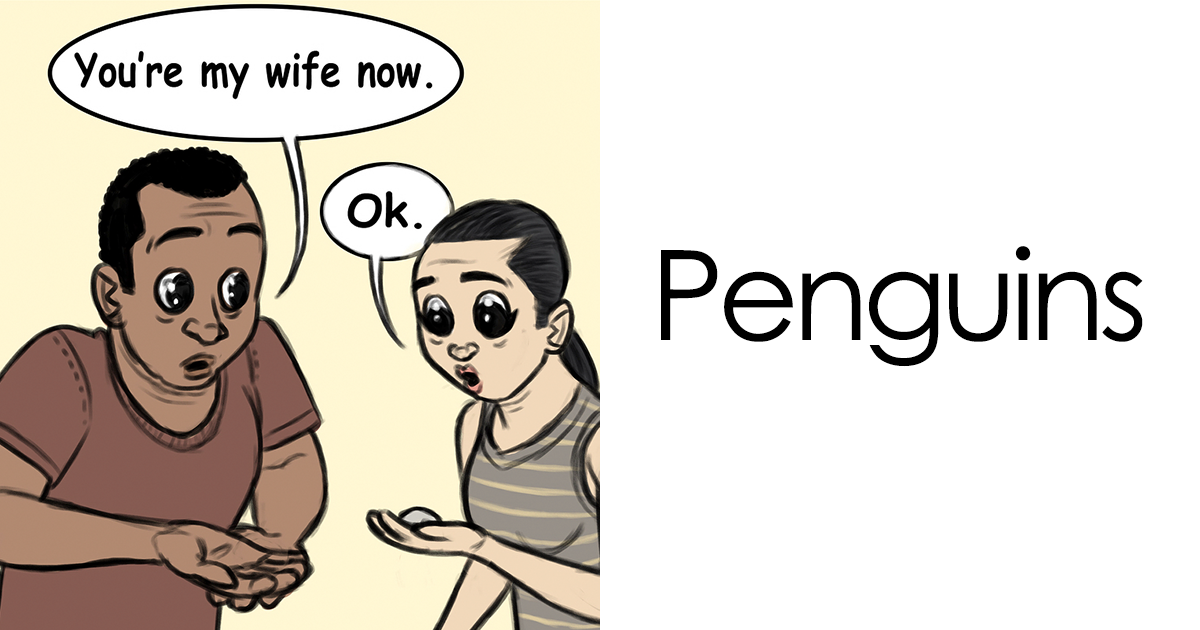
The genius of the comic is that it does not need an overcomplicated plot. The humor comes from contrast. Animal courtship is often direct, ritualized, repetitive, and weirdly theatrical. Human flirting, meanwhile, likes to imagine itself as subtle and sophisticated. Put those two systems together and the illusion collapses in the funniest possible way. A woman being handed a pebble with deep sincerity is ridiculous. A guy showing off through dance moves like a manakin is ridiculous. But both are also weirdly believable, which is exactly why readers laugh instead of merely nodding politely and moving on with their day.
Animal Courtship Is Already Nature’s Stand-Up Routine
If the comic feels exaggerated, biology would like a word. Across the animal kingdom, courtship can involve visual displays, sound, color, movement, gifts, architecture, persistence, and some truly questionable decision-making. In birds, especially, romance can look like a full-stage production with choreography, lighting, costume design, and a performer who absolutely refuses to leave the stage until somebody claps. Birds-of-paradise are famous for elaborate dances and poses. Manakins have been observed doing moves so slick they look like tiny backup dancers in a very exclusive rainforest talent show.
And then there are the frigatebirds, which do not simply show up and hope for the best. Males inflate bright throat pouches and use them as part of a dramatic display. Translation for human purposes: imagine someone puffing up like a living parade balloon and drumming on themselves outside your apartment window. You would call security. In the animal world, however, that counts as serious effort. Nature is not afraid of spectacle. If anything, nature seems convinced that subtlety is for amateurs.
That is why Hed’s comic feels so rich. It is not built on random nonsense. It is built on real behavioral patterns that already sound like they were written by a comedy writer with too much coffee and not enough supervision. Animal courtship is full of rituals that make perfect sense biologically and perfect nonsense socially. Put those same gestures on human bodies, and the humor writes itself.
The Funniest “If Humans Did This” Examples
Birds: Dance First, Explain Never
One of the strongest comic ideas in this theme involves birds because birds do not flirt halfway. Many species rely on movement, color, rhythm, and display to get attention. That means if humans copied them, flirting would become a contact sport performed in sneakers. Instead of leaning against a bar and pretending to know wine, someone would clear a patch of floor, tidy it like a performance stage, and begin a moonwalk with terrifying commitment. The audience would be confused. One target viewer would be impressed. Mission accomplished.
The joke works because humans absolutely do this already, just with more denim and less honesty. We dress strategically. We rehearse jokes in the mirror. We pick restaurants that make us look more mysterious than we really are. We post one casually brilliant photo and pray it says, “I am fun, emotionally available, and somehow also naturally photogenic.” Birds simply skip the performance anxiety and go full Broadway.
Penguins: The Pebble Has Better Intentions Than Most DMs
Among the most charming courtship gestures in the animal world is the penguin pebble move. In some penguin species, a stone can function as a practical nesting gift and, in certain contexts, a courtship gesture. That is hilarious when translated to humans because it is both absurdly small and weirdly thoughtful. Imagine someone approaching you with the confidence of a Victorian poet and saying, “I saw this rock and thought of our future.” On paper, nonsense. In practice, somehow more romantic than “u up?”
The pebble joke also exposes a truth about human attraction: effort matters. Not price. Not performance. Effort. The reason the gesture scans as funny and sweet is because it is clear, simple, and intentional. The giver noticed something, chose it, and brought it to one specific person. Compared with the lukewarm chaos of modern flirting, the humble penguin pebble looks almost elite.
Galápagos Giant Tortoises: Slow, Loud, and Strangely Competitive
Galápagos giant tortoises are not exactly associated with sleek charm. Nobody has ever whispered, “Be still, my heart, here comes a reptile with the energy of a moving ottoman.” Yet courtship in giant tortoises has its own kind of dramatic flair, from deep vocalizations to long, physical effort. The comic version turns that into a human flirting strategy so primitive and straightforward that it becomes instantly funny. No poetry, no ambiguity, no “let’s not label this.” Just a public display of effort and a very obvious attempt to win.
That absurd directness is what makes the joke stick. Human dating often gets tangled in layers of image management. Tortoise flirting does not care. It has one speed, one objective, and absolutely zero interest in mixed signals. There is something deeply comic about replacing modern romantic confusion with a giant reptile energy that says, “I have arrived, I am making noise, and yes, this is my best angle.”
Black Widow Spiders: Dating, But Make It High Stakes
Then the tone swerves beautifully into the darkly hilarious territory of black widow spiders. In widow spiders, courtship can be genuinely risky for the male. Hed’s human translation of that fact is funny because it takes the familiar phrase “dating is brutal” and gives it actual biological consequences. Suddenly bad first dates feel a little more manageable. At least nobody is greeting a romantic setback by somersaulting into danger for reproductive strategy points.
The black widow example is important because it shows how the comic balances cute and chaotic. Not every animal courtship ritual is sweet. Some are stressful, risky, and wildly impractical by human standards. That contrast widens the comic range. One minute you are laughing at pebble-based romance; the next you are grateful that human relationships, for all their confusion, usually do not involve survival-level stakes. Usually.
Why the Joke Says Something Real About Human Dating
The best humor is not just silly. It is revealing. Hed’s animal-flirting concept works because it strips human romance down to its oldest parts: signaling interest, standing out from competitors, demonstrating value, and trying not to embarrass yourself too catastrophically in the process. The tools change. The instincts do not. Swap feathers for cologne, a dance platform for a dating profile, and a pebble for an overpriced coffee, and the machinery still looks familiar.
That is also why the article title has such staying power. Readers are not just laughing at imaginary humans acting like birds or penguins. They are recognizing fragments of themselves. The friend who suddenly becomes “effortlessly funny” around their crush? Bird behavior. The person who brings a tiny thoughtful gift and pretends it is no big deal? Penguin behavior. The man who transforms into a motivational speaker with chest-forward confidence the second someone attractive enters the room? Congratulations, evolution has entered the chat.
There is even a scientific twist that makes the whole comparison more interesting. Research highlighted by Smithsonian Magazine suggests humans can sometimes share preferences for certain courtship sounds in ways that echo animal choices. So while no one is arguing that your playlist is biologically identical to frog calls, the broader point remains deliciously awkward: people may be more tuned to the logic of animal attraction than we usually admit. We are not outside nature watching it happen. We are in the group project.
Why the Internet Cannot Resist Funny Animal Courtship
Funny animal content already performs well online because it combines recognition with surprise. We know animals. We think we know humans. But when a comic welds the two together, it makes both feel fresh again. That is the secret sauce here. Readers do not need a complicated setup to understand why a human penguin-pebble proposal is funny. The image is immediate. The emotional logic is immediate. The absurdity is immediate. It is meme-ready, shareable, and just intellectual enough to make people feel like they are laughing and learning.
There is also a sneaky relief built into the joke. Dating can be exhausting. Courtship, romance, interest, chemistry, timing, social rules, rejection, overthinkingnone of that is light material when you are living through it. But a comic that reframes the whole mess as wildlife behavior lets people laugh at the system instead of drowning in it. Suddenly human awkwardness looks less like personal failure and more like a species-wide tradition with questionable packaging.
Extra: Real-Life Experiences This Topic Brings to Mind
One reason “humans flirting like animals” feels so relatable is that nearly everybody has lived through some version of it already. Not literally, of course. Most people have not moonwalked across a living room to announce affection, and hopefully nobody has ever attempted to launch a romance by dramatically presenting neck length as a personality trait. But the emotional shape of these animal-style rituals is familiar. People perform. People signal. People try to stand out. People get weird when they care.
Think about the classic experience of trying to seem cooler than you actually are around someone you like. That is pure courtship behavior with a modern haircut. Suddenly your laugh changes. Your posture improves by 12 percent. You become deeply invested in topics you normally would not mention, like vinyl records, matcha quality, or the “best neighborhood for authentic tacos.” In the comic universe, that same instinct gets translated into feathers, dances, whistles, and dramatic body language. In real life, it becomes selective personality enhancement with a side of panic.
Another experience this topic taps into is the gift impulse. Humans may not carry pebbles in their pockets as standard flirting equipment, but we absolutely invent our own version of the pebble ritual. Someone sends a song link because the lyrics “felt right.” Someone brings back a snack from a trip because “you said you liked these.” Someone remembers a tiny detail from a conversation three weeks earlier and turns it into a gesture. That is not so far from animal courtship at all. It is a signal that says, “I noticed you specifically.” No wonder the penguin example hits so well. It sounds ridiculous until you realize people do emotional pebble-delivery all the time.
Then there is the experience of over-performing in group settings. Every friend group has witnessed this in the wild. A usually normal person suddenly starts telling stories louder, laughing harder, or attempting a suspiciously ambitious joke because one particular person is within earshot. That is not a character flaw. That is a branch-dance with Wi-Fi. The details are human, but the logic is ancient: be visible, be memorable, and maybe do not fall off the metaphorical tree in front of everyone.
This topic also captures the awkwardness of mixed signals. Animals often seem refreshingly clear by comparison. The dance is the dance. The call is the call. The gift is the gift. Humans, meanwhile, can turn one text message into a six-person advisory meeting. “They liked my story, but only after six hours.” “They used two exclamation points last Tuesday, but one today.” “They said ‘sounds good,’ and I cannot tell whether that means romance or calendar efficiency.” If humans really flirted like animals, the emotional ambiguity might drop dramatically, though public dignity would suffer catastrophic losses.
And maybe that is why the whole concept feels so satisfying. It lets people imagine a version of attraction that is both more ridiculous and more honest. Animal courtship is not elegant in the way humans like to define elegance, but it is often clear. It says: here I am, here is my effort, here is my signal, please evaluate accordingly. Human dating often wraps that same impulse in irony, delay, and enough social choreography to require a project manager. Hed’s comic peels all of that away. What remains is hilarious, but it is also strangely refreshing.
There is a final, very human experience hidden underneath the laughs: the desire to be chosen without having to guess forever. That is the real emotional engine behind all of this. Whether it is a bird cleaning a stage, a penguin presenting a stone, or a person sending the “safe but not too safe” follow-up text, the goal is the same. We want our signal to land. We want the other person to understand it. We want some proof that our effort was seen. Viewed that way, the comic is not just funny. It is weirdly tender. It reminds us that under all the rituals, both human and animal, attraction is still about trying to connect without making a complete fool of yourself. The humor is that we usually make a partial fool of ourselves anyway. Nature shrugs. The internet laughs. And honestly, that feels fair.
Final Thoughts
“Artist Shows What Would Happen If Humans Flirted Like Animals, And It’s Hilarious” is more than a funny premise with great visual potential. It is a sharp little mirror. Ben Hed’s concept succeeds because it turns biology into comedy and comedy into recognition. The dances, gifts, displays, and absurd rituals of the animal kingdom may look wildly different from modern dating, but they are not as far removed from human behavior as we pretend. We still signal. We still perform. We still hope somebody notices.
And maybe that is the final joke: humans do not need to flirt like animals to be hilarious. We already do, just with better shoes, worse communication, and a stronger commitment to pretending everything is casual. The animal kingdom simply has the courtesy not to call it “playing it cool.”