Note: This article is written as original SEO content synthesized from reputable entertainment, television, streaming, and review sources. It is intended for web publication and contains no source-code placeholders or citation tags.
A perfect lawn, a dead body, and a very suspicious compost pile
At first glance, Grosse Pointe Garden Society looks like the kind of show where people argue politely about hydrangeas, fundraising galas, and whether a rose bush has been pruned with sufficient emotional commitment. Then the body turns up. Suddenly, the flower beds are less “suburban charm” and more “please do not bring a shovel unless you are legally prepared.”
The glossy U.S. mystery thriller has arrived for British viewers through ITVX, bringing with it a deliciously dangerous setup: four members of an affluent suburban garden club become tangled in scandal, secrets, mischief, and a murder no one wants to discuss. It is the rare drama that understands a basic truth about polite society: the more perfect the garden, the more terrifying the group chat.
Created by Jenna Bans and Bill Krebs, Grosse Pointe Garden Society blends dark comedy, suburban satire, relationship drama, and whodunit suspense. Its title may sound like a local newsletter section wedged between “Bake Sale Volunteers Needed” and “Lost Cat, Answers to Mr. Pickles,” but the show has much sharper thorns. It is about image, class, ambition, motherhood, marriage, friendship, guilt, and the exhausting performance of appearing fine when your life is one sprinkler malfunction away from total collapse.
What is Grosse Pointe Garden Society about?
Grosse Pointe Garden Society follows four people whose lives intersect through a prestigious garden club in Grosse Pointe, Michigan. The setting matters. Grosse Pointe carries the air of old money, social ranking, carefully maintained homes, and the kind of neighborhood where a badly placed lawn ornament might be treated as a cry for help. Into this manicured world steps a murder mystery that slowly cracks the surface.
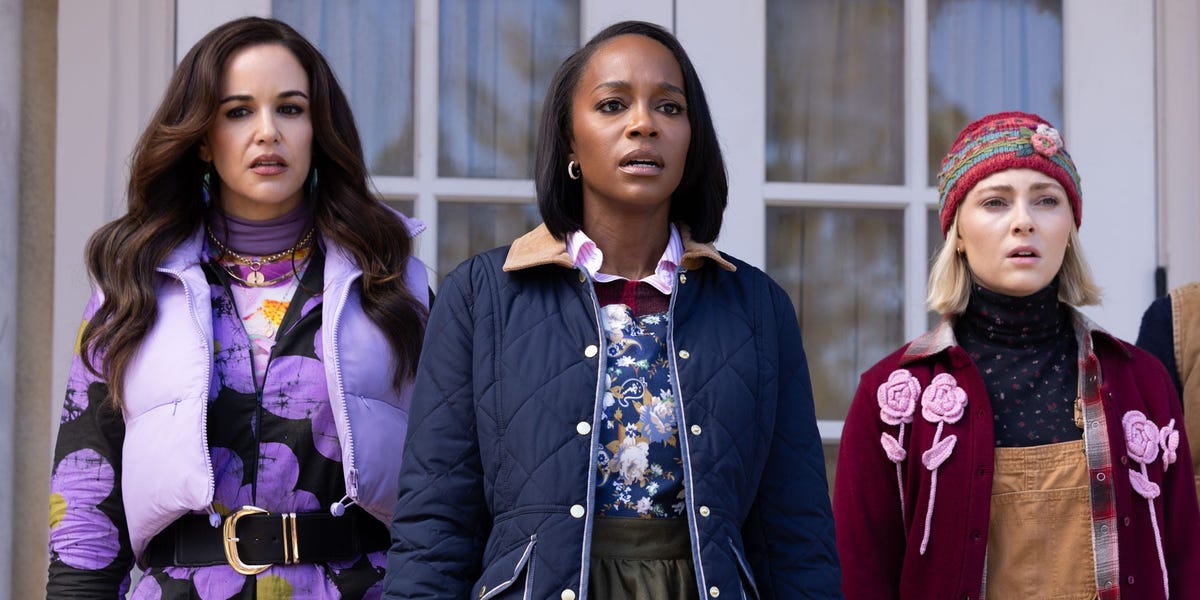
The central characters are Alice, Birdie, Catherine, and Brett. Each arrives at the garden society with a different personal mess tucked neatly behind a smile. Alice is a teacher and aspiring writer whose life feels smaller than she hoped. Birdie is a magnetic socialite with glamour, confidence, and secrets that do not fit into a tasteful clutch bag. Catherine is a real estate agent who knows how to sell a dream while concealing the rot underneath. Brett is a divorced father and garden club manager trying to keep life together while surrounded by people who treat social status like an Olympic sport.
The show’s hook is simple and wonderfully wicked: these four members are connected by a murder. What makes it work is not only the question of what happened, but why these people, who might otherwise spend their evenings discussing tulip bulbs and gala seating charts, end up sharing a secret darker than overwatered mulch.
Why ITV viewers should pay attention
ITV has a strong appetite for glossy, bingeable dramas, and Grosse Pointe Garden Society fits neatly into that lane. It has the polished look of a prestige suburban thriller, the pace of a network mystery, and the emotional messiness of a soap that went to therapy but still reads everyone’s texts.
For viewers who enjoyed the social warfare of Desperate Housewives, the morally tangled plotting of Good Girls, or the secret-heavy tension of Big Little Lies, this series should feel familiar in the best possible way. The show does not pretend suburbia is peaceful. Instead, it treats suburbia as a pressure cooker decorated with seasonal wreaths.
The ITVX release also gives the series a second life. In the United States, the show aired on NBC and streamed on Peacock, but it was canceled after one season. That sounds like bad news, and for fans hoping for years of additional chaos, it certainly was. Yet for new viewers, there is an upside: the available season is a compact, 13-episode binge. You can enter, get hooked, suspect everyone, develop an unhealthy interest in fictional gardening politics, and come out the other side without needing a decade-long viewing plan.
The cast: a strong ensemble with thorns, charm, and secrets
Melissa Fumero as Birdie
Melissa Fumero, widely known for Brooklyn Nine-Nine, brings sharp comic timing and charisma to Birdie. Birdie is the type of character who can turn a room with one look and probably has a backup plan hidden inside a designer handbag. She is stylish, funny, manipulative, wounded, and unpredictable. In a show built around secrets, Birdie feels like someone who has alphabetized hers.
Aja Naomi King as Catherine
Aja Naomi King plays Catherine, a real estate agent whose polished exterior hides emotional and moral complications. King’s presence gives the show a strong dramatic center. Catherine understands image management because her work depends on it, but the series uses that skill against her. Selling perfection is easy when it belongs to someone else. Maintaining it in your own life is where the foundation starts to crack.
AnnaSophia Robb as Alice
AnnaSophia Robb’s Alice is one of the show’s most relatable entry points. She is a teacher, a would-be writer, and a woman who senses that her life has become a little too beige. Alice is not presented as a flawless heroine; she is anxious, frustrated, and capable of questionable choices. That makes her interesting. Nobody watches a murder mystery because everyone has excellent boundaries.
Ben Rappaport as Brett
Ben Rappaport’s Brett adds a different rhythm to the ensemble. As a divorced father navigating co-parenting, work, and the garden club’s social minefield, Brett is both insider and outsider. He understands the club’s rules but does not always benefit from them. His presence broadens the story beyond a women-only social circle and gives the show another angle on class, pride, and reinvention.
Why the garden club setting works so well
A garden club is a perfect mystery setting because gardening is already dramatic. Plants die for mysterious reasons. People fight about sunlight. Someone always claims they “just threw something together” when the flower arrangement clearly required three mood boards and a small emotional breakdown. The show understands that the rituals of gardening can become a comic mirror for social control.
In Grosse Pointe Garden Society, gardens symbolize everything the characters want to project: order, beauty, taste, patience, and legacy. But gardens also require cutting, burying, digging, removing, covering, and waiting. That makes the metaphor almost too good. The characters are not only tending flowers; they are managing damage. Every bed has roots. Every secret needs soil. Every polished surface has something crawling underneath.
The production design leans into that contrast. The world is bright, attractive, and inviting, which makes the darker elements more effective. When a thriller takes place in a shadowy alley, danger is expected. When it happens beside a floral centerpiece and a tray of hors d’oeuvres, it becomes funnier, stranger, and more unsettling.
A mystery thriller with humor in the dirt
The show’s best trick is tonal balance. It is not a grim crime drama where everyone whispers in gray rooms. It is also not a fluffy comedy with a body tossed in for decoration. Instead, it sits in the fertile middle: tense enough to keep viewers guessing, funny enough to avoid melodrama, and emotionally messy enough to make the characters feel human.
The humor often comes from contrast. People discuss scandal with the same energy others bring to bake-off judging. Social niceties continue even when the situation absolutely does not deserve manners. Someone may be hiding a devastating secret while still worrying about attendance, reputation, or whether the gala looks tasteful. This is where the show finds its bite. It knows that respectable people can behave terribly while still saying “lovely to see you” through clenched teeth.
How the show compares to Desperate Housewives, Big Little Lies, and Good Girls
Comparisons to Desperate Housewives are inevitable. Both shows use an attractive suburban setting to expose betrayal, jealousy, crime, and social absurdity. But Grosse Pointe Garden Society feels more compact and mystery-driven. It is less about the whole neighborhood and more about a tight circle of people caught in the same dangerous bloom.
The Big Little Lies comparison comes from the show’s interest in status, performance, and a death that changes how viewers interpret every interaction. Still, Grosse Pointe Garden Society is lighter on its feet. It has emotional stakes, but it also enjoys the absurdity of its premise. It knows there is something inherently funny about people committing serious moral errors while dressed for a high-end community function.
The link to Good Girls is especially natural because Jenna Bans was one of the creative forces behind that beloved crime dramedy. Like Good Girls, this series explores what happens when ordinary people step into criminal territory and discover that one bad decision grows vines. The result is a show about consequences, friendship, desperation, and the weird confidence that comes from having no good options left.
Is Grosse Pointe Garden Society worth watching?
Yes, especially if you like mysteries that are character-led rather than puzzle-only. This is not the kind of thriller that simply drops clues like breadcrumbs and waits for the final reveal. It is more interested in how secrets reshape relationships. Who trusts whom? Who is lying to survive? Who is lying because they enjoy it a little too much? Who brought a casserole to a crime scene emotionally, if not literally?
The show is also ideal for viewers who enjoy a binge that does not require a detective board, red string, and three unpaid interns. There are time shifts, twists, and reveals, but the pleasure is accessible. You can watch for the mystery, the performances, the social satire, or simply the joy of seeing a garden club become the least relaxing hobby group in television history.
The cancellation question: should new viewers be worried?
One important fact should be addressed clearly: Grosse Pointe Garden Society was canceled after one season in the United States. That means viewers should not go in expecting multiple completed seasons. However, that does not make the show unwatchable. Many one-season dramas are still worth discovering because they offer a distinctive world, memorable performances, and enough narrative momentum to justify the trip.
In fact, the cancellation may add a strange kind of urgency. There is something bittersweet about watching a show that clearly had room to grow. You notice the seeds planted for future storylines. You feel the ambition. You may even become one of those viewers who finishes the finale, stares at the screen, and mutters, “Wait, they canceled this?” That is not a viewing flaw. That is a rite of passage in modern television.
Why the series feels “masterful” when it clicks
The word “masterful” fits the show best when describing its tonal recipe. Grosse Pointe Garden Society takes familiar ingredients and arranges them with confidence: a wealthy suburb, a suspicious death, complicated friendships, hidden affairs, class tension, family resentment, and a group of people who should absolutely stop making things worse but cannot. The result is not revolutionary, but it is skillful, stylish, and highly watchable.
Its craft lies in knowing what kind of show it is. It does not apologize for being soapy. It does not flatten its characters into saints and villains. It does not treat humor as a distraction from suspense. Instead, it lets the comedy sharpen the danger. When people are funny, charming, vain, frightened, and morally flexible all at once, they become harder to predict. That unpredictability is the engine of a good mystery thriller.
Experiences related to watching Grosse Pointe Garden Society
Watching Grosse Pointe Garden Society feels a little like attending a neighborhood event where everyone is too well dressed and no one is telling the truth. You arrive expecting polite conversation, maybe a few jokes about soil quality, and then suddenly you realize every smile has a footnote. That is the fun of it. The show turns everyday social rituals into suspense devices.
One of the most enjoyable viewing experiences is trying to decide which character is the most dangerous. At first, you may assume danger belongs to the person with the sharpest lines or the most obvious secrets. Then the quieter characters start making choices. The show understands that people do not need to be criminal masterminds to cause chaos. Sometimes all it takes is panic, pride, jealousy, or a desperate need to be seen as normal.
It is also a great group-watch series. This is the kind of show that invites commentary. Someone will accuse the wrong person within the first twenty minutes. Someone else will insist they “knew it” after every twist, even if their previous theory involved an entirely different character and possibly the dog. The show’s social setting makes it easy to debate motives because everyone has a public face and a private agenda.
For viewers who garden, the series adds another layer of amusement. Real gardeners know that the hobby already contains obsession, rivalry, patience, heartbreak, and the occasional dramatic confrontation with pests. The show exaggerates that world into a thriller, but the emotional truth is recognizable. A garden is never just a garden. It is a statement. It says, “I have control,” even when the person holding the watering can very much does not.
The series also resonates because it captures the pressure of performing success. Many people know what it feels like to keep up appearances: the tidy home, the cheerful update, the smiling photo, the sense that everyone else has somehow mastered adulthood while you are barely keeping your basil alive. Grosse Pointe Garden Society takes that feeling and pushes it into melodrama. The characters are not simply hiding a crime; they are hiding disappointment, loneliness, resentment, and fear.
That is why the show can be funny and tense at the same time. The murder mystery pulls viewers forward, but the emotional secrets make the story linger. You may come for the body in the garden, but you stay for the question underneath: how far will people go to protect the version of themselves they have sold to the world?
By the end, Grosse Pointe Garden Society feels like a beautifully arranged bouquet with something alarming tied to the stems. It is stylish, witty, suspicious, and just dramatic enough to make you look differently at the next neighborhood club flyer. Join a garden society, by all means. But maybe check what they are planting first.
Conclusion
Grosse Pointe Garden Society is a sharp, glossy, and entertaining mystery thriller that turns suburban perfection into fertile ground for secrets. With a strong ensemble cast, a clever garden-club premise, and a tone that mixes murder, mischief, and dark humor, it is exactly the sort of series that can hook ITVX viewers looking for their next binge.
It may have lasted only one season in the United States, but that does not make it a lesser discovery. If anything, its short run gives the show the feel of a hidden gem: compact, stylish, strange, and ready to be devoured by viewers who like their thrillers with polished lawns, loaded glances, and at least one deeply suspicious flower bed.