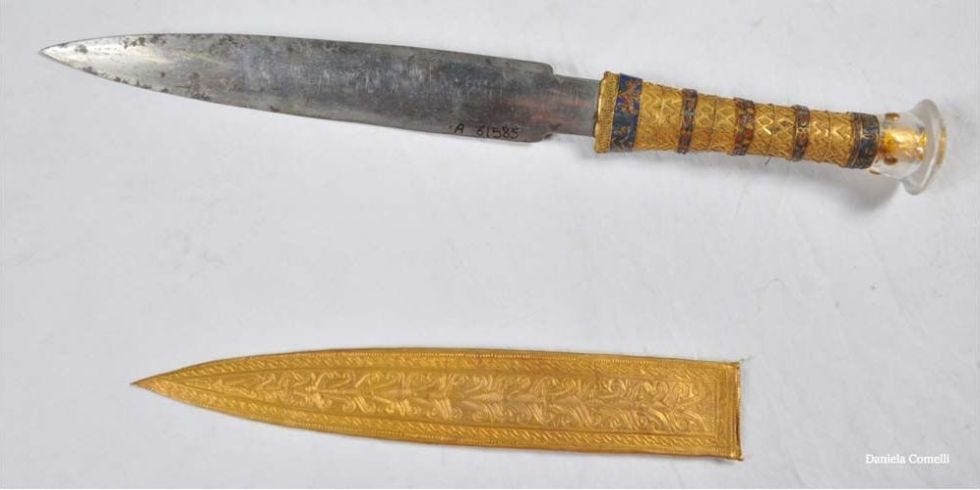
Before humans became masters of iron furnaces, they apparently had a much flashier supplier: outer space. A major study on Bronze Age iron artifacts argues that the rare iron objects made before widespread iron smelting were not produced from ordinary terrestrial ore. They were made from meteoritic ironmetal that had already been forged by cosmic violence long before a human smith ever picked up a hammer.
That sounds like a headline designed by a museum curator after too much coffee, but the science is serious. Research led by Albert Jambon and published in the Journal of Archaeological Science used a geochemical strategy to distinguish meteoritic iron from smelted iron. By analyzing the relationship between iron, cobalt, and nickel, the study concluded that the Bronze Age iron artifacts examined were made from metal that fell from the sky.
In other words, some of humanity’s earliest iron jewelry, ceremonial weapons, and royal objects were not merely “ancient.” They were ancient plus extraterrestrial. That is a strong résumé for a bead.
Why Iron Was So Strange in the Bronze Age
The Bronze Age was named for bronze because bronze was the superstar metal of the period. Made mainly from copper and tin, bronze was easier to cast than iron, more practical than pure copper, and strong enough for tools, weapons, statues, ornaments, and all the shiny things early civilizations loved to show off.
Iron, meanwhile, was everywhere and nowhere at the same time. Iron ore is abundant in Earth’s crust, but turning that ore into workable metal requires smelting. That means heating iron compounds in a furnace hot enough to remove oxygen and produce metallic iron. For Bronze Age societies, this process was difficult, inconsistent, and not yet widely mastered.
So when archaeologists found iron objects dated to the Bronze Age, they faced a puzzle. How were people making iron objects before iron smelting became common? Were a few clever metalworkers secretly ahead of schedule? Did early furnaces occasionally produce iron by accident? Or was there another source?
The new chemical evidence points strongly to the third option: meteorites. Unlike iron ore, meteoritic iron arrives on Earth already in metallic form. No furnace breakthrough required. Nature, or more accurately the early solar system, did the heavy industrial work first.
The “Space Metal” Signature: Nickel and Cobalt
To understand why scientists can identify meteoritic iron, we need to talk about nickel. Do not worry; this will not turn into a chemistry exam. There will be no pop quiz unless a meteorite lands in your backyard.
When large planetary bodies form, dense iron and nickel tend to sink toward their cores. Earth’s surface rocks usually do not contain large amounts of metallic nickel-rich iron. Iron meteorites, however, are often fragments of the metallic cores of ancient asteroids or planetesimals. These bodies formed, melted, separated into layers, and were later shattered by collisions.
That history leaves iron meteorites with a recognizable composition. They are mostly iron, but they commonly contain significant nickel and cobalt. Modern industrial iron and smelted terrestrial iron usually follow a different chemical pattern. Jambon’s study did not rely only on the amount of nickel. Instead, it compared iron, cobalt, and nickel together, creating a more reliable way to separate extraterrestrial metal from Earth-made iron.
This matters because some ancient objects are heavily corroded. If a researcher looks only at one element, especially on a damaged surface, the result may be misleading. By studying Fe-Co-Ni relationships, scientists get a stronger chemical fingerprint. It is like checking three forms of ID instead of accepting a blurry library card.
How the Study Was Done Without Damaging Priceless Artifacts
Ancient iron artifacts are rare, fragile, and often culturally priceless. You cannot simply slice up King Tutankhamun’s dagger like a loaf of bread to see what is inside. Curators tend to frown on that sort of thing, and for excellent reasons.
The study used nondestructive portable X-ray fluorescence analysis, often called p-XRF. This technique allows researchers to measure elemental composition without removing chunks of the object. A portable XRF device can be used in museums and collections, which is ideal when the artifact is too valuable or delicate to travel.
Jambon analyzed or compiled data on several famous Bronze Age iron objects, including beads from Gerzeh in Egypt, a dagger from Alaca Höyük in Turkey, a pendant from Umm el-Marra in Syria, an axe from Ugarit in Syria, objects associated with Shang dynasty China, and iron pieces from the tomb of Tutankhamun in Egypt.
The result was striking: the analyzed Bronze Age iron artifacts matched meteoritic iron. The study therefore challenged the idea that these early iron objects came from precocious smelting. The evidence suggests that before the Iron Age, iron was not an everyday industrial material. It was a rare cosmic luxury.
Gerzeh Beads: Tiny Objects With a Huge Story
Among the most famous examples are the iron beads from Gerzeh, an ancient Egyptian cemetery. These beads date to around 3200 BCE and are among the earliest known worked iron artifacts. They were found with other precious materials, including gold, lapis lazuli, and carnelian, which suggests that meteoritic iron was treated as an exotic high-status material.
Researchers studying the Gerzeh beads found that they were made from meteoritic iron and shaped by hammering thin sheets of metal before rolling them into tubes. That is impressive work. Meteoritic iron can be hard and brittle, so shaping it requires skill, patience, and probably a few ancient metalworkers muttering the Bronze Age equivalent of “who designed this stuff?”
The beads show that ancient craftspeople were not simply picking up a fallen rock and calling it jewelry. They understood how to work a difficult material. They heated it, hammered it, formed it, and turned it into something meaningful enough to place in a burial. That is technology, artistry, and symbolism packed into a tiny tube of space metal.
Tutankhamun’s Dagger: Royal Blade, Cosmic Origin
The most glamorous example is the iron dagger found in the tomb of Tutankhamun. Discovered among the treasures of the young Egyptian pharaoh, the dagger puzzled researchers for decades because of its unusually fine workmanship and rare material.
Later scientific analysis found high levels of nickel and cobalt in the blade, strongly supporting a meteoritic origin. The dagger was not an ordinary weapon. It was a royal object made from a substance that must have seemed almost supernatural: metal that came from the sky, shining, hard, rare, and difficult to obtain.
That helps explain why meteoritic iron appears in elite and ceremonial contexts. It was not used to make plows for the average farmer or kitchen knives for chopping onions. It was reserved for objects of power, burial, status, and ritual. If bronze was the practical metal of the age, meteoritic iron was the VIP guest who arrived in a flaming chariot.
Why Ancient People Valued Meteoritic Iron
Imagine living in a world where nearly every usable material comes from the ground, riverbeds, animals, forests, or trade routes. Then imagine seeing a fireball cross the sky and later finding a strange, dense metallic mass. Even without modern astronomy, ancient people could make a connection between the sky and the material.
Some ancient languages and religious texts appear to link iron with the heavens. Egyptian references to “iron of the sky” and similar associations in other cultures suggest that at least some ancient peoples recognized the celestial nature of rare iron. They may not have known about asteroid cores, planetary differentiation, or nickel-cobalt ratios, but they knew enough to treat the material as special.
That special status makes sense. Meteoric iron was rare, visually unusual, hard to work, and dramatic in origin. A bronze tool could be cast from mined and traded metals. A meteoritic iron object, by contrast, began as part of an ancient world beyond Earth. That is not just raw material. That is a story you can hold.
From Meteorites to Furnaces: The Birth of the Iron Age
The Iron Age did not begin because people suddenly discovered iron existed. They already knew iron existed. The real revolution was learning how to produce iron from terrestrial ore on a larger and more reliable scale.
Once smelting technology improved, societies no longer needed to wait for rare meteorites. They could use abundant iron ores from the Earth. This changed everything. Iron could become common enough for tools, weapons, agriculture, construction, and trade. A material once reserved for kings and burials slowly became practical.
That transition also explains why Bronze Age iron was so rare. Before smelting, meteoritic iron was available only when people found it, traded for it, or inherited it through elite networks. After smelting, iron became a technology. The shift was not simply from bronze to iron; it was from cosmic scarcity to human-controlled production.
What This Study Changes About Ancient Metallurgy
The study does not mean Bronze Age people were primitive or passive. Quite the opposite. Working meteoritic iron required observation, experimentation, and skill. Ancient craftspeople recognized unusual materials and learned how to shape them long before industrial iron production became common.
It also reminds us that technological history is rarely a straight ladder. People did not move neatly from stone to copper to bronze to iron as if following a school textbook timeline. Materials overlapped. Rare experiments happened. Trade carried objects far from their sources. Religious meaning shaped technology just as much as practicality did.
The Bronze Age use of meteoritic iron shows a fascinating middle stage: people had iron objects before they had widespread iron metallurgy. They had the metal, but not yet the full industrial system to produce it from ore. Space delivered the sample pack before humanity built the factory.
Important Examples of Bronze Age Meteoritic Iron
Gerzeh Iron Beads, Egypt
Dated to around 3200 BCE, these small tubular beads are among the earliest known worked iron objects. Scientific analysis shows they were made from meteoritic iron and shaped through careful hammering and rolling.
Alaca Höyük Dagger, Turkey
This early Bronze Age dagger is one of the artifacts included in discussions of meteoritic iron use. It reflects how rare iron could be used in elite or ceremonial contexts before iron smelting became widespread.
Umm el-Marra Pendant, Syria
The pendant from Umm el-Marra shows that meteoritic iron was not limited to Egypt. It appeared across different regions of the ancient Near East, suggesting that rare iron circulated through elite networks.
Ugarit Axe, Syria
The iron axe from Ugarit is another example of a Bronze Age object whose composition supports a meteoritic origin. It also shows that space metal could be incorporated into weapon-like or symbolic forms.
Tutankhamun’s Dagger, Egypt
The famous dagger from King Tut’s tomb is perhaps the best-known example. Its high nickel and cobalt content strongly supports the conclusion that it was made from meteoritic iron.
Mörigen Arrowhead, Switzerland
A later Bronze Age arrowhead from Mörigen, Switzerland, has also been shown to be made from meteoritic iron. Its possible connection to the Kaalijarv meteorite in Estonia raises exciting questions about ancient movement, exchange, and long-distance trade.
Why the Headline Says “All Bronze Age Iron Came From Space”
The phrase is bold, but it needs one careful clarification. Scientists can only analyze the artifacts available to them. The strongest claim is that the Bronze Age iron artifacts examined in the key study showed meteoritic origin, and that this pattern strongly suggests Bronze Age iron objects were generally made from meteorites rather than smelted ore.
That nuance matters. Good science is not magic; it is evidence plus careful interpretation. Still, the conclusion is powerful. The available chemical data refute the idea that the analyzed Bronze Age objects were made from early smelted terrestrial iron. Instead, the evidence points to meteoritic iron as the main source of rare pre-Iron Age iron artifacts.
So yes, the headline is exciting. But the real story is even better: ancient people recognized, valued, traded, and worked metal from meteorites long before iron smelting transformed civilization.
Experience: Meeting Bronze Age Space Iron in the Real World
One of the best ways to understand this discovery is to imagine encountering meteoritic iron not as a scientist in a lab, but as a visitor in a museum. You walk past glass cases filled with bronze blades, pottery, beads, seals, and carved stones. Then a label mentions that a tiny iron object predates the Iron Age. At first, that sounds like a typo. Iron before the Iron Age? Did someone in the ancient world skip ahead in the technology textbook?
Then comes the twist: the iron came from a meteorite. Suddenly the object changes personality. A bead is no longer just a bead. A dagger is no longer just a dagger. It becomes a meeting point between archaeology and astronomy, between human hands and asteroid cores. The object was shaped by a craftsperson, buried with meaning, excavated by archaeologists, analyzed by scientists, and originally formed in a body that existed billions of years before the civilization that used it.
That is the kind of experience that makes ancient history feel alive. Many people think of the Bronze Age as distant and dusty, full of dates, dynasties, and pottery fragments. But meteoritic iron gives the period a cinematic spark. It invites readers to picture a fireball crossing the night sky, a strange metal mass discovered on the ground, a craftsperson testing it with heat and hammer, and an elite patron deciding that this rare sky-born substance deserves a place in a tomb or royal object.
You can also experience the topic through modern meteorite collections. Iron meteorites in museums often look dense, dark, and rugged. Cut and etched examples may show Widmanstätten patterns, geometric bands formed as iron-nickel minerals cooled extremely slowly inside an asteroid. Those patterns are not decorative engravings; they are natural evidence of deep time. They remind us that meteorites are not random rocks. They are fragments of ancient worlds.
For students, travelers, and curious readers, this topic is a perfect bridge between disciplines. It makes chemistry useful, archaeology dramatic, and space science surprisingly personal. A person who does not normally care about metal composition may suddenly care very much when nickel and cobalt reveal that a royal dagger came from beyond Earth. A child who loves shooting stars may discover that meteorites helped shape ancient craftsmanship. A history fan may realize that technological progress was not only about human invention; sometimes it depended on what the universe happened to drop at our feet.
The experience also changes how we think about ancient people. They were not waiting around for modern science to explain the sky. They observed, interpreted, experimented, and created meaning from rare materials. They may not have used the vocabulary of planetary cores or extraterrestrial chemistry, but they understood that some iron was extraordinary. When they turned it into beads, blades, pendants, and ceremonial objects, they were not simply making artifacts. They were making contact with the cosmos.
Conclusion: A Cosmic Upgrade to Ancient History
The discovery that Bronze Age iron artifacts were made from meteoritic iron gives us a thrilling new way to understand early metalworking. Before furnaces made iron common, meteorites made it possible. Before iron became the metal of armies, farmers, and empires, it was a rare material of kings, burials, and sacred objects.
Albert Jambon’s Fe-Co-Ni chemical strategy helped settle a long-running debate about whether Bronze Age iron came from early smelting or meteorites. The evidence points skyward. From the Gerzeh beads to Tutankhamun’s dagger, ancient iron objects tell a story of cosmic material transformed by human skill.
That may be the most charming part of all: Bronze Age people did not have rockets, telescopes, or modern labs, but they still managed to work with material from space. Humanity’s relationship with the cosmos did not begin with satellites. It began, in part, with someone picking up a strange piece of metal from the ground and wondering what it could become.
Note: This article is based on peer-reviewed archaeology, museum research, and reputable science references. Source links are not displayed in the article body as requested.