Every step you take is a tiny engineering drama. Your heel hits the ground, your foot rolls forward, your knee bends, your backpack bounces, and most of that mechanical energy disappears as heat, vibration, and the faint sound of your shoes judging the sidewalk. But what if a little of that wasted motion could be captured and turned into electricity?
That is the big idea behind harvesting energy while walking: using ordinary human movement to power small electronics, sensors, wearables, GPS trackers, emergency devices, or health monitors. It sounds like science fiction, but researchers have been working on shoe-based generators, smart insoles, knee-mounted harvesters, energy-producing backpacks, and flexible textile materials for years. The goal is not to make your morning walk power a refrigerator. Sorry, your sneakers are not replacing the electric grid. The more realistic goal is smaller, smarter, and surprisingly useful: reducing battery dependence for low-power devices.
This article takes another look at walking energy harvestingnot as a magic charger for every gadget in your life, but as a practical technology with fascinating design challenges, real-world promise, and a few stubborn problems that refuse to politely leave the lab.
What Does “Harvesting Energy While Walking” Mean?
Energy harvesting is the process of capturing small amounts of energy from the environment or from motion that would otherwise be wasted. In the case of walking, the source is the human body’s mechanical movement. Each stride creates pressure, vibration, joint rotation, bending, impact, and up-and-down motion. Engineers look at those movements and ask, “Can we turn some of that into usable electricity without making the walker feel like they are dragging a toaster uphill?”
The answer is yesbut with conditions. Walking can generate measurable electrical power through several technologies, including piezoelectric materials, triboelectric nanogenerators, electromagnetic generators, pneumatic shoe systems, and mechanical backpack systems. The challenge is capturing that energy efficiently while keeping the device light, comfortable, durable, affordable, and safe.
That last part matters. A device that generates electricity but makes every step feel like stepping on a Lego brick is not innovation. It is punishment with wires.
Why Walking Is Such an Attractive Energy Source
Walking is repetitive, predictable, and common. Unlike solar power, it does not need sunshine. Unlike wind energy, it does not need weather cooperation. Unlike plugging into a wall, it does not require a wall, which is inconvenient when you are hiking, working in disaster response, serving in the field, or wandering through an airport with 3% battery and a charging cable that has chosen retirement.
Human walking also contains more energy than many people assume. The key is not whether energy exists; it clearly does. The key is whether enough of it can be captured without forcing the body to spend extra effort. If a harvesting device makes the user burn far more energy than it produces, it becomes a very fancy way to get tired.
That is why the best research focuses on “free” or low-cost energy moments in the gait cycle. For example, the knee performs negative work during parts of walking, similar in concept to regenerative braking in hybrid cars. Instead of fighting the body, a well-designed harvester may assist a natural braking motion and capture some of the energy that would normally be dissipated.
The Main Ways Researchers Capture Energy From Walking
1. Piezoelectric Shoe Insoles
Piezoelectric materials generate electrical charge when they are bent, compressed, or stressed. Place those materials inside a shoe sole or insole, and every footstep can create a tiny electrical output. This is one of the most widely discussed approaches because shoes already experience repeated pressure during walking.
The advantage is obvious: people already wear shoes. A built-in energy harvester could quietly collect power while the user walks. The drawback is also obvious: people are picky about shoes. Add too much stiffness, bulk, weight, or weird squishiness, and the user will notice immediately. Feet are dramatic little critics.
Piezoelectric footwear works best for low-power applications such as sensors, step counters, Bluetooth beacons, or emergency signals. It is less realistic for charging a laptop unless your “walk” is actually a cross-country pilgrimage with frequent snack breaks.
2. Triboelectric Nanogenerators
Triboelectric nanogenerators, often called TENGs, generate electricity from contact and separation between materials. If you have ever rubbed a balloon on your hair and made it stick to a wall, congratulations: you have participated in a low-budget physics demonstration. TENG systems use a more controlled version of that effect.
In footwear, a TENG can be placed inside an insole so that walking repeatedly presses and separates layers. Research prototypes have demonstrated impressive voltage outputs and the ability to light LEDs, which makes for excellent lab demonstrations and very satisfying videos. However, high voltage does not automatically mean high usable power. For real products, engineers still need effective power management circuits, energy storage, waterproofing, long-term durability, and comfort.
The big appeal of triboelectric walking harvesters is that they can be lightweight, flexible, and compatible with self-powered sensors. A smart shoe could detect gait patterns, monitor balance, count steps, or support rehabilitation without relying heavily on batteries.
3. Pneumatic Footwear Systems
Another clever approach uses air or fluid movement inside the shoe. Imagine small compressible bladders built into the sole. When the foot presses down, the bladder pushes air through a tiny turbine or pneumatic motor, which spins a generator. As the foot lifts, the system resets for the next step.
This method treats the shoe like a miniature power plant, minus the smokestack and the confused city inspector. The advantage is that pneumatic systems can use the natural compression of the sole. The hard part is fitting turbines, channels, bladders, generators, and wiring into footwear without turning a sneaker into a science-fair submarine.
Still, pneumatic footwear is an exciting concept because it may capture energy across different parts of the gait cycle, such as heel strike, midfoot loading, and toe-off. With good design, it could power GPS receivers, location tags, or low-energy communication devices.
4. Knee-Mounted Energy Harvesters
Shoes are not the only place to look. The knee is one of the busiest joints in walking, and it moves through a large range of motion. Researchers have explored knee braces and joint-mounted devices that harvest energy as the leg flexes and extends.
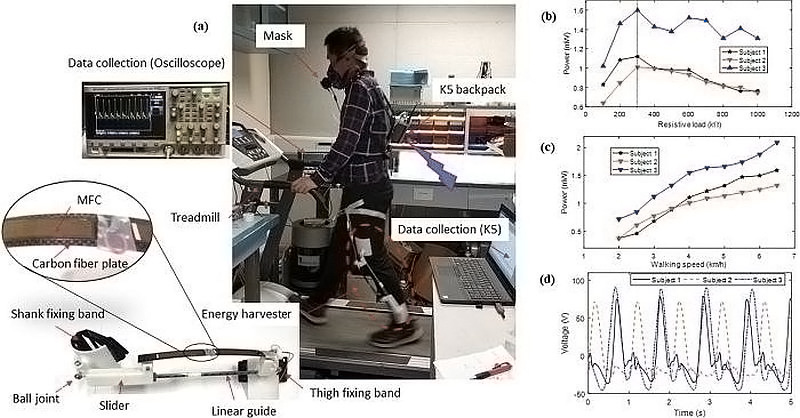
The most interesting designs try to capture energy during phases when the body is already slowing the leg down. This reduces the extra effort required from the user. Some larger knee systems have produced several watts in research settings, while lighter piezoelectric knee devices produce smaller amounts of power suitable for wearable sensors or health monitoring equipment.
The challenge is social as much as mechanical. People may accept a knee harvester for military missions, hiking expeditions, rehabilitation, or industrial work. They may be less excited to wear one to brunch. Even if it powers your phone, it also says, “I came prepared for both pancakes and field robotics.”
5. Energy-Harvesting Backpacks
Backpacks bounce. Usually, that bounce is just annoying. But in energy-harvesting backpacks, the relative motion between the load and the wearer can drive a generator. Some prototypes use spring-mounted frames, while others use triboelectric or mechanical systems to turn vertical motion into electricity.
This approach makes sense for hikers, soldiers, disaster workers, researchers, students, and anyone already carrying a load. A backpack has more room than a shoe, which makes it easier to include mechanical parts and storage. It can also generate more power when carrying heavier loads.
The problem is weight and comfort. Add too much equipment, and the backpack becomes the thing it was supposed to improve: a burden. The most promising designs do two jobs at once, such as reducing perceived load while also harvesting energy. That is the backpack equivalent of bringing snacks and doing the dishes.
What Can Walking Energy Actually Power?
Let’s set expectations before anyone tries to fast-charge a tablet by pacing aggressively around the kitchen. Walking energy harvesting is best suited for low-power electronics. Think health monitors, pedometers, GPS beacons, wireless sensors, emergency transmitters, smart insoles, environmental sensors, and small LED indicators.
It may also extend battery life rather than replace batteries entirely. That distinction is important. A self-powered sensor that wakes up only when needed can run on tiny bursts of harvested energy. A smartphone, on the other hand, is a hungry rectangle with a glowing screen and many opinions. Walking may help top up small devices, but it is not likely to replace a wall charger for everyday consumer electronics soon.
Still, partial power can be valuable. In remote settings, even a small amount of harvested energy can keep a locator beacon alive, support health tracking, or power a low-energy communication signal. For soldiers and rescue teams, reducing battery weight can matter. For medical devices and wearables, extending battery life can improve reliability and convenience.
The Biggest Engineering Challenges
Comfort Comes First
A wearable energy harvester must be comfortable enough that people forget it is there. If the device changes walking mechanics, causes fatigue, creates pressure points, or makes shoes feel unstable, users will abandon it faster than a gym membership in February.
Power Management Is Hard
Walking produces irregular bursts of energy, not a smooth electrical stream. That means the system needs circuits to rectify, regulate, store, and release electricity. Capacitors, supercapacitors, rechargeable batteries, and specialized power-management chips often play a crucial role.
Durability Is Non-Negotiable
Shoes get wet, dirty, compressed, twisted, and occasionally introduced to mystery substances on city sidewalks. Any walking energy harvester must survive thousands or millions of cycles. Lab prototypes can be delicate. Consumer products cannot be.
Weight Can Defeat the Purpose
If the harvester weighs too much, the user spends extra energy carrying it. A device that generates two watts but makes walking significantly harder is not a win. The best designs aim for a favorable trade-off between power output, weight, comfort, and metabolic cost.
Cost Must Make Sense
Even brilliant technology can struggle if it is too expensive. For mass-market shoes or wearables, the harvester must be affordable, manufacturable, and easy to maintain. For military, medical, or industrial use, higher costs may be acceptable if reliability and performance justify them.
Where Walking Energy Harvesting Makes the Most Sense
The strongest early use cases are not fashion sneakers that charge your phone while you stroll to the coffee shop. The stronger opportunities are specialized environments where battery life, mobility, and independence matter.
Outdoor recreation is one example. Hikers, climbers, campers, and field researchers may benefit from shoe or knee systems that power GPS trackers, emergency beacons, or health sensors. In remote areas, a few extra hours of device life can be more than convenient; it can be important for safety.
Military and tactical applications are another major driver. Soldiers often carry heavy battery packs for radios, navigation, night-vision equipment, and other electronics. Any system that safely reduces battery dependence without adding major fatigue has obvious appeal.
Healthcare and rehabilitation may be an even better fit. Smart insoles and wearable sensors can track gait, balance, pressure distribution, recovery progress, and fall risk. If those sensors harvest some of their own power, patients and clinicians get longer monitoring time with fewer battery changes.
Industrial safety is also promising. Workers in warehouses, construction sites, mines, and large facilities could use self-powered wearables for location tracking, fatigue monitoring, hazard alerts, or emergency signaling.
Why This Technology Has Not Taken Over Yet
The idea is attractive, but reality keeps wearing steel-toed boots. Many prototypes work well in controlled tests, yet real life is messy. People walk at different speeds, weigh different amounts, wear different shoes, step on different surfaces, and have different tolerance for wearable gadgets. A design that performs beautifully on a treadmill may struggle on stairs, gravel, rain-soaked sidewalks, or a long airport sprint to Gate B37.
Another issue is competition from better batteries. Lithium-ion batteries keep improving, electronics keep becoming more efficient, and portable power banks are cheap. For many consumers, carrying a small battery pack is easier than buying specialized energy-harvesting shoes.
That does not mean walking energy harvesting is a dead end. It means its best future may be invisible and application-specific. Instead of replacing chargers, it may quietly power sensors inside shoes, braces, backpacks, uniforms, medical wearables, and safety equipment.
The Future: Less “Charge My Phone,” More “Self-Powered Intelligence”
The most exciting future for walking energy harvesting may not be about charging consumer gadgets. It may be about creating self-powered systems that monitor, respond, and communicate. A smart insole could harvest energy from each step and use it to measure foot pressure. A knee brace could monitor rehabilitation progress. A backpack could reduce load and power a location sensor. A textile patch could generate small signals from movement and support haptic feedback.
In other words, the future may be less about turning humans into walking wall outlets and more about making wearables more independent. The best version of this technology will not shout, blink, or demand attention. It will simply work in the background, sipping tiny amounts of energy from motion that was already happening.
Real-World Experience: What It Feels Like to Think About Power With Every Step
Anyone who has spent a long day walking with devices knows the quiet anxiety of battery percentages. A phone at 12%, a smartwatch begging for mercy, wireless earbuds gasping out their final beepmodern life has turned us all into part-time battery managers. That is why the idea of harvesting energy while walking feels so appealing. Walking is already happening. Why not make it useful?
Imagine a day hike. You start with a phone, a GPS tracker, a headlamp, and maybe a small health monitor. At first, everything feels fine. Then the trail gets longer, the signal gets weaker, and your power bank suddenly seems much smaller than it did at breakfast. In that situation, even modest walking-generated power could feel valuable. It might not fully charge your phone, but it could keep a low-power locator alive or extend a sensor’s runtime. That small difference can matter when the nearest outlet is several miles away and disguised as a tree.
Now picture a hospital rehabilitation setting. A patient recovering from an injury wears a smart insole that tracks pressure and gait symmetry. Normally, clinicians must worry about charging, replacing, or maintaining the sensor battery. But if the insole can harvest small amounts of energy from walking practice, the device becomes easier to use and more reliable. The patient does not have to think about the electronics. They simply walk, and the system quietly gathers both motion data and power.
There is also a psychological benefit. Energy-harvesting wearables make movement feel productive in a new way. People already count steps for fitness. In the future, they may also think about steps as tiny power events. That does not mean we should gamify every sidewalk stroll until people start speed-walking through grocery stores to charge their socks. But it does suggest a future where human movement and personal technology cooperate more naturally.
Of course, comfort will decide everything. A power-generating shoe that feels awkward will end up in the closet next to the “revolutionary” posture corrector nobody wears. A smart backpack that adds too much weight will lose to a simple power bank. A knee harvester that looks like medical equipment may be perfect for field work but unlikely to become a casual fashion trend. The winning designs will be the ones that disappear into products people already use.
From a practical standpoint, walking energy harvesting is most exciting when it solves a real problem rather than chasing a flashy promise. “Charge your phone by walking” sounds great, but “keep a medical sensor running longer,” “power an emergency beacon,” or “reduce battery weight for field workers” may be more realistic and more important. The technology does not need to be magical. It just needs to be useful.
So the next time you walk across a room, climb stairs, or carry a backpack, remember: your body is producing motion that engineers are still learning how to capture. Most of it will remain ordinary movement, and that is fine. But a little of it may someday power the quiet electronics that help us navigate, heal, communicate, and stay safe. Not bad for something humans have been doing since before we invented pockets.
Conclusion
Harvesting energy while walking is not a gimmick, but it is also not a miracle charger. It sits in a practical middle ground where small amounts of captured motion can support low-power electronics, smart sensors, emergency devices, and specialized wearables. The most promising systems are comfortable, lightweight, durable, and designed around real human movement.
Piezoelectric insoles, triboelectric smart shoes, pneumatic footwear, knee-mounted harvesters, and energy-producing backpacks all show that walking contains recoverable energy. The hard part is not proving that footsteps can generate electricity. The hard part is building devices people actually want to wear.
The future of walking energy harvesting will likely be quiet, specialized, and useful. It may live inside smart shoes, medical braces, hiking gear, work uniforms, and sensor networks. It probably will not make your sneakers the next power company. But if it keeps a GPS beacon alive, extends a health monitor’s battery, or reduces the number of batteries someone must carry, that is already a step in the right direction.