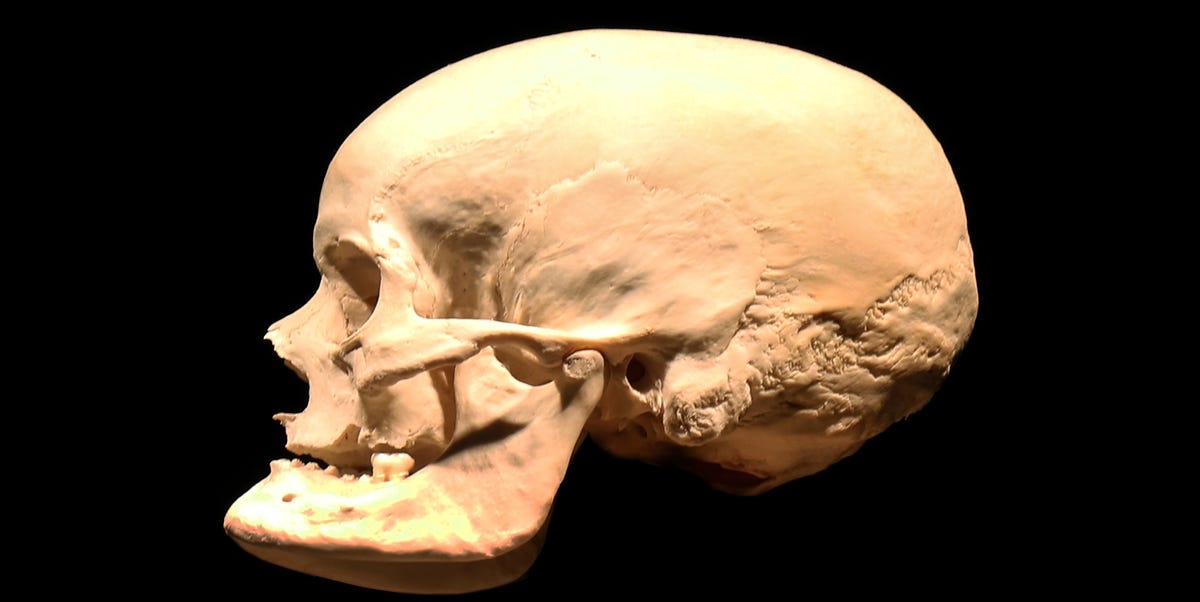
Every so often, archaeology delivers a discovery that sounds less like a journal article and more like the opening scene of a very serious fantasy movie. This is one of those finds. At the medieval castle of Zorita de los Canes in central Spain, researchers uncovered the remains of a man buried among members of the Order of Calatrava, a Christian military-religious order. What made this particular burial so unforgettable was the skull: astonishingly long, unusually narrow, and impossible to forget once you have seen it.
The headline-friendly version is simple: archaeologists found the bizarre skull of an ancient Christian knight. The more accurate version is even more interesting. The man was not “ancient” in the Roman or Egyptian sense, but medieval, most likely buried sometime between the 13th and 15th centuries. He appears to have been an adult male, roughly 45 to 49 years old, with a skull measuring about 230 millimeters long and 122 millimeters wide. That extreme shape was not random, ceremonial, or decorative. Researchers believe it was caused by a severe form of craniosynostosis, most likely consistent with Crouzon syndrome.
That would already make the discovery remarkable. But this man was not tucked away in some quiet monastic corner, spared from the rough edges of history. His remains showed signs of trauma, including stab wounds to the skull and an injury to the left tibia, suggesting he may have died in battle. In other words, this was probably a warrior who lived with a dramatic congenital cranial condition, survived into middle age without modern medical treatment, and still seems to have taken part in a brutally physical world. Medieval life was rarely gentle. This man appears to have met it head-on. Literally, and perhaps more courageously than most of us manage Monday morning email.
The Castle, the Cemetery, and the Christian Military Order Behind the Find
To understand why this skull matters, it helps to understand where it was found. Zorita de los Canes was not just another stone ruin sitting around looking photogenic. The fortress occupied a strategic position near the Tagus River and became deeply tied to the long conflict between Christian and Muslim powers on the Iberian Peninsula. In 1174, the castle was ceded to the Order of Calatrava, one of medieval Spain’s major military-religious orders. These orders combined monastic identity with military duty, which is a very medieval solution to the question, “Can a person pray and fight at the same time?” Apparently, yes.
The Order of Calatrava helped defend frontier territory during the Reconquista and became a powerful institution in Castile. Earlier research on the cemetery at Zorita de los Canes examined 25 individuals buried there and found that many showed unhealed injuries consistent with violent death. Stable isotope work also suggested diets associated with elite or near-elite status, including significant animal protein and even marine fish, which is not exactly the menu you expect from a humble medieval peasant living inland. The burial ground appears to have served men closely tied to the order, including warriors and possibly knights or sergeants.
That context matters because the man with the unusual skull was not buried in isolation. He was placed within a cemetery associated with people whose lives were shaped by combat, status, religious identity, and service to a military order. His skull may be what grabs modern attention, but the burial context is what turns an anatomical mystery into a historical story.
Why the Skull Looked So Strange
The skull was classified as ultradolichocephalic, meaning extremely long and narrow. That is not the sort of term people casually drop at dinner unless they are osteologists, medical specialists, or trying very hard to clear the room. In this case, the shape appears to have resulted from premature fusion of several cranial sutures, the fibrous joints between skull bones that normally remain open long enough for the brain and skull to grow properly in childhood.
When those sutures close too early, the skull has to keep growing around the problem. It becomes a biological detour sign. Growth gets redirected into other dimensions, producing unusual head shapes and often major changes to the face. That broader process is called craniosynostosis. Depending on which sutures are involved, the resulting skull can become long, broad, pointed, or asymmetrical. In this man’s case, the fusion pattern produced an exceptionally elongated form.
Researchers also observed narrowing of the skull base and a long lower jaw with possible prognathism. Dental pathology was notable too, with heavy tartar on one side and tooth loss on the other. Taken together, the features suggest that this was not a case of artificial cranial modification or a simple variation in human anatomy. It was a serious congenital condition written directly into the bone.
Was It Really Crouzon Syndrome?
The study does not claim absolute certainty, and that caution is important. Ancient bones are eloquent, but they do not fill out medical paperwork. The researchers concluded that the skeleton is consistent with Crouzon syndrome, a rare genetic condition linked most often to mutations in the FGFR2 gene. Crouzon syndrome causes premature fusion of skull bones and can affect the head, face, jaw, eyes, hearing, and airway. It is one of the best-known syndromic forms of craniosynostosis.
Modern medical references describe Crouzon syndrome as highly variable. Some people have severe symptoms; others function well, especially with treatment. Intelligence is often normal, though complications can occur depending on severity and associated pressure on the brain or visual system. In modern medicine, early diagnosis and surgical intervention are often crucial. That is what makes this medieval case so striking. The man reached mature adulthood without the benefit of craniofacial surgery, imaging, antibiotics, or the kind of multidisciplinary care that would now involve surgeons, neurologists, ophthalmologists, and genetic specialists.
In short, surviving with probable Crouzon syndrome in the Middle Ages was not impossible, but it was certainly not easy. The paper also notes that most documented medieval cases of similar syndromic craniosynostosis are pediatric, which makes an adult example especially rare. This knight-sized medical mystery did not just survive childhood. He appears to have remained physically active in a world that rewarded toughness and punished weakness.
How Researchers Believe He Lived and Died
The most dramatic evidence came from trauma. The skeleton showed two stab wounds to the skull, one at the left temple and another at the occipital region, along with a blunt injury to the left tibia. These injuries did not show healing, which means they likely occurred around the time of death. That strongly suggests a violent end, possibly in battle.
Researchers also found signs on the postcranial skeleton that indicate an active lifestyle consistent with a warrior. They did not describe a frail or sheltered individual. Instead, they described a man who appears to have lived physically, not passively. That is an important point because it pushes against an easy modern assumption: that someone with a dramatic cranial abnormality must have been excluded from martial life or permanently disabled in a social sense. The burial context and skeletal evidence suggest otherwise.
Even more intriguing, the study found no skeletal evidence of severe cognitive impairment. Skeletal remains cannot measure personality, intelligence, bravery, or how annoying someone may have been at supper. But they can sometimes rule out the more obvious signs of profound developmental disability. That matters because it supports the possibility that this man could participate meaningfully in the military and social life of the Order of Calatrava.
Why This Discovery Matters Beyond the Shock Value
There is a temptation with stories like this to focus only on the visual oddity. Long skull! Medieval knight! Cue the dramatic thumbnail and spooky music. But the real value of the discovery lies in what it adds to our understanding of disability, survival, status, and identity in the medieval world.
First, it reminds us that medieval populations were medically diverse. Congenital conditions did not suddenly appear in the modern era because someone invented diagnostic labels. They existed then too, even if people understood them differently. Archaeology lets us recover that hidden biological history.
Second, the find complicates assumptions about who could become a warrior. If this man really was a member of the Order of Calatrava or otherwise closely tied to its military community, then visible physical difference did not automatically prevent participation in combat culture. Either he proved himself despite his condition, or his community found space for him within that world, or perhaps both. That is a human story as much as a medical one.
Third, the discovery highlights how powerful context is in archaeology. A strange skull found alone would still be interesting. A strange skull found in a cemetery linked to medieval Christian warriors, in a fortress with a documented frontier history, alongside individuals with similar combat trauma, becomes something much more meaningful. It becomes biography by fragments.
Ancient Christian Knight? Not Exactly. Medieval Is the Better Word
Let’s gently fix the headline language for the sake of historical accuracy. The phrase “ancient Christian knight” is catchy, but “medieval Christian knight” is more precise. Knights, military orders, and the Order of Calatrava all belong to the medieval period, not antiquity. The remains were dated broadly between the 13th and 15th centuries, which places them hundreds of years after the ancient world had already packed up its sandals and left the stage.
That said, the emotional effect of the discovery is ancient in a different sense. When modern people see a skull like this, we feel the same mix of awe, curiosity, and unease that humans have probably felt for millennia when confronted with the physical traces of an extraordinary life. Bones have a way of making history feel uncomfortably personal. You cannot really argue with a skull. It already won the last debate by outlasting everyone involved.
What Discoveries Like This Feel Like: The Human Experience Behind the Bones
One of the most compelling parts of a discovery like this is not just the pathology or the battlefield evidence, but the experience of slowly realizing that a person long reduced to silence still has a story to tell. In archaeology, that recognition rarely happens in one cinematic instant. It arrives piece by piece. A fragment of bone is cleaned. A contour looks wrong. Measurements start to pile up. The burial context raises new questions. Then, gradually, the dead individual stops being “specimen T4.2” and begins to feel like a human being with a lived history.
Imagine the moment researchers first saw the shape of this skull clearly enough to know it was not ordinary. There is a strange mix of scientific detachment and emotional jolt in that kind of encounter. On one hand, professionals start cataloging: cranial index, suture closure, trauma pattern, dental wear, preservation status. On the other hand, a very human reaction slips in: who was this person, and how did he live like this in such a hard world?
That is the experience these discoveries create for readers, too. We begin with curiosity because the skull looks bizarre. But if the research is any good, curiosity matures into empathy. Suddenly the story is not about a weird head. It is about a man who may have grown up visibly different in medieval society, reached adulthood anyway, entered a religious-military environment, and died violently enough to leave the final chapter etched into his bones. The skull becomes less of a spectacle and more of a witness.
There is also something deeply humbling about how much information bone can preserve and how much it still refuses to reveal. We can estimate age. We can infer trauma. We can compare pathological patterns. We can place a burial inside a wider political and military landscape. But we cannot know his name. We cannot know whether he was feared, admired, mocked, respected, or all four before lunch. We cannot know whether he volunteered for combat, whether he believed he was serving God, whether he joked with other men in the fortress, or whether he ever caught his reflection in polished metal and wondered how others saw him.
That uncertainty is not a weakness of archaeology. It is part of its power. The discipline teaches patience with incomplete evidence. It asks us to hold two truths at once: this man is profoundly knowable in some ways and permanently unreachable in others. His injuries can be mapped. His inner life cannot. The result is a form of historical intimacy that never becomes full possession.
For modern audiences, that experience matters. We live in an age that loves instant explanation, tidy labels, and loud certainty. A skull like this interrupts all of that. It says: here is a real human life that does not fit neatly into your categories. He was probably disabled, but also probably a warrior. He was physically unusual, but apparently functional. He was buried centuries ago, yet his remains still force modern medicine, archaeology, and history into conversation. That is not just good science. That is the kind of discovery that lingers.
Final Thoughts
The bizarre skull found at Zorita de los Canes is more than a medieval oddity and more than a click-worthy archaeological headline. It is evidence of a man who lived with a rare cranial condition, survived into middle age, and likely moved through the violent world of a Christian military order before dying from battle injuries. The skull is unusual. The life behind it may be even more extraordinary.
For archaeologists, this is a rare case study in pathology, identity, and medieval warfare. For the rest of us, it is a reminder that history is full of people who would have seemed unlikely on paper and unforgettable in person. Long before modern medicine could name his condition, this man lived it. Long after his name was lost, his bones made sure he would not be completely forgotten.