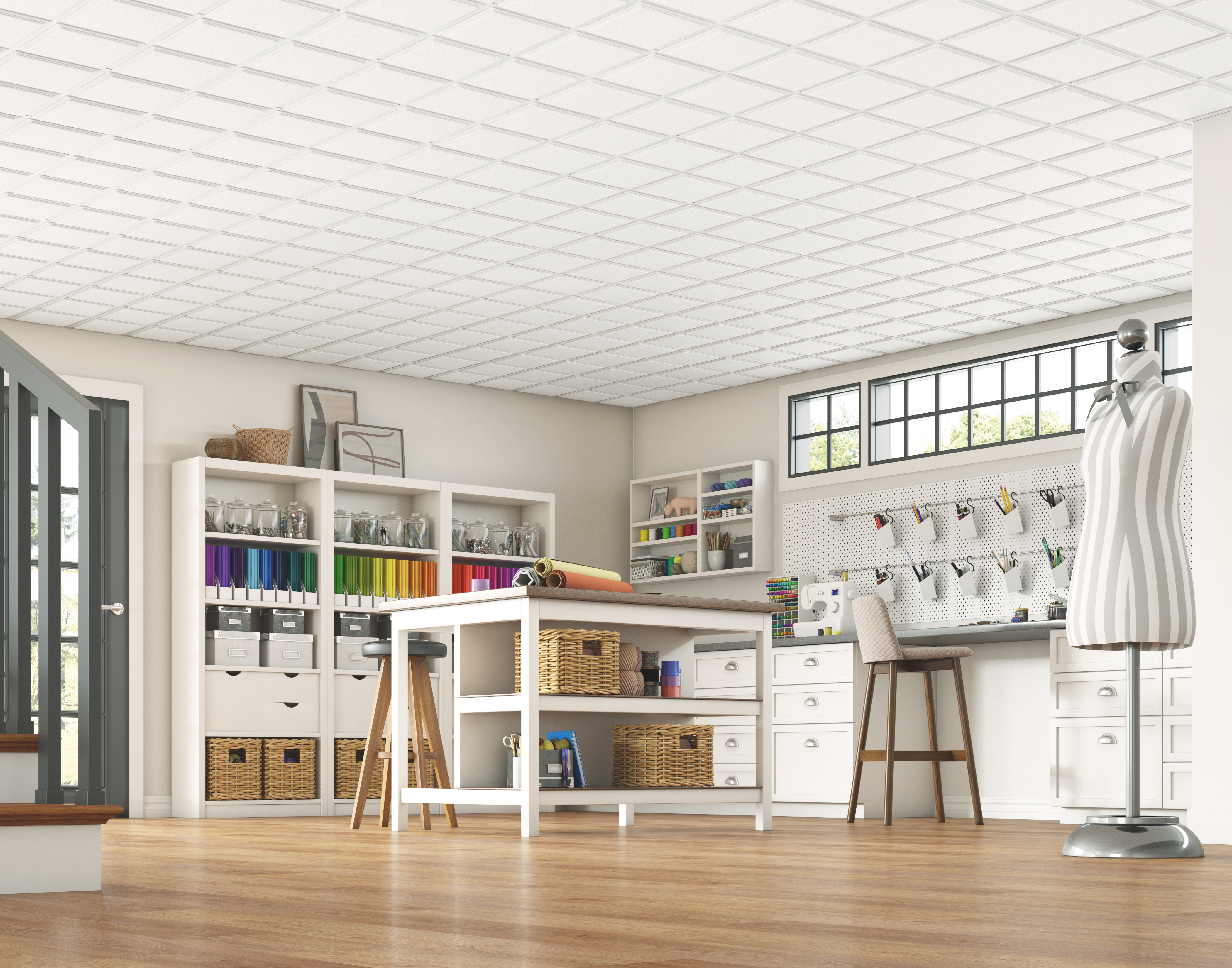
Let’s talk about a home upgrade that’s weirdly satisfying: dropping in a ceiling that looks intentional (not “we ran out of drywall patience”). The Armstrong Ceilings CASCADE 24 in. x 24 in. paneloften referred to as Armstrong item #1270is a decorative 2×2 suspended ceiling tile designed to bring some architecture to a space that might currently be… pipes and regrets.
This guide goes beyond “buy tile, insert tile.” We’ll break down the specs, why the stepped edge matters, where Cascade looks its best, what the sound and fire numbers actually mean, and how to install it without inventing new curse words. We’ll also finish with a longer, experience-based section (because the ceiling always teaches you something the first weekend).
What the CASCADE 24×24 Tile Is (and What It Isn’t)
CASCADE is a decorative mineral fiber ceiling tile made for a suspended (drop) ceiling system. It’s sized for standard 2×2 grid openings and uses a stepped, square tegular edgethat’s the design feature that helps minimize how much metal grid you visually notice once everything’s up.
What it isn’t: a glue-up decorative panel for a finished drywall ceiling, a waterproof PVC tile for shower-steam chaos, or a high-absorption acoustic specialty panel for a recording studio. CASCADE is best described as a “looks-better-than-basic, practical-for-real-homes” option for people who want access to wiring and ducts and a ceiling that doesn’t scream “office basement circa 1998.”
Specs at a Glance (The Stuff You Actually Need to Know)
- Nominal size: 24 in. x 24 in. (2 ft. x 2 ft.)
- Thickness: about 3/4 in.
- Material: mineral fiber
- Edge profile: square tegular / stepped tegular (designed for 15/16 in. grid)
- Coverage per carton: 48 sq. ft. (typically 12 tiles per carton)
- Sound blocking (CAC): around 30 (moderate sound-blocking performance)
- Fire rating: Class A (with manufacturer-listed flame spread and smoke developed values)
- Light reflectance: ~0.80 (bright white that helps bounce light around)
Translation: it’s a standard 2×2 drop ceiling tile with a thicker, more dimensional face than ultra-basic fissured panels, and it’s designed to “dress up” a room while still functioning like a classic suspended ceiling.
Design Deep-Dive: Why the Stepped Tegular Edge Is the Secret Sauce
If you’ve ever looked at a drop ceiling and thought, “I see nothing but grid,” you already understand the problem CASCADE is trying to fix. A tegular edge has a drop-down lip around the perimeter. Instead of sitting flat on top of the grid like a basic lay-in tile, the tile edge creates a reveal and a more sculpted look. That reveal can make the ceiling read as a pattern of panelsrather than a pattern of metal rails.
Tegular vs. Lay-In (Quick Visual Explanation)
Lay-in tiles sit directly on the grid. They’re easy and common, but the grid lines are prominent. Square tegular tiles sit slightly below the grid plane, creating depth and minimizing that “T-bar runway” effect. Armstrong’s own edge-type explanation is basically: tegular edges create a more dimensional look by design.
CASCADE takes it further by adding a stepped, dimensional face pattern. That means you’re getting depth from both the edge and the surface. In practice, it can make a basement family room or home office feel finishedwithout losing access above the ceiling.
Performance: Sound, Fire, and the Reality of Basements
Sound: CAC 30What That Means for Real Life
CASCADE is often listed with a CAC (Ceiling Attenuation Class) around 30. CAC measures how well a ceiling system helps block sound from traveling between adjacent rooms that share an air plenum (like two offices or rooms separated by a corridor above the ceiling). Armstrong explains CAC simply: higher CAC means better sound-blocking between spaces; below ~25 is low, and 35+ is considered high performance.
A CAC around 30 is a “solid middle” numberuseful for taming noise transfer in many residential setups (think: TV room under a bedroom), especially when combined with other smart moves like sealing obvious gaps, using insulation where appropriate, and avoiding open returns that let sound travel like it bought a season pass.
“Blocks Sound Between Floors” (Worth Noting, But Keep Expectations Real)
Armstrong’s HomeStyle decorative panels literature describes benefits like improved sound blocking between floors (presented as “up to” a certain percentage in their materials). Treat that as directional guidance rather than a promise your teenager’s drum practice will become a silent film. Sound control is always a system: ceiling + plenum + insulation + wall construction + flanking paths.
Fire Rating: Class A Isn’t a VibeIt’s a Test Result
CASCADE is listed as Class A for fire performance. In the broader building-material world, Class A is tied to surface burning characteristics tested under standards like ASTM E84, which looks at flame spread and smoke developed indices. Generally, Class A corresponds to low flame spread (commonly 0–25). Manufacturers may also publish smoke developed values for specific products.
The practical takeaway: Class A is a strong, commonly required rating for many interior finish applications, and it’s a reassuring check box for a ceiling productespecially in a basement where you want every material choice to behave sensibly.
Mold/Mildew Resistance: Helpful, Not Magical
Armstrong describes BIOBLOCK performance as resisting mold and mildew growth on the treated surface of certain ceiling tiles. CASCADE appears within the HomeStyle decorative panel family that highlights mold/mildew/bacteria resistance as a feature, which is a big deal for basements and utility-adjacent rooms.
Reality check (said with love): mold resistance isn’t a substitute for controlling moisture. If your basement is humid enough to qualify as a rainforest exhibit, run a dehumidifier, address water intrusion, and don’t expect any ceiling tile to negotiate with physics.
Where CASCADE Looks Best (And Where It’s Just “Okay”)
CASCADE shines when you want a ceiling to look designedwithout going full ornamental palace. It’s especially good for:
- Basement family rooms: hides utilities, improves appearance, keeps access.
- Home offices: the dimensional pattern reads “finished,” which helps a space feel less temporary.
- Rec rooms / game rooms: looks nicer than basic fissured panels, still practical for lighting and wiring changes.
- Workshops: bright white, reflective surface can help bounce light, and you can remove tiles for access.
Places where you might choose something else: high-moisture zones like indoor pool areas, rooms that need washable/scrubbable ceilings, or projects where you need very high acoustic absorption (high NRC). CASCADE is decorative-first with solid all-around performance, not a niche specialty tile.
Planning the Layout (The Step Everyone Skips, Then Regrets)
The difference between a ceiling that looks “custom” and one that looks “close enough” is usually layout symmetry. A classic pro move is making border tiles on opposite sides the same size and as large as practical. That prevents one wall from having a skinny sliver of tile that looks like the ceiling ran out of money.
A Real Example
Imagine a 12 ft. x 14 ft. room. With a 2×2 grid, you’re basically working in 2-foot modules. If you center the grid, you’ll typically end up with borders that are about the same width on opposite sides. Your goal: avoid 2-inch borders unless you’re designing a ceiling for ants.
Pro tip from installers: snap chalk lines, measure twice, and keep checking square. Even small layout errors show up across a room like a crooked picture frameexcept it’s on your ceiling, so you’ll notice it forever.
Installation Options: Standard Grid vs. QUICKHANG (DIY Friendly)
Option 1: Classic Suspended Grid (Prelude 15/16 System)
CASCADE is designed to install in a 15/16-inch suspended ceiling gridcommonly the Armstrong Prelude family of systems. The basic anatomy is:
- Wall molding: supports the perimeter and sets ceiling height.
- Main beams (main tees): long runners that hang from joists/wires.
- Cross tees: snap into mains to form 2×2 openings.
- Hanger wires or hooks: support and level the grid.
Armstrong’s installation instructions emphasize keeping the grid square (measure diagonals to confirm) and listening for the “click” when tees fully seat. That click is the sound of your future ceiling not slowly drifting into abstract art.
Option 2: QUICKHANG Installation Kit (Fast Leveling for Homes)
If you want a simpler DIY approach, Armstrong’s QUICKHANG hardware and kits are built to make grid installation and leveling easier for residential ceilings. Their instructions note the hardware accommodates ceiling drops roughly in the range of a few inches up to around a foot below joists (depending on kit/hook length), and the system is designed for residential use conditions.
QUICKHANG is the route for people who want “weekend doable” without buying specialized commercial tools. It won’t remove the need to measure, but it can reduce the pain of leveling the whole ceiling by turning it into a series of adjustable points rather than a full-wire origami project.
Pro Installation Tips (Actually Useful Ones)
- Pick your height to clear the lowest obstruction: ductwork and pipes always win.
- Work from the center out for symmetry: it helps patterns and borders land nicely.
- Don’t rush squaring the grid: measure diagonals; fix it now, not after tiles are in.
- Cross tees generally shouldn’t be “randomly trimmed”: plan borders so cuts happen where they’re expectedat the perimeter.
Cutting, Handling, and “Why Is This Tile Suddenly Fragile?”
Mineral fiber tiles are sturdy enough for normal use but can chip if you treat corners like they owe you money. When cutting border tiles, a sharp utility knife and a straightedge help. Cut from the face side for cleaner edges, and support the tile so it doesn’t crumble at the finish line.
Also: keep tiles flat and dry before install. A bowed tile is a subtle villainit installs “fine” and then keeps whispering its problems to you every time the light hits it just right.
Maintenance: Cleaning Without Ruining the Finish
Mineral fiber ceilings aren’t meant to be soaked. Armstrong’s cleaning guidance emphasizes using clear cleaners (dyed liquids can stain), cleaning only the finished face, and avoiding saturation. In other words: damp, not drenched.
- Dust: vacuum with a soft brush attachment (gentle, no aggressive scrubbing).
- Light marks: wipe with a lightly damp cloth using minimal water.
- Cleaning agents: go mild and clear; test a hidden area first if you’re nervous.
- Ceiling tile spa day: not recommendedno soaking, no baths, no “let’s rinse it off outside.”
Cost & Value: What You’re Really Paying For
CASCADE is usually sold in cartons that cover 48 square feet (commonly 12 tiles). Retail pricing varies by store, region, and time of year. As an example, one major retailer has listed it at roughly a few dollars per square foot when sold by the case.
Value-wise, you’re paying for:
- Better aesthetics than basic panels: the stepped look and pattern read “designed.”
- Access above the ceiling: huge value if you expect wiring, plumbing, or network changes.
- Practical performance: Class A fire rating and a respectable CAC number.
If you’re deciding between drywall and a suspended ceiling, ask one question: Will I ever need access up there? If the answer is “yes,” a drop ceiling often wins on long-term sanity.
FAQ: Quick Answers to Common Questions
Can I paint Armstrong CASCADE tiles?
Armstrong’s HomeStyle decorative panels are presented as paintable in their literature. If you paint, use a method that won’t clog texture or add so much moisture that tiles warp. Many homeowners use a light, even coatmore “upgrade” than “latex flood.”
Will CASCADE hide the grid completely?
It minimizes grid visibility, but it doesn’t make the grid vanish. The tegular edge and dimensional pattern help the ceiling read as panels, not railsespecially with clean alignment and consistent lighting.
Is CAC 30 “soundproof”?
NoCAC isn’t a soundproofing guarantee. Think of it as sound-blocking assistance within a ceiling system, most relevant for reducing sound transfer through shared ceiling plenums.
Is it a good option for basements?
Yes, particularly when you want easy access above the ceiling and a more finished look than entry-level panels. Just keep humidity in check.
Wrap-Up: The Short Verdict
If you want a 2×2 drop ceiling tile that looks more intentional than the standard “office tile,” the Armstrong CASCADE 24 in. x 24 in. is a strong contender. It’s decorative without being fussy, installs in common 15/16-inch grid systems, and hits practical checkboxes like a Class A fire rating and a moderate CAC rating. It’s the kind of upgrade that makes a basement feel like part of the housenot the place where holiday decorations go to retire.
Real-World Experience: What It’s Like Living With (and Installing) CASCADE 24×24
The first thing you notice when you open a carton of CASCADE tiles is that they feel “serious.” Not in a dramatic waymore like “these are not flimsy foam squares pretending to be building materials.” The tiles are mineral fiber, and that comes with two truths: they’re stable and finish-friendly, and they will absolutely chip a corner if you treat them like pizza boxes.
Installation day typically starts with optimism and ends with a new appreciation for chalk lines. The grid is everything. When the grid is level and square, CASCADE looks crisp: the stepped edge creates that subtle shadow line and the ceiling reads as a field of dimensional panels. When the grid is slightly off, the pattern doesn’t “hide it”it highlights it. That’s not a flaw in CASCADE; it’s just the ceiling equivalent of a tailored suit. Tailoring looks incredible… as long as you measure correctly.
The most surprisingly satisfying moment is the “first full row” of tiles. Early on, you’re staring at bare grid and thinking, “This is taking forever and also looks like a cafeteria.” Then you drop in a few CASCADE panels, step back, and suddenly the room changes. The dimensional face catches light differently than flat tiles, and the ceiling becomes part of the design rather than a cover-up. If you’re doing a basement remodel, that moment is often when the project starts feeling like a room you’d actually invite people into.
Practical living notes: CASCADE’s bright white face helps in rooms that need more reflected light (basements, offices, workshops). With decent lighting, the subtle pattern adds texture without making the room feel busy. It’s a “noticeable upgrade” that doesn’t dominate the rest of your decor, which is rare in the decorative-ceiling universe (where things can go from “classy” to “Victorian opera set” in about three seconds).
Sound-wise, the ceiling feels calmer in a way that’s hard to quantify: less harsh reflection, less “hollow room” vibeespecially if you add soft furnishings and treat obvious gaps. If you were hoping for cinematic, total sound isolation, you’ll be disappointed, because that’s not what a decorative mineral fiber drop ceiling tile is built to do. But for everyday lifekids upstairs, TV downstairs, a home office that doesn’t echo like a parking garageit’s a meaningful improvement when installed as part of a decent ceiling system.
Maintenance is refreshingly normal: dust it gently, avoid soaking, and use mild, clear cleaners when needed. The big “experience lesson” is humidity management. In a basement, you’ll love CASCADE most when your dehumidifier is doing its job and your HVAC isn’t cycling the room into a tropical cloud. Keep the environment stable, and the ceiling stays looking sharp. Ignore moisture, and the ceiling becomes a scoreboard for every humid week you pretended not to notice.
Final experience-based verdict: CASCADE is a great choice when you want a ceiling that looks intentionally designed but still functions like a practical drop ceiling. It rewards careful layout and a square grid, it plays nicely with common 2×2 lighting options, and it turns that “unfinished ceiling zone” into something you can be proud of. Just remember: the ceiling doesn’t forgive shortcuts. It hangs above you, quietly judging, forever.