Some bird photography celebrates speed: wings slicing through the air, talons extended, sunlight exploding across a lake. Sharon Montrose takes a very different route. Her birds are not distant specks chased through a telephoto lens. They appear as individual characters, photographed with the directness of formal studio portraiture and the visual restraint of contemporary art.
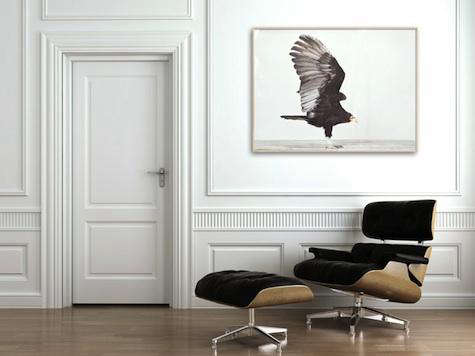
A goose stands against a quiet background as if waiting for its appointment with a magazine editor. A vulture becomes sculptural rather than sinister. A pheasant reveals an astonishing wardrobe that would make most fashion influencers quietly delete their accounts. By removing visual clutter, Montrose asks viewers to stop thinking of birds as generic wildlife and start noticing posture, expression, texture, and personality.
That deceptively simple approach helped make her Animal Seriesand especially its bird portraitsrecognizable far beyond traditional wildlife photography. The photographs have appeared in interiors, nurseries, design publications, private collections, and Montrose’s 2011 book Menagerie. They sit comfortably between fine-art photography, animal portraiture, and minimalist interior design.
Who Is Sharon Montrose?
Sharon Montrose is an American photographer known for creating refined portraits of both domestic and wild animals. By combining her affection for animals with a carefully controlled photographic style, she became a sought-after commercial specialist and produced work for prominent pet-industry brands. Her biography credits her with eleven photography books, while her Animal Series has received recognition from photography and design organizations and has entered notable public and private collections.
In 2008, Montrose and her husband, Spencer, established The Animal Print Shop, an online gallery that offered open-edition and limited-edition fine-art photographs. The shop helped make polished photographic art more approachable for people who loved animals but did not necessarily speak fluent gallery jargon. No black turtleneck was required.
The Animal Print Shop operated through 2025. During that period, it became especially well known for Montrose’s broader Animal Series and the charming young subjects in her Little Darlings collection. The business emphasized archival production, carefully selected paper, and high-quality digital capture and printing.
From Animal Lover to Animal Portraitist
Montrose’s work succeeds because the animals are not treated as decorative props. Her stated goal during a shoot was to capture each subject’s particular charm, whether that quality appeared in the eyes, movement, expression, or physical presence. She distinguished between animals whose appeal was naturally adorable and those whose power came from being majestic or visually striking.
That distinction matters. A photographer trying to make every species “cute” would quickly flatten the natural differences between a flamingo, a buffalo, a vulture, and a kitten. Montrose instead adapts her visual attention to the animal in front of her. The resulting portrait may feel tender, funny, elegant, peculiar, or imposingbut rarely generic.
Why Sharon Montrose’s Bird Photography Feels So Distinctive
1. The Birds Receive the Celebrity-Portrait Treatment
Traditional wildlife photographs often depend on habitat, action, and environmental drama. Montrose’s bird portraits depend on presence. By isolating a bird against a restrained background, she gives it the kind of visual authority normally reserved for actors, musicians, or extremely confident chief executives.
The effect is subtle but transformative. A grey goose is no longer merely “a goose.” Its long neck creates a graceful line through the composition. Its feathers become layers of silver, charcoal, cream, and smoke. Its stance may suggest caution, dignity, irritation, or the unmistakable suspicion that the photographer has not provided enough snacks.
Remodelista’s early feature on the series highlighted works including Vulture No. 1 and Grey Goose No. 2, praising Montrose’s ability to capture character and give her avian subjects a spirit that seems to lift them from the page.
2. Minimal Backgrounds Make Every Feather Count
Montrose’s sparse backgrounds are not empty in the careless sense. They are active negative space. Without branches, grass, sky, fences, or photobombing squirrels competing for attention, the viewer notices the architecture of the bird itself.
Long legs become graphic lines. Curved beaks create punctuation marks. Layered wing feathers form repeating patterns. The soft transition between a bird’s body and the neutral surroundings can make the photograph feel almost like a charcoal drawing, except the subject might flap away at any moment.
This visual simplicity also explains why the photographs work so well in interiors. They can add life to a room without creating chaos. A colorful bird can energize a pale wall, while a monochromatic goose or vulture can introduce texture to a minimalist space without turning the room into an accidental aviary.
3. The Portraits Balance Humor and Dignity
Birds are excellent photographic subjects partly because they are naturally theatrical. Flamingos look like they are perpetually arriving late to a garden party. Vultures possess the solemn confidence of medieval judges. Geese appear fully prepared to dispute a parking violation in court.
Montrose allows this humor to emerge without forcing it. She does not rely on costumes, elaborate sets, or novelty poses. The comedy comes from recognition: the slight tilt of a head, an awkwardly elegant leg, or an expression that seems uncannily familiar.
Yet the birds are never reduced to jokes. The same photograph that makes a viewer smile can also reveal delicate feather structures, unexpected color relationships, or the imposing physical design of a species that is often ignored or misunderstood.
4. The Work Sits Between Nature Study and Modern Design
Montrose’s bird photography is descriptive enough to reward close observation but stylized enough to function as contemporary wall art. This dual identity broadens its appeal.
A bird enthusiast may study plumage, proportions, and species-specific characteristics. A photographer may examine light, tonal range, timing, and composition. An interior designer may focus on scale, palette, framing, and the relationship between the image and surrounding furniture. A child may simply announce, with complete confidence, that the goose looks “kind of bossy.” All four responses are valid.
Design writers have frequently noted how naturally Montrose’s animal portraits fit nurseries and family spaces, although their restrained presentation also works in grown-up bedrooms, offices, hallways, and living rooms. The art feels friendly without becoming sugary and sophisticated without becoming chilly.
How the Bird Portraits Were Created
The apparent simplicity of a Sharon Montrose photograph hides a demanding production process. Animals do not accept creative direction in the conventional sense. You cannot ask a goose to turn its left shoulder toward the key light, soften its expression, and “give us something more vulnerable.” Well, you can ask, but the goose will make its own artistic decisions.
Successful animal portraiture therefore depends on preparation, patience, observation, experienced handling, and the ability to react during brief moments when posture, expression, and light come together.
Working With Live Birds and Experienced Handlers
According to The Animal Print Shop’s official description, the series featured live animals raisedand in many cases rescuedby experienced keepers and handlers. The animals’ welfare was supervised during photography. Some sessions took place in a studio, while others were photographed at the facilities where the animals lived and later integrated with the series’ characteristic background.
Montrose has also explained that her confidence during difficult shoots came from trusting professional handlers. Her concentration remained fixed on finding the photograph rather than controlling the animal herself.
This collaboration is an important part of ethical animal photography. A compelling image is not worth distressing an animal, and experienced handlers understand body language, safe distances, signs of discomfort, and species-specific behavior. The photographer’s job is to work within those boundaries, not to demand a performance at any cost.
Waiting for Character Rather Than Manufacturing It
Montrose’s method depends less on posing an animal like a human model and more on recognizing the instant when its natural behavior communicates something memorable. That instant might last only a fraction of a second.
A bird stretches its neck, shifts its balance, looks directly into the lens, or briefly arranges its feathers into a perfect silhouette. The successful photograph makes that fleeting gesture feel inevitable, as though the bird had been rehearsing all morning. In reality, the photographer has probably been watching, waiting, adjusting, and silently negotiating with fate.
Notable Birds and Visual Personalities
The Grey Goose: Elegance in Everyday Plumage
The grey goose demonstrates Montrose’s talent for finding visual richness in familiar animals. Geese are common enough that people may stop looking at them closelyusually while keeping a sensible distance from the beak. Against a neutral setting, however, the goose becomes a study in curved anatomy, layered feathers, and finely graded color.
The portrait’s appeal comes partly from contradiction. The body appears soft and rounded, while the neck creates a strong vertical line. The feathers feel gentle, but the expression may suggest formidable self-confidence. This tension gives the image personality without requiring a theatrical setup.
The Vulture: From Ominous Symbol to Sculptural Subject
Vultures carry heavy cultural baggage. They are often used as symbols of menace, decay, or opportunism. In a clean portrait, those associations loosen. Viewers can appreciate the bird’s shape, textured head, powerful beak, and dark feather mass as formal visual elements.
Montrose’s vulture portrait makes a useful point about animal art: beauty does not have to mean conventionally pretty. Sometimes the most compelling subject is the one that initially causes a viewer to hesitate. The photograph invites a second look, and the second look often reveals far more than the first.
Pheasants and Flamingos: Nature’s Unapologetic Dressers
Pheasants bring pattern and color into the series with almost unreasonable generosity. Their feathers combine spots, stripes, iridescence, and intricate tonal changes. Isolating the bird prevents these details from disappearing into vegetation and turns the plumage into a living textile.
Flamingos offer a different kind of visual drama. Their curved necks, narrow legs, unusual proportions, and pink coloration already seem designed by an artist who ignored the instruction to “keep it realistic.” In Montrose’s portrait style, their eccentric anatomy becomes graceful rather than merely novel.
Menagerie and the Wider Animal Series
Montrose’s bird portraits belong to a much broader body of animal photography that includes farm animals, household pets, young wildlife, reptiles, and large mammals. Her 2011 book Menagerie brought many of these images together in a 192-page collection.
HarperCollins described the book as a compendium of wild and domestic animal portraits arranged in playful thematic sections such as “Babies,” “Pouches,” “Forest,” and “Farm.” The design also incorporated hand lettering by illustrator Juliana Swaney, reinforcing the book’s blend of polished art and approachable charm.
Within this larger collection, the birds contribute important visual variety. Their shapes are less familiar than the compact silhouettes of cats or dogs. Their feathers provide complex surfaces. Their movements can be both graceful and startlingly abrupt. They introduce a little airborne unpredictability into a photographic menagerie that already contains plenty of strong personalities.
What Photographers Can Learn From Sharon Montrose
Simplify Before Adding More
Montrose’s images demonstrate that a photograph does not need a complicated environment to hold attention. Removing unnecessary details can strengthen the relationship between subject and viewer. This principle applies far beyond bird photography. Portraits, product images, food photographs, and still lifes often improve when the photographer asks one ruthless question: “Does this element help, or is it merely standing around?”
Photograph Personality, Not Just Appearance
A technically sharp bird photograph may identify a species beautifully while still feeling emotionally flat. Montrose looks for gestures that suggest temperament. The lesson is not to project human emotions recklessly onto wildlife, but to notice behavior. A head angle, pause, stretch, or direct glance can turn documentation into portraiture.
Let Texture Carry the Composition
Feathers are not background details. They can become the visual subject. Soft light reveals overlapping structures without producing harsh reflections or losing subtle color transitions. A restrained setting then allows those textures to provide complexity.
Respect the Animal’s Limits
The most important lesson is practical rather than aesthetic. Live-animal photography should be built around welfare, experienced supervision, and patience. The photographer must be prepared to abandon an idea when the animal is uncomfortable. A missed photograph is disappointing. An unsafe shoot is unacceptable.
How to Display Bird Photography at Home
Because Sharon Montrose’s bird portraits combine neutral space with strong silhouettes, they can work in many decorative styles. Their impact depends on scale and placement.
Use One Large Portrait as a Focal Point
A large goose, vulture, or flamingo portrait can anchor a room above a console, fireplace, bed, or sofa. The generous negative space prevents the piece from feeling crowded even at a substantial size. Choose a subject whose posture complements the wall: a tall bird suits a narrow vertical area, while a wider pose works above furniture.
Create a Small, Consistent Gallery
Two or three bird portraits can form a witty visual conversation. Pair subjects with contrasting shapesperhaps a long-necked bird beside a compact, heavily feathered one. Consistent frames and generous spacing maintain the clean character of the photography.
Coordinate With the Room, but Do Not Overmatch
A flamingo does not require pink pillows, pink curtains, and a lamp shaped like a tropical cocktail. Allow the photograph to be the room’s surprise. Neutral bird portraits pair naturally with wood, linen, plaster, and muted paint, while more colorful species can introduce an accent without demanding a complete decorative migration.
The Viewing Experience: Living With Sharon Montrose’s Birds
Encountering one of Montrose’s bird portraits is different from seeing a dramatic wildlife image in a field guide or nature documentary. The photograph does not immediately tell a story about migration, hunting, nesting, or survival. Instead, it creates the quieter experience of a meeting.
At first, viewers usually recognize the species or general type of bird. “That is a goose.” “That is a vulture.” “That pink creature has clearly never believed in subtlety.” Then the longer viewing begins. The eye moves from the overall silhouette to smaller details: the direction of the feathers, the shape of the eyelid, the texture around the beak, and the tiny adjustments that allow the bird to balance.
This change in attention can make an ordinary room feel briefly slower. A photograph above a desk may become something you glance at during a difficult email. The bird remains composed, unimpressed, and entirely uninvolved in your spreadsheet emergency. That emotional distance is oddly reassuring.
In a child’s room, the experience may be more imaginative. A bird portrait can become a character with a name, a mood, and an elaborate unofficial biography. The goose might be appointed principal of an imaginary school. The flamingo may run a dance studio. The vulture, unfairly but predictably, will probably be placed in charge of mysteries. Because Montrose’s backgrounds provide little narrative information, viewers are free to invent their own.
In a living room or hallway, the images often produce conversation without overwhelming the space. Guests may begin by discussing the animal and end up talking about photography, conservation, pets, childhood memories, or the strange fact that birds sometimes look more judgmental than people. Effective art does not always need to deliver a grand philosophical lecture. Sometimes it simply opens a door.
The portraits also reward changes in distance. From across a room, a bird appears as a bold shape within negative space. Up close, the image becomes a study in surface and detail. This two-stage viewing experience is one reason the work adapts well to residential interiors: it contributes to the architecture of a room while retaining enough complexity for repeated observation.
For photographers, spending time with the series can alter the experience of taking pictures outdoors. After studying Montrose’s emphasis on posture and personality, it becomes easier to notice portrait-like moments in everyday birds. A pigeon waiting on a railing, a crow turning its head, or a duck pausing at the edge of a pond may suddenly seem less like background wildlife and more like an individual presence.
The goal is not to imitate Montrose’s studio aesthetic in every situation. It is to borrow her attentiveness. Instead of firing the shutter the instant a bird enters the frame, a photographer can wait for the gesture that clarifies the subject’s shape or behavior. Instead of including every branch and blade of grass, the photographer can shift position to simplify the composition. Instead of chasing novelty, the photographer can look more closely at what is already familiar.
Living with this kind of art can therefore become a small exercise in observation. The portrait remains physically unchanged, yet different details emerge depending on the viewer’s mood, the room’s light, and the amount of time available. One day the image seems funny. Another day it appears elegant or mysterious. The bird, naturally, refuses to explain itself.
Why the Bird Series Still Resonates
Sharon Montrose’s bird photography endures because it brings together qualities that rarely coexist so comfortably. The images are polished but playful, minimal but expressive, decorative but observant. They appeal to children without feeling childish and to design enthusiasts without becoming inaccessible.
Most importantly, the portraits encourage sustained attention. They remind viewers that familiar animals contain extraordinary structures, colors, and behaviors when separated from assumptions and visual noise. A goose can become elegant. A vulture can become magnificent. A pheasant can look as though it owns several successful nightclubs.
Montrose eventually expanded her creative practice into ceramics, describing clay as a return to a slower, more tactile process after the photographic shift from film to digital. That evolution feels consistent with the patience visible in her animal work: close observation, respect for material, and an appreciation for subtle imperfections.
Her bird portraits remain a distinctive chapter in contemporary animal photographya reminder that wildlife does not always need a dramatic landscape to command attention. Sometimes all a bird needs is gentle light, a quiet background, an experienced team, and one perfectly timed fraction of a second.