Note: This article discusses fan-made artistic reinterpretations of well-known Disney villains. The artworks are creative tributes and are not official Disney redesigns.
Disney heroes get the castles, the ballads, the animal sidekicks, and usually the good lighting. Disney villains, meanwhile, get thunder, suspicious cheekbones, dramatic entrances, and the kind of confidence that says, “Yes, I rehearsed this speech in a mirror.” But what would happen if the villains stopped lurking in the shadows and stepped into the spotlight as the actual main characters?
That is the deliciously wicked idea behind a viral art concept by Japanese artist onose1213, also known online as J. The artist reimagined several famous Disney villains with the kind of polished, attractive, lead-character energy usually reserved for princes, princesses, and chosen ones with unusually obedient hair. The result is a fascinating mix of fan art, character redesign, pop-culture commentary, and one big question: were these villains always main-character material, or did we simply fail to give them the camera angle they deserved?
The series includes reimagined versions of characters such as Scar, Hades, Ursula, Captain Hook, Cruella de Vil, the Queen of Hearts, Maleficent, Shan Yu, Jafar, Dr. Facilier, and Claude Frollo. Each redesign invites viewers to look beyond the familiar “bad guy” label and consider how much of villainy is shaped by framing, costume, expression, posture, and narrative perspective.
Why Disney Villains Already Feel Like Main Characters
Here is the uncomfortable truth: many Disney villains are already more memorable than the heroes they oppose. They enter with theatrical flair, wear bolder colors, sing the best songs, and speak like every sentence has been dipped in glitter and menace. While heroes often have to be relatable, villains are allowed to be excessive. They can be elegant, ridiculous, terrifying, funny, stylish, bitter, wounded, glamorous, or all of the above before breakfast.
Think about Maleficent. She does not merely arrive at a royal celebration; she materializes like the smoke machine was invented specifically for her. Ursula does not simply offer Ariel a deal; she performs a full underwater cabaret number with legal paperwork attached. Hades talks like a fast-talking Hollywood agent who accidentally got assigned the underworld. Cruella de Vil walks into a room as if the room should apologize for not being a runway.
That is why the idea of turning Disney villains into main characters works so well. These characters were designed to command attention. The artist’s redesigns do not create charisma from nothing; they reveal charisma that was already there, hiding behind plot function and ominous background music.
The Artist’s Concept: From Antagonist to Protagonist Energy
The central appeal of J’s series is not simply that the villains are made “prettier.” A good villain redesign does something more interesting: it changes the emotional contract between the viewer and the character. When a villain looks like a lead character, we instinctively search for a story behind their eyes. We ask what happened before the curse, before the revenge plan, before the dramatic laugh that definitely scared at least three interns in the animation department.
In traditional Disney storytelling, visual design often tells us who to trust. Heroes tend to be bright, open, soft, and approachable. Villains often feature sharper shapes, darker palettes, exaggerated features, dramatic silhouettes, and theatrical expressions. These choices are effective because animation must communicate quickly. A child should be able to look at a character and think, “Ah yes, that person owns a suspicious amount of black fabric.”
But fan art can pause the movie and ask, “What if the visual language changed?” If Scar had heroic lighting, would he look tragic instead of treacherous? If Ursula were framed as a glamorous sea diva instead of a lurking threat, would viewers read her confidence differently? If Jafar were redesigned like the brooding lead of a fantasy epic, would his ambition seem more like a dangerous flaw than pure evil?
That is where the series becomes more than a fun gallery. It becomes a small experiment in storytelling. It reminds us that character design is never neutral. A raised eyebrow, a slimmer silhouette, softer lighting, a heroic pose, or a more romantic expression can shift the entire way an audience interprets a character.
Scar: The Drama King of Pride Rock
Scar is already one of Disney’s most cinematic villains. He has a voice made for betrayal, a face built for side-eye, and the body language of someone who has been silently judging the entire savanna for years. In a protagonist-style redesign, Scar becomes less like a lurking usurper and more like a tragic royal antihero.
What makes this transformation interesting is that Scar’s original design is not random. His darker mane, angular face, and slinking posture separate him from Mufasa’s broad, warm, heroic presence. But when reimagined with more attractive or noble qualities, Scar’s bitterness starts to look like backstory. Suddenly, he is not just the jealous brother; he is the prince who never got the song, the throne, or apparently a decent family therapist.
Hades: The Villain Who Was Already the Funniest Person in the Room
Hades from Hercules barely needs help becoming a main character. He is sarcastic, fast, impatient, stylish in a flaming-blue way, and surrounded by underworld chaos. His original design already mixes menace with comedy, which is why fans continue to love him. He is less “ancient god of death” and more “overworked manager of a cursed customer-service department.”
When reimagined as a lead, Hades becomes the kind of character who could carry an entire animated series. His appeal lies in contrast. He is powerful but petty, immortal but exhausted, terrifying but somehow relatable on a Monday morning. A protagonist-style Hades would not need to become good; he would simply need a goal that lets viewers understand his frustration. Give him a broken divine bureaucracy, a few incompetent minions, and one emotionally honest scene, and suddenly he has a full season arc.
Ursula: Confidence, Camp, and Sea-Witch Stardom
Ursula is one of the clearest examples of a villain whose performance nearly takes over the movie. She is funny, theatrical, persuasive, and visually unforgettable. Her design draws from drag performance, stage presence, and exaggerated glamour, which helps explain why she feels less like a background threat and more like a headliner waiting for her curtain call.
As a main character, Ursula becomes especially compelling because she is not timid about wanting power. She enjoys spectacle. She understands branding. She has a lair, hench-eels, a signature song, and the confidence of someone who has never once asked, “Is this too much?” For Ursula, too much is the starting point.
A redesign that makes Ursula more conventionally glamorous can be fun, but it also raises an important point: her original power comes from not fitting a narrow beauty standard. The best version of a protagonist Ursula would not erase her size, age, theatricality, or strangeness. It would celebrate them. She does not need to become a princess to be the main character. She needs the story to admit she already owns the stage.
Cruella de Vil: Fashion First, Ethics Later
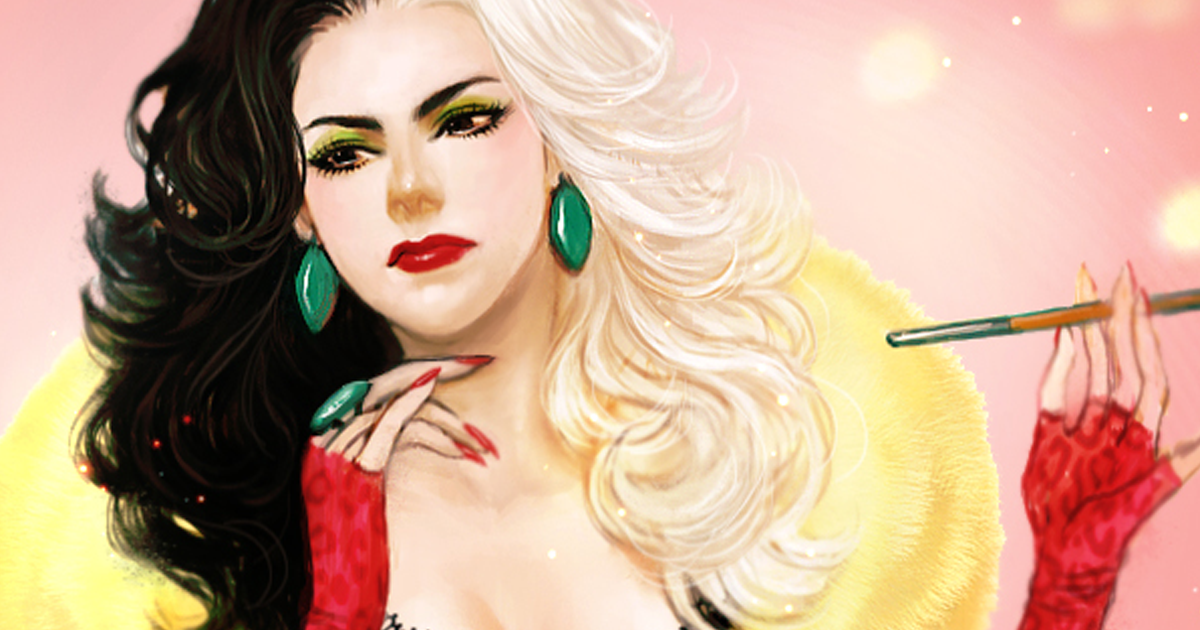
Cruella de Vil has always had main-character style, even when her morals are parked somewhere in a ditch. The black-and-white hair, the cigarette holder in older versions, the enormous coat, the frantic driving, the obsession with fashionCruella is a walking editorial spread with a police report attached.
Disney’s later live-action approach to Cruella showed how naturally the character fits an origin-story format. When a villain is connected to fashion, performance, class, revenge, and identity, the leap from antagonist to complicated lead is not difficult. You do not have to excuse Cruella’s worst behavior to understand why audiences are fascinated by her. She is visual storytelling with cheekbones.
In fan art, Cruella often becomes even more glamorous, but the strongest redesigns keep her danger intact. Smooth her out too much and she stops being Cruella. The fun is in the contrast: elegance with chaos, couture with cruelty, lipstick with bad decisions.
Maleficent: The Blueprint for Villain-as-Hero
Maleficent may be the ultimate example of a Disney villain who was destined to become a protagonist. Even in Sleeping Beauty, she feels enormous compared with the story around her. Her silhouette is iconic: horns, cloak, staff, high collar, and a presence so commanding she makes every doorway look underdesigned.
Disney’s live-action Maleficent explored her backstory by shifting the audience’s perspective. Instead of presenting her as evil from the first frame, the film asks what betrayal, grief, and protection might do to a powerful being. That is exactly the kind of question fan art encourages. What happens when the villain gets interiority? What happens when the curse is not the beginning of the story but the middle?
Artistically, Maleficent is also a gift. Her original design uses sharp, flame-like shapes and dramatic color patterns, making her both elegant and dangerous. A main-character redesign does not have to soften her much. In fact, softening her too much would miss the point. Maleficent’s appeal is that she is majestic, terrifying, wounded, and fabulous enough to make a spinning wheel feel like a national security issue.
Jafar, Captain Hook, and the Charm Problem
Some Disney villains are dangerous because they are charming. Jafar, Captain Hook, and Dr. Facilier all understand presentation. They dress well, speak theatrically, and know how to hold a pose. As main characters, they become fascinating because their villainy is tied to ambition and performance.
Jafar’s redesign as a protagonist-style figure can make him look like the lead of a dark fantasy romance. But his core traitscontrol, manipulation, entitlementmust remain visible. Otherwise, the redesign becomes just a handsome costume. The best fan art keeps a hint of calculation in his eyes. Main-character Jafar should still look like he has read the terms and conditions and found a loophole.
Captain Hook, meanwhile, is almost too theatrical to be contained by the role of villain. He is vain, fussy, dramatic, frightened of a crocodile, and dressed like he expects every battle to be painted in oil. A protagonist Hook could easily become a comic adventure lead: a pirate captain with wounded pride, excellent tailoring, and terrible emotional regulation.
Dr. Facilier is another standout. His charisma is musical, mysterious, and dangerous. A main-character version of him would have to explore the cost of making deals with forces bigger than oneself. He is stylish, yes, but his story works because the charm has consequences.
Why Villain Redesigns Go Viral
Villain fan art spreads quickly because it combines nostalgia with surprise. Viewers recognize the character instantly, but the new design gives them a reason to look twice. That second look is where the magic happens. People begin debating beauty standards, storytelling, childhood memories, favorite villains, and whether it is morally acceptable to have a crush on a lion who committed royal crimes. The internet has hosted stranger debates, but not many with better hair.
These redesigns also fit a larger pop-culture trend: audiences love alternate perspectives. Stories like Maleficent, Cruella, and modern villain-centered games and shows suggest that fans are curious about what happens when the “bad guy” gets the narrative microphone. Sometimes the result is redemption. Sometimes it is satire. Sometimes it is simply the pleasure of watching a dramatic character chew the scenery like it owes them money.
Fan artists are especially good at exploring these possibilities because they are not limited by studio formulas. They can ask playful questions: What if Scar looked like a tragic prince? What if Hades were styled like a chaotic anime lead? What if the Queen of Hearts looked less like a comic tyrant and more like the star of a royal political drama? The answers do not have to replace the originals. They can simply sit beside them, winking wickedly.
The Beauty Debate: When “Main Character” Means “Attractive”
One of the most interesting reactions to villain redesigns involves beauty. When villains are reimagined as more attractive, viewers often enjoy the transformation, but some also ask a fair question: why does becoming a main character often mean becoming younger, thinner, smoother, or more conventionally beautiful?
That question matters. Villains are often visually exaggerated, and those exaggerations can be part of what makes them iconic. Ursula’s size, the Queen of Hearts’ roundness, Hades’ sharp flame hair, Cruella’s harsh angles, and Scar’s gaunt elegance are not design flaws. They are character language. If a redesign removes too much of that language, the character can become generic.
The strongest fan art does not simply “beautify” villains. It translates them. It asks: what is essential here? For Maleficent, it is authority and controlled fury. For Ursula, it is theatrical confidence. For Scar, it is resentment wrapped in elegance. For Cruella, it is fashion weaponized into identity. For Hades, it is immortal sarcasm. A great redesign keeps the soul of the character, even when changing the surface.
What These Redesigns Teach About Character Design
J’s Disney villain series is entertaining, but it also offers a useful lesson for artists, writers, and fans: character design is storytelling. A character’s face, clothes, posture, colors, and expression tell us how to feel before the plot explains anything. That is why a redesign can change the entire emotional temperature of a familiar figure.
Give a villain softer eyes, and viewers may sense vulnerability. Give them heroic lighting, and they may seem misunderstood. Give them fashionable clothes, and they may read as aspirational. Give them a romantic pose, and suddenly the audience is writing fan fiction at 2:00 a.m. with a cup of coffee and no regrets.
At the same time, the original Disney designs remain powerful because they are so specific. Disney villains are not memorable by accident. They are built with visual clarity. Their silhouettes are readable. Their colors communicate mood. Their voices and gestures make them larger than life. Fan redesigns work because the originals give artists such strong material to remix.
Experience: What It Feels Like to See Disney Villains as the Leads
Looking at Disney villains as main characters creates a strange, funny, and surprisingly emotional experience. At first, it feels like a joke: the bad guys got a glow-up. Scar is suddenly giving tragic prince energy. Hades looks like he might headline a supernatural comedy. Captain Hook appears ready for a pirate romance poster. Ursula seems less like someone hiding in a cave and more like the owner of the most exclusive underwater nightclub in the kingdom.
But after the initial laugh, something more interesting happens. The viewer starts filling in the missing movie. If this version of Maleficent is the lead, what is her opening scene? Does she begin alone in the Moors, proud but guarded? If Jafar is the protagonist, is the story about ambition in a palace where power is always just out of reach? If Cruella is centered, is the movie a fashion-world revenge fantasy? If Hades leads the story, is it a workplace comedy about managing souls, monsters, and incompetent minions while Zeus gets all the publicity?
That imaginative leap is the real pleasure of the concept. The artwork does not need to provide a full script. It gives just enough visual information for the audience to invent one. Fans bring their own memories of the original films, their favorite lines, their childhood fears, and their adult appreciation for complicated characters. Suddenly, a familiar villain becomes a doorway into a new version of the story.
There is also a nostalgic thrill in realizing how much these characters shaped our memories. Many people remember the heroes fondly, but they remember the villains vividly. The villain was the one with the song everyone secretly wanted to sing. The villain had the dramatic costume. The villain had the forbidden room, the glowing staff, the magic mirror, the contract, the creepy laugh, the pet sidekick, or the suspiciously well-decorated lair. Seeing them redesigned as leads feels like admitting what fans have known for years: the villains were doing half the entertainment labor all along.
The experience can also make viewers reconsider how stories assign sympathy. A hero is often framed as good because the story begins with their pain, their dream, or their point of view. A villain is often framed as evil because the story enters after their wound has hardened into action. When fan art shifts the frame, the audience becomes curious. Curiosity does not erase accountability, but it adds dimension. We can understand a character without approving of every spell, scheme, kidnapping, betrayal, or deeply questionable puppy-related plan.
Finally, these redesigns are fun because they give permission to play. They let fans imagine Disney movies as gothic romances, political dramas, fashion thrillers, supernatural comedies, or tragic royal epics. They prove that beloved characters can survive reinterpretation. In fact, they often become more interesting when artists twist the angle and ask, “What if the villain got the close-up?” That question is why this concept continues to charm audiences. It is not just about making villains beautiful. It is about making them visible.
Conclusion: Maybe the Villains Were the Main Characters All Along
Artist Shows How Disney Villains Would Look If They Were The Main Characters is more than a catchy fan-art idea. It taps into a deep truth about Disney storytelling: villains are often the most visually daring, emotionally loud, and theatrically unforgettable figures in the room. They may not win in the final act, but they frequently win the audience’s attention.
J’s redesigns invite fans to rethink what makes a character worthy of center stage. Is it goodness? Beauty? Power? Tragedy? Style? A great entrance? Ideally, it is a mix of all these elements, plus enough complexity to keep viewers asking questions after the credits roll.
Disney villains endure because they are not bland obstacles. They are symbols of ambition, jealousy, fear, pride, hunger, performance, pain, and power. Reimagining them as main characters does not erase their darkness. It simply turns on a different light. And honestly, if any group of characters knows how to work dramatic lighting, it is this one.