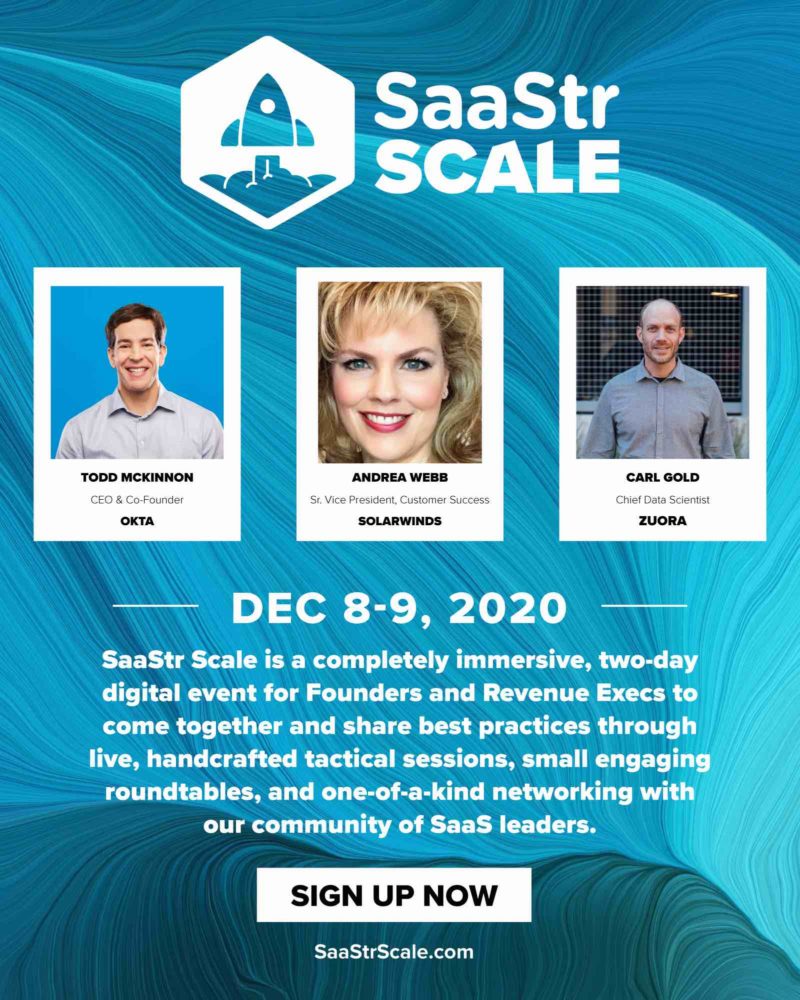
SaaStr Scale has never been the kind of event where people show up, sip coffee, nod politely, and leave with three vague motivational quotes. It is built for operators who want the real stuff: how to scale revenue, expand customer success, build smarter products, tighten go-to-market operations, and move from promising startup to serious SaaS machine without setting the office plants on fire.
The latest SaaStr Scale speaker lineup brings together founders, CEOs, revenue leaders, product executives, customer success experts, data specialists, and investors from some of the most recognized names in software. Think Airtable, Okta, Zuora, MongoDB, Zendesk, Snowflake, Vanta, Tipalti, Paddle, Freshworks, CrowdStrike, Sumo Logic, Checkout.com, Insight Partners, and more. That is not a random collection of logos. It is a practical map of how modern SaaS companies grow.
For founders, CROs, CMOs, CCOs, product leaders, and anyone trying to scale a B2B software company, this is the kind of speaker list that deserves more than a quick scroll. The sessions point directly at the questions SaaS teams ask every week: How do we build a stronger sales motion? How do we reduce churn? How do we sell to the enterprise? How do we use data better? How do we build customer trust? How do we grow without turning every department into a heroic emergency response unit?
Why the SaaStr Scale Speaker Lineup Matters
Great SaaS events are not just about famous speakers. Famous is nice. Famous gets clicks. Famous also makes the event badge feel a little shinier. But the real value comes from speakers who have lived through the messy middle of growth: the hiring mistakes, the pricing debates, the product pivots, the customer escalations, the board meetings, and the “why is our forecast suddenly wearing a disguise?” moments.
SaaStr Scale focuses on the operating playbooks behind growth. Its speaker lineup has historically emphasized lessons from executives who have helped companies move through meaningful stages of expansion, including product-led growth, enterprise selling, customer retention, revenue operations, partner ecosystems, and security readiness. That matters because scaling is rarely one big trick. It is usually a stack of better decisions made consistently across sales, marketing, product, finance, support, and leadership.
The featured speakers represent different corners of the SaaS world. Airtable brings the low-code and collaborative app-building perspective. Okta brings identity and security. Zuora brings subscription monetization and quote-to-cash thinking. MongoDB brings the data platform angle. Zendesk brings customer experience. Vanta brings trust and compliance. Tipalti brings finance automation. Snowflake, CrowdStrike, Sumo Logic, and others bring the infrastructure, data, and security backbone that fast-growing companies eventually need.
Featured SaaStr Scale Speakers to Watch
Howie Liu, Co-Founder and CEO of Airtable
Howie Liu is one of the most interesting voices for founders building flexible, horizontal platforms. Airtable became known for helping teams create custom workflows, applications, and collaborative systems without forcing every user to become a database administrator. That makes Liu’s perspective especially valuable for SaaS leaders trying to build products that are powerful enough for enterprise users but approachable enough for teams that simply want work to move faster.
The big lesson from Airtable’s story is that broad platforms require patience. A horizontal product can serve many industries, but that flexibility also creates positioning challenges. Who exactly is it for? What use cases should sales prioritize? How do you explain a product that can do many things without sounding like it does everything and nothing at the same time? Liu’s experience speaks directly to founders navigating category creation, product-led adoption, and upmarket expansion.
Todd McKinnon, CEO and Co-Founder of Okta
Todd McKinnon’s SaaStr Scale appearance brings a founder-level view of identity, enterprise trust, and high-performance organizations. Okta’s rise has been tied to a simple but powerful reality: as companies adopt more cloud tools, they need secure ways to manage access for employees, customers, partners, and increasingly, non-human digital actors like automated systems and AI agents.
For SaaS founders, McKinnon’s lessons go beyond security. Identity is a deeply strategic category because it touches IT, compliance, product experience, and customer confidence. His perspective is useful for leaders asking how to build enterprise-grade reliability while still moving fast. Growth is fun, but enterprise buyers tend to ask uncomfortable questions involving security reviews, procurement, compliance, uptime, and documentation. In other words, the party gets more serious when the contract gets bigger.
Carl Gold, Chief Data Scientist at Zuora
Carl Gold represents one of the most important topics in SaaS: understanding customers through data. Zuora is associated with subscription management, recurring revenue, billing, payments, revenue recognition, and monetization. Those are not glamorous cocktail-party subjects unless you attend very unusual cocktail parties, but they are absolutely central to scaling a SaaS business.
As companies grow, pricing and packaging get more complicated. Customers want usage-based options, bundles, add-ons, flexible terms, and billing models that match the value they receive. Data science becomes crucial because it can reveal patterns behind expansion, contraction, churn, retention, and customer lifetime value. Gold’s perspective helps SaaS leaders think more clearly about how data can support better monetization decisions instead of simply decorating dashboards with colorful charts.
Javier Molina and Sahir Azam from MongoDB
MongoDB’s presence at SaaStr Scale adds a strong data platform and sales execution angle. Javier Molina, a corporate sales leader, and Sahir Azam, a product executive, represent two sides of growth that must work together: what customers need and what the product must become to meet that demand.
This combination is especially relevant for SaaS companies moving upmarket. Enterprise buyers often need flexibility, integration, security, and proof that the product will keep evolving. Product teams need to understand those needs without becoming a custom development shop for every large account. Sales teams need to win major deals without promising features that cause engineers to quietly update their LinkedIn profiles. MongoDB’s example offers useful lessons in balancing developer adoption, enterprise readiness, and scalable go-to-market execution.
Andrea Webb, Pablo Dominguez, Brooke Treseder, and Gordana Vuckovic
One of the strongest themes in the SaaStr Scale lineup is revenue leadership. Andrea Webb, Pablo Dominguez, Brooke Treseder, and Gordana Vuckovic bring experience across customer success, sales, revenue operations, and go-to-market strategy. Together, their topics point to a truth every SaaS company eventually learns: growth is not only about acquiring customers. It is about keeping them, expanding them, supporting them, and making the entire revenue engine less chaotic.
Revenue operations has become one of the most important disciplines in SaaS because it connects data, process, forecasting, enablement, sales execution, and customer lifecycle management. When revenue operations is weak, teams argue about numbers. When it is strong, teams argue about strategy. That is progress. SaaStr Scale’s revenue-focused sessions help companies understand how to create cleaner handoffs, stronger pipeline discipline, better retention systems, and more predictable growth.
Christina Cacioppo, CEO of Vanta
Christina Cacioppo’s inclusion is especially relevant for startups trying to sell into larger customers. Vanta is known for helping companies automate security and compliance workflows, including evidence collection for frameworks such as SOC 2 and ISO 27001. For early-stage founders, compliance can feel like homework assigned by enterprise buyers. But as companies scale, trust becomes a sales accelerator.
The lesson is simple: the faster your company grows, the more your customers will care about how you handle data, access, risk, and security. A startup can sometimes win early customers with speed and charm. Enterprise customers want speed, charm, documentation, audit trails, security controls, and someone who can answer a procurement questionnaire without crying into a spreadsheet.
Chen Amit, Co-Founder and CEO of Tipalti
Chen Amit brings a finance automation perspective that is often underappreciated in SaaS growth conversations. Tipalti focuses on accounts payable, procurement, global payments, treasury, and finance operations. These systems become increasingly important as companies expand across countries, vendors, partners, contractors, affiliates, and payment methods.
Finance operations may not get the same applause as product launches, but it can determine whether a company scales smoothly or drowns in manual work. As SaaS companies grow, financial workflows need automation, compliance, control, and visibility. Amit’s experience is valuable for leaders who understand that scaling is not only about selling more; it is also about building the operational discipline to support that growth.
What Founders Can Learn from This Speaker Group
Scaling Requires Focus, Not Just Ambition
Many founders want to scale quickly. Fewer are prepared for the trade-offs that come with scale. The SaaStr Scale speakers repeatedly point toward focus as a core growth principle. Focus means choosing the right customer segments, prioritizing the right product bets, hiring leaders who match the company’s stage, and avoiding the temptation to chase every shiny opportunity that waves from the side of the road.
Focus is particularly important in SaaS because recurring revenue can create a comforting illusion. A company may look healthy while hiding churn risk, weak expansion, inefficient acquisition costs, or messy onboarding. The best operators look beneath the surface. They ask whether growth is durable, whether customers are successful, and whether the business model becomes stronger as it gets bigger.
Customer Success Is a Growth Strategy
Customer success is not a department that sends friendly check-in emails and hopes everyone renews. In modern SaaS, customer success is part of the growth engine. It helps customers reach value faster, identifies expansion opportunities, reduces churn, and feeds product teams with real-world insight.
Speakers from companies such as Zendesk, SolarWinds, Freshworks, Paddle, and Checkout.com highlight the importance of customer experience across the entire lifecycle. Support, onboarding, billing, payments, knowledge management, and retention all influence whether customers stay and grow. A great SaaS company does not simply close deals; it earns renewals.
Enterprise Readiness Changes Everything
Moving upmarket sounds exciting until the first enterprise prospect sends a security questionnaire longer than a short novel. Enterprise readiness requires better systems across product, sales, legal, finance, security, and customer success. It also changes the buying process. More stakeholders get involved. Sales cycles lengthen. Procurement appears. Legal reviews multiply. Suddenly, your simple pricing page has entered a courtroom drama.
That is why speakers from Okta, Vanta, CrowdStrike, Snowflake, MongoDB, and Sumo Logic matter. Their experience reflects the infrastructure required to support larger customers. Enterprise SaaS companies must prove that they are secure, reliable, scalable, and operationally mature. The reward can be larger contracts and stronger retention, but the cost is discipline.
Why SaaStr Scale Is Useful for Revenue Leaders
Revenue leaders attend events like SaaStr Scale because they need practical benchmarks. They want to know what is working in sales, marketing, customer success, partner ecosystems, pricing, and revenue operations. They also want to hear from people who have already made the mistakes they are trying to avoid. This is professional development with fewer buzzwords and more scar tissue.
The lineup includes leaders connected to sales strategy, global partnerships, customer retention, revenue marketing, and GTM operations. That mix is important because revenue growth is no longer a single-lane road. Companies need outbound motions, inbound demand, product-led loops, partner channels, customer expansion, community, and sometimes a very patient RevOps team explaining why the CRM cannot be treated like a personal diary.
Key Themes Across the SaaStr Scale Sessions
Product-Led Growth and Platform Expansion
Products such as Airtable, MongoDB, Gainsight PX, and Twilio show how important product experience has become in SaaS growth. Buyers increasingly expect software to be easy to try, easy to adopt, and flexible enough to expand across teams. Product-led growth does not eliminate sales; it often gives sales a stronger foundation by creating usage signals and internal champions before a formal enterprise deal begins.
Trust, Security, and Compliance
Trust is now part of the buying journey. Customers want to know how vendors protect data, manage access, handle compliance, and respond to risk. Vanta, Okta, CrowdStrike, and Sumo Logic represent this shift. Security is not just an IT concern. It is a revenue concern, a product concern, and a board-level concern.
Revenue Operations and Forecasting Discipline
Revenue operations has become the connective tissue of SaaS growth. It helps teams understand pipeline quality, conversion rates, churn signals, sales productivity, territory planning, and expansion opportunities. Without strong RevOps, scaling can feel like driving at night with sunglasses on. Technically possible, but not recommended.
Customer Retention and Expansion
The SaaS model rewards companies that keep customers happy over time. Retention is not just a metric; it is a reflection of product value, onboarding quality, support responsiveness, account management, and pricing alignment. Customer success leaders in the SaaStr Scale ecosystem help show how retention becomes a company-wide discipline.
How to Get the Most Value from SaaStr Scale
To get real value from an event like SaaStr Scale, attendees should do more than watch sessions passively. Before the event, identify the top three business problems you want to solve. Maybe your company needs a better enterprise sales process. Maybe churn is rising. Maybe your pricing model needs a serious adult conversation. Maybe your RevOps system resembles a group project where everyone used a different spreadsheet.
Then match sessions to those problems. Watch the speakers who have solved similar challenges. Take notes in terms of actions, not quotes. “Improve onboarding” is too vague. “Create a 30-day enterprise onboarding checklist with success milestones, risk flags, and owner assignments” is useful. The best SaaStr Scale sessions are tactical, so attendees should turn insights into operating changes quickly.
It also helps to share session notes across departments. A sales leader may hear something useful for product. A product leader may hear something useful for customer success. A founder may finally understand why finance has been asking for cleaner billing workflows since the beginning of time. The more cross-functional the learning, the more valuable the event becomes.
Experience-Based Takeaways: What It Feels Like to Learn from SaaStr Scale
The real experience of following a SaaStr Scale speaker lineup is that it feels like getting a backstage pass to the operating rooms of high-growth SaaS companies. Not the glamorous backstage with velvet ropes and sparkling water. The useful backstage, where people admit what broke, what worked, what they would never do again, and which decisions actually moved the company forward.
One of the most valuable experiences is hearing how different leaders describe the same problem from different angles. A CEO may talk about focus. A CRO may talk about pipeline quality. A customer success leader may talk about retention risk. A product leader may talk about adoption. A finance leader may talk about billing complexity. At first, those sound like separate topics. But when you listen closely, they connect. Scaling is the art of making those functions work together without turning every meeting into a tiny courtroom.
For a founder, the experience can be both inspiring and humbling. It is inspiring because the speakers prove that enormous companies are built by people who once faced the same messy questions: Who is our ideal customer? How do we price this? When do we hire a VP? Should we go upmarket? Why is churn higher in one segment? How do we make sales and product stop glaring at each other across the table? It is humbling because the answers are rarely magic. They usually involve sharper focus, better systems, stronger managers, and more honest measurement.
For revenue leaders, SaaStr Scale feels like a reality check. The sessions often reinforce that growth problems are not solved by simply asking sales to “push harder.” Better growth comes from better segmentation, stronger enablement, cleaner handoffs, realistic forecasting, thoughtful compensation, and a deep understanding of customer value. A great sales team can do a lot, but even the best team struggles when pricing is confusing, onboarding is weak, or the product promise does not match the customer experience.
For customer success teams, the event experience highlights how strategic their role has become. Customer success is not a rescue squad that appears when usage drops. It is a growth function that begins before the contract is signed. The best teams define success early, measure adoption clearly, create repeatable onboarding, and know when to involve product, support, or executive sponsors. In a recurring revenue business, the renewal is not the end of the story. It is the customer voting again.
For product and operations leaders, SaaStr Scale offers a reminder that internal systems matter. A product may be brilliant, but if the company cannot bill customers correctly, answer security questions, support integrations, or forecast demand, growth becomes painful. The speakers connected to data, trust, finance automation, and infrastructure show that scale is built in the details. Nobody writes a viral LinkedIn post titled “We Finally Fixed Our Quote-to-Cash Workflow,” but that kind of work can unlock serious growth.
The best way to experience SaaStr Scale is to treat it like a working session, not background noise. Pick sessions based on your company’s current stage. Write down specific experiments to test. Share notes with your team. Revisit the ideas after 30 days. Events are exciting, but execution is where the money is hiding. And like most money hiding in SaaS, it is probably somewhere between customer retention, expansion revenue, and a cleaner sales process.
Conclusion
The latest SaaStr Scale speakers offer more than a list of impressive names. They represent the practical disciplines that help SaaS companies grow: product strategy, enterprise selling, customer success, data science, trust, compliance, finance automation, revenue operations, and leadership focus. From Howie Liu at Airtable to Todd McKinnon at Okta, Christina Cacioppo at Vanta, Chen Amit at Tipalti, and many more, the lineup gives founders and operators a rare chance to learn from people who have navigated real scale.
For anyone building or leading a SaaS company, the message is clear: scaling is not about copying someone else’s playbook word for word. It is about understanding the principles behind great companies and adapting them to your own market, customers, team, and stage. SaaStr Scale is valuable because it brings those principles into the open. No fluff, no empty hype, and hopefully no panels where everyone agrees that “alignment is important” for 40 minutes. Just practical lessons from people who know what growth really takes.