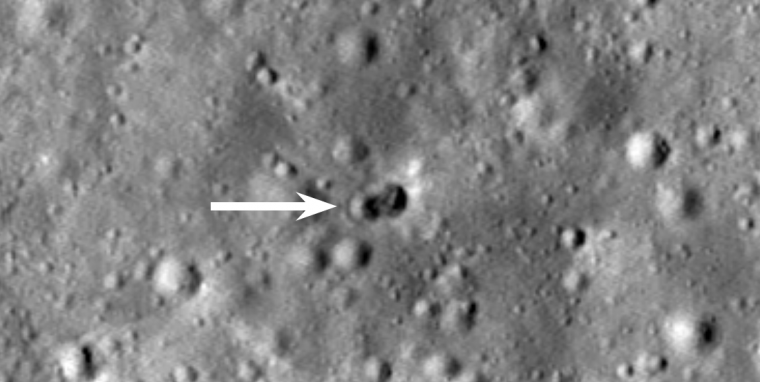
A rocket body slammed into the far side of the Moon on March 4, 2022, and for once, the Moon did not simply shrug and add another anonymous dent to its already battered face. This impact left behind something strange: a double crater. Not one neat hole. Not one cosmic pothole. Two overlapping craters, sitting side by side like the Moon had been punched with a pair of brass knuckles.
The object, known to astronomers as WE0913A, had been wandering through the Earth-Moon system for years before its final appointment with lunar geology. At first, many observers thought it was a discarded SpaceX Falcon 9 upper stage from the DSCOVR mission. Later analysis pointed elsewhere: to a Chinese Long March 3C rocket body from the Chang’e 5-T1 mission, launched in 2014 as a test run for China’s lunar sample-return ambitions.
Then came the deliciously weird part. When NASA’s Lunar Reconnaissance Orbiter photographed the crash site, the scar did not look like a typical rocket impact. The unusual double crater suggested that the crashing rocket may have had significant mass at both ends. In plain English: something heavy may have been attached to the booster. What was it? That remains the million-dollar lunar mystery, and unfortunately, the Moon is not currently taking questions.
The Crash Heard by Almost Nobody
The Moon has no air, no weather, and no dramatic Hollywood shockwave. When WE0913A hit the lunar far side, there was no thunderclap, no fireball visible from Earth, and no heroic camera angle with dramatic music. The impact happened out of sight, beyond direct Earth view, near the huge Hertzsprung crater.
But even silent crashes leave evidence. NASA’s Lunar Reconnaissance Orbiter, often called LRO, later compared before-and-after images of the region. The spacecraft spotted a fresh double crater roughly 28 to 29 meters wide at its longest dimension. One crater measured about 18 meters across, while the other was about 16 meters. That is not “city-destroying asteroid” territory, but for a piece of human-made space junk, it was a pretty rude landing.
The discovery mattered because other known rocket impacts on the Moon, including Apollo-era Saturn rocket stages, did not create the same kind of paired crater. Those older impacts produced irregular but more conventional scars. This new double feature made scientists ask a simple question with complicated implications: what exactly hit the Moon?
From SpaceX Suspect to Chinese Booster
The mystery began with mistaken identity. Astronomer Bill Gray, who tracks near-Earth objects and space debris, initially linked WE0913A to a SpaceX Falcon 9 upper stage from the 2015 DSCOVR mission. That seemed reasonable at first. The object was tumbling, bright, and roughly the size expected for a discarded rocket stage.
But orbital detective work is not as easy as reading a license plate in space. Deep-space debris can loop around Earth and the Moon for years, nudged by gravity, sunlight, and imperfect tracking records. Later, Jon Giorgini at NASA’s Jet Propulsion Laboratory and other analysts helped show that the SpaceX identification did not fit well enough.
The revised candidate was China’s Long March 3C upper stage from Chang’e 5-T1, a 2014 mission designed to test technologies for returning lunar samples to Earth. That mission successfully demonstrated a high-speed lunar-return profile, helping prepare the way for China’s later Chang’e 5 sample-return mission. The booster, however, appears to have remained on a wandering path until gravity eventually mailed it to the Moon with no return address.
Why the Double Crater Is So Strange
A typical rocket upper stage has most of its heavy hardware concentrated at one end, especially near the engine. The rest is largely empty tankage after the fuel is spent. If that kind of object strikes the Moon, scientists would generally expect a single main crater or an irregular impact mark, not two similarly sized craters.
That is why the WE0913A impact site raised eyebrows. Researchers from the University of Arizona and other institutions argued that the double crater could be explained if the object had two major masses separated from each other. One mass would be the rocket engine section. The other could have been an additional payload, counterweight, support structure, or some object that was never publicly identified.
This does not automatically mean “secret superweapon,” “alien luggage,” or “Moon goblin storage container.” Sorry, internet. The most responsible answer is less cinematic: researchers found evidence suggesting an undisclosed object or unusual mass distribution, but the exact nature of that object is unknown.
What Was the Mystery Object?
The honest answer is: nobody outside the mission’s full technical records can say for sure. The object may have been a payload adapter, a balancing mass, instrumentation, or another piece of mission hardware attached to the spent booster. It may have had a perfectly ordinary engineering purpose. Spacecraft are full of brackets, tanks, sensors, and odd-looking structures that would make no sense to a person expecting everything to look like a clean science-fiction spaceship.
However, the mystery remains because public documentation has not clearly identified a second heavy object attached to the Chang’e 5-T1 rocket body. China has disputed the conclusion that the booster belonged to that mission, saying the relevant rocket stage reentered Earth’s atmosphere. Independent tracking and spectral analysis, however, have supported the view that WE0913A was most consistent with the Long March 3C booster from Chang’e 5-T1.
That disagreement is part of what makes the story fascinating. Space is often described as vast and empty, but modern space operations are crowded with incomplete records, national security concerns, commercial secrecy, and old debris that refuses to behave like a well-labeled museum exhibit.
How Scientists Tracked the Lunar Impactor
Tracking a rocket body in cislunar space is a little like trying to follow a soda can thrown into a dark ocean, except the ocean is gravity, the soda can is moving thousands of miles per hour, and everyone involved has a spreadsheet open.
Scientists used a combination of orbital calculations, telescope observations, brightness measurements, and spectral data. The way WE0913A reflected light helped researchers compare it with known rocket materials. Its tumbling pattern also gave clues about its shape and balance. According to the research team, the object rotated in a way that suggested unusual stability, which may support the idea of mass at both ends.
The final piece of evidence came from the Moon itself. LRO’s images of the double crater provided the geological receipt. The Moon may be dusty and quiet, but it is an excellent record keeper. With no rain, wind, rivers, or annoyed homeowners’ associations to erase impact scars, lunar craters can preserve evidence for years, centuries, or much longer.
Why This Lunar Crash Matters
At first glance, a rocket crashing into the Moon may sound like a cosmic shrug. After all, the Moon is covered with craters. It has been hit by asteroids, meteoroids, and ancient debris for billions of years. One more impact might seem like tossing a pebble onto a gravel driveway.
But this event matters because it highlights a growing issue: human-made space junk is no longer limited to low Earth orbit. As more nations and companies send missions to the Moon, Mars, and deep space, leftover rocket stages and discarded hardware can end up in long, complicated orbits. Some may eventually hit the Moon. Others may return toward Earth or remain in hard-to-track paths for years.
The WE0913A case showed that identifying deep-space debris is difficult. It also showed that public tracking systems are not always complete. In low Earth orbit, many objects are closely monitored because they can threaten satellites and crewed spacecraft. In the Earth-Moon region, the tracking environment is less mature. That is a problem because the next decade is expected to bring more lunar missions, more landers, more orbiters, and eventually more infrastructure near the Moon.
The New Era of Lunar Traffic
The Moon is becoming busy again. NASA’s Artemis program aims to return astronauts to the lunar surface. China has continued its successful Chang’e program, including sample-return and far-side missions. Private companies are building lunar landers. Scientific teams are eyeing the lunar south pole, where permanently shadowed regions may contain water ice.
That future is exciting, but it also means the Moon needs better traffic management. A random rocket body hitting an empty patch of lunar far side is one thing. A similar object threatening a lunar orbiter, lander, radio telescope, or future base is another.
Space agencies already know how to plan controlled disposals. Rocket stages can sometimes be directed into solar orbit, targeted impact zones, or safer trajectories. The challenge is making such practices consistent across nations and companies. Space may be big, but bad bookkeeping has a special talent for making big places feel crowded.
What the Double Crater Teaches Us About the Moon
Scientifically, fresh impact craters are useful. They allow researchers to study how material behaves when something strikes the lunar surface at high speed. Because the impact time was known, scientists can compare images taken before and after the crash. That makes the crater a controlled accident, which is not usually a phrase anyone wants to hear in aerospace, but in this case it has research value.
The double crater also helps scientists understand how artificial objects differ from natural impactors. Asteroids and meteoroids are usually compact rocks or metal-rich bodies. Rocket stages are hollow, oddly shaped, and made of engineered materials. Their impacts can reveal how structure, speed, angle, and mass distribution affect crater formation.
In other words, the Moon became an accidental crash-test facility. Nobody should make a habit of using it that way, but once the dent exists, researchers might as well learn from it.
No, This Is Not an Alien Story
Whenever the words “Moon,” “mystery object,” and “China” appear in the same headline, the internet puts on a tinfoil hat so fast it should qualify as a chemical reaction. But this story does not require aliens, secret moon bases, or a dramatic soundtrack from a 1990s UFO documentary.
The mystery is technical, not supernatural. The evidence points toward a human-made rocket body with an unusual mass configuration. The unknown object was likely mission-related hardware, not a visitor from another star system. That may sound less thrilling, but it is actually more important. The real story is about transparency, tracking, engineering, and the future of responsible space exploration.
Sometimes the truth is not “aliens.” Sometimes it is “somebody left hardware attached to a rocket stage, and now lunar geologists have questions.” That may not sell as many movie tickets, but it is how space science usually works.
Why Transparency in Space Matters
Space exploration depends on trust. Nations do not have to reveal every engineering detail of every mission, but basic information about large objects in deep-space trajectories can help everyone. Accurate tracking reduces confusion, prevents false blame, and helps scientists understand what is moving through the Earth-Moon system.
The WE0913A case became messy partly because the object was difficult to identify. If mission hardware were cataloged more clearly after launch, analysts would have a better chance of determining what an object is before it crashes into something. Better data sharing would also help avoid diplomatic finger-pointing when debris is misidentified.
As lunar exploration grows, transparency will become more valuable. Future missions may operate near valuable landing zones, scientific instruments, or communication relays. Knowing where old rocket bodies are headed is not just nerd housekeeping. It is basic space safety.
Experiences and Reflections: What This Story Feels Like From Earth
There is something strangely humbling about reading that a forgotten rocket stage spent years looping through space before crashing into the Moon. On Earth, we are used to losing small things: keys, earbuds, phone chargers, the will to fold laundry. In space, humanity loses rocket boosters. The difference is that our misplaced objects can travel for years and carve a crater into another world.
This story also changes the way many people look at the Moon. For most of us, the Moon is a familiar silver disk hanging in the sky, the same quiet companion that shows up over city skylines, farms, oceans, and late-night parking lots. It feels ancient and untouchable. Then a story like this arrives and reminds us that the Moon is no longer just a distant symbol. It is becoming part of our working neighborhood.
Imagine standing outside on a clear night, looking up at the Moon, and realizing that somewhere on its far side there is a fresh scar made by a human machine. You cannot see it with your eyes. You cannot point it out to a friend without a spacecraft image. But it is there, a small mark in lunar dust that says: humans have reached far enough to make a mess even where nobody lives.
That thought is funny, impressive, and a little uncomfortable all at once. It is funny because the idea of a rocket stage wandering around like lost luggage is absurd. It is impressive because tracking such an object across deep space requires serious skill. It is uncomfortable because it reveals how quickly exploration can create leftovers. Every great adventure has a cleanup problem, and space is no exception.
The mystery object adds another emotional layer. People love mysteries because they create a blank space for imagination. Was it a sensor package? A counterweight? A payload adapter? Some routine component nobody bothered to describe publicly? The unknown invites speculation, but it also invites better questions. What should countries disclose about deep-space missions? Who tracks old hardware? How do we prevent future confusion? How do we explore without turning the Moon into a dusty attic full of abandoned equipment?
For students, space fans, engineers, and casual sky-watchers, this event is a reminder that science is not always clean and polished. Sometimes it is a detective story. Someone notices an object. Someone calculates an orbit. Someone corrects the first guess. A spacecraft photographs a crater. Researchers compare materials, motion, and impact patterns. Slowly, the story becomes clearer, though not perfectly complete.
That is part of the charm. Science does not always arrive wearing a lab coat and carrying a final answer. Sometimes it arrives as a weird double crater on the far side of the Moon, looks everyone in the eye, and says, “Explain this.”
The best lesson from the Chinese rocket crash is not that space is dangerous or that every mystery is suspicious. The lesson is that the space age has entered a more complicated phase. The Moon is no longer just a destination for flags and footprints. It is becoming a place of experiments, traffic, competition, cooperation, and responsibility. If humanity is going to work there, we need better habits than “launch it and hope someone remembers where the leftovers went.”
In the end, the Moon kept the evidence. It held the impact scar in silence until LRO came around with its camera. That is wonderfully lunar behavior: no drama, no press conference, just a gray surface preserving the facts. The mystery object may never be fully identified in public, but the double crater has already done its job. It reminded us that space exploration is not only about reaching new places. It is also about taking responsibility for what we leave behind.
Conclusion
The story of the Chinese rocket that crashed into the Moon with a mystery object in tow is more than a quirky space headline. It is a preview of the future. The object known as WE0913A likely came from China’s Chang’e 5-T1 mission, struck the lunar far side on March 4, 2022, and left behind an unusual double crater that scientists are still working to fully explain.
The most likely explanation is not science fiction, but engineering: the rocket body may have carried or retained a second heavy component that helped create two overlapping craters. Still, the lack of a clear public identification keeps the mystery alive. More importantly, the event shows why better tracking, transparency, and disposal practices are essential as lunar exploration accelerates.
The Moon can handle another crater. It has had practice. But humanity should treat this impact as a warning label written in lunar dust: space junk does not disappear just because it is far away. As we return to the Moon with bigger plans, we need to bring not only ambition, but accountability.