Some homes whisper. This one walks up, introduces itself with excellent posture, and casually reveals that it knows what a Noguchi lantern is. The Santa Monica house associated with designer Alexandra Loew is memorable for exactly that reason: it feels smart without acting smug, playful without turning into a children’s birthday party, and colorful without looking like a paint store exploded in slow motion. In other words, it is the rare designer home that has both a point of view and a pulse.
Loew has built a reputation for interiors that feel intellectually grounded yet emotionally alive. That balance is what makes Designer Visit: Alexandra Loew in Santa Monica such an enduring point of reference for anyone interested in interior design, California homes, family-friendly style, or the magical moment when geometry, color, and personality all agree to get along. This is not a sterile showplace built for applause alone. It is a lived-in, idea-rich Santa Monica bungalow where design becomes a form of storytelling.
Who Is Alexandra Loew?
Alexandra Loew is not a decorator who simply arrives with fabric swatches and a heroic amount of confidence. Her background spans architecture, scholarship, exhibition design, and an early creative life in filmmaking. That mix matters. It helps explain why her rooms often feel cinematic, layered, and slightly transportive, as though they are staging a scene from a very stylish movie in which everyone has better books and better lamps than the rest of us.
Her studio’s identity has long centered on the idea that interiors can do more than look attractive. They can shape mood, frame memory, and create a stronger reflection of the client’s personality. Loew is often described as a designer with a curatorial eye, and that feels exactly right. She does not merely fill a room. She edits it, sharpens it, and gives it an internal logic. The result is not a signature style in the lazy sense. It is a signature intelligence.
That intelligence shows up across her body of work. In one project, she brought narrative structure and architectural discipline to a massive Marina del Rey renovation. In another, she infused a Victorian house with Moroccan mood. In museum work, she has used color and spatial rhythm to make furniture exhibitions feel more intimate and emotionally charged. Seen together, these projects reveal a designer who loves form, but refuses to let form become boring. For Loew, design is not just arrangement. It is atmosphere with a thesis.
The Santa Monica House: Where Geometry Gets a Personality
The Santa Monica project that made such a strong impression began with a renovated bungalow owned by a mother with two young daughters. The house already had unusual bones, including folded planes and an unfussy material palette. Instead of fighting that architecture, Loew leaned into it. Hard. She turned those angular cues into a full visual language, using triangles and folded forms as recurring motifs throughout the home.
This is one of the most instructive things about the house. A lesser designer might have treated the existing architecture like a neutral container and added decoration on top. Loew did the opposite. She read the house carefully, picked up on its angular rhythm, and let that rhythm spread through curtains, furnishings, murals, alcoves, and spatial detailing. It is a smart lesson in how good design often starts with noticing what is already there.
Color That Refuses to Behave Politely
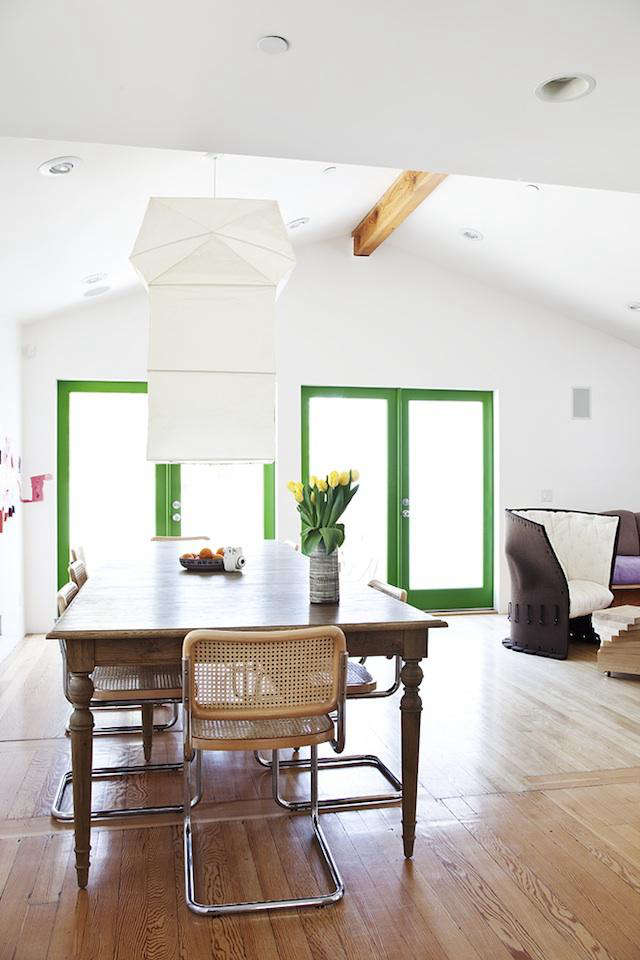
Then comes the color. And no, this is not the kind of color story that timidly suggests a “pop” of blue in a throw pillow. This home uses color the way some people use punctuation: generously, confidently, and with excellent timing. A bright green door frame wakes up the living area. Built-in seating wrapped in multiple shades of lavender turns a practical architectural feature into a soft, eccentric centerpiece. In the children’s rooms, pink-glazed plywood and playful fabrics create spaces that feel imaginative rather than overly precious.
What keeps the house from tipping into chaos is Loew’s control. She knows where to go vivid and where to stay restrained. She knows when a room needs pattern, and when texture alone can carry the mood. She also understands that color is not just decorative. It is emotional. It can make a room feel playful, cerebral, dreamy, irreverent, or intimate. In Santa Monica, she uses it to make the house feel alive from one room to the next.
A Family Home That Actually Includes the Family
One of the most charming aspects of the project is that the children were not treated like tiny, inconvenient tenants who should be hidden behind beige walls until adulthood. They were invited into the design process. Their taste influenced fabric choices, and their presence is visible in the spirit of the rooms. That decision matters because it reveals Loew’s larger philosophy: the best interiors do not erase real life. They elevate it.
That is why the house feels warm instead of performative. Yes, it contains collectible design references and sharp visual ideas. But it also makes room for delight, family rituals, and a little whimsy. It understands that a serious design mind can still appreciate pom-pom trim, playful alcove beds, and a room that does not mind a child crashing into it with marker-stained fingers and a dramatic opinion about snacks.
The Details That Make the Project Sing
Some designer homes succeed because they feature expensive pieces. This one succeeds because it has a clear visual argument. Loew’s Santa Monica interiors combine recognizable design history with a willingness to get weird in the best way. A Noguchi lantern floats over the dining area. Breuer chairs bring modern pedigree. A felted chair introduces sculptural texture. A custom marble-topped bedside table adds gravitas. Elsewhere, silver wallpaper turns a study into something moodier and more immersive.
And then there is the deliciously practical touch of Tyvek balloon curtains in the guest room. That is classic Loew energy: conceptual, unexpected, and a little mischievous. She is perfectly comfortable pairing high-minded references with smart, surprising materials. This makes the rooms feel less precious and more inventive. They are informed by design history, but not trapped by it.
Another standout quality is her handling of contrast. Plush upholstery plays against harder geometry. Decorative gestures sit alongside simple materials. Historical references appear in rooms that still feel fresh and current. Even when she nods to traditional decoration, she does so with a slight twist of irony or theatricality. That keeps everything from feeling nostalgic in a dusty way. Loew does not recreate the past. She remixes it.
Why the Santa Monica Project Still Feels Relevant
Design trends come and go with the emotional stability of a caffeinated squirrel. But this project still resonates because it is built on principles that age well. First, it is personal. Second, it is architecturally responsive. Third, it is unafraid. Those three qualities are harder to fake than any trending finish or algorithm-approved paint color.
The Santa Monica house also anticipated a design direction that has only become more valued over time: spaces that feel collected, emotionally specific, and resistant to generic luxury. Today, many homeowners want interiors with more character and less showroom stiffness. They want rooms that reflect real identity. Loew was already doing that. She showed how a home could be sophisticated without becoming humorless, and how family-friendly design could still be visually ambitious.
There is also something deeply Californian about the project, though not in the usual all-white, oak-and-linen, smoothie-on-the-counter way. This is a different California story. It is coastal, yes, but it is also artistic, layered, and slightly rebellious. Santa Monica provides the lightness; Loew provides the edge. Together, they create a house that feels casual enough for real life and strong enough for editorial memory.
What Alexandra Loew Does Better Than Almost Anyone
If you trace Loew’s work across publications and projects, a pattern emerges. She is exceptionally good at building interiors around a narrative instead of a formula. In Marina del Rey, she transformed an over-the-top house into something more ordered and architectural. In other homes, she has mixed antiques with contemporary elements to create tension and surprise. In exhibition design, she has used color and material to make ideas feel spatial. The through line is not one look. It is one mindset.
That mindset values story, contradiction, and point of view. Loew understands that a room becomes memorable when it contains a conversation: between old and new, hard and soft, humor and seriousness, intellect and instinct. The Santa Monica house captures that beautifully. It is geometric but not cold. Colorful but not childish. Referenced but not derivative. Stylish but still human. Frankly, many homes would be thrilled to accomplish even two of those things.
Ideas Worth Borrowing From This Home
Start With the Architecture
Instead of forcing a house into a trend, identify what makes it distinctive. In Santa Monica, folded planes and angular lines became the design seed for everything else.
Let Color Be Specific
Not all bold color is good color. The secret is intention. Green, lavender, pink, silver, and patterned textiles work here because they are orchestrated, not random.
Design for the People Who Actually Live There
Rooms become more convincing when the client’s habits, history, and even children’s opinions help shape them. Personality beats perfection every time.
Mix Prestige With Play
A home can include recognized design pieces and still have a sense of humor. In fact, it probably should. A little irreverence keeps sophistication from becoming sleepy.
Experiencing Alexandra Loew in Santa Monica: An Extra of Pure Atmosphere
Imagine arriving in Santa Monica in that late-afternoon coastal light that makes everything look faintly edited, as if the neighborhood hired its own cinematographer. You step toward the house expecting a tasteful bungalow, maybe something charming and bright and politely well behaved. Instead, what you get is a home that feels like it already knows you were about to underestimate it. The exterior offers a clue, but the interior makes the argument.
The first sensation is not just visual. It is psychological. The house does not unfold in a dull, predictable sequence. It nudges you from one mood to another. A flash of green at a doorway acts like a wink. Lavender upholstery softens the architecture without surrendering to it. Angled details keep your eye moving. You start realizing that this is one of those rare spaces that is playful and disciplined at the same time, like a ballet dancer who can also roast you at dinner.
Then the details begin to land one by one. The lantern over the dining table is airy and sculptural, the kind of piece that changes the emotional temperature of a room without shouting about itself. Chairs carry memory and pedigree. Textiles do not merely upholster; they participate. A curtain does not hang. It echoes the geometry of the house. A child’s alcove does not just provide a place to sleep. It becomes a small declaration that imagination deserves square footage too.
What is most striking is that the house never feels decorated in the superficial sense. It feels interpreted. Someone looked at the clients, the architecture, the light, the family dynamic, the history of design, and then translated all of that into rooms. That translation is where Loew’s work becomes especially compelling. She is not just assembling beautiful things. She is creating relationships between them. Color relates to shape. Shape relates to architecture. Architecture relates to personality. Suddenly the whole house starts to feel like one sustained sentence instead of a stack of design decisions.
And because this is Santa Monica, the atmosphere matters. The local ease is there, but it has been sharpened. There is none of that sleepy coastal blandness that makes every room look like it is waiting for a candle called Ocean Whisper to arrive. This house has energy. It has edge. It has the confidence to be elegant and odd at the same time. You can imagine children running through it, guests pausing mid-conversation to inspect a wallpaper choice, someone reading in the study while silver walls catch the light and quietly perform their little miracle.
By the time you mentally leave the house, what lingers is not just a list of furnishings or color choices. It is a feeling that design can still surprise us. That a family house can be rigorous and funny, polished and personal, highbrow and inviting. That Santa Monica style does not have to mean sand-colored surrender. In Loew’s hands, it can mean geometry with charm, scholarship with swagger, and a home that behaves less like a backdrop and more like a living character. Honestly, more houses should be this interesting. More houses should also probably steal that confidence.
Conclusion
Designer Visit: Alexandra Loew in Santa Monica remains such a strong design story because it proves a home does not need to choose between intelligence and joy. Alexandra Loew created a Santa Monica interior that honors architecture, invites color, includes children, references design history, and still feels fresh years later. It is stylish without stiffness, creative without chaos, and personal without cliché. For homeowners, designers, and anyone who suspects beige has had a suspiciously long run in American interiors, this project is a reminder that the best rooms are the ones brave enough to mean something.