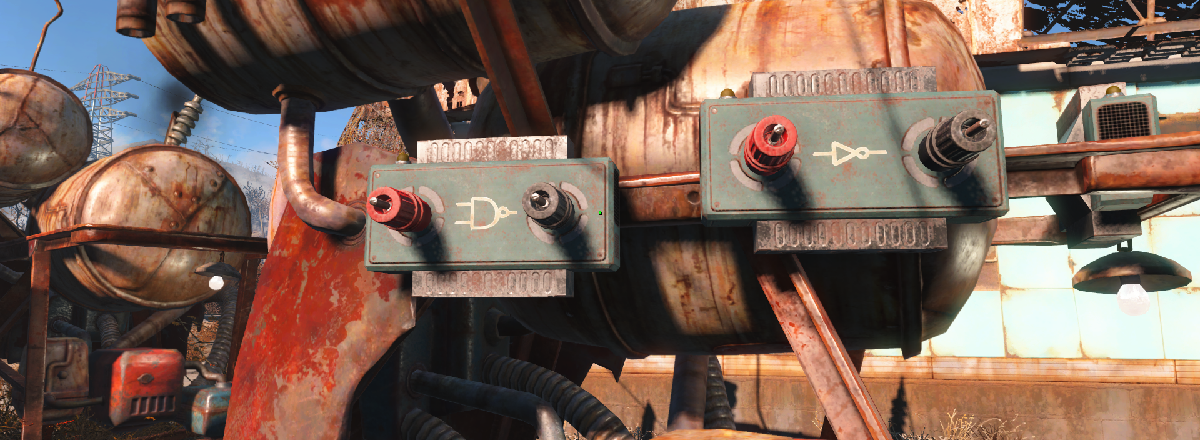
For years, Fallout asked players to survive radiation, super mutants, questionable canned meat, and people who urgentthe map. Then Fallout 4 introduced a different threat: digital electronics.
With the arrival of the Contraptions Workshop add-on, settlement builders gained conveyor belts, manufacturing machines, elevators, track pieces, display equipment, and seven types of logic gates. That last addition quietly transformed the Workshop from a construction tool into a primitive programming environment. Players were no longer limited to placing powered lamps and turrets. They could create circuits that made decisions.
In other words, the Commonwealth had acquired Boolean logic. Civilization was clearly back on schedule.
How Contraptions Workshop Changed Fallout 4
Released on June 21, 2016, for PC, PlayStation 4, and Xbox One, Contraptions Workshop was the fourth paid add-on for Fallout 4. Unlike story-focused expansions such as Far Harbor, it concentrated almost entirely on settlement construction. Bethesda promoted it as a toolkit for machines that could sort, build, combine, transport, and display objects. add-on included manufacturing units for producing ammunition, weapons, armor, clothing, explosives, and miscellaneous objects. Vacuum hoppers could pull items from nearby containers, conveyor belts could carry materials between machines, and storage units could collect the final products. Players could also install elevators, greenhouse walls, warehouse structures, scaffolding, fireworks mortars, armor racks, weapon displays, and ball tracks.
Those additions made settlements look more industrial, but logic gates made them behave differently. Instead of sending power directly from a generator to a device, builders could send it through a circuit that evaluated one or more conditions first. Bethesda’s support documentation describes the gates as tools for routing Workshop power according to simple logical rules. n>
What Logic Gates Do in Fallout 4
A logic gate accepts one or more inputs and produces an output based on a predefined rule. In conventional digital electronics, the inputs and outputs are represented by binary values: zero or one, off or on, false or true. Fallout 4 translates that concept into settlement electricity.
The input connection on a Workshop logic gate is marked in red, while the output is marked in black. Indicator lights help show whether the gate is receiving power and whether its input or output currently represents a true state. The gate then decides whether electricity should continue toward a lamp, siren, powered door, turret, conveyor, pitching machine, or other device. ND
An AND gate transmits power only when all of its required inputs are active. A settlement builder could use it to create a system in which a powered door opens only when two separate switches are on. It is the electronic equivalent of saying, “You may enter if you have the keycard and remembered to turn on the generator.”
OR
An OR gate produces an active output when at least one input is active. This works well when several different switches should control the same alarm, lamp, or machine. Pulling any connected emergency switch could activate the circuit.
XOR
An XOR, or exclusive-OR, gate activates when its inputs differ. With two inputs, the output is on when one switch is on and the other is off. If both switches match, the output turns off. Players quickly recognized that XOR gates could imitate familiar multi-location lighting controls, allowing a lamp or door to be toggled from two different positions. Community builders demonstrated three-way-switch-style systems shortly after the add-on launched. OT
A NOT gate reverses a signal. An inactive input produces an active output, while an active input produces an inactive output. It is useful for devices that should remain powered until a particular condition occurs. For example, a warning light might stay on until a safety switch is activated.
NAND, NOR, and XNOR
NAND reverses the result of AND, while NOR reverses OR. XNOR activates when its inputs match. Together, these gates provide enough variety for locks, alarms, control panels, comparisons, selectors, and more ambitious digital circuits.
The in-game implementation is not always as tidy as a textbook diagram. Negative gates such as NOT, NAND, NOR, and XNOR can depend on properly powered upstream logic, and players reported inconsistent behavior when conduits or other components interrupted direct gate-to-gate connections. Consequently, debugging sometimes feels less like electrical engineering and more like persuading a brahmin to leave your bedroom. n>
What “Functionally Complete” Actually Means
The phrase “functionally complete” sounds like marketing language for a product that has finally stopped crashing. In logic design, however, it has a specific meaning. A collection of logical operations is functionally complete when those operations can be combined to express every possible Boolean function.
NAND and NOR are known as universal gates because either type can be used by itself to reproduce the behavior of AND, OR, NOT, and other logical operations. Since Fallout 4 includes both NAND and NOR gates, its Workshop offers the fundamental ingredients required to construct arbitrary combinational logicat least in theory. t does not mean the game instantly becomes a modern computer simulator. Functional completeness says that a Boolean function can be represented; it does not promise that the result will be compact, fast, stable, or pleasant to build. A complicated circuit may require a field full of gates, kilometers of virtual wire, a reliable power source, and the patience of someone who has already organized every loose coffee cup in Sanctuary.
Building a general-purpose computer also requires more than combinational logic. Useful processors need memory, timing, registers, data paths, and control systems. Those elements can potentially be assembled from universal gates, feedback loops, switches, and carefully timed components, but the engineering challenge grows rapidly.
From Powered Doors to Wasteland Computers
The most accessible logic-gate projects solve ordinary settlement problems. A player might build a security entrance that requires two switches, an alarm triggered by any of several pressure plates, or lighting that can be controlled from opposite sides of a building. These projects are practical, understandable, and unlikely to consume an entire weekend.
More advanced builders can combine gates into reusable circuits:
- Latches can preserve a state after a button is released.
- Counters can track repeated pulses or events.
- Selectors can choose which machine receives power.
- Adders can perform binary arithmetic.
- Comparators can determine whether input patterns match.
- Sequencers can activate lights or machinery in a planned order.
Within days of the DLC’s release, players were already publishing proof-of-concept registers, adders, and multipliers. One widely shared project included a mechanical register followed by a four-bit adder and multiplier. Its creator argued that a general-purpose computer was possible, while also advising that nobody attempt it unless they enjoyed spending weeks connecting wires. This is excellent advice for both wasteland engineers and real-life software projects. nimated Signs and Light Displays
Fallout 4 already offered light boxes and powered decorations. Logic gates made it possible to control larger groups of lights according to patterns. With timing mechanisms and chained circuits, builders could create animated signs, status boards, countdown displays, and crude numeric readouts.
Musical Machines
Powered speakers and sequenced signals could be arranged into simple musical devices. The result would not threaten a professional synthesizer, but it could play recognizable patterns while settlers stared blankly at the machinery. In fairness, settlers stare blankly at nearly everything.
Automated Factories
Logic circuits could also coordinate manufacturing equipment. Hoppers, conveyors, sorters, builders, and storage units allowed materials to travel through miniature production lines. PC Gamer described the experience as a small taste of factory-automation games: not essential for gathering equipment, but surprisingly satisfying when materials began moving through a functioning system. yers used these tools to manufacture ammunition, feed objects into pitching machines, load junk mortars, sort materials, and create elaborate Rube Goldberg devices. Bethesda’s conveyor system passed electricity between connected pieces, although belts and rollers came with directional snapping and movement limitations that builders had to consider. n>
Why Logic Gates Matter in a Role-Playing Game
Logic gates did not add a major questline, new faction, or unexplored region. Many players could complete Fallout 4 without placing a single one. Nevertheless, they expanded the game in a way that traditional missions could not.
A scripted quest gives players a problem designed by a developer. A programmable construction system lets players invent their own problems, then spend an unreasonable amount of time solving them. This difference is central to creative sandbox games. The developer supplies rules and components; the community discovers unexpected applications.
Minecraft demonstrated the same principle with redstone. What began as a system for powering doors and traps became a platform for calculators, music machines, displays, memory systems, and processors. Hackaday’s original discussion of the Fallout 4 gates immediately compared their potential with the elaborate computers built in Minecraft. comparison does not mean Fallout’s Workshop is equally convenient. Its parts are physically large, its wiring can become chaotic, and settlement build limits restrict scale. The first-person construction interface was already known for awkward snapping and object placement. Logic gates provided remarkable theoretical freedom inside a system that could still fight back when a wall refused to align by half an inch. Contemporary coverage praised the creativity of the tools while noting that the Workshop interface remained clumsy. n>
Practical Limits of Fallout 4 Logic Gates
Settlement Build Capacity
Large circuits consume settlement space quickly. A modest arithmetic unit can require many gates, wires, switches, displays, and power connections. Builders attempting computer-scale projects may need to simplify circuits, divide them into modules, or use modifications that expand construction limits.
Power and Wiring
Logic gates require upstream power. Disconnecting the generator does not merely change an input value; it can stop the gate from functioning altogether. This distinction matters when creating inverted circuits because an unpowered system is not always equivalent to a powered system carrying a false signal. iming Problems
Real digital systems rely on predictable timing. In a game engine, signals, physics objects, scripts, and visual effects may not update with laboratory precision. A circuit that works during one test may behave differently after fast travel, reloading, or attaching additional devices.
Debugging Complexity
A simple gate is easy to test. A network of 50 gates is a glowing plate of spaghetti. Builders must trace wires, inspect indicator lamps, confirm power distribution, and test each module separately. Labeling inputs and keeping circuits physically organized becomes essential once the machine grows beyond “switch turns on lamp.”
A Practical Wasteland-Building Experience
The best way to understand the appeal of Fallout 4 logic gates is to imagine building a project from scratch. Start with something modest: a lamp outside a warehouse that can be controlled from two entrances. You place a generator, install two switches, connect them to an XOR gate, and run the output to the lamp. After a few minutes of wiring, either switch can change the light’s state. It is a tiny achievement, but it feels more satisfying than simply connecting the lamp directly to power because the system now behaves according to a rule you designed.
Confidence arrives immediately, which is dangerous.
The two-switch lamp becomes a powered warehouse door. Then you decide the door should remain locked unless two authorization switches are active, so an AND gate joins the circuit. Next, you add an emergency button that opens the door regardless of the authorization state, requiring an OR stage. A warning lamp should turn off when the door opens, so now there is a NOT gate. What began as a light switch has become a security system with enough exposed copper wire to attract every scavenger between Sanctuary and Diamond City.
The first testing session usually reveals that conceptual logic and Workshop logic are not always identical. One gate lacks upstream power. A wire attaches to the wrong connector. A negative gate does not respond because another component interrupts the chain. The door opens correctly but the warning lamp refuses to cooperate. You move a conduit, reconnect three wires, and accidentally select the entire wall behind the circuit.
This debugging process is part of the experience. Indicator lights become invaluable because they reveal which inputs and outputs are active. Testing one module at a time is far more effective than powering the finished machine and hoping the Commonwealth recognizes your genius.
Once the security system works, automation begins to look tempting. A vacuum hopper feeds raw materials onto a conveyor. A manufacturing machine turns those materials into ammunition. A sorter directs selected objects toward storage while rejecting everything else. Logic gates control when sections receive power, allowing the factory to pause, redirect, or activate warning signals.
The factory may not be economically necessary. Exploring ruined buildings already supplies an impressive quantity of weapons, ammunition, desk fans, typewriters, and dinner plates. The reward is watching a system operate because every switch, belt, gate, and machine was positioned by the player. It turns scavenged junk into a moving demonstration of cause and effect.
Eventually, ambition defeats practicality. You consider an electronic combination lock, a binary counter, or a display that spells a message in light boxes. At that point, the project stops being settlement improvement and becomes experimental engineering. The destination matters less than the process of planning, testing, failing, rearranging, and finally seeing the correct lights turn on.
That is the real experience behind the claim that Fallout 4 became functionally complete. The phrase is mathematically meaningful, but its emotional meaning is simpler: the game gives builders enough basic pieces to surprise themselves. The result might be a calculator, a factory controller, an automated shooting gallery, or a door that opens with unnecessary theatrical complexity. All are valid. In the wasteland, efficiency is optional; spectacle is forever.
Conclusion
Contraptions Workshop did more than add industrial decorations to Fallout 4. By introducing AND, OR, XOR, NOT, NAND, NOR, and XNOR gates, it gave settlement builders a genuine logical toolkit. NAND and NOR made the system functionally complete in the Boolean sense, allowing arbitrary logical operations to be constructed from in-game components.
Practical obstacles remained. Gates required careful power management, negative logic had unusual wiring constraints, large circuits strained settlement limits, and the Workshop interface could turn precise engineering into slapstick. Even so, players rapidly built registers, adders, multipliers, automated factories, security systems, animated displays, and machines whose only purpose was to launch household objects at unfortunate settlers.
That combination of serious engineering potential and ridiculous application is perfectly suited to Fallout. Humanity may have lost its cities, institutions, and most of its unmutated wildlife, but it retained the ability to construct a binary calculator beside a shack made from rusted sheet metal. Progress finds a way.