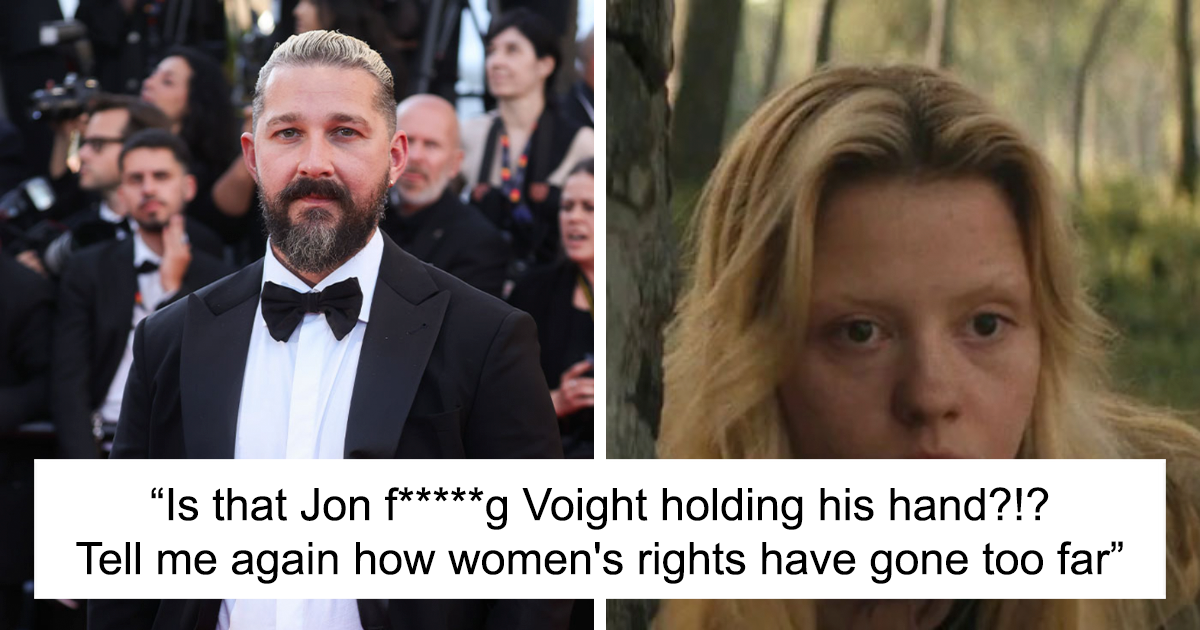
Hollywood loves a comeback story. Give the industry a fallen star, a tailored suit, a soft-focus camera angle, and a soundtrack that whispers “redemption,” and suddenly the machinery starts humming again. But when Shia LaBeouf appeared on the Cannes red carpet for Megalopolis, many fans did not see a neat comeback arc. They saw something much messier: an industry seemingly eager to welcome back a controversial actor while serious allegations and unresolved questions about accountability still lingered in the public imagination.
The reaction was fast, loud, and deeply familiar. Social media users accused Hollywood of “promoting an abuser,” arguing that major film institutions often rehabilitate male celebrities faster than they meaningfully address the harm alleged by women. The anger was not just about one red carpet. It was about the pattern: the glamorous premiere, the applause, the interviews, the professional second chance, and the uncomfortable sense that audiences are expected to move on before everyone involved has had the same opportunity to heal.
This debate sits at the intersection of celebrity culture, public accountability, legal nuance, and the entertainment industry’s complicated relationship with redemption. It asks an uncomfortable question: when a famous person is accused of serious misconduct, what does a comeback actually require?
Why Shia LaBeouf’s Red Carpet Return Sparked Backlash
Shia LaBeouf returned to a high-profile red carpet at the 2024 Cannes Film Festival to promote Francis Ford Coppola’s long-awaited film Megalopolis. On paper, the event had all the ingredients of a major cinema moment: an iconic director, a star-studded cast, global press, and Cannes doing what Cannes does bestturning stairs into a full-contact sport for photographers.
But the celebratory framing around LaBeouf’s appearance immediately struck critics as tone-deaf. For many viewers, headlines about his “rare appearance” or “return” failed to fully acknowledge why his absence from major red carpets had become notable in the first place. The actor had been the subject of a 2020 lawsuit filed by musician FKA twigs, whose legal name is Tahliah Barnett, accusing him of sexual battery, assault, and infliction of emotional distress during their past relationship.
LaBeouf has denied wrongdoing in legal filings, while also publicly acknowledging in interviews that he hurt people and had serious personal failings. That combinationlegal denial, partial public remorse, and industry re-entryhas made the conversation especially complicated. Fans were not simply asking whether a person can change. They were asking why Hollywood so often seems to offer image repair before transparent accountability.
The Allegations And The Public Context
FKA twigs filed her lawsuit in 2020, alleging a pattern of abuse during her relationship with LaBeouf. Her case became one of the most widely discussed celebrity abuse lawsuits of the post-#MeToo era because it involved a high-profile actor, a respected musician, and allegations that went far beyond the vague “bad behavior” language Hollywood often prefers when things get legally inconvenient.
The lawsuit was settled in 2025, with the details kept private. The settlement ended the civil case, but it did not end public debate. In 2026, FKA twigs filed new legal action challenging what she described as an unlawful nondisclosure agreement connected to the settlement. Her legal team argued that she should not be restricted from speaking about issues related to sexual abuse and survivor advocacy. That development renewed public attention around the earlier allegations and again raised questions about silence, power, and who gets to control the story after a settlement.
For SEO purposes, the key terms hereShia LaBeouf red carpet backlash, FKA twigs lawsuit, Hollywood accountability, celebrity comeback, and abuse allegationsare not just search phrases. They represent the actual themes audiences are trying to understand. People are not only searching for gossip; they are searching for moral context.
Why Fans Used The Phrase “Promoting An Abuser”
The phrase “promoting an abuser” carries emotional weight, and it is important to handle it carefully. Many fans used it not as a courtroom conclusion, but as a public criticism of Hollywood’s choices. Their argument was that when a studio, festival, or media outlet presents a celebrity comeback without meaningful context, it can feel like the industry is asking audiences to separate art from alleged harm on command.
That is a hard sell in 2026. Audiences are more media-literate than ever. They know the difference between a legal outcome and a public relations campaign. They understand that a red carpet is not just a sidewalk with better lighting. It is a machine of endorsement. Every photograph, caption, interview, and standing ovation helps shape a public narrative.
So when LaBeouf appeared alongside respected actors and filmmakers, some viewers saw the moment as Hollywood granting him cultural permission to return. The frustration was not only, “Why is he working?” It was also, “Why does the return look so effortless?”
Hollywood’s Long Love Affair With The Redemption Arc
Hollywood has always adored redemption. It is practically written into the town’s operating system. A star falls, disappears, reflects, reforms, returns, cries tastefully in an interview, and eventually appears in a prestige project where the audience is invited to clap twice: once for the performance and once for the personal growth. Roll credits. Cue awards-season whisper campaign.
The problem is that real accountability does not move at the same speed as publicity. A red carpet comeback can happen in one night. Trust takes longer. Repair takes longer. Survivors and critics often point out that the entertainment industry tends to focus on the feelings, career prospects, and “complexity” of accused men while giving less sustained attention to the people who say they were harmed.
That imbalance is why LaBeouf’s appearance hit a nerve. It was not simply about one actor getting photographed. It was about the familiar rhythm of Hollywood forgiving powerful men in public while expecting everyone else to process the discomfort quietly.
The Difference Between Forgiveness And Platforming
One of the most useful distinctions in this debate is the difference between forgiveness and platforming. Forgiveness is personal. It belongs to individuals. It cannot be demanded by fans, studios, journalists, or film festivals. Platforming, however, is institutional. It involves jobs, press opportunities, festival invitations, promotional campaigns, and the cultural prestige that comes with being placed back in the spotlight.
A person can believe in rehabilitation while still questioning whether a major red carpet is the right setting for a comeback narrative. A person can support second chances while asking what conditions should come with them. Has there been accountability? Has there been repair? Has the person addressed the harm with clarity? Has the industry made space for the alleged victim’s voice too?
These questions are not “cancel culture.” They are basic media literacy with a moral backbone.
How Media Framing Shapes Public Reaction
The backlash around LaBeouf also shows how much headlines matter. When entertainment coverage frames a controversial figure’s return as merely “rare,” “surprising,” or “emotional,” it can feel like context has been vacuumed out of the room. Audiences notice when coverage emphasizes a celebrity’s comeback while minimizing why the comeback is controversial.
This is where celebrity journalism sometimes trips over its own velvet rope. Red carpet coverage is designed to be glossy, quick, and flattering. But when the subject has a serious public history, the standard “Who are you wearing?” approach can seem almost absurd. It is hard to discuss a comeback responsibly if the article pretends the past is a locked closet and nobody can hear the skeletons doing tap dance practice.
Responsible coverage does not need to be cruel. It does need to be complete. A brief mention of the lawsuit, settlement, and public debate gives readers the context they need to understand why the moment matters.
What The Shia LaBeouf Backlash Says About Celebrity Accountability
The public response reveals a major shift in how audiences engage with fame. Fans no longer see themselves as passive consumers waiting for Hollywood to decide who deserves applause. They investigate timelines, compare interviews, read legal updates, and challenge narratives that feel incomplete.
That does not mean every online reaction is fair, measured, or legally precise. Social media is many things; a calm courthouse is not one of them. But the broader demand is clear: audiences want accountability to be more than a branding exercise. They want the entertainment industry to stop treating serious allegations as temporary obstacles in a career management plan.
LaBeouf’s case also highlights the challenge of evaluating public remorse. He has spoken about addiction, recovery, and personal harm. Some people view those comments as signs of growth. Others see them as insufficient, especially when legal disputes and public criticism continue. Both reactions can exist at the same time because celebrity accountability is rarely neat. It is a messy human issue filtered through agents, lawyers, film festivals, and paparazzi flashes.
Can An Accused Celebrity Ever Come Back?
This is the question behind much of the debate. Can someone accused of serious misconduct ever return to public work? Many people would answer yes, but not automatically and not without conditions. Rehabilitation should not be impossible. But it should also not be treated as a public relations costume someone puts on for a premiere.
A meaningful comeback should include honesty, accountability, changed behavior, and respect for those who say they were harmed. It should avoid turning the accused person into the main victim of the story. It should not pressure audiences to applaud before they are ready. Most importantly, it should not erase the original allegations simply because a famous director, major festival, or expensive movie campaign has decided it is time to move forward.
Hollywood often struggles here because its business model is built around visibility. If a studio invests in a project, it wants promotion. If a festival screens a major film, it wants stars. If media outlets cover the event, they want clicks. Accountability, unfortunately, does not always photograph as well as couture.
Why The Cannes Moment Felt Bigger Than One Actor
The Cannes Film Festival has repeatedly faced criticism for platforming controversial male figures. That broader context made LaBeouf’s appearance feel symbolic. To critics, the red carpet represented an old industry habit: celebrating artistic achievement while sidestepping uncomfortable conversations about alleged abuse, power, and gendered harm.
It also came during a period when the public is still debating the legacy of #MeToo. The movement changed Hollywood, but unevenly. Some powerful figures faced lasting consequences. Others returned with surprising speed. Some survivors were believed and supported. Others were scrutinized, doubted, or quietly pushed to the margins once the news cycle moved on.
That inconsistency fuels cynicism. When fans saw LaBeouf photographed at Cannes, many interpreted it as another sign that Hollywood’s moral memory can be very short when talent, prestige, or money is involved.
The Role Of Audiences In The New Accountability Era
Audiences now play a major role in shaping a celebrity’s public future. A red carpet appearance may introduce a comeback, but viewers decide whether to accept it. They do this through social media, ticket-buying choices, streaming behavior, comments, essays, podcasts, and the old-fashioned art of saying, “No thanks, I’m good.”
This does not mean every person must respond the same way. Some viewers separate art from artist. Others cannot or will not. Some believe in watching controversial work critically. Others choose not to support it at all. The point is not that there is one perfect answer. The point is that audiences are increasingly refusing to let Hollywood make the decision for them.
That refusal is powerful. It forces studios and festivals to realize that context follows celebrities onto the carpet. A tuxedo does not erase a timeline. A premiere does not delete public memory. And a comeback is no longer something Hollywood can simply announce like a release date.
Experiences And Lessons Related To The Backlash
For many entertainment readers, the Shia LaBeouf red carpet backlash feels familiar because it mirrors a common experience: watching institutions move on faster than people do. Anyone who has followed celebrity scandals over the last decade has seen this cycle. First comes the allegation. Then comes the apology or denial. Then comes the quiet period. Then, almost inevitably, comes the comeback story, polished until it shines like a studio executive’s forehead under premiere lighting.
The frustrating experience for fans is not simply seeing someone work again. It is seeing the narrative shift without enough public reckoning. A viewer may remember the allegations clearly, while a headline acts as though the only story is fashion, film, and “a rare public appearance.” That disconnect creates emotional whiplash. It makes readers feel as if they are being asked to forget on schedule.
There is also a personal dimension to why this topic resonates. Many people know what it feels like when a charming, talented, or socially powerful person is excused because they are useful to others. In workplaces, schools, families, and friend groups, the person who causes harm is sometimes protected because they are popular, successful, funny, wealthy, or simply inconvenient to confront. Hollywood is bigger and shinier, but the pattern is recognizable. That is why online reactions can be so intense. Fans are not only responding to a celebrity. They are responding to a system they have seen in miniature.
Another common experience is exhaustion. Audiences have spent years learning the language of accountability, trauma, restorative justice, legal nuance, and public relations spin. They know that allegations are not convictions. They also know that settlements are not emotional closure. They understand that recovery is possible, but they are tired of seeing “growth” marketed mainly when it helps a career. In other words, people are not rejecting redemption. They are rejecting redemption as a publicity package with a bow on top.
The LaBeouf backlash also teaches media consumers to read beyond the headline. A red carpet photo is never just a photo. It is a promotional object. It tells audiences who is being centered, who is being celebrated, and what context is being left outside the frame. When fans criticize Hollywood for platforming controversial figures, they are often asking for a broader frameone that includes the alleged harm, the legal history, the survivor’s perspective, and the industry choices that made the comeback possible.
Finally, this controversy shows that public trust is now part of celebrity currency. Talent still matters. Box office still matters. Prestige still matters. But audiences increasingly expect ethical context too. A star can be cast in a major film, invited to Cannes, and photographed by every camera in France, but that does not guarantee public acceptance. The crowd outside the industry gates has its own memory, and lately, that memory has been harder to charm.
Conclusion: Hollywood Can Offer Comebacks, But Audiences Can Ask Questions
Shia LaBeouf’s red carpet return became controversial because it touched a nerve far beyond one premiere. It raised questions about how Hollywood handles allegations of abuse, how quickly powerful men are reintroduced to prestige spaces, and whether public redemption is being earned or simply staged.
The backlash does not mean every person agrees on what should happen next. But it does show that audiences are no longer satisfied with comeback stories that skip the hard chapters. A red carpet can signal professional return. It cannot, by itself, answer questions about accountability, repair, or trust.
Hollywood may still love a redemption arc, but viewers are increasingly asking to see the receipts. And honestly, after decades of glossy reinventions, that does not seem unreasonable. It seems overdue.
Note: This article is written as an SEO-ready commentary and analysis piece based on public reporting. It uses legally careful language such as “alleged,” “lawsuit,” “settlement,” and “public criticism” where appropriate.