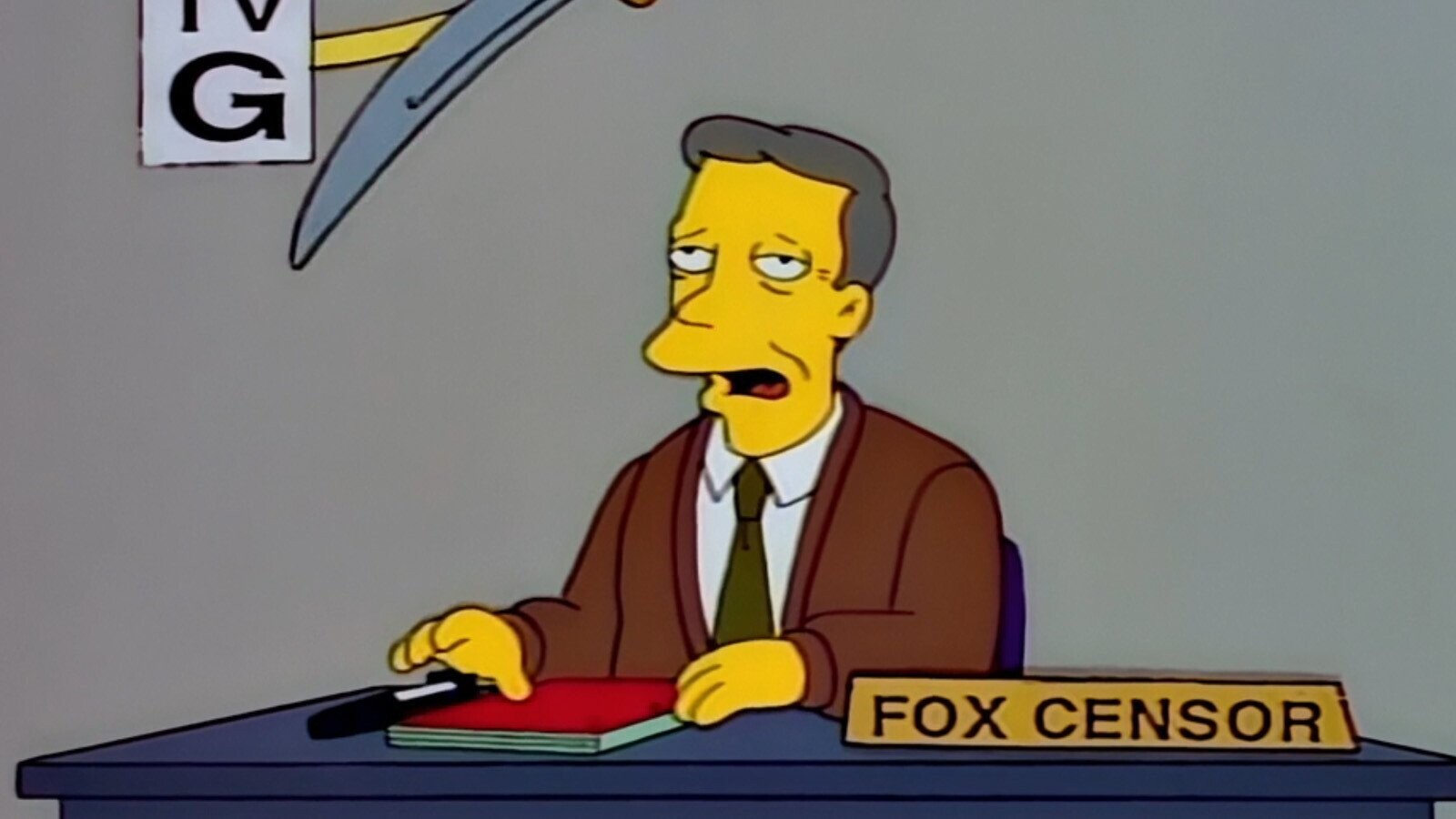
There are TV jokes, there are inside-baseball TV jokes, and then there are The Simpsons jokes that grab television’s own rulebook, light it on fire, and roast marshmallows over the ashes. Few examples capture that rebellious little genius better than the opening of Treehouse of Horror VIII, the 1997 Halloween special that kicked off with a fictional Fox censor proudly taming the episode for family viewing, only to be gruesomely stabbed by the very ratings icon meant to keep the show respectable. It was morbid, ridiculous, self-aware, and exactly the kind of prank that made The Simpsons feel smarter than the average network sitcom.
What makes the bit even sweeter is the punchline behind the punchline: real Fox censors reportedly had problems with it. Not because the show cheekily targeted a censor, but because the death was too bloody, too sharp, too violent, too much. In other words, the satire worked so well that it wandered off the page and annoyed the exact kind of people it was mocking. That is not just comedy. That is comedy doing donuts in the parking lot.
This story has survived for decades because it perfectly captures the old magic of The Simpsons: the show could be broad enough for a Sunday-night audience and sneaky enough to make media-savvy viewers grin like they had just been let in on a secret. The Fox censor opening was not random shock value. It was a pointed joke about television standards, the new ratings culture of the late 1990s, and the absurd dance between artists and gatekeepers. It also arrived inside the Treehouse of Horror tradition, the annual Halloween sandbox where the writers could crank the darkness, blood, and parody up a notch without worrying too much about canon, continuity, or whether Springfield would be back to normal by next week. Of course it would. That was part of the fun.
Why the gag hit so hard in 1997
Timing matters in comedy, and this joke had impeccable timing. By 1997, American television was adjusting to the new TV parental-guidelines system and the broader V-chip-era conversation about what families should be able to filter. For a show like The Simpsons, which had already spent years being blamed for corrupting the youth despite being milder than the panic suggested, that climate was perfect fuel for satire. If the industry was suddenly going to dress up censorship in the language of helpful little rating boxes, the writers were more than ready to ask a simple question: what if the rating box itself turned into the monster?
That is why the opening still feels so sharp. It was not merely spoofing network notes. It was parodying a whole cultural mood. Television executives, advocacy groups, politicians, and watchdogs had created a climate in which content warnings and family guidance were increasingly visible parts of the viewing experience. The Simpsons responded the way it often did at its best: by turning a bureaucratic system into a grotesque visual gag. Instead of delivering a lecture, the show let the rating icon become a tiny executioner. Elegant. Unhinged. Very Springfield.
The beauty of the scene is that it compresses a huge argument into a few seconds. A censor boasts that he has cleaned up the program. Then the supposedly reassuring badge of safety erupts into violence. The rating climbs as the attack worsens, until it becomes comically demonic. That progression tells the whole joke: television regulation can be performative, moral panic can become theater, and attempts to make art “safe” can sometimes look more absurd than the art itself.
The Halloween special where the joke could get away with murder
The annual Treehouse of Horror installments gave The Simpsons a special license to misbehave. From the beginning, the Halloween episodes operated slightly outside the show’s normal boundaries. Characters could die, the town could be destroyed, and beloved side figures could get chopped up, mutated, cursed, or otherwise turned into seasonal decorations. That freedom mattered. The writers did not need to preserve emotional realism when the entire point was to blend horror parody, pop culture satire, and gleeful bad taste.
By the time Treehouse of Horror VIII arrived, the series had already developed a reputation for using Halloween as a creative pressure valve. The specials had become a place for literary spoofs, movie riffs, gore, aliens, and the kind of one-off nightmare logic that would never fit in a regular episode about PTA politics or Homer’s latest get-rich-slowly plan. In that setting, murdering a fictional network censor before the first segment even begins feels less like a detour and more like a mission statement.
And what a mission statement it was. The opening tells viewers that this year’s special will not quietly sit in the corner wearing a paper skeleton mask. It is here to be loud, nasty, and self-referential. Then the actual segments keep that mood rolling: post-apocalyptic devastation, body horror, witch-trial chaos, and enough cartoon doom to make a pumpkin flinch. If the censor opening is the appetizer, the rest of the episode is a haunted buffet.
What Fox censors reportedly objected to
Here is where the story becomes comedy gold. According to commentary-based reporting on the episode, the creative tug-of-war was not simply about the idea of a censor getting killed. The objections were more specific and, somehow, funnier: the scene was considered too bloody, too violent, and too gruesome in execution. There was reportedly discussion over the sound effects, the amount of blood, and even the size of the weapon. In one of those gloriously television-industry details that sounds made up but apparently was not, a smaller dagger was viewed as worse, while a bigger sword was considered more acceptable.
That is a classic standards-and-practices paradox. A broad, cartoonishly oversized weapon can feel less real, and therefore less troubling, than a smaller blade that suggests intimacy or realism. It is twisted logic, sure, but it is also very TV logic. Network notes often live in that world, where the question is not whether something is violent, but whether it looks like the wrong kind of violent. This is the same universe where dialogue can be too blunt, a bodily fluid can be the wrong shade, and one extra sound effect can tip a scene from acceptable to apparently civilization-ending.
That absurdity is exactly why the anecdote endures. It reveals that censorship is rarely a simple moral line in the sand. More often, it is a weird negotiation over optics, tone, and the emotional temperature of tiny details. The Simpsons understood that. Better yet, it found a way to make those negotiations the subject of the joke.
The genius of making censorship the punchline
The opening works because it is not merely anti-censor. It is anti-pretension. It does not argue that all standards are evil or that every creative impulse deserves a free pass. Instead, it skewers the performative nature of content control on television. The fictional Fox censor presents himself as a guardian of decency, a protector of fragile viewers, a heroic filter between audience and reality. The show then pops that self-image like a balloon at a porcupine convention.
That satirical move fits neatly into the broader DNA of The Simpsons. The series has long loved exposing the puffed-up language of institutions. Politicians speak in slogans. corporations speak in euphemisms. schools posture as moral engines while barely functioning. television itself gets no special protection. The Fox censor is just one more self-important authority figure stepping into Springfield and discovering that the town runs on banana peels, not dignity.
What really elevates the joke, though, is that it never turns into a sermon. The writers do not stop the show for a media-studies lecture about regulation, free expression, or the semiotics of on-screen advisory labels. They trust the audience to get it. The image does the work. That economy is one reason the scene has remained memorable long after countless more elaborate satire attempts have evaporated like cheap fake blood in studio lighting.
Why this moment still matters in the history of The Simpsons
In a series packed with famous couch gags, endlessly quoted one-liners, and landmark episodes, the Fox censor murder may seem like a niche fan favorite. But it matters because it captures a specific version of The Simpsons at full power. The show was old enough to know exactly how television worked, but still young enough to enjoy throwing elbows. It had confidence, cultural clout, and an instinct for turning administrative nonsense into art.
This was also the era when the series excelled at blending smarty-pants references with primal silliness. Treehouse of Horror VIII nods to apocalyptic fiction, body horror, and witch-trial narratives, yet its cold open is essentially a workplace joke delivered with a geyser of blood. That combination is peak Simpsons. The show could wink at genre history, mock policy trends, and still make the average viewer laugh because a ratings icon had apparently decided to become a tiny avenging maniac.
It also helps that the joke remains relatable. Viewers may not know the exact committee structures of standards and practices, but almost everyone understands the feeling of creative work being “cleaned up” by people who seem afraid of life itself. Writers, editors, artists, filmmakers, and even office workers can recognize the spirit of the bit. Someone always appears to make things safer, smoother, blander, more approved, more presentable. Then the human urge to make fun of that person arrives right on schedule, wearing clown shoes and carrying a sword.
The larger legacy of the Halloween bloodbath
Part of the reason people still bring up this opening is that it represents a larger truth about the Treehouse of Horror brand. These episodes are beloved not simply because they are spooky, but because they let the show exaggerate everything that makes The Simpsons fun: the cruelty, the wit, the cultural references, the visual imagination, and the total lack of respect for sacred cows. When the annual special is working, it feels like the writers have slipped out of their day clothes and into the weird stuff in the back of the closet.
The Fox censor gag embodies that energy in miniature. It is festive and vicious at the same time. It is childish in the best possible way, like drawing devil horns on a hall monitor’s photo and somehow turning it into a masterpiece. More importantly, it proves that television satire can be most effective when it bites the hand that feeds it and then asks whether the hand wants a bandage or a punchline.
There is also a lovely historical irony here. The scene was built around a contemporary concern of the late 1990s, yet it remains understandable decades later. That is the mark of durable satire. You do not need to have followed every V-chip headline to appreciate the joke. All you need to understand is that official systems meant to make television cleaner can themselves become ridiculous objects worthy of parody. The Simpsons spotted that truth, sharpened it, and handed it to a ratings icon.
Experiences viewers and fans still connect to in this moment
One reason the Fox censor opening stays lodged in people’s brains is the experience of seeing television turn inward and make fun of its own nervous system. For viewers, that creates a special little thrill. You are not just watching a joke; you are watching a show pull back the curtain and reveal that behind every polished half-hour is a maze of approvals, notes, warnings, and people trying to decide how much weirdness America can survive before bedtime. The scene makes that invisible machinery visible, and then immediately sprays fake blood all over it.
For longtime Simpsons fans, the experience is even richer because the show had already built trust. Audiences knew that Halloween episodes were where the writers got friskier, meaner, and more willing to break the furniture. So when the special opens by attacking a censor, it feels like the show greeting its audience with a conspiratorial grin. It is saying, yes, we know how television works too, and yes, we are going to make fun of it before the first real segment starts. That creates a bond with the viewer. You feel included in the prank.
There is also the experience of tonal whiplash, which The Simpsons used brilliantly. A network censor is usually associated with caution, moderation, and reducing offense. The ratings icon is supposed to calm nervous parents. But here, the “safe” symbols become the source of menace. That reversal is what makes people laugh and wince at the same time. The joke works almost physically. It pulls the floor out from under your expectations, then hands you a candy bucket and asks whether you saw where your dignity landed.
Writers and media people often connect to the scene on a different level. To them, the experience is less about shock and more about recognition. Anyone who has ever received a nitpicky note, had a sentence sanitized into mush, or watched a good joke get smothered by committee can see the emotional truth under the cartoon exaggeration. The opening turns bureaucratic frustration into slapstick revenge fantasy. Not real revenge, obviously. Satirical revenge. The healthiest kind, right after naps and soup.
Then there is the larger fan experience of remembering when The Simpsons could still surprise people by being both mainstream and mischievous. The Fox censor gag belongs to an era when the show was a gigantic network institution that still knew how to act like an impudent outsider. That combination is rare. Big hits often become careful. The Simpsons, at least in moments like this, stayed cheeky enough to mock the very systems surrounding it. Fans remember that feeling. It is the pleasure of seeing a cultural giant behave like a class clown who somehow keeps getting invited back.
Even now, revisiting the scene feels like reconnecting with a particular television experience: the old Sunday-night ritual, the Halloween anticipation, the sense that one episode a year got to be just a little nastier, smarter, and more gloriously unhinged than usual. The Fox censor opening captures all of that in one compact blast. It is not just a funny bit from a Halloween special. It is a snapshot of what it felt like when The Simpsons knew the rules, understood the ratings, saw the gatekeepers standing there, and decided the funniest possible response was to hand the gatekeepers a sword and let the joke swing first.
Conclusion
The story of Fox censors taking issue with The Simpsons killing off a Fox censor for Halloween is funny because it is so perfectly circular. A show mocked censorship. The real censors objected to the mockery, specifically to the mechanics of how that mockery spilled fake blood. That loop is pure Simpsons: smart, petty, playful, and weirdly elegant.
More than a gruesome cold open, the moment stands as a reminder of what made the show such a force in its prime. It could absorb the politics, anxieties, and institutional silliness of its moment, then spit them back out as a joke simple enough for casual viewers and layered enough for media nerds to frame on the wall. The Fox censor scene did not just roast television standards. It showed that even the machinery designed to tame comedy could become comedy’s favorite target. On Halloween, that is about as festive as it gets.