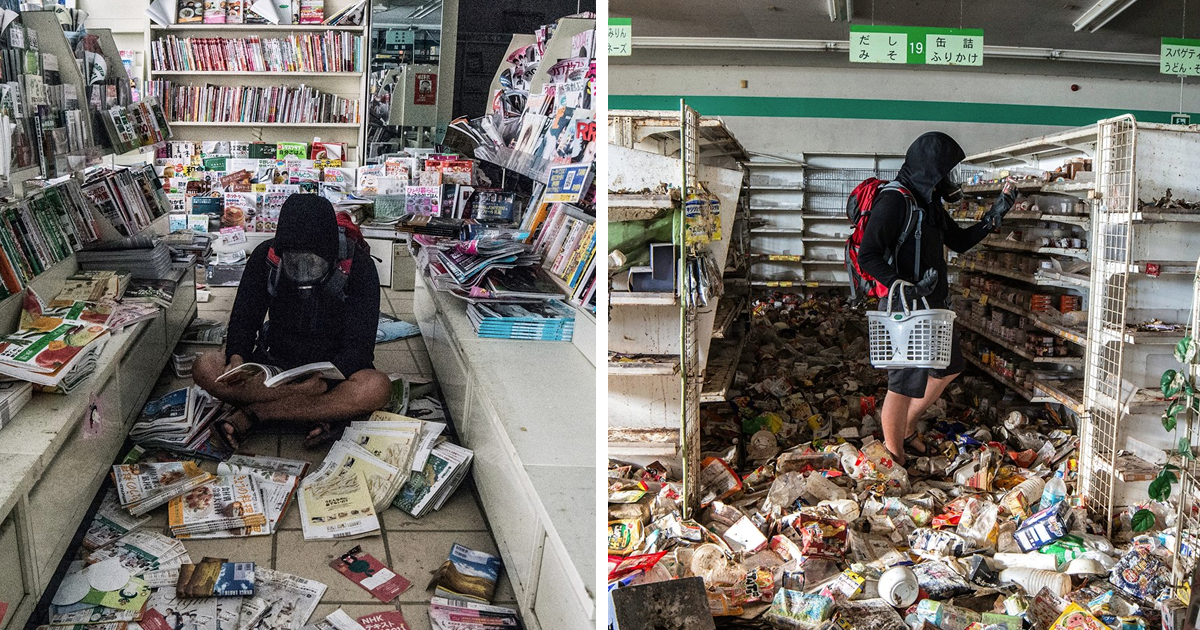
Five years after the Fukushima Daiichi nuclear disaster, Malaysian photographer Keow Wee Loong entered restricted communities near the damaged power station and photographed a world that appeared to have stopped in the middle of an ordinary day. Supermarket shelves remained stocked. Calendars still showed March 2011. Cars sat where their owners had parked them, while weeds quietly began renegotiating the local property lines.
The images spread rapidly online in 2016 because they looked less like documentary photography and more like screenshots from a post-apocalyptic video game. Yet behind every dusty storefront was a real business, behind every abandoned bedroom was a displaced family, and behind every dramatic caption was a complicated story involving radiation, evacuation, loss, recovery, and an unauthorized visit that many residents considered disrespectful.
These Fukushima exclusion zone photos are undeniably haunting. They are also more meaningful when viewed with the full story attached.
What Happened at Fukushima in March 2011?
On March 11, 2011, a magnitude 9.0 earthquake struck off northeastern Japan. The earthquake triggered an enormous tsunami that devastated coastal communities and overwhelmed protective systems at the Fukushima Daiichi Nuclear Power Station.
The reactors operating at the time automatically shut down, but shutting down nuclear fission does not instantly eliminate heat. Cooling systems must continue working. When floodwater disabled electrical equipment and backup generators, cooling was lost. Fuel in reactor units 1, 2, and 3 overheated and melted, while hydrogen explosions severely damaged several reactor buildings.
The earthquake and tsunami killed thousands of people across the region and destroyed entire communities. The nuclear emergency then created a second disaster: mass evacuation and long-term displacement.
Authorities initially ordered people near the plant to leave, eventually establishing a mandatory evacuation area extending roughly 20 kilometers, or 12.4 miles, from the facility. Additional communities outside that circle were also evacuated because radioactive material did not spread in a neat geometric pattern. Wind, rainfall, elevation, vegetation, and local geography created areas with very different contamination levels.
Residents often left believing the evacuation would be temporary. Many packed only essential items. The result was a collection of houses, stores, schools, laundromats, restaurants, and offices abandoned with remarkable speed.
Who Took the Viral Fukushima Exclusion Zone Photos?
Keow Wee Loong was a 27-year-old Malaysian photographer and urban explorer when his Fukushima images went viral in July 2016. Already known for climbing tall structures and visiting unusual locations, he was attracted to places that most travelers would wisely admire from a safe, legal, thoroughly permitted distance.
According to interviews published at the time, Loong wanted to document communities close to the nuclear plant that had received relatively little public access. He reportedly traveled with a Japanese companion and entered restricted territory without the required authorization, avoiding official checkpoints and approaching through wooded areas.
Obtaining formal entry could involve advance applications, local permission, escorts, and safety procedures. Loong said he had originally considered applying but continued without approval after losing money and bank cards during his trip. That explanation did not make the entry legal, and it did little to satisfy residents who felt their former homes had been treated as an adventure playground.
His photographs included scenes associated with Namie, Futaba, Okuma, and Tomioka, communities located around the Fukushima Daiichi plant. Some locations were inside highly restricted districts, while others belonged to evacuation areas with varying access rules and radiation conditions.
The distinction matters. “The Fukushima exclusion zone” was never one uniform, permanently sealed circle in which every street carried the same risk. Conditions varied greatly, and the boundaries changed as monitoring, decontamination, infrastructure work, and government decisions continued.
What the Photographs Revealed
Stores That Looked Ready to Open
Some of the most memorable photographs showed shops filled with merchandise. Bottles stood in orderly rows. Magazines and books remained on racks. Music stores still held CDs, while video advertisements promoted entertainment released around 2011.
In another setting, coins were reportedly still sitting near laundry machines. It was the sort of tiny detail that made the disaster feel immediate. A ruined reactor is almost too large for the mind to process; a forgotten load of laundry is painfully understandable.
Food stores created a more unsettling scene. Products had expired years earlier, packaging had deteriorated, and animals had apparently entered some buildings in search of food. Nature and weather had become extremely unreliable store managers.
Homes Interrupted Mid-Routine
Inside abandoned residences, the photographs showed clothing, furniture, electronics, family possessions, and household clutter. These were not carefully arranged museum displays. They were private spaces left behind when evacuation instructions turned a normal afternoon into an emergency.
The rooms also challenged the familiar phrase “frozen in time.” Time had not actually stopped. Dust accumulated. Moisture entered. Mold spread. Floors weakened. Plants grew through cracks, and animals moved into human spaces. What remained unchanged was not the physical environment but the absence of the people who once maintained it.
Traffic Lights With No Traffic
Empty roads formed another recurring image. Traffic signals continued cycling through their colors even though there were few or no drivers to obey them. The lights appeared to be patiently managing an intersection for ghosts.
Parked vehicles, damaged buildings, roadside signs, railway platforms, and weeds pushing through pavement reinforced the impression that civilization had stepped away without turning off the lights.
Calendars Still Showing March 2011
Photographs of calendars and dated publications became visual timestamps. They reminded viewers that the abandonment was not gradual, like a mining town declining over several decades. It happened abruptly after a specific morning when the ground moved, the ocean surged inland, and the future of entire communities changed.
Was the Town Really “Untouched Since 2011”?
The viral description was powerful, but it should not be interpreted literally.
Some interiors may indeed have remained largely undisturbed for years. However, the surrounding region was not sealed inside a glass dome. Police, municipal employees, cleanup crews, researchers, utility workers, journalists, authorized photographers, and former residents had entered different sections under controlled conditions.
Residents were sometimes permitted to make short visits to retrieve possessions, inspect property, maintain graves, or prepare homes for possible demolition. Decontamination crews removed soil, vegetation, debris, and waste. Roads were inspected, barriers moved, buildings documented, and radiation levels repeatedly measured.
The phrase also risks implying that all of Fukushima Prefecture became an abandoned wasteland. It did not. Fukushima is a large prefecture with functioning cities, farms, businesses, schools, natural attractions, and communities far beyond the evacuation districts. Referring to the entire prefecture as a ghost town is rather like describing an entire state by one fenced industrial accident site.
A more accurate description is that Loong photographed specific abandoned or restricted communities affected by the Fukushima Daiichi evacuation. That wording may be less cinematic, but accuracy occasionally arrives without its own dramatic soundtrack.
The Radiation Claims Need Important Context
Loong wrote that he experienced eye irritation and a chemical odor after entering the restricted area. Those sensations may have been real, but they could not establish the presence or intensity of ionizing radiation.
Radiation itself cannot be seen, smelled, tasted, heard, or felt by human senses. Detecting it requires appropriate instruments such as survey meters, dosimeters, and contamination monitors. A strange smell might come from mold, decaying materials, chemicals, sewage, smoke, or damaged buildings, but it is not a built-in human radiation alarm.
The photographs showed Loong using a full-face mask in some locations, but a respirator is not a magic force field. Protective equipment must be selected for the actual hazard, fitted correctly, used with proper filters, and combined with controlled routes, exposure limits, dosimetry, protective clothing, contamination checks, and decontamination procedures.
Radiological risk depends on several factors, including dose rate, time spent in an area, distance from a source, shielding, and whether radioactive material is inhaled, swallowed, or carried away on clothing and equipment. A location that permits limited professional work under monitored conditions is not automatically appropriate for untrained visitors.
It is also important to separate the consequences of radiation exposure from the broader public-health consequences of the disaster. U.S. health authorities report that no deaths were attributed to direct radiation exposure from the Fukushima accident. However, evacuation, interrupted medical care, relocation, stress, isolation, and the loss of social networks caused serious harm, particularly among older and medically vulnerable residents.
That distinction does not make the disaster minor. It shows why nuclear emergencies must be understood as social and medical crises as well as technical ones.
Why the Unauthorized Entry Became Controversial
Many viewers praised the photographs for documenting places hidden behind evacuation barriers. Others argued that the method of obtaining them overshadowed their documentary value.
Residents and people working in Fukushima criticized the expedition as illegal, unsafe, and insensitive. To them, the abandoned homes were not fascinating ruins waiting to be explored. They were addresses, businesses, schools, family histories, and neighborhoods from which people had been forcibly separated.
There is an ethical difference between photographing an abandoned factory with the owner’s permission and entering a disaster victim’s former home without consent. An object may look forgotten while still belonging to someone. A room may look empty while remaining emotionally occupied.
The photographer said he did not steal or intentionally damage anything, and he later apologized to residents who felt hurt by the project. Even so, the controversy raised a question that applies to all disaster photography: Does public awareness justify crossing legal and personal boundaries?
There is no universal answer, but strong documentary work normally depends on more than dramatic access. It also requires verification, context, consent when possible, and respect for the people whose suffering gives the images their emotional power.
Fukushima Has Not Remained Frozen
The 2016 photographs captured a particular stage of the disaster’s aftermath. They should not be mistaken for a complete picture of the region today.
Most evacuation orders outside areas officially designated difficult to return were lifted by April 2017. Additional sections have reopened in later years after decontamination, infrastructure repair, radiation monitoring, and government review. Railway stations and transportation links have resumed service in several communities.
Reopening a district, however, does not instantly restore a town. Many former residents built new lives elsewhere during years of displacement. Some are elderly, some lost employment in the region, and others remain concerned about radiation, health care, education, or limited local services. In several previously evacuated communities, only a small fraction of the original population has returned.
Meanwhile, dismantling the Fukushima Daiichi plant remains an enormous technical undertaking. Workers continue managing radioactive material, contaminated structures, water, waste, and melted reactor fuel. The project is expected to require decades, and the most difficult stages cannot be solved with a determined expression and a very long pair of pliers.
Recovery therefore happens on several timelines at once. A road can reopen before a neighborhood feels alive. A radiation reading can decline before trust returns. A new building can appear while an old community remains scattered across the country.
Why the Fukushima Ghost-Town Images Still Matter
The photographs endure because they translate an abstract catastrophe into ordinary objects. Terms such as reactor cooling failure, cesium contamination, evacuation radius, and decommissioning are technically important, but they can feel distant. A child’s belongings, a restaurant menu, or a calendar left open to March 2011 reaches viewers immediately.
The images also demonstrate how quickly normal life can become historical evidence. Nobody places a laundry basket in a room expecting it to become part of an internationally shared photo essay five years later.
At their best, the photographs encourage serious questions about nuclear engineering, disaster preparedness, emergency communication, community consent, energy policy, and the long-term cost of displacement. At their worst, they reduce a living region to spooky scenery.
The difference depends on how the images are presented. Fukushima should not be treated merely as Japan’s version of a haunted attraction. It is a place where people continue rebuilding, measuring, debating, remembering, returning, and sometimes deciding that returning is no longer possible.
An Experience-Based Reflection: Entering a Town Paused Mid-Sentence
Most people will never enter a restricted disaster zone, and that is generally a sign that their vacation planning is functioning correctly. Yet accounts from authorized visitors, residents, workers, and photographers help explain why abandoned Fukushima communities create such a strong emotional response.
The First Surprise Is the Silence
A normal town produces a constant background orchestra: engines, footsteps, doors, bicycles, conversations, delivery trucks, dogs, music, and someone somewhere trying to repair something with a tool that is much louder than necessary.
Remove the population and the silence becomes physical. Wind moves through damaged buildings. Metal signs tap against their frames. Birds and insects replace traffic. A working signal changes from green to yellow to red without receiving a single complaint from an impatient driver.
The scene may look peaceful for a moment. Then the reason for the silence returns to mind.
Ordinary Objects Become the Most Disturbing
Collapsed buildings are dramatic, but household objects often produce the deeper reaction. Shoes wait beside an entrance. Cups remain in cupboards. A poster advertises a movie everyone stopped discussing years ago. A calendar displays a month that ended long ago everywhere except on that wall.
These details allow the viewer to reconstruct invisible routines. Someone selected those groceries. Someone planned to wear that coat. Someone expected to return to that desk the following morning.
The emotional experience comes from recognizing that the missing people did not consider their lives finished. They were interrupted.
The Invisible Hazard Changes How Space Feels
Radiation has no spooky green glow, convenient villainous odor, or cinematic humming noise. This invisibility changes the psychology of a contaminated landscape. A sunny sidewalk may look safer than a mold-filled basement, yet appearances alone cannot determine radiological conditions.
Professionals rely on instruments, maps, work limits, protective procedures, and local instructions. A detector reading transforms an apparently empty street into measured space: time matters, location matters, and unnecessary wandering is not charmingly adventurous.
This may be one reason photographs of exclusion zones fascinate viewers. The pictures show recognizable places while the principal hazard remains outside the image.
Curiosity Quickly Collides With Privacy
An abandoned shop invites visual exploration. A family home demands restraint. The closer a visitor gets to personal belongings, the more the experience changes from exploring a historical site to entering another person’s interrupted life.
A responsible observer begins asking different questions. Who owned this object? Did the family retrieve what mattered most? Are they alive? Do they want strangers looking at this room? Would the photograph preserve their story, or simply turn their loss into atmospheric content?
That ethical discomfort is not a distraction from the experience. It is one of its most important parts.
Leaving May Feel Stranger Than Entering
A visitor eventually passes a barrier and returns to populated streets. Convenience stores are open. Trains carry commuters. Phones ring. People argue about dinner. The normal world resumes with almost insulting efficiency.
The abandoned town remains behind, but its objects have altered the meaning of ordinary life. A stocked refrigerator, a traffic jam, or a pile of unfolded laundry can suddenly seem less annoying. They are evidence that someone is still present to complain about them.
That is the lasting experience offered by the Fukushima photographs. Their greatest power is not that they resemble a fictional apocalypse. It is that everything in them once belonged to normal people who expected normal tomorrows.
Conclusion
Keow Wee Loong’s 2016 photographs offered a rare and unsettling view of abandoned communities near Fukushima Daiichi. Empty supermarkets, silent railway stations, working traffic lights, dusty bedrooms, and calendars fixed on March 2011 made the effects of evacuation visible in a way technical reports could not.
But the full story is more complicated than the viral headline. The entry was unauthorized. Radiation cannot be detected through smell or physical intuition. The photographed towns represented specific evacuation districts, not all of Fukushima Prefecture. Some areas have since reopened, while other difficult-to-return zones and the damaged nuclear facility continue to present long-term challenges.
The pictures deserve attention not because they provide a thrilling glimpse into forbidden territory, but because they preserve evidence of communities disrupted in minutes and changed for generations. Seen responsibly, they are not trophies from a ghost town. They are reminders of the people who had to leave it.