Plastic has a talent for overstaying its welcome. A straw may be used for ten minutes, a takeout lid for twenty, and a shiny candy wrapper for about as long as it takes someone to say, “I’ll throw this away later.” But “away” is not a magical kingdom with tiny sanitation elves. Away is a landfill, a gutter, a river, a beach, a bird’s stomach, or a slow-motion breakdown into microplastics that nobody invited to dinner.
That uncomfortable truth is exactly what makes assemblage paintings made from discarded plastic so powerful. Instead of lecturing from a podium, these artworks stare back from the wall with bottle caps, broken toys, grocery packaging, utensils, beads, lids, and scraps that once looked too ordinary to notice. Suddenly, the trash drawer becomes a portrait. The recycling bin becomes a color palette. The thing we tried to ignore becomes the loudest object in the room.
The project behind “Here Are My 22 Assemblage Paintings That I Created To Bring Awareness To Plastic Waste” turns plastic waste into visual storytelling. These pieces are not just “trash art,” though that phrase is catchy enough to deserve its own tiny parade. They are environmental art, found-object art, and social commentary rolled into one bright, strange, occasionally funny, and deeply serious reminder: our plastic problem is not abstract. It is sitting in our kitchens, floating in our waterways, and sometimes hiding inside the most cheerful-looking packaging imaginable.
What Are Assemblage Paintings?
Assemblage art is a form of artwork made by combining found, purchased, or repurposed objects into a new composition. Unlike a traditional painting, which may rely mainly on paint and canvas, assemblage gives physical objects a starring role. A button can become an eye. A broken comb can become a skyline. A bottle cap can become a flower, a planet, a halo, or a warning sign wearing a very convincing disguise.
Assemblage paintings sit beautifully between painting and sculpture. They may hang on the wall like a painting, but they have texture, depth, and shadow. Viewers do not just look at the image; they inspect it. They recognize pieces from everyday life and experience that small jolt of recognition: “Wait, is that a shampoo cap?” That moment matters. Recognition turns passive viewing into participation.
In the case of plastic-waste assemblage, the material is not neutral. A clean blue cap, a cracked toy wheel, or a single-use fork carries its own history. It was manufactured, packaged, sold, used, tossed, collected, cleaned, sorted, and finally placed into an artwork. The result is not simply decorative. It is evidence.
Why Plastic Waste Works So Well As Art Material
Plastic is visually seductive. That is part of the problem. It comes in candy colors, glossy finishes, flexible shapes, transparent layers, and absurdly specific forms. A detergent lid looks like it was designed by someone who wanted a spaceship but had a laundry deadline. Yogurt cups, bread tags, straws, blister packs, and food wrappers arrive in every shade of modern convenience.
For an artist, that variety is a treasure chest. For the planet, it is a migraine with a barcode.
Plastic’s durability is what makes it useful and troubling at the same time. Many plastic items are designed for short use but long survival. They may not biodegrade in the comforting, banana-peel way people imagine. Instead, many plastics fragment into smaller and smaller pieces. Those microplastics can move through water, soil, and food webs, making the original object harder to see but not necessarily gone.
Assemblage paintings expose that contradiction. They make plastic look beautiful enough to pull people closer, then uncomfortable enough to make them think. The viewer may first admire the color and pattern, then realize the glow comes from discarded packaging. That emotional U-turn is where the artwork becomes activism.
The Message Behind These 22 Plastic Assemblage Paintings
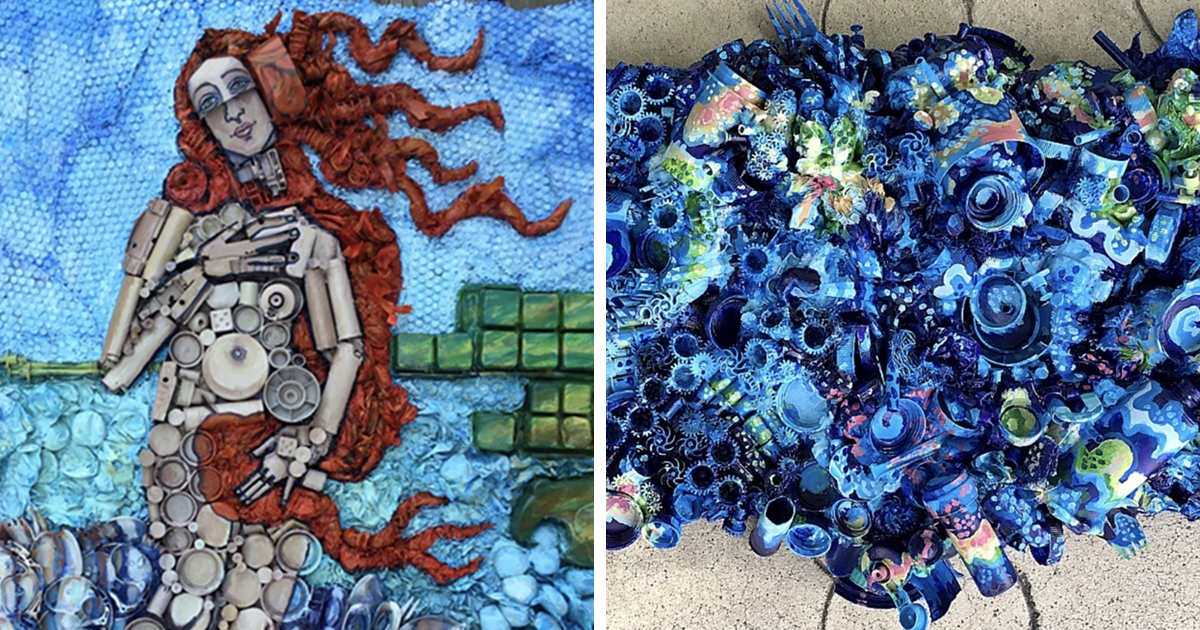
The original series featured 22 assemblage paintings created to raise awareness about plastic waste. Some works referenced familiar art-historical or spiritual imagery, while others leaned into urban landscapes and playful visual irony. Titles such as Plastic Crap Venus, Concrete Jungle, and Our Lady of Plastic suggest a clever mix of humor, beauty, criticism, and reverence for the discarded materials themselves.
That balance is important. Environmental messaging can become heavy very quickly. Nobody wakes up thinking, “I would love to be emotionally tackled by a documentary before breakfast.” But art has a gentler way of entering the conversation. It can use wit, color, absurdity, and surprise to keep people looking long enough for the message to land.
These assemblage paintings do not simply say, “Plastic waste is bad.” Most people already know that in the same vague way they know they should floss more often. The stronger message is: look at how much of this stuff is around us, look at how long it lasts, and look at what we might do differently once we stop pretending it disappears.
From Disposable Object To Environmental Story
One of the most compelling parts of plastic assemblage art is transformation. A single-use spoon becomes a decorative form. A bottle cap becomes a jewel. A torn package becomes texture. Objects that once belonged to convenience culture are rearranged into something that asks for patience, attention, and interpretation.
That transformation mirrors the shift people need to make in daily life. Instead of seeing plastic as invisible background material, we can start seeing it as a design decision. Who made it? Why was it used? Could it have been refillable, reusable, compostable, or avoided entirely? Why is a cucumber sometimes wrapped like it is being preserved for a museum opening in the year 3026?
Art cannot solve plastic pollution by itself. A painting will not swim into the ocean and politely gather fishing line. But art can change perception, and perception often comes before behavior. When people see plastic as material with consequences, they are more likely to question packaging, support better waste systems, reuse what they can, and demand smarter product design.
The Plastic Waste Problem In Plain English
The plastic waste crisis is not just about litter. It is about production, consumption, disposal, and systems that make disposable items feel normal. In the United States and around the world, plastic packaging remains one of the most visible parts of the waste stream. Much of it is used briefly, and not all of it is easy or economical to recycle.
Recycling helps, but it is not a magic trapdoor. Different plastics require different handling. Food contamination can reduce recyclability. Local recycling rules vary. Some small items are too tiny for sorting equipment. Black plastic, mixed materials, plastic film, and multi-layer packaging can be especially tricky. The result is a frustrating truth: many people place plastic in the bin with good intentions, but the system cannot always turn that hope into a new product.
This is why plastic-waste art is so effective. It shows the material in a new context without pretending the problem is solved by craftiness alone. A bottle cap in an artwork is one bottle cap kept from disposal, yes. But more importantly, it represents thousands, millions, and billions of similar objects moving through daily life.
Why Humor Helps Environmental Art Hit Harder
Humor is underrated in environmental communication. A grim warning may be accurate, but it can also make people freeze, scroll away, or suddenly remember they need to reorganize their sock drawer. Humor keeps the door open. It lets the viewer admit the situation is ridiculous without denying that it is serious.
Plastic waste is, in many ways, deeply ridiculous. We created a material that can last for generations, then used it to make things meant to be thrown away after one sandwich. We individually wrap items, then bundle the wrapped items into a bigger wrapper, then put the whole thing in a bag, as if the product is preparing for a cross-country expedition through hostile terrain.
Assemblage paintings can capture that absurdity. Bright plastic bits can look festive and alarming at the same time. A work may seem playful from across the room, then become more unsettling up close. That contrast gives the art its staying power. It does not scold. It winks, then points to the mess.
How These Paintings Encourage Plastic Awareness
They Make Waste Visible
Most people encounter plastic waste in fragments: a cup lid on the sidewalk, a wrapper in the car, a bag caught in a tree. Assemblage collects those fragments and makes them impossible to ignore. It creates a concentrated portrait of a scattered problem.
They Turn Guilt Into Curiosity
Guilt can shut people down. Curiosity can open them up. When viewers ask, “What is this made of?” they begin learning without feeling attacked. The artwork becomes an invitation rather than a courtroom.
They Connect Personal Habits To Larger Systems
A plastic fork in a painting is personal because almost everyone has used one. But it is also systemic because that fork exists within supply chains, restaurant habits, packaging norms, and waste policies. Good environmental art helps people see both levels at once.
They Show That Creativity Is Part Of Change
Solving plastic pollution requires policy, science, business redesign, waste infrastructure, and consumer behavior. But creativity matters too. It helps people imagine alternatives. It turns “this is terrible” into “what else could we do?”
Examples Of Visual Ideas In Plastic Assemblage Art
A plastic assemblage painting can take almost any form. A portrait made from bottle caps may suggest the human face behind consumption. A cityscape assembled from packaging may show how urban life is built on convenience. A flower made from lids and straws may point to the strange imitation of nature by synthetic materials. A sacred icon made from discarded plastics may ask whether modern culture worships consumption more faithfully than anything else.
Imagine a sea turtle formed from green caps, blue wrappers, and tangled fishing-line-like strands. From far away, it might look charming. Up close, the materials reveal the threat. Or picture a “plastic garden” where every petal is made from cut packaging. The colors bloom, but nothing is alive. That tension is exactly where the message lives.
Artists who work with plastic waste often become collectors, sorters, cleaners, and accidental archaeologists of consumer culture. The studio begins to look like a recycling center with better lighting and stronger opinions. Every object has potential. Every label, curve, and color can become part of a larger visual argument.
What Viewers Can Do After Seeing The Art
The best response to environmental art is not panic. Panic is exhausting and usually bad at remembering reusable bags. A better response is practical awareness. Start by noticing where plastic enters your life most often. Is it takeout? Bottled drinks? Online shopping packaging? Bathroom products? Snack wrappers? Once you identify the main source, you can make targeted changes instead of trying to become a perfect zero-waste superhero overnight.
Simple changes add up when they are realistic. Carry a reusable water bottle. Choose refillable products when available. Keep a tote bag in the car or backpack. Skip unnecessary utensils with delivery orders. Buy larger containers instead of many tiny ones when it makes sense. Support local refill shops, deposit systems, and businesses that reduce packaging. Most importantly, do not let individual action become a distraction from bigger responsibility. Companies, cities, schools, and governments all have roles to play.
Plastic pollution is not caused by one forgetful person forgetting one grocery bag. It is caused by a culture that made disposable plastic the default. Changing that default requires both personal choices and structural change.
Why Assemblage Paintings Belong In The Plastic Pollution Conversation
Environmental data is essential, but data alone rarely changes hearts. A statistic can inform; an image can haunt. Assemblage paintings made from plastic waste combine both worlds. They are physical proof of overconsumption and creative proof that discarded materials still have meaning.
They also challenge the viewer’s idea of value. Before the artwork, these plastic pieces were unwanted. After the artwork, they become composition, color, texture, symbol, and story. That does not mean all trash should become art, or that art can absorb the scale of plastic waste. It means the artwork can interrupt the automatic journey from use to disposal. It slows the object down long enough for us to think.
In that sense, these 22 assemblage paintings are not just about plastic. They are about attention. They ask us to look closely at what we normally discard quickly. They remind us that the world is shaped not only by what we buy, but by what we fail to notice after we are finished with it.
Conclusion: When Trash Refuses To Stay Quiet
“Here Are My 22 Assemblage Paintings That I Created To Bring Awareness To Plastic Waste” is more than a clever art project. It is a visual wake-up call built from the very materials that make the problem so persistent. These works use color, humor, texture, and surprise to turn discarded plastic into something viewers cannot casually ignore.
The power of plastic assemblage art lies in its contradiction. It is beautiful and troubling. Playful and serious. Familiar and strange. It shows us that plastic waste is not merely an environmental issue happening somewhere else; it is part of everyday life, hiding in plain sight as packaging, convenience, and habit.
Art does not need to shout to be persuasive. Sometimes it just needs to hang on a wall, sparkle with a few bottle caps, and make someone whisper, “Oh no, I recognize all of this.” That recognition is the beginning of awareness. And awareness, when paired with action, can become change.
Additional Experience: What Creating Plastic Waste Assemblage Teaches You
Working with discarded plastic changes the way you move through the world. At first, you see potential materials everywhere. A blue cap on the sidewalk becomes a possible moon. A red bread tag becomes a tiny architectural accent. A cracked toy part becomes a future bird wing, flower center, or abstract symbol. This sounds magical, and sometimes it is. It also means you may become the person at a picnic asking, “Are you done with that lid?” which is a fast way to make friends either admire you or move their chair slightly farther away.
The first lesson is that plastic waste is astonishingly abundant. Once you begin collecting it for art, you realize how quickly it appears. A single household can produce a surprising variety of shapes and colors in a short time: caps, films, wrappers, seals, trays, tabs, handles, pumps, labels, and mystery pieces that look like they came from a tiny robot’s garage. Sorting them becomes a visual education. You begin to understand packaging not as background noise, but as design.
The second lesson is patience. Plastic is not always cooperative. Some pieces are too slick for glue. Some bend in the wrong direction. Some have logos that dominate the composition unless you cut, layer, sand, or hide them. Cleaning the pieces takes time, especially when food packaging is involved. Nobody wants yesterday’s sauce becoming part of a gallery experience. Before the fun begins, there is washing, drying, trimming, sorting, and testing. The glamorous life of an environmental artist includes many encounters with dish soap.
The third lesson is emotional. When you create with waste, you are constantly balancing beauty and discomfort. You want the artwork to attract people, but you also want it to tell the truth. If the piece becomes too pretty, the message may soften. If it becomes too grim, people may look away. The sweet spot is often found through contrast: cheerful colors arranged into uneasy shapes, familiar objects placed in unfamiliar roles, playful surfaces carrying serious meaning.
Another surprising experience is how strongly people react when they recognize an object. A viewer may not respond immediately to an abstract environmental message, but they will point to a piece and say, “I use those coffee lids,” or “That looks like the cap from my laundry detergent.” That small recognition can be more powerful than a long lecture. It connects the artwork to personal routine. The viewer is no longer outside the issue; they are part of the material story.
Creating assemblage paintings also teaches resourcefulness. You learn to build texture without buying new supplies. You discover that “trash” has an impressive range of visual personalities. Clear plastic can create shine and water effects. Caps provide circles and rhythm. Cut containers create petals, scales, feathers, or architectural panels. Flexible packaging adds movement. Broken toys bring humor and nostalgia. Each piece carries a past life, and the artwork gives it a second job.
Most importantly, the process teaches humility. Turning plastic waste into art is meaningful, but it does not make the plastic crisis disappear. A finished painting may keep a small amount of material out of the landfill, but its larger purpose is communication. It is a conversation starter, a classroom tool, a visual essay, and sometimes a mirror. It asks the artist and the viewer to reconsider convenience, responsibility, and imagination.
After creating this kind of work, ordinary shopping becomes different. You notice unnecessary packaging faster. You become suspicious of items wrapped inside other items like they are fragile royal babies. You start asking whether a purchase is worth the waste it creates. That shift in awareness may be the most lasting part of the project. The art remains on the wall, but the habit of noticing follows you into grocery stores, restaurants, studios, and daily life.
In the end, assemblage painting is not just about making something from plastic. It is about making meaning from what society has trained itself to overlook. It proves that even the most disposable objects can tell a storyespecially when they are gathered, arranged, and finally allowed to speak.