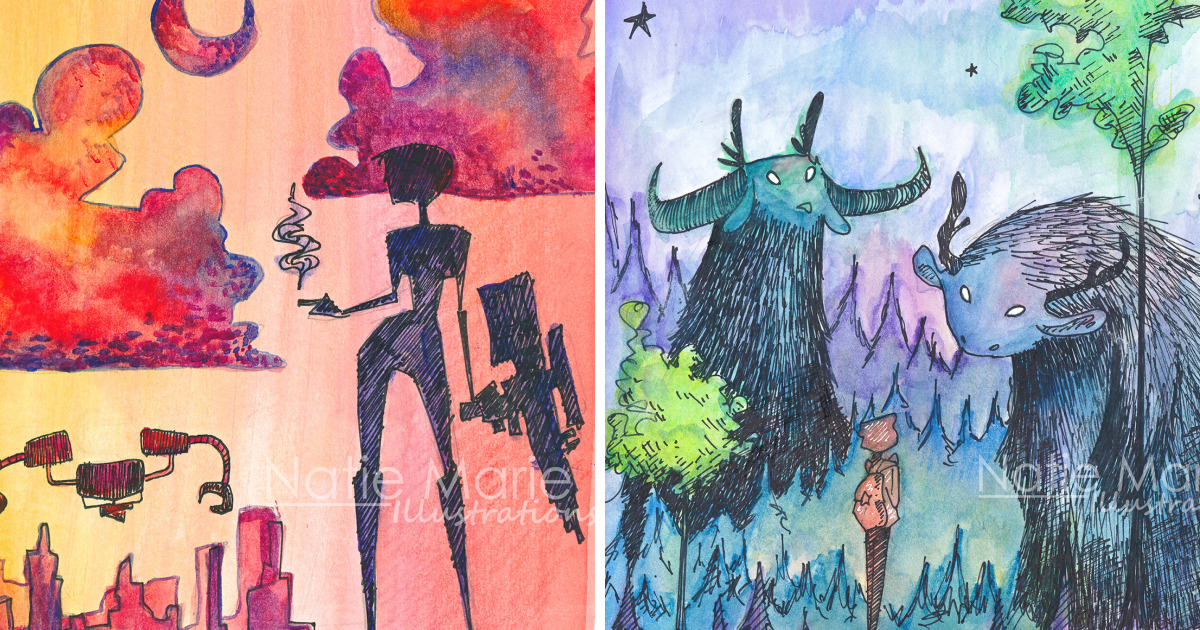
Some people come home from work and become one with the couch. I come home, stare at a blank sheet of watercolor paper, and politely ask a tiny imaginary mushroom village what drama it has brought me today. That is the strange little joy of painting whimsical fantasy scenes with ink and watercolor: the world can be loud, practical, scheduled, and very fond of emails, but a page can still become a forest where lanterns grow on branches and a fox wears a cape for reasons nobody questions.
Ink and watercolor make a perfect pair for this kind of fantasy art because they balance structure and surprise. Ink gives a scene bones: crisp branches, crooked rooftops, expressive little faces, staircases that probably violate building codes in three kingdoms. Watercolor brings the atmosphere: misty blues, mossy greens, glowing golds, and happy accidents that look suspiciously like magic. Together, they create artwork that feels hand-touched, story-rich, and alive.
This article explores why whimsical fantasy painting is so appealing, how ink and watercolor work together, what makes a scene feel magical, and why making art after work can be more than a hobby. It can be a soft landing after a long day, a private doorway into imagination, and occasionally, a socially acceptable excuse to buy one more brush.
Why Ink and Watercolor Are Perfect for Whimsical Fantasy Scenes
Whimsical fantasy scenes live in the sweet spot between planning and play. They need enough detail to make viewers believe in the world, but enough looseness to let the scene breathe. That is exactly where ink and watercolor shine.
Ink is confident. It says, “Here is the crooked tower. Here is the sleepy dragon. Here is the bridge made of suspiciously thin twigs, but everyone is crossing it anyway.” Watercolor, on the other hand, whispers. It spreads, blooms, fades, pools, and surprises you. One wash can become twilight. One splash of green can become moss. One accidental backrun can become fog rolling through an enchanted valley. Instead of fighting every unexpected mark, the artist can invite it into the story.
The Charm of Linework
Linework gives fantasy watercolor painting its personality. A thin pen line can define a fairy door hidden in tree bark, while a heavier line can make a creature feel grounded and bold. Crosshatching can add shadow beneath a mushroom cap. Tiny dots can become stars, pollen, dust, or the mysterious crumbs left by a very small goblin with snack issues.
Ink also helps viewers navigate a detailed composition. In whimsical illustration, there may be floating islands, spiral staircases, leaves, lanterns, animals, clouds, moons, and a cottage that appears to have been designed by a hedgehog architect. Without strong linework, the painting can become a beautiful blur. With ink, the eye knows where to travel.
The Magic of Transparent Color
Watercolor adds emotional weather. A pale violet sky can turn a village scene dreamy. Warm yellow in the windows can make a tiny house feel welcoming. A soft green wash can make a forest feel ancient without having to draw every leaf individually, which is good because nobody has time to draw 78,000 leaves after work unless they are avoiding laundry with professional dedication.
The transparent nature of watercolor also allows layers to glow. Instead of covering the paper completely, the painter can let white areas remain bright. This is especially useful in fantasy scenes where light matters: moonlight, fireflies, glowing crystals, magical portals, candlelit windows, or the dramatic sparkle in the eye of a raccoon wizard.
What Makes a Fantasy Scene Feel Whimsical?
Whimsy is not just “cute.” It is a mood, a visual rhythm, and a tiny rebellion against the overly serious. A whimsical fantasy scene feels like it belongs to a storybook, but not necessarily one that behaves. It can be cozy, strange, funny, mysterious, or even a little eerie. The key is to make the impossible feel emotionally familiar.
Scale Creates Wonder
One of the easiest ways to create whimsy is to play with scale. A teacup can become a house. A snail can carry a library. A pumpkin can become a carriage, a bakery, or a very judgmental landlord. When ordinary objects become architecture or vehicles, the viewer instantly understands the scene as magical.
Scale also invites curiosity. Who lives there? How do they open the door? Is the spoon ladder safe? Why is there a mailbox outside a mushroom? Does the mushroom receive bills? These questions make a painting feel like a small window into a bigger world.
Characters Bring the Scene to Life
A fantasy landscape becomes more engaging when someone lives inside it. The character does not have to be elaborate. A tiny traveler with a backpack, a bird delivering letters, a sleepy cat guarding a castle, or a frog painting portraits by the pond can transform a scene from “pretty” to “story.”
Expressions matter. A creature looking up at the moon feels poetic. A creature looking suspiciously at a sandwich feels relatable. Whimsical art often works because it combines the magical with the everyday. Dragons are exciting, but a dragon trying to fold laundry? That is literature.
Details Reward the Viewer
Small details are the treasure hunt of whimsical illustration. Tiny windows, hidden faces in tree trunks, miniature signs, patterned scarves, teapots, maps, floating candles, and little footprints can keep viewers exploring the artwork long after the first glance.
However, details need breathing room. A common mistake is to decorate every inch of the page until the painting looks like a fantasy yard sale. A stronger approach is to create focal areas: one detailed cottage, one glowing path, one curious creature, then softer surrounding washes to support the story.
Building a Whimsical Ink and Watercolor Scene
Although finished fantasy paintings may look spontaneous, many begin with simple decisions: mood, setting, character, light source, and color palette. You do not need a grand epic. Sometimes “a mouse opens a bakery in a tree stump” is more than enough. Honestly, it may be better than half the meetings anyone attended that week.
Start With a Tiny Story
Before sketching, ask one simple question: what is happening here? Maybe a traveler has found a lantern-lit path. Maybe a witch is watering moonflowers. Maybe a fox is moving into a boot-shaped house. A small story helps guide the composition and prevents the scene from becoming a random pile of charming objects.
The story does not need to be written out in full. A sentence is enough. “A little owl runs a midnight bookshop.” “A giant turtle carries a village through fog.” “A tired artist paints stars back into the sky.” Once the idea exists, the visual choices become easier.
Sketch Lightly Before Inking
A light pencil sketch helps place the main shapes without trapping the energy of the drawing. In whimsical fantasy scenes, slightly imperfect lines can add charm. A crooked chimney, uneven stones, or a leaning fence can make the world feel handmade. The goal is not architectural precision; the goal is visual storytelling.
After the sketch, ink can be added with fineliners, dip pens, fountain pens, brush pens, or waterproof ink. Many artists prefer waterproof ink if they plan to paint over the lines with watercolor. This helps prevent the drawing from dissolving into dramatic black soup. Dramatic black soup has its place, but usually not on the good paper.
Paint From Light to Dark
Watercolor usually rewards patience. Light washes can establish the atmosphere first: pale sky, soft ground, distant trees, warm window glow. Darker values come later to define shadows, depth, and contrast. This gradual build is especially useful for fantasy scenes because it allows the glow and airiness to remain intact.
For example, a moonlit forest might begin with a pale blue wash. Once dry, soft green and violet shapes can suggest trees. Then ink and darker paint can bring forward the branches, stones, and characters. Finally, tiny highlights can be preserved or added with white gouache, gel pen, or careful lifting, depending on the desired effect.
Choosing Colors for Fantasy Watercolor Painting
Color carries the emotional weight of a fantasy scene. A warm palette of ochre, rose, and burnt orange can make a village feel cozy and autumnal. A cool palette of indigo, teal, and lavender can suggest night, mystery, or old magic. A limited palette often works better than every color in the box competing like they are auditioning for a musical.
Cozy Fantasy Palettes
For gentle storybook scenes, try warm browns, moss greens, soft yellows, muted reds, and creamy neutrals. These colors work beautifully for cottages, forests, bakeries, libraries, fox dens, and anything involving a kettle. Warm window light is especially powerful. A few golden rectangles inside a blue or green scene can instantly create a sense of home.
Mysterious Fantasy Palettes
For moonlit scenes, use deep blues, violets, cool grays, and small touches of bright color. A limited glow color, such as yellow-green or pale turquoise, can make magical elements stand out. This is useful for enchanted ponds, ghostly paths, spell circles, glowing mushrooms, or suspiciously intelligent frogs.
Playful Fantasy Palettes
For cheerful whimsical art, try brighter colors but keep them organized. Coral, turquoise, lemon yellow, and spring green can work well when balanced with neutral ink lines and white space. The trick is to make the colors feel intentional, not like the palette fell down the stairs and landed on the paper.
Why Painting After Work Feels So Restorative
Painting after work is not only about producing finished artwork. It is about changing pace. Work often asks for concentration, responsibility, deadlines, communication, and problem-solving. Art asks for attention too, but in a different language. It allows the brain to move from productivity to exploration.
With ink and watercolor, the process itself can feel calming. The scratch of pen on paper, the clean rinse of a brush, the slow spread of pigment in water, the decision to leave a shape unfinished until it driesall of these small actions pull attention into the present moment. You are no longer juggling twelve tasks. You are deciding whether a mushroom roof should be red or blue. This is still a serious decision, obviously, but at least nobody is forwarding it to accounting.
Creative hobbies also provide a sense of personal ownership. Not every painting has to be shared, sold, posted, framed, or turned into a brand. Some paintings can simply exist because making them felt good. That freedom is important. It keeps the art honest, playful, and sustainable.
Common Challenges in Ink and Watercolor Fantasy Art
Even whimsical painting has its little gremlins. Water buckles paper. Ink smudges. Colors dry lighter than expected. A creature that looked adorable in pencil may become mildly haunted after inking. These are normal problems, not signs of doom.
Smudged Ink
If ink smears when watercolor touches it, the ink may not be waterproof, or it may need more drying time. Testing pens on scrap paper can prevent heartbreak. Every artist should have a small test page, also known as the “paper of humble discoveries.”
Muddy Colors
Mud often happens when too many pigments mix while wet. Letting layers dry between washes helps preserve clarity. A limited palette also reduces chaos. When in doubt, mix fewer colors and let the paper shine through.
Overworking the Painting
Watercolor has a point where it politely asks to be left alone. If ignored, it may become dull, patchy, or dramatic in a way nobody requested. Step back often. If the scene already tells the story, stop. The tiny wizard does not need seventeen more shadows on his hat.
Specific Ideas for Whimsical Fantasy Scenes
If the blank page feels intimidating, start with a simple prompt. Here are a few fantasy watercolor illustration ideas that work well with ink:
1. The Traveling Tea House
Paint a teapot-shaped cottage with chicken legs, wheels, or tiny wings. Add steam that curls into clouds. Use ink for the details on the windows, shingles, and signboard, then add warm watercolor washes for a cozy glow.
2. The Moon Gardener
Create a character tending flowers that bloom only under moonlight. Use cool blues and violets for the garden, then add pale yellow or silver-white accents to suggest magical petals.
3. The Library in a Tree
Draw a giant tree with shelves built into its trunk, ladders spiraling around branches, and owls serving as librarians. Keep the background soft so the ink details in the tree remain the focal point.
4. The Fox Cartographer
A fox in a scarf studies a map beneath a lantern. Add tiny mountains, rivers, and compass marks. This scene is perfect for combining delicate ink patterns with earthy watercolor tones.
5. The Village on a Turtle
A slow-moving turtle carries cottages, gardens, and laundry lines across a misty landscape. Use transparent washes for distance and heavier ink lines for the turtle’s shell and village details.
My After-Work Painting Experience: Finding a Small Door Back to Wonder
When I paint whimsical fantasy scenes after work, the first few minutes are usually not glamorous. There is no cinematic shot of me gracefully entering the studio while golden light hits perfectly arranged brushes. More often, I am tired, slightly suspicious of my own posture, and wondering why there are three mugs on the desk when I only remember using one. Still, I sit down. That is the important part.
I usually begin with a tiny sketch, something so small it cannot intimidate me. A crooked house. A lantern. A rabbit wearing a backpack. The smallness helps. After a long workday, I do not want to wrestle a masterpiece. I want to open a little door and see what is on the other side. Sometimes the idea arrives quickly; sometimes I draw circles until one of them becomes a moon, a pond, or a very round bird with strong opinions.
Ink is the moment the scene starts talking back. Pencil feels like a suggestion, but ink feels like commitment. I like that slight danger. A line may wobble, but a wobble can become character. If a roof tilts too much, suddenly the house belongs to a forgetful wizard. If a tree branch bends strangely, perhaps it is reaching toward a star. Whimsical art is forgiving because it welcomes the odd mark. In fact, odd marks are often where the personality lives.
Watercolor changes the mood completely. The first wash feels like turning on the weather. A pale blue sky calms everything down. A warm orange window makes the scene feel inhabited. A green bloom near the bottom of the page can become moss, grass, or the exact spot where a tiny creature spilled soup. I enjoy not controlling every part of it. After a day full of controlled tasks, watercolor’s unpredictability feels like a friendly rebellion.
There are evenings when the painting works beautifully. There are also evenings when the paper buckles, the ink smears, and the charming creature looks like it knows too much. But even then, I usually feel better after painting. The act itself has value. The brush moving across the page, the quiet decisions, the slow layering of colorthese things create a pocket of peace. Not a perfect escape from real life, but a soft pause inside it.
Over time, painting after work has taught me that creativity does not always need a grand schedule. It can live in thirty minutes at the kitchen table. It can happen beside a stack of mail, a half-finished drink, and a lamp that flickers like it has secrets. A fantasy scene does not require a castle-sized studio. It only needs paper, pigment, ink, and the willingness to ask, “What if?” What if the moon had a garden? What if a fox delivered maps? What if a tired person could come home, make something small and strange, and remember that imagination is still there, waiting patiently with a tiny lantern?
Conclusion: The Joy of Painting Small Worlds
Painting whimsical fantasy scenes from ink and watercolor is a wonderful blend of craft, storytelling, and personal restoration. Ink gives the artwork clarity and character, while watercolor adds atmosphere, softness, and surprise. Together, they make it possible to create tiny worlds that feel cozy, curious, and alive.
The best part is that this kind of art does not demand perfection. A crooked line can become charm. A color bloom can become mist. A mistake can become a magical weather event. Whether you paint after a long shift, during a quiet weekend, or in the mysterious hour when you should probably be sleeping, whimsical fantasy art offers a playful way to return to yourself.
So sharpen the pencil, uncap the ink, wake up the watercolors, and let the page become somewhere impossible. The real world will still be there afterward, but you may return to it with a little more color in your pocket.
Note: This article is written as original web-ready content in standard American English and is based on real art-making practices, museum knowledge, watercolor and ink techniques, and creative hobby research. It contains no unnecessary source-code references or copied source text.