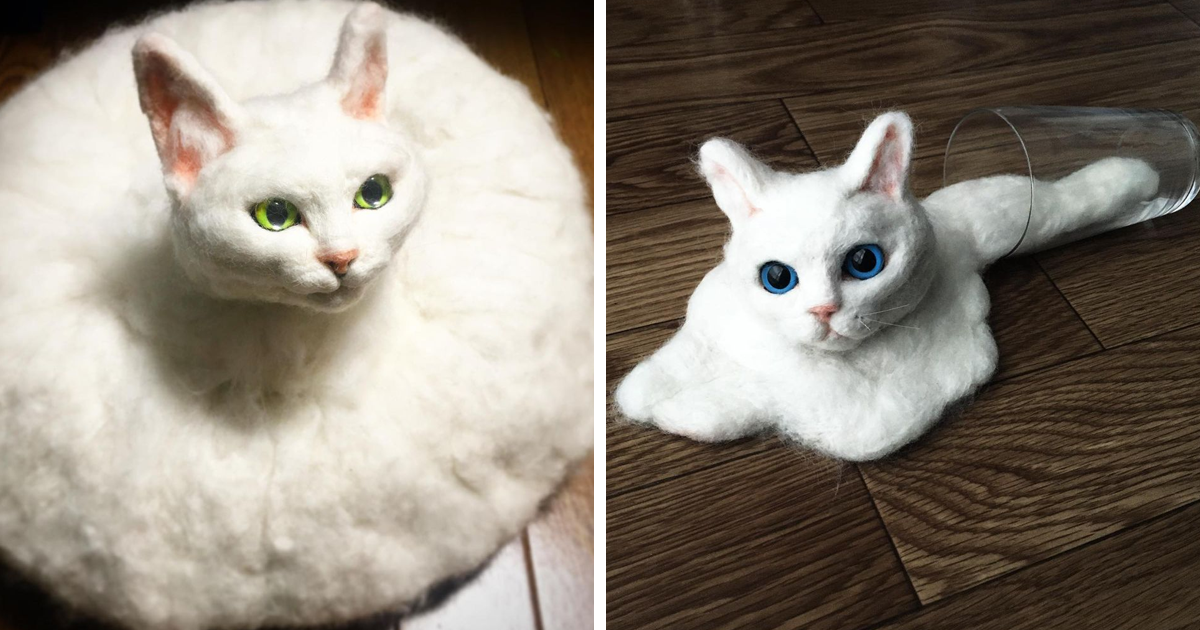
Some cats purr. Some cats nap in sunbeams. And then there are the cats created by Japanese felt artist Sacocho, also known online as ArtificialCat: woolly little creatures that look as if a pet store, a robotics lab, and a fever dream all agreed to share one very suspicious litter box. His strange felt cats are funny, unsettling, strangely adorable, and impossible to ignorewhich is probably why they travel so well across the internet.
The main keyword here is Japanese felt artist, but the real hook is the collision of two worlds that usually sit far apart. On one side, there is needle felting, a slow, tactile craft built from wool, repeated poking, shaping, trimming, and patience. On the other side, there is technology: moving bases, sound, video, social media, and the internet’s endless appetite for cats doing things that cats absolutely should not be doing. Put them together and you get a Roomba cat that glides toward you when called, a felt feline with a rotating head, and a gallery of creepy cats that somehow feel both handmade and haunted.
This is not ordinary cute cat art. These are not cozy plushies designed to sit quietly on a shelf and say, “Please love me.” They say, “Please love me, but also maybe do not turn your back.” That tension is exactly what makes Sacocho’s work so memorable. It is the uncanny valley with whiskers.
Who Is the Japanese Felt Artist Behind These Creepy Cats?
The artist behind these bizarre wool felt cats is known publicly as Sacocho, or @sacocho on social media. He is associated with the name ArtificialCat, a fitting label for an artist whose creations often feel like cats that escaped from a parallel universe where household appliances evolved fur.
Sacocho’s work became widely discussed after images and videos of his strange felt cats spread online. One of the most famous examples is the felt cat Roomba, a realistic-looking cat form mounted onto a robotic vacuum-like moving base. In video clips, the creature glides across the floor, turns its head, responds to being called, and meows. That sentence is either delightful or alarming depending on your relationship with technology, cats, and sleep.
Unlike many hyperrealistic needle felt artists who focus on creating elegant pet portraits, Sacocho leans into the absurd. His cats are not simply realistic; they are concept-driven. A cat becomes a robot vacuum. A cat becomes a hat. A cat becomes toast. A cat becomes a purse. A cat becomes a double-headed creature that looks like it should be displayed in a museum, a meme account, or a very confused veterinarian’s office.
What Makes These Felt Cats So Creepy?
The creepiness comes from precision. That may sound backwards, but it is true. If the cats were poorly made, they would just look silly. Instead, Sacocho gives them enough realism to make the viewer pause. The fur texture looks soft. The face has expression. The proportions often borrow from real feline anatomy. Then the artist introduces one impossible twist: the cat has no legs, or two heads, or a machine-like body, or the suspicious posture of an object that has plans.
This is the secret sauce of creepy-cute art. It must be cute enough to invite attention and strange enough to hold it. Sacocho understands that cats already occupy a special space in visual culture. They are elegant, ridiculous, mysterious, and emotionally unreadable. Add technology to that mix and the cat becomes a perfect vehicle for surreal humor.
The internet loves animals because animals are expressive without trying to be. A normal cat staring at a wall can look like it has discovered a ghost. A felt robotic cat moving across the room while meowing feels like the ghost filed paperwork and bought batteries.
Needle Felting: The Soft Sculpture Technique Behind the Madness
To understand why these cats are impressive, it helps to understand needle felting. Felt is a nonwoven textile made by matting, condensing, and pressing fibers together. In traditional wet felting, heat, moisture, friction, and pressure cause wool fibers to interlock. Needle felting uses a different method: a special barbed needle is repeatedly pushed into loose wool, tangling the fibers and gradually forming a firm shape.
That sounds simple until you try it. Then you realize the process is less “instant craft magic” and more “patiently stabbing fluff until it agrees to become a creature.” The barbed needle catches tiny scales on the wool fibers and locks them together. With enough control, an artist can build cheeks, ears, paws, wrinkles, fur layers, and the exact expression of a cat that has seen your browser history.
Why Wool Works So Well for Cats
Wool is ideal for feline sculpture because it naturally mimics fur. It can be blended in different colors, layered for depth, trimmed for texture, and shaped into soft contours. A skilled felt artist can create tabby stripes, fluffy cheeks, sleepy eyelids, and those tiny face details that make cats look both majestic and mildly disappointed.
Japanese needle felt artists have become especially well known for realistic cat creations. Artists such as Wakuneco have created lifelike framed cat portraits using wool, glass eyes, and careful reference photos. Housetsu Sato and students at the Japan School of Wool Art also gained attention for gigantic wearable cat heads made from wool felt. Sacocho belongs to this broader world of Japanese wool art, but his lane is different. Instead of using realism only to honor the beauty of cats, he weaponizes realism for comedy, surprise, and just enough nightmare fuel to keep things interesting.
Where Art Meets Technology
The phrase art and technology often brings to mind digital installations, AI visuals, projection mapping, or 3D printing. Sacocho’s work is more low-key and funnier: he uses technology not to replace craft, but to animate it. The wool remains handmade. The face still depends on artistic skill. The joke still begins with a physical object. Technology simply gives the creature a second life.
The Roomba-style cat is the clearest example. A static felt cat is already impressive. A moving felt cat that glides like a household appliance is something else entirely. It becomes performance art. The viewer is not only looking at a sculpture; they are watching a strange little being enter the room. Motion changes the relationship between artwork and audience. Suddenly the creepy cat is not just “there.” It is approaching.
Sound also matters. A meow from a normal cat is charming. A meow from a felt robot cat is comedy with a tiny splash of existential dread. That is why the videos are so shareable: they deliver a complete emotional loop in seconds. First, curiosity. Then recognition. Then laughter. Then the quiet thought, “Why do I want one?”
Why These Creepy Cats Went Viral
Sacocho’s creepy cats are built for the internet without feeling like they were cynically designed by a marketing committee. They work because they combine several viral ingredients naturally: cats, handmade skill, weirdness, short-form video, and a visual punchline that can be understood across languages.
You do not need a long explanation to understand a cat Roomba. You see it, and your brain immediately says, “That is wrong,” followed closely by, “Show me again.” This instant readability is one reason visual memes spread so easily. The best internet images do not require homework. They reward a quick glance, then invite a longer stare.
There is also a strong element of contrast. Needle felting is associated with softness, warmth, and handmade charm. Robotic movement is associated with machines, automation, and clean efficiency. Sacocho smashes those associations together. The result is a fuzzy machine that looks domesticated but behaves like a gadget. It is a pet, a sculpture, a joke, and a tiny technological cryptid.
26 Pics, 26 Tiny Portals Into Weird Cat Logic
The popular gallery format of “26 pics” fits this kind of art perfectly. Each image can stand alone as a joke, but together they build a world. Sacocho’s cats do not feel like random one-offs. They feel like residents of a fictional cat cafe where the menu probably includes tuna, static electricity, and a waiver.
Some pieces play with the body: double-headed cats, elongated cats, cats with impossible proportions. Others play with function: a cat that cleans the floor, a cat that can be worn, a cat that looks like an accessory. Still others play with food or household objects. These combinations are funny because they treat cats as if they can be merged with anything and still remain, somehow, aggressively cat-like.
This is where the artist’s imagination shines. The work is not merely “look, a cat.” It is “what if a cat was also this other thing, and what if nobody in the room acknowledged how alarming that is?” That deadpan quality is very effective. The sculptures do not wink too hard. They simply exist, furry and strange, leaving the viewer to handle the emotional paperwork.
The Creepy-Cute Appeal of Japanese Cat Art
Japan has a long and lively relationship with cat imagery, from lucky maneki-neko figures to modern mascot culture, anime cats, cat cafes, and internet-famous felines. Japanese pop culture often handles cuteness with impressive flexibility. Cute can be sweet, elegant, absurd, chaotic, or slightly unsettling. Sacocho’s felt cats sit comfortably in that flexible space.
The Japanese idea of character-driven design often gives everyday objects personality. A train mascot, a snack mascot, a regional mascot, or a household item with a face can become charming. Sacocho pushes this concept toward the surreal by giving cat identity to machines and objects. Instead of making technology look sleek, he makes it furry and suspicious. Instead of making cats more graceful, he makes them more mechanically confusing.
That is why the works feel fresh. They are not just creepy for shock value. They are carefully balanced between craft tradition and contemporary internet humor. They respect the handmade object while also laughing at the absurd possibilities of modern life.
Why Handmade Art Still Matters in a Digital World
One reason Sacocho’s work feels so satisfying is that it is visibly handmade. In an era of filters, generated images, and endlessly polished digital media, a physical wool sculpture has weight. It has texture. It took time. Someone had to shape the head, place the eyes, blend the fur, test the movement, and probably explain to at least one person why there was a robotic cat body sitting on the floor.
Handmade art creates trust because we can imagine the labor behind it. The technology may provide movement, but the soul of the piece comes from craft. That combination makes the work more memorable than a purely digital gag. A digital image of a cat Roomba might be funny once. A real felt cat Roomba moving in the physical world feels like evidence. It says, “No, really. Someone made this.”
What Artists and Content Creators Can Learn From Sacocho
Sacocho’s creepy cats offer useful lessons for artists, makers, bloggers, and anyone trying to create memorable online content. First, a strong concept matters. The technique is impressive, but the idea is what travels. “Realistic felt cat” is interesting. “Realistic felt cat that behaves like a robotic vacuum” is unforgettable.
Second, contrast creates energy. Soft versus mechanical. Cute versus creepy. Traditional craft versus modern tech. Cat versus appliance. These contrasts make the work easy to describe and fun to share.
Third, humor does not need to be loud. Sacocho’s cats are funny because they are presented almost matter-of-factly. The artist does not need to over-explain the joke. The object carries it. In a crowded digital space, that kind of visual confidence is powerful.
Experience Section: What It Feels Like to Encounter These Creepy Cats
Seeing Sacocho’s creepy cats for the first time is a very specific experience. At first, you think you are looking at a normal felt cat sculpture. Your brain relaxes. Wool, whiskers, soft fur, tiny facesafe territory. Then the object moves, or you notice that it has no normal body, or you realize it is attached to something that looks suspiciously like home-cleaning technology. Suddenly your brain sits upright like a cat hearing a can opener.
That delayed reaction is part of the fun. Good surreal art often works like a prank played gently on perception. You recognize the familiar, then discover the impossible hiding inside it. With Sacocho’s cats, the familiar part is extremely familiar. Most people know what a cat looks like. Even people who do not own cats understand the basic cat software: stare, loaf, judge, repeat. So when the artist alters that software, the viewer notices immediately.
Imagine standing in a room and watching a felt cat Roomba glide toward you after being called. You would probably laugh first. Then you might step back, just a little. Not because it is truly frightening, but because it activates the same part of your mind that reacts to lifelike dolls, animatronics, or mannequins that seem a bit too aware of your presence. The wool makes it charming. The motion makes it uncanny. The meow seals the deal like a tiny haunted receipt.
There is also something oddly wholesome about the whole thing. These cats may look creepy, but they are not cruel or dark. They are playful experiments. They celebrate curiosity. They ask, “What happens if we combine this craft with that machine?” That kind of question is at the heart of creative work. The answer does not have to be practical. Nobody needs a cat-shaped vacuum companion that may or may not be plotting. But the world is more interesting because someone made one.
For viewers who enjoy crafts, the experience can be inspiring. Needle felting is approachable in theory, but mastery takes serious control. Looking at these cats reminds us that wool can become almost anything in the right hands. A beginner might start with a round sheep or a tiny mushroom. An advanced artist might sculpt a realistic face. Sacocho goes further by asking what happens after the sculpture exists. Can it move? Can it perform? Can it become a character?
For cat lovers, the experience is even funnier. Cats already behave like mysterious little machines with unpredictable settings. They power down in sun patches, reboot at 3 a.m., reject expensive accessories, and occasionally stare into empty corners with the intensity of a paranormal investigator. A robotic felt cat simply makes the metaphor literal. It is not that Sacocho makes cats strange. Cats were strange first. He just documents the truth in wool.
For technology fans, the appeal lies in the low-tech/high-tech blend. The work does not need to be a glossy robot from a futuristic showroom. In fact, it is better because it is fuzzy, handmade, and imperfectly alive. The visible softness makes the technology feel approachable. The technology makes the softness feel mischievous. Together they create an object that feels like a joke, a sculpture, and a tiny performance.
That is why these creepy cats stay in the memory. They are not just images to scroll past. They are little questions disguised as pets. Where does craft end and animation begin? Why do we find lifelike objects charming until they move slightly too well? Why are cats the perfect ambassadors for weird art? And most importantly, if a felt cat Roomba cleaned the floor, would it still knock a glass off the table afterward? Science has not yet answered, but spiritually, we all know the answer is yes.
Conclusion
Japanese felt artist Sacocho has created a wonderfully strange niche by combining needle felting, cat sculpture, robotics-inspired movement, and internet-ready humor. His creepy cats are more than novelty objects. They are examples of how traditional craft can evolve when artists treat technology not as a replacement for handmade skill, but as a playful extension of it.
The result is a world of wool felt cats that glide, stare, meow, transform into objects, and challenge our expectations of what soft sculpture can be. They are cute. They are creepy. They are technically clever. They are also proof that the internet has not run out of ways to make cats weird, which is comforting news for humanity and concerning news for furniture.
Note: This article is an original, publication-ready synthesis based on public information about Sacocho’s felt cats, Japanese needle felt art, wool felting techniques, cat-themed soft sculpture, and the broader online culture surrounding creepy-cute handmade art. Source links have been intentionally omitted according to the publishing brief.