If your home had a “backstage,” the laundry room and mudroom would be it: the place where muddy shoes, mystery socks,
and last-minute “where’s my hoodie?!” moments all happen at once. The good news? These two spaces are basically
made for organizationbecause they already have a job. The better news? You don’t need a magazine-perfect renovation
to make them work. You need zones, a few smart storage decisions, and a system that survives real life (including
dogs, sports gear, and the occasional wet mitten apocalypse).
This guide breaks down how to organize a laundry room and mudroom like a prowithout turning your home into a sterile
showroom. You’ll get practical layouts, storage ideas that actually fit daily routines, and maintenance habits that keep
the clutter from creeping back like it pays rent.
Start With One Big Idea: Create a “Flow,” Not a Pile
The fastest way to improve a laundry room or mudroom is to stop treating it like a holding cell for random stuff.
Instead, design it like a tiny workflow: things come in, get handled, and go out where they belong. When the space
matches your routine, it practically organizes itself. When it doesn’t, you end up with a “laundry chair” and a
“shoe mountain,” both of which are powerful, ancient forces.
The Four Questions That Decide Your Layout
- Where do shoes and coats land first? (That’s your drop zone.)
- Where does dirty laundry collect? (That’s your sort zone.)
- Where do wet items dry? (That’s your drip zone.)
- Where do clean items pause before leaving? (That’s your “launch” zone.)
If your mudroom and laundry room are separate, you’ll still use the same logicjust split zones between rooms.
If they’re combined (common in many homes), you’ll want tighter, more intentional boundaries so wet boots don’t
vibe too close to freshly folded towels.
Zone Planning That Works in Real Homes
Zone 1: The Drop Zone (A Landing Spot That Isn’t the Floor)
The drop zone is the “first five seconds” of coming home. If you don’t give people an obvious place to put things,
they will invent one. Usually that place is the closest flat surface. Or the floor. Or your soul.
What to include:
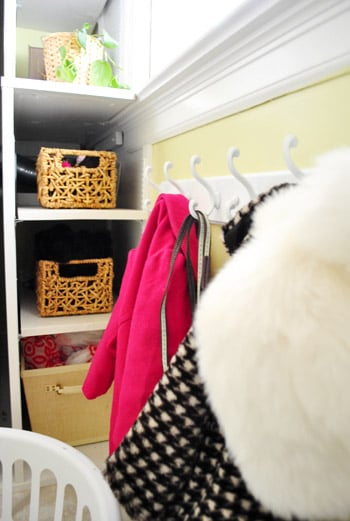
- Hooks for coats, bags, and backpacks (install at adult height and kid height if needed).
- A bench for sitting while taking off shoesbonus points for storage underneath.
- A tray or bowl for keys, earbuds, and the tiny items that vanish into another dimension.
- A “one-mail rule” spot (a wall file or bin) so paper doesn’t migrate to the kitchen counter.
Example: A family with two school-age kids can assign each child two hooks (coat + backpack) and one
cubby/bin for hats and gloves. If you only assign one hook, it becomes an overstuffed scarf monster by Tuesday.
Zone 2: The Shoe Zone (Because Shoes Multiply Overnight)
Shoes are the #1 mudroom clutter culprit because they’re bulky, dirty, and oddly sentimental (“I might wear these
again… someday… in 2029”). The fix is to store the shoes you actually wear and give everything else a seasonal home.
- Everyday shoe storage: open cubbies, a rack, or baskets under a bench.
- Boot control: a boot tray to catch mud and water; boot stands to help them dry faster.
- Seasonal rotation: store off-season shoes in labeled bins in a closet or overhead shelf.
Pro tip: Measure your “shoe population” for a normal week. If you have space for 8 pairs but your
household generates 18 pairs, your system will fail. Storage isn’t about aestheticsit’s about capacity.
Zone 3: The Wet & Dirty Zone (The “Please Don’t Touch the Walls” Area)
Mudrooms exist because nature is beautiful… and also extremely rude. Plan for wet coats, muddy paws, sports gear,
and rainstorms that arrive exactly when you’re carrying groceries.
Smart additions:
- Durable flooring (tile, sealed concrete, or waterproof vinyl plank) plus a washable runner.
- Wall protection like washable paint, beadboard, or wainscoting in splash zones.
- Drying solutions such as a wall-mounted drying rack, tension rod, or sturdy hooks near airflow.
- A small towel bin for pet paws and drips (yes, this is worth it).
If your mudroom is also your laundry room, keep wet items on the “mud side” and laundry supplies on the “clean side.”
Even a visual dividerlike a bench line, a rug boundary, or a tall hamperhelps everyone understand what goes where.
Laundry Room Organization: Make the “Work Triangle” Your Friend
Kitchens have work triangles (sink-stove-fridge). Laundry rooms have one too: collect → wash → dry → fold.
Your storage should support those steps so you aren’t walking laps like you’re training for the Sock Olympics.
Zone 1: Laundry Sorting (Stop Sorting on Laundry Day)
Sorting is easiest when it happens automaticallymeaning you sort while you drop clothes in, not later when you’re
already tired.
- Two- or three-bin hamper system: lights/darks/towels, or adult/kids, depending on your routine.
- Labels that people will follow: simple words, big letters, or icons for kids.
- A small “stain station” with a spray bottle and a rag so you treat stains before they become permanent roommates.
Example: If sports uniforms are your weekly crisis, add a dedicated “sports bin” so they don’t get buried
under pajamas. That bin can become your “wash first” queue.
Zone 2: Supply Storage (Make It Safe, Visible, and Not a Jenga Tower)
Laundry products are small but chaotic. Organize them by frequency of use and store them where they’re easy to grabbut
also safe if you have children or pets.
- Everyday items: detergent, stain remover, dryer sheets/wool balls in a caddy or shelf at arm height.
- Bulk refills: on a high shelf or in a closed cabinet to reduce visual clutter.
- Small tools: lint roller, sewing kit, missing-button supplies in a labeled bin.
- Safety rule: store pods and concentrated detergents up high or in child-locked cabinets.
If you love the “matching container” look, keep it realistic: decant what you use weekly and keep bulk backups out of sight.
The goal is function first, not a detergent museum.
Zone 3: Folding & Hanging (Give Clean Clothes a Place to Land)
Folding fails when there’s no surface. Hanging fails when there’s no rod. These are not personal flaws. They are
physics problems.
- Countertop space: even 24–30 inches of clear counter makes folding dramatically easier.
- Hanging rod: mount a rod above the counter or between cabinets for “hang-dry” and fresh-out-of-dryer items.
- Drying rack: wall-mounted fold-down racks save space in small rooms.
- Clean-clothes staging: baskets labeled by person (or by room) to transport clean items efficiently.
Example: For a household of four, use four clean-laundry baskets labeled with names. When a load finishes,
sort into baskets immediately (not “later,” which is code for “never”). Each person carries their basket to put away.
Small Space? Here’s How to Organize Without a Full Renovation
Not everyone has a dreamy laundry room with built-in cabinets and a chandelier (which would be bold above a spinning
washer, but okay). If you’re working with a closet laundry, hallway nook, or tiny combined entry, focus on vertical
storage and movable systems.
High-Impact Upgrades for Tight Rooms
- Wall hooks and rails: use vertical wall space for bags, coats, and even brooms.
- Over-the-door organizers: perfect for cleaning supplies, lint rollers, and small essentials.
- Stackable bins: label them by category (pet, sports, winter, cleaning) so you can find things fast.
- Rolling cart: turns an awkward corner into a supply station you can move when needed.
- Magnetic strips or side-mount storage: use the sides of washers/dryers (carefully) for small items.
When space is limited, consistency matters more than perfection. A small system that everyone follows beats a fancy
system nobody understands.
Make It Durable: Materials and Design Choices That Stay Clean
Organization gets easier when surfaces are easy to clean. Mudrooms and laundry rooms deal with moisture, grit, and the
occasional detergent spill that looks like modern art.
- Flooring: choose water-resistant, easy-wipe materials and use washable mats where traffic is highest.
- Paint: washable/scrubbable paint finishes in high-splash areas help walls recover faster.
- Hardware: sturdy hooks and handles matterflimsy hooks will betray you at the worst time.
- Ventilation: airflow reduces odors and helps wet gear dry faster; consider a fan if humidity is an issue.
Common Organization Mistakes (So You Don’t Have to Learn the Hard Way)
- Too few hooks: if there aren’t enough, coats end up on chairs and chairs become coat racks.
- No “wet plan”: without a drip zone, wet items spread across the room like a slow-moving flood.
- Storage without categories: bins without labels become “random stuff portals.”
- Ignoring the exit path: if shoes block the door, people will kick them aside and the chaos begins anew.
- Overstuffing: if drawers and baskets are packed, nobody can put things away quickly.
The Maintenance Routine That Keeps It Organized
The secret to keeping these spaces tidy is not “being a naturally organized person.” It’s doing a tiny reset often,
before the mess becomes a project.
The 5-Minute Daily Reset
- Hang up coats and bags.
- Put shoes back in their zone.
- Empty the “pocket stuff” tray (receipts, rocks, tiny treasures) into a small dump bin to sort weekly.
- Wipe obvious wet spots so they don’t turn into grime.
The 15-Minute Weekly Reset
- Return stray items to their homes (or assign them one).
- Quickly check detergent and restock from bulk supplies.
- Shake out mats and empty boot trays.
- Do a “lost socks and lonely gloves” sweep and reunite what can be reunited.
If you want the space to feel calm, focus on keeping surfaces clear: the bench, the folding counter, and the floor.
Those three areas set the emotional tone of the whole room.
Real-Life Experiences & Lessons From Laundry Room & Mudroom Organization (About )
In real homes, the laundry room and mudroom aren’t just roomsthey’re emotional roller coasters with excellent lighting
(if you’re lucky). The “experience” of these spaces is often a cycle: calm on Monday, questionable by Wednesday, and
full-blown “how did this happen?” by Saturday. That’s why the best organization systems aren’t the ones that look
impressive; they’re the ones that recover quickly after a chaotic day.
One of the most common lived scenarios is the after-school avalanche: backpacks drop, shoes kick off,
jackets slide to the floor, and suddenly your entry area looks like a tiny yard sale. The fix usually isn’t yelling
(tempting, but rarely effective). It’s making the “right” action the easiest action. When hooks are at kid height,
bags can hang up without adult assistance. When shoes have a clear, open cubbyno lids, no complicated stackingkids
can toss them in and move on. When the system requires extra steps, people will invent shortcuts, and those shortcuts
look suspiciously like piles.
Then there’s the wet weather reality. A rainy day can undo a week of organization in about three minutes:
soaked jackets, muddy pant legs, umbrellas dripping like tiny indoor waterfalls. The households that handle this best
usually have a designated “wet zone” that acts like containment. A boot tray is the unsung hero hereit’s not glamorous,
but it quietly prevents mud from migrating across the floor. A towel bin near the door also changes the whole vibe:
instead of hunting for a towel (and somehow ending up with a kitchen dish toweltragic), there’s always one ready for
paws, boots, or hands.
Laundry brings its own set of experiences, especially the clean-clothes bottleneck. Many people don’t
struggle with washing and dryingthey struggle with what happens next. Clean laundry sits in baskets because putting
it away feels like a separate job (because it is). A surprisingly effective workaround is the “sort once” approach:
when the load is done, clean items get sorted directly into person-labeled baskets. That turns “putting away laundry”
from one giant task into smaller, predictable steps. It also reduces the classic “I can’t find my shirt” moment, because
at least it’s in the correct basket, not somewhere in the Great Cotton Wilderness.
The most memorable lesson from real-life organizing is that systems need forgiveness. Some weeks are
busy, some days are messy, and sometimes a single sports tournament creates a mountain of uniforms and towels that
deserves its own documentary. A good laundry room and mudroom setup doesn’t demand perfection; it makes cleanup faster.
When you can reset the space in 10–15 minutes, you stop feeling behind all the time. And when the space feels manageable,
people are more likely to maintain itbecause nobody wants to tidy a room that already feels like defeat.
Conclusion
Laundry room and mudroom organization works best when you build around real routines: where things land, where they
dry, where laundry gets sorted, and where clean items get staged for the rest of the house. Start with zones, give
everything a clear “home,” and choose storage that matches your household’s actual volumeespecially shoes, coats,
and weekly laundry. Add a simple reset routine, and you’ll spend less time managing clutter and more time enjoying a
home that feels calm from the moment you walk in the door.