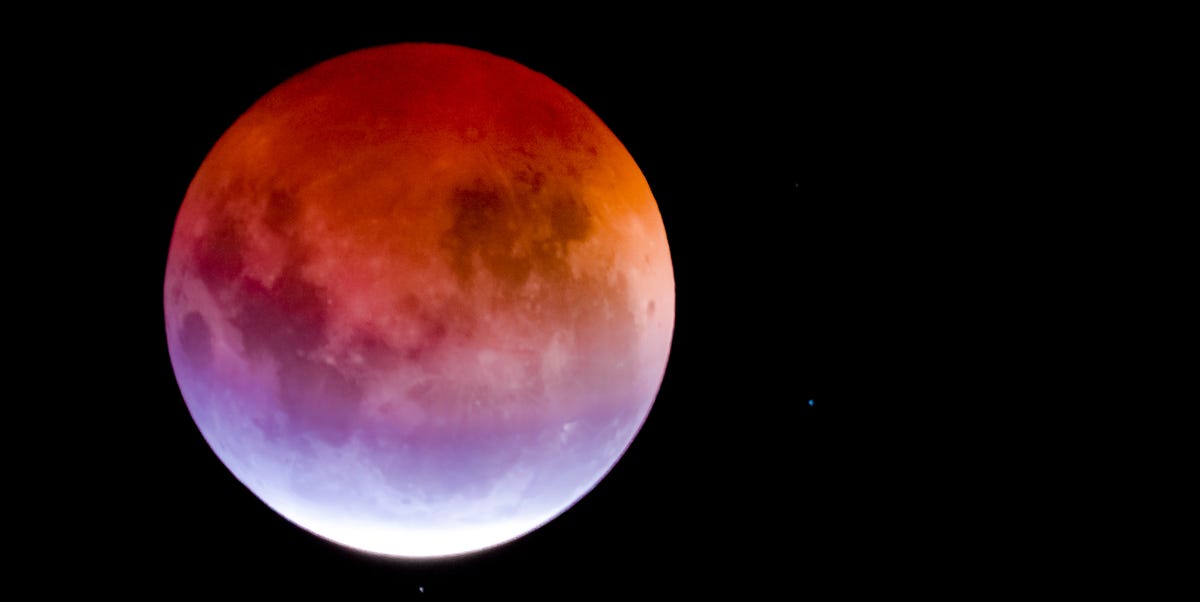
Some sky events politely show up, sparkle a little, and head home before your coffee gets cold. The lunar eclipse of July 27, 2018 was not that kind of guest. It arrived with drama, stayed for nearly four hours, turned the Moon a moody red, shared the stage with bright Mars, and earned headlines around the world as the “longest lunar eclipse of the century.” That phrase made for excellent clickbait and solid backyard bragging rights, but the more precise description is even better: it was the longest total lunar eclipse of the 21st century.
In plain English, this was the big one. Totality lasted 1 hour, 42 minutes, and 57 seconds, which is almost absurdly generous by eclipse standards. The full event, including the lighter shadow phases before and after totality, stretched close to four hours. That gave skywatchers across Africa, Europe, Asia, Australia, and parts of South America plenty of time to stare upward, text friends in all caps, and say some version of, “Okay, wow, the Moon really does look red.”
If you missed it, do not worry. We are about to unpack why the July 2018 blood moon was so special, why it lasted so long, where it was visible, what made it look coppery and eerie, and why Mars decided to photobomb the whole occasion like an overachieving red celebrity.
What Happened During the July 2018 Lunar Eclipse?
A total lunar eclipse happens when Earth moves directly between the Sun and the Moon, causing Earth’s shadow to fall across the lunar surface. Unlike a solar eclipse, which requires careful eye protection and a specific geographic path, a lunar eclipse is wonderfully low-maintenance. If it is nighttime where you are and the Moon is above the horizon, you can watch it safely with your own eyes. No special glasses, no gadgets, no need to explain to your relatives why you bought three eclipse maps and a folding chair.
On July 27, 2018, the Moon moved deeply through Earth’s umbra, which is the darkest central part of our planet’s shadow. That deep passage is one big reason the event was so impressive. The eclipse began with the subtle penumbral phase, when the Moon slipped into Earth’s faint outer shadow. Then came the partial phase, when a dark bite seemed to be taken out of the lunar disk. Finally, totality arrived, and the Moon glowed in shades of red, rust, and burnt orange instead of disappearing completely.
The key moments in Universal Time were especially neat for eclipse nerds and anyone who enjoys a good celestial schedule:
- Penumbral eclipse began: 17:14:49 UT
- Partial eclipse began: 18:24:27 UT
- Totality began: 19:30:15 UT
- Greatest eclipse: 20:21:43 UT
- Totality ended: 21:13:12 UT
- Partial eclipse ended: 22:19:00 UT
- Penumbral eclipse ended: 23:28:37 UT
That timeline helps explain why people kept talking about the eclipse lasting nearly four hours even though totality itself lasted about 103 minutes. The Moon spent a long time moving into, through, and back out of Earth’s shadow system. In other words, this was not a blink-and-you-missed-it performance. It was a full cinematic release.
Why Was It the Longest Total Lunar Eclipse of the 21st Century?
This is where astronomy gets wonderfully specific. The July 2018 eclipse lasted so long because several orbital factors lined up in the Moon’s favor.
1. The Moon Was Near Apogee
The Moon was near apogee, which means it was close to the farthest point in its orbit from Earth. When the Moon is farther away, it moves a bit more slowly in its orbit. Slower Moon, longer crossing time. Nature occasionally rewards patience with math.
2. The Moon Passed Deeply Through Earth’s Umbra
This was a central-style passage, meaning the Moon traveled near the middle of Earth’s dark shadow rather than just skimming the edge. That deeper route increased the time spent in totality. It is the eclipse equivalent of taking the scenic route, except the scenery is a giant cone of shadow cast by our home planet.
3. Earth Was Near Aphelion
Earth had recently reached aphelion, the point in its orbit where it is farthest from the Sun. When that happens, Earth’s shadow can stretch a little larger in the right geometry. A larger umbra gave the Moon more shadow to travel through, which added even more time to the show.
Put those three factors together and you get a total lunar eclipse that came within just a few minutes of the theoretical maximum possible length. That is why the event drew so much attention from astronomers, science writers, photographers, and people who simply enjoy looking up and feeling pleasantly tiny.
Why Did the Moon Turn Red?
The nickname “blood moon” sounds like something a streaming platform would greenlight immediately, but the science behind it is beautiful and straightforward. During a total lunar eclipse, sunlight still reaches the Moon indirectly. As that sunlight passes through Earth’s atmosphere, shorter blue wavelengths are scattered away more easily, while red and orange wavelengths bend through the atmosphere and continue onward into Earth’s shadow.
That filtered reddish light falls on the Moon, making it glow in shades ranging from copper and amber to dark brick red. In a poetic sense, the eclipsed Moon is lit by the combined sunrises and sunsets of Earth. Which is both scientifically accurate and dramatically overqualified for a greeting card.
The exact color can vary from one eclipse to another. Dust, pollution, and volcanic particles in Earth’s atmosphere can make the Moon appear darker or redder. So while “blood moon” is a catchy label, no two total lunar eclipses are exactly alike. July 2018 was especially memorable because the Moon passed so deeply into the shadow, making the color shift feel richer and more intense.
Where Was the July 2018 Lunar Eclipse Visible?
The eclipse was visible across a huge portion of the world, including much of Africa, Europe, the Middle East, Asia, Australia, and parts of South America. Some regions saw the full event, while others caught the Moon rising or setting during part of the eclipse.
Unfortunately for skywatchers in the United States, this one was basically a no-show from home. North America was on the wrong side of Earth at the critical time, so U.S. viewers mostly had to rely on livestreams, international photos, and the emotional support of astronomy websites.
Still, the broad visibility across the Eastern Hemisphere helped turn the event into a global spectacle. People gathered on rooftops, at observatories, in deserts, on beaches, and in city parks. Social media filled up with eclipse photos from everywhere from South Africa to India to central Europe. It was one of those rare nights when half the planet seemed to be looking up at the same thing and collectively agreeing, “Yep, that is absolutely worth losing sleep over.”
Mars Stole a Little Attention Too
As if the longest total lunar eclipse of the century were not enough, Mars also happened to be putting on one of its best performances in years. On the same date, Mars reached opposition, meaning Earth was positioned between the Sun and Mars. Around opposition, Mars appears especially bright and prominent in the night sky.
That meant many viewers saw not one but two reddish objects at once: the eclipsed Moon and a brilliant Mars nearby. It was the kind of cosmic double feature that makes amateur astronomers sound smug for at least a week, and honestly, they earned it.
The pairing also helped the July 2018 eclipse stand out in memory. People were not just seeing a blood moon. They were seeing a blood moon with Mars glowing close by, creating a sky scene that looked a little theatrical, a little spooky, and very difficult to ignore.
How Did It Compare With Other Lunar Eclipses?
Not all lunar eclipses are created equal. Some are partial, where only part of the Moon enters Earth’s umbra. Some are penumbral, so subtle that many casual observers barely notice anything beyond a faint dimming. Even among total lunar eclipses, duration varies a lot.
The July 2018 event stood out because totality lasted nearly 103 minutes. For comparison, some total lunar eclipses barely make it past the one-hour mark, and a few are dramatically shorter. In fact, one of the shortest total lunar eclipses of the century lasted less than five minutes. That makes the July 2018 eclipse feel less like a quick celestial cameo and more like the director’s cut.
It is also worth noting that the phrase “longest lunar eclipse of the century” gets thrown around loosely in headlines. The technically correct claim is that July 27, 2018 produced the longest total lunar eclipse of the 21st century. That distinction matters because astronomy loves precision, and because the internet sometimes writes headlines like it just chugged three energy drinks.
Why the July 2018 Eclipse Still Matters
Years later, this eclipse still gets searched, shared, and talked about because it checked every box people love in a sky event. It was rare, dramatic, visually striking, easy to understand, and visible to a huge part of the world. It also invited curiosity. You did not need an advanced degree to appreciate it, but if you were curious enough to ask why, the science turned out to be just as interesting as the view.
For educators, it was a perfect example of orbital mechanics made visible. For photographers, it offered a long enough timeline to plan compositions and exposures. For casual viewers, it was proof that the night sky can still surprise us without requiring a rocket launch or a new telescope. And for SEO readers landing on this page because they typed “Lunar Eclipse July 2018” into a search bar at 1:12 a.m., it remains one of the most memorable moon events of modern times.
What It Was Like to Experience the Longest Lunar Eclipse of the Century
Even if you understand all the science, the experience of a long total lunar eclipse feels deeply human. The July 2018 event was not only about orbital speed, shadow geometry, and atmospheric scattering. It was also about standing outside longer than you planned to, letting your eyes adjust, and realizing the Moon had become something strangely unfamiliar.
At first, an eclipse can seem almost underwhelming. The penumbral phase is subtle, like the Moon has turned down its brightness one click. Then the partial phase begins, and suddenly the familiar full Moon looks as if a dark curtain is being drawn across it. That is the moment many people stop casually glancing up and start paying serious attention. Phones come out. Conversations pause. Someone always says, “Wait, is that it?” Then, five minutes later: “Oh wow, okay, now I get it.”
What made the July 2018 eclipse special as an experience was time. Because totality lasted so long, viewers were not rushed. There was time to settle in, compare the changing colors, notice the surrounding stars, and feel the night sky become more textured than usual. A bright full Moon can wash out the sky, but an eclipsed Moon softens. The darkness around it seems deeper, and the stars feel bolder, as though they have been waiting politely for the Moon to stop hogging the spotlight.
There is also something emotionally odd about seeing the Moon red. We know, rationally, what is happening. We know it is sunlight filtered through Earth’s atmosphere. We know this is physics, not prophecy. But the visual impact still lands. The Moon looks ancient, almost theatrical, like an object from mythology that briefly wandered into real life. It is familiar and strange at the same time, which is a combination humans are terrible at ignoring.
For people who watched with friends or family, the experience often became social in the best way. There is a unique pleasure in sharing a sky event because nobody owns the view. You do not need tickets. You do not need a reservation. You just need a horizon, some decent weather, and enough patience to look up. The July 2018 eclipse rewarded that patience generously.
If you watched it alone, the mood could be even more powerful. A long lunar eclipse creates stillness. There is no explosion, no dramatic sound, no instant transformation. Everything changes slowly. The shadow moves at a pace that feels older than human schedules. In a world trained by notifications and autoplay, that slowness feels almost rebellious. The eclipse asks nothing except attention, and then quietly proves that attention is enough.
The pairing with Mars added another layer to the experience. Seeing bright Mars near the eclipsed Moon made the sky feel unusually busy, almost cinematic. It gave even casual observers a clear sense that the solar system is not static wallpaper. Things move. Alignments happen. Nights are not all the same. Sometimes the universe really does show off.
Long after the event ended, that is probably why so many people remembered it so vividly. They did not remember only the exact duration or the official timing. They remembered the color, the stillness, the surprise, the conversations, the photos that never quite matched what their eyes saw, and that brief feeling of standing under a sky that seemed bigger than usual. The July 2018 lunar eclipse lasted less than four hours. The memory of it has lasted much longer.
Final Thoughts
The July 2018 lunar eclipse earned its reputation honestly. It was long, dramatic, scientifically fascinating, and genuinely beautiful. Headlines called it the longest lunar eclipse of the century, and while astronomers would tighten that phrase to “the longest total lunar eclipse of the 21st century,” the spirit of the claim holds up. This was a blockbuster moon event.
It reminded us that the best sky shows do not always arrive with noise. Sometimes they unfold in shadow, color, and patience. And sometimes the Moon, a body we think we know by heart, manages to look brand new.