There are two kinds of silence at a public exhibition. The first is the polite, admiring silence of visitors staring at a masterpiece. The second is the frozen, soul-leaving-the-body silence that happens when a life-sized LEGO sculpture worth about $15,000 suddenly becomes a colorful pile of plastic confetti.
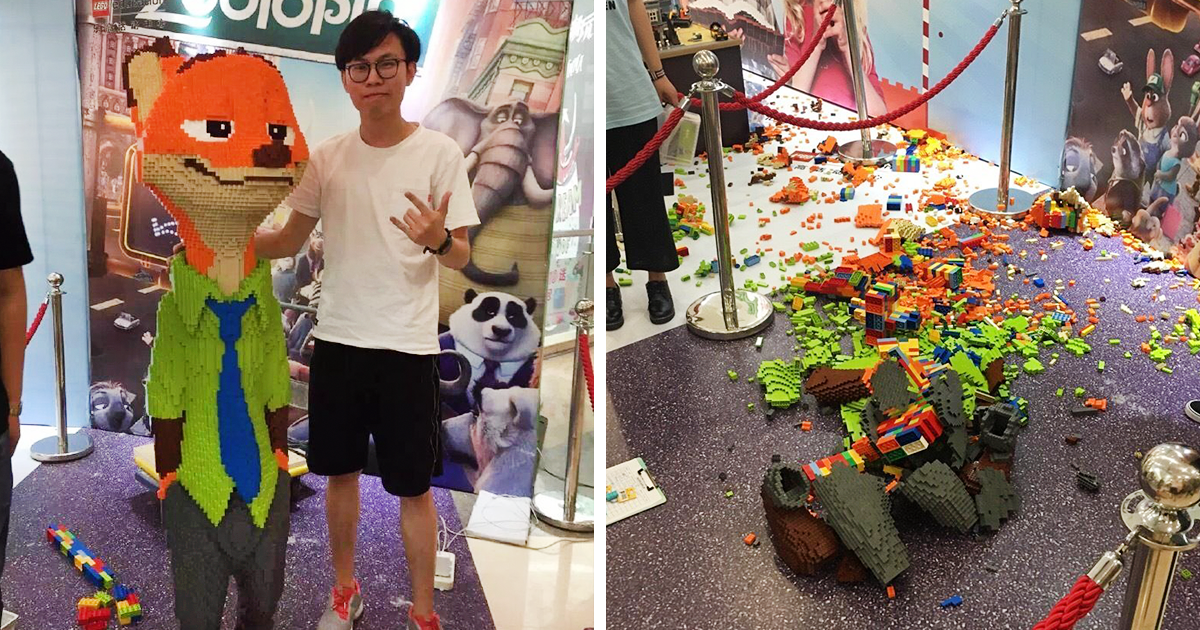
That second kind of silence reportedly arrived at a LEGO expo in Ningbo, China, when an artist known as Mr. Zhao spent three intense days and nights building a detailed statue of Nick Wilde, the sly fox from Disney’s Zootopia. The sculpture had barely begun its public life when a young child accidentally knocked it over. In seconds, the carefully stacked work collapsed into a heartbreaking scatter of bricks.
The story went viral because it sounds like the plot of a tiny disaster movie: one exhausted artist, one expensive sculpture, one excited child, and one very bad day for fox-shaped architecture. But behind the shocking headline is a bigger conversation about art, parenting, public displays, museum safety, and the strange emotional power of LEGO bricks.
The Story Behind the $15,000 LEGO Statue
According to widely reported accounts, Mr. Zhao built a large LEGO sculpture of Nick Wilde for a shopping mall exhibition. The statue was estimated to be worth more than 100,000 yuan, or roughly $15,000. That value was not simply about the bricks. It included time, design skill, planning, display value, and the kind of obsessive patience required to turn thousands of small plastic pieces into a recognizable character.
The build reportedly took three days and nights. Anyone who has ever lost a LEGO piece under a sofa knows that three days of building is not “just playing with toys.” It is mental geometry, finger endurance, color discipline, and the constant fear that one wrong connection will make the whole model lean like a tired shopping cart.
The tragedy happened soon after the exhibit opened. Reports said a child crossed or slipped past the boundary around the sculpture and knocked it down while trying to get close. The damage was severe. Because parts of the sculpture were not fully glued, the piece could not simply be lifted back into place like a knocked-over chair. It was, in the language of devastated builders everywhere, a rebuild-from-the-soul situation.
Why This LEGO Disaster Went Viral
The internet loves a simple emotional equation: enormous effort plus sudden chaos equals instant viral attention. This story had everything. It featured a beautiful handmade object, a painfully short display life, an innocent child, and a creator who responded with surprising grace.
What made the incident especially memorable was the contrast between the building time and the destruction time. Three days to create. A few seconds to destroy. That ratio feels unfair in a way everyone understands. A cook spends hours preparing dinner, and someone drops the tray. A student works all week on a project, and the printer eats the final copy. A gardener grows tomatoes all summer, and a squirrel treats the backyard like an all-you-can-eat buffet.
In this case, the emotional weight was multiplied by the public setting. The statue was not hidden in a private studio. It had been built to be seen, photographed, admired, and shared. Instead, it became famous for the wrong reason: not as a finished tribute to Zootopia, but as a cautionary tale about fragile art in crowded spaces.
Was the Child to Blame?
This is where the story becomes more complicated than a headline. A child did destroy the LEGO statue, but “destroy” does not automatically mean “malicious.” Reports described the incident as accidental. The child was young, and young children do not always understand value, boundaries, or the physics of “if I push the giant fox, the giant fox may become floor salad.”
That does not mean there was no responsibility. Public exhibitions rely on parents, organizers, and visitors working together. Children need supervision, especially around fragile displays. Event organizers need clear barriers and staff presence. Artists need realistic protection plans for delicate work. When all three layers are weak, one curious step can become an expensive disaster.
Mr. Zhao reportedly accepted the parents’ apology and declined compensation. That response turned the story from simple outrage into something more human. He had every reason to be upset. Yet instead of turning the child into a villain, he recognized that the situation involved youth, accident, and perhaps a lack of adequate protection around the work.
Why LEGO Sculptures Are More Fragile Than They Look
LEGO bricks are famous for their “clutch power,” the satisfying grip that lets one brick snap firmly onto another. That strength is why a child can build a spaceship, swoosh it across the room, crash-land it into a pillow, and still have a recognizable spaceship afterward. But large sculptures are a different beast.
A life-sized LEGO model is not just a big toy. It is a structural puzzle. Weight distribution matters. Internal support matters. Brick direction matters. The taller and more detailed the sculpture becomes, the more it behaves like a small building made of colorful rectangles. Even if sections are strong individually, the entire object can be vulnerable to side pressure, uneven force, or a sudden impact.
Some professional LEGO artists use glue for public models, especially when pieces must travel, survive crowds, or remain in place for months. Others avoid glue to preserve the pure building experience. Both choices have trade-offs. Glue can protect a sculpture, but it also changes the nature of the build. No glue keeps the model closer to traditional LEGO creativity, but it increases the risk of collapse.
The Real Value Was Not Just the Price Tag
The $15,000 figure grabbed attention, but the emotional value may have been even higher. A LEGO sculpture like this represents planning, design, and muscle memory. The artist has to understand the character’s shape, translate curves into blocky form, choose colors, and keep the model stable while building upward. It is not as simple as opening a box and following page 37 until the fox appears.
Nick Wilde is also a character with distinctive visual features: pointed ears, expressive eyes, a long snout, a slim body, and a relaxed, mischievous personality. Capturing that in LEGO requires artistic interpretation. The builder must decide which details matter most. Too much detail can make the model cluttered. Too little can make it look like “orange mammal, possibly fox, possibly tax accountant.”
That is why the loss hit so hard. The destroyed statue was not only a pile of plastic. It was a finished creative decision. It was time made visible.
Public Exhibits Need Better Protection Than a Rope
One of the biggest lessons from the incident is that a simple rope barrier may not be enough, especially in family-friendly environments. LEGO attracts children. Disney characters attract children. A colorful life-sized fox made of LEGO practically screams, “Come closer and inspect my brick-based ears.”
Good exhibition design anticipates behavior instead of merely wishing for perfect manners. Signs help, but many visitors do not read signs closely. Ropes create a visual boundary, but small children can duck under them. Low barriers can be stepped over. Staff may be distracted. Crowds create blind spots. Cameras capture what happened after the fact, but they do not stop a sculpture from becoming a puzzle again.
Better protection might include raised platforms, transparent cases, wider buffer zones, trained floor staff, child-height warning graphics, and separate interactive LEGO areas where touching is encouraged. That last point matters. If an exhibit includes hands-on zones, children are less likely to treat every object as a personal invitation.
Why LEGO Art Feels Different From Traditional Art
Part of the confusion comes from LEGO’s identity. It is both a toy and an artistic medium. People understand that they should not touch an oil painting. They understand that a marble statue is not a jungle gym. But LEGO is deeply associated with touch. We build it, rebuild it, drop it, sort it, step on it, and occasionally question our life choices at 2 a.m. while searching for a missing dark gray hinge.
That tactile history makes LEGO exhibitions uniquely challenging. A brick sculpture can look approachable even when it is extremely fragile. Visitors may think, “It’s LEGO, so it can be rebuilt.” Technically, yes. Emotionally, financially, and logistically, not so fast.
Professional LEGO artists have helped push the medium into galleries, museums, touring exhibitions, and architectural showcases. Their work proves that plastic bricks can communicate humor, memory, emotion, and engineering skill. But public understanding has not fully caught up. Many people still see LEGO as play first and art second. The Nick Wilde incident showed what can happen in that gap.
The Artist’s Grace Made the Story Bigger
Outrage travels quickly online, but grace travels farther than people expect. Mr. Zhao’s reported decision not to demand compensation changed the tone of the story. Instead of becoming a public trial of a child and parents, it became a conversation about empathy.
That does not erase the loss. It does not make the sculpture magically reassemble itself like a cartoon robot. But it does show maturity. The artist could separate damage from intent. He could be disappointed without being cruel. In an internet culture that often wants a villain before breakfast, that response was refreshing.
Parents reading the story may feel secondhand panic. Artists may feel secondhand heartbreak. Event organizers may feel secondhand paperwork. But everyone can learn something from the way the aftermath was handled: accountability matters, but so does proportion.
What Parents Can Learn From the LEGO Statue Incident
Parents do not need to treat every museum visit like a military operation. Children should explore, ask questions, and be excited by art. But before entering an exhibit, it helps to explain the rules in concrete language. “Don’t touch” is useful, but “stay behind the rope because the sculpture can break” is better. Young children need the reason, not just the command.
It also helps to give children something specific to do. Ask them to count colors, find shapes, choose a favorite detail, or describe what they see. A child with a mission is less likely to invent one called “Operation Touch the Fox.”
Finally, parents should stay physically close in spaces with fragile objects. Public displays can be exciting, crowded, and overstimulating. A child may move faster than expected. The difference between a sweet photo and a viral apology can be one step.
What Event Organizers Can Learn
Exhibition planning should begin with one honest question: “What is the most predictable wrong thing visitors might do?” If the answer is “children may try to touch the bright LEGO character,” then protection must be designed around that reality.
For valuable brick sculptures, organizers should consider risk from multiple angles. Is the display stable? Can a child reach it? Is the barrier high enough? Is there a staff member nearby? Does the signage communicate quickly? Is there an interactive area to absorb curiosity? Is the artwork insured? Has the artist provided repair instructions or digital plans?
The goal is not to make exhibitions cold or unfriendly. The goal is to make wonder safe. A good display lets visitors get close enough to feel amazed without getting close enough to accidentally become part of the demolition crew.
What Artists Can Learn From the Collapse
Artists who build public work face a hard truth: once art leaves the studio, the world gets a vote. Weather, crowds, lighting, transport, children, cleaning crews, and one person with an oversized backpack can all become part of the risk profile.
For LEGO artists, documentation is essential. Photos, building notes, digital models, part lists, and section-by-section plans can make repair possible. If a sculpture is valuable, the artist should discuss insurance, barriers, handling rules, and emergency procedures before the exhibit opens.
That may sound boring compared with the joy of building, but paperwork is the invisible baseplate of public art. Without it, even the most beautiful sculpture is standing on hope.
The Internet Reaction: Sympathy, Blame, and Brick-Based Grief
Online reactions to the incident ranged from sympathy to fury. Some people blamed the parents. Others blamed the event organizers. Some defended the child. Many simply mourned the sculpture. LEGO fans, especially adult builders, understood the pain immediately. They know how long complex builds can take, and they know how fragile a large model can be when force hits the wrong point.
The story also triggered a broader debate about children in public spaces. Should family-friendly exhibitions expect unpredictable behavior? Yes. Should parents supervise children carefully? Also yes. Should artists assume that a rope is a magical force field? Absolutely not. A rope is just a polite string with confidence.
The fairest answer is shared responsibility. No single group can prevent every accident, but each group can reduce risk. Parents guide. Organizers protect. Artists plan. Visitors respect. When any one part fails, the bricks may fall.
Why This Story Still Matters Years Later
The incident continues to circulate because it captures a universal truth: fragile things often take longer to create than to destroy. That is true of sculptures, trust, reputations, gardens, websites, relationships, and perfectly organized LEGO bins. The headline is about a child and a statue, but the lesson is bigger.
We live in a world that rewards speed. Fast videos. Fast reactions. Fast judgment. But craftsmanship is slow. Mr. Zhao’s sculpture represented attention, patience, and care. Its destruction reminded people how easily slow work can be undone when environments are not designed to protect it.
That is why the story sticks. It is funny in a painful way, dramatic in a small way, and meaningful in a surprisingly large way. It asks us to respect what people make, especially when what they make looks playful.
Experience-Based Reflections: What This LEGO Incident Teaches Us
Anyone who has built something delicate can relate to this story, even without a $15,000 fox involved. Maybe it was a school project carried in the back seat of a car. Maybe it was a birthday cake with frosting architecture that leaned suspiciously to the left. Maybe it was a model airplane, a gingerbread house, a handmade costume, or a carefully arranged display shelf that met the family cat. The common experience is the same: creation feels personal, and destruction feels rude even when it is accidental.
The first experience this story highlights is the emotional investment of making things by hand. When someone spends days creating an object, they are not only spending time. They are making dozens or hundreds of small decisions. Which piece goes here? Which angle looks right? How do I keep it balanced? How do I make the face look alive? That invisible decision-making becomes part of the finished object. When the object breaks, the maker loses more than materials. They lose the record of those choices.
The second experience is the challenge of sharing creative work publicly. Many creators want people to enjoy what they make, but public attention brings risk. A display can be admired, misunderstood, mishandled, photographed badly, criticized unfairly, or damaged accidentally. This is true for artists, small business owners, teachers, designers, and even hobbyists posting projects online. The moment work becomes visible, it enters a shared space where the creator no longer controls every outcome.
The third experience involves children and curiosity. Children are not naturally museum-ready. They learn public behavior through repetition, explanation, and supervision. A child sees a bright LEGO fox and thinks, “Amazing, I want to get closer.” An adult sees the same fox and thinks, “That probably required a budget, a contract, and a nervous person holding a clipboard.” The gap between those two thoughts is where accidents happen.
That is why the best family spaces teach boundaries without killing wonder. A great exhibit does not simply say, “No.” It says, “Look closely from here,” “Build your own over there,” and “This object is special because someone worked hard on it.” Children can understand respect when adults explain it clearly and model it consistently.
The fourth experience is about forgiveness. Mr. Zhao’s reported reaction showed that disappointment and compassion can exist together. He did not have to pretend the damage was small. It was not. But he also did not need to turn a child’s mistake into a lifelong public shame festival. That balance is rare and worth noticing.
The final experience is practical: protect what matters. If you are displaying something valuable, do not rely on hope, luck, or a tiny sign printed in polite font. Use barriers, distance, cases, supervision, insurance, backups, and clear communication. This applies far beyond LEGO. Protect your files. Save drafts. Photograph your work. Keep records. Create repair plans. And if your masterpiece is standing in a crowded mall, maybe do not trust a waist-high rope to do the job of a security team.
In the end, the destroyed LEGO statue is not only a viral story about a child and a costly mistake. It is a reminder that creativity deserves protection, children need guidance, and public spaces should be designed for real human behaviornot imaginary perfect visitors who read every sign, walk slowly, and never touch the giant fox.
Conclusion
The story of the man who spent three days making a $15,000 LEGO statue only to see it destroyed in seconds is heartbreaking, memorable, and oddly educational. It shows how much effort goes into LEGO art, how quickly public displays can go wrong, and why shared responsibility matters. The child’s action may have been accidental, but the incident revealed very real lessons for parents, artists, and exhibition organizers.
Great art does not always come in marble, bronze, or oil paint. Sometimes it comes in thousands of tiny plastic bricks arranged with patience and imagination. And sometimes, unfortunately, it needs more protection than a rope and a prayer.
Note: This article is based on synthesized reporting and public information about the Ningbo LEGO expo incident, LEGO art, public exhibit safety, and professional brick sculpture practices. It is fully rewritten for original web publication.