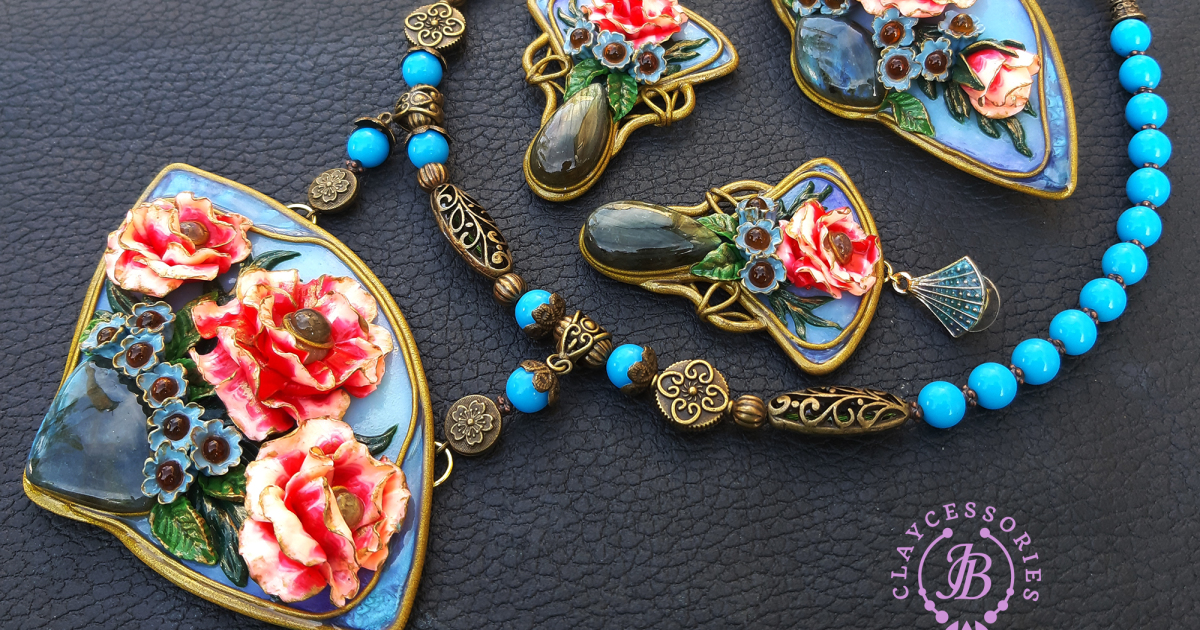
Some jewelry sparkles. Art Nouveau jewelry sparkles and daydreams. That is exactly why I keep coming back to it. When I think about my jewelry in Art Nouveau style, I do not picture stiff symmetry, overly polished perfection, or designs that look like they were drafted by a ruler having a bad day. I picture vines that seem to move, dragonflies caught mid-hover, petals curling around stones, and metal lines that flow like a ribbon in the wind.
Art Nouveau jewelry has always stood out because it treats adornment like a tiny work of art rather than a simple status symbol. Historically, the movement rose around the end of the 19th century and flourished into the early 20th century, embracing natural forms, expressive curves, and handcrafted beauty. In jewelry, that meant artists often cared as much about atmosphere, symbolism, and line as they did about carat weight. Frankly, that feels refreshing even now. Sometimes a moonstone with mystery beats a diamond with attitude.
In this article, I want to explore what makes my jewelry in Art Nouveau style so distinctive, why this look still feels relevant, which design details matter most, and how the style can be interpreted for modern wear without losing its soul. If you love jewelry that feels romantic, artistic, and a little delightfully dramatic, you are in the right place.
What Makes Art Nouveau Jewelry So Special?
Art Nouveau jewelry is built on movement. Instead of relying on rigid geometry, it favors flowing lines, asymmetry, and forms borrowed from the natural world. Flowers, leaves, tendrils, insects, birds, waves, and even the female figure became recurring motifs. The result is jewelry that feels alive. It rarely sits still, even when it is sitting perfectly still.
That sense of life is one reason the style has such staying power. The curves are often called “whiplash” lines because they sweep and snap across a design in a fluid, energetic way. In a pendant, that might look like vines wrapping around an opal. In a brooch, it may appear as a woman’s hair turning into butterfly wings. In earrings, it can show up as an elongated floral stem that drops elegantly without looking heavy.
Another defining trait is the way Art Nouveau challenged traditional ideas of luxury. Instead of focusing only on the most expensive gemstones, designers often embraced materials for their color, texture, glow, or poetic effect. Enamel, horn, glass, moonstones, opals, baroque pearls, and semi-precious gems all played important roles. The message was clear: beauty was not just about price. It was about imagination.
Why My Jewelry In Art Nouveau Style Feels Different
When I describe my jewelry in Art Nouveau style, I am really describing a design philosophy as much as a look. I want each piece to feel as though it grew naturally instead of being assembled mechanically. That means I am drawn to shapes that twist, unfurl, bloom, and arc. Straight lines are welcome only when they have a good reason to be there, and preferably when they are accompanied by something leafy.
This style also appeals to me because it creates emotional texture. A clean modern piece can be beautiful, but Art Nouveau jewelry often feels personal, intimate, and story-rich. A brooch with iris petals or a pendant shaped like a dragonfly says something beyond “I accessorized today.” It suggests mood, symbolism, and artistic intention. It whispers instead of shouting, but it is still impossible to ignore.
There is also a lovely tension inside the style. Art Nouveau jewelry can be delicate yet bold, ornate yet natural, feminine yet strong. It often blends softness with structure in a way that keeps a piece from feeling overly sweet. A necklace can be floral without becoming sugary. A ring can be romantic without becoming costume-like. That balance is the magic trick.
The Hallmarks I Look For In Art Nouveau-Inspired Jewelry
1. Flowing, organic lines
The first thing I notice is the line work. Great Art Nouveau-inspired jewelry does not look boxed in. It curves. It stretches. It loops. It gives the eye somewhere to travel. Those sweeping contours make even a small pendant feel dynamic.
2. Nature as the main character
Nature is not a side note in this style. It is the lead actor. Flowers, orchids, lilies, poppies, peacocks, dragonflies, swans, and leaves appear again and again because they bring rhythm and symbolism. These motifs are rarely copied in a stiff way. Instead, they are stylized just enough to feel elegant and dreamlike.
3. Materials with personality
One of my favorite things about Art Nouveau jewelry is its willingness to let materials speak. Opals offer shifting color. Moonstones create a soft glow. Enamel introduces painterly detail. Horn and glass add surprising warmth and translucence. These materials do not just decorate the design; they help tell its story.
4. A sense of artistry over flash
Art Nouveau jewelry often values composition more than obvious extravagance. That is why a beautifully designed enamel brooch can feel more captivating than a piece covered in stones but lacking character. My ideal Art Nouveau-inspired design looks thoughtful from every angle, including the back. Especially the back. Hidden beauty is still beauty.
Signature Pieces That Fit My Jewelry In Art Nouveau Style
Pendants
Pendants may be the easiest place to showcase the Art Nouveau spirit. They provide enough visual space for curves, layered motifs, and gemstone placement that feels painterly rather than predictable. I love pendants that frame a central opal, pearl, or moonstone with tendrils, petals, and airy metalwork.
Brooches
Brooches are practically made for Art Nouveau. They allow for narrative composition and sculptural details in a way few other jewelry types can. A brooch in this style can become a miniature tableau: a winged creature, a flowering branch, or a female figure entwined with botanical forms. Yes, it is dramatic. No, that is not a problem.
Earrings
Art Nouveau earrings often work best when they stay graceful and elongated. Floral drops, vine-like curves, and enamel accents can bring the style to life without making the design feel heavy. Even when the motif is ornate, the best examples still look fluid and wearable.
Hair ornaments and combs
If any category captures the historical romance of Art Nouveau, it is the hair ornament. Combs and hairpieces decorated with flowers, leaves, and delicate color transitions feel especially true to the period. They turn adornment into theater, but in a refined way. Think opera, not costume aisle.
Rings and cuffs
Rings and cuffs in Art Nouveau style need careful restraint. Too much detail can make them bulky, but the right amount creates a sculptural effect that feels luxurious and original. I especially love rings with asymmetrical shoulders, leaf-like prongs, and stones that look as if they were discovered in a woodland instead of a display case.
Color, Texture, and Finish Matter More Than People Think
To me, the color story in Art Nouveau jewelry is one of the most underrated aspects of the style. It is not only about bright sparkle. It is about nuance. Soft greens, smoky blues, milky whites, iridescent purples, mossy tones, and luminous gold all fit beautifully within the movement’s visual language.
Texture is equally important. Smooth enamel beside textured metal. Polished stone against matte petals. Transparent glass near opaque pearl. These contrasts make a piece feel tactile and alive. Art Nouveau is often romantic, but it is not flat. The best designs have depth, variation, and a sense of movement created through surface as much as shape.
Finishes should support the mood. High shine has its place, but an overly glossy finish can strip the design of subtlety. I tend to prefer jewelry that looks softly burnished, hand-finished, or lightly antiqued, because it allows the lines and motifs to breathe. A piece should feel discovered, not factory-fresh in the least poetic sense.
How Art Nouveau Jewelry Differs From Art Deco
This comparison comes up constantly, and for good reason. Both styles are iconic, both influenced jewelry design in major ways, and both can look glamorous. But their personalities are very different.
Art Nouveau is organic, curving, symbolic, and nature-driven. Art Deco is sleek, geometric, symmetrical, and more closely tied to modernity, machine-age energy, and polished glamour. If Art Nouveau is a winding garden path at sunset, Art Deco is a mirrored elevator in a skyscraper. Both are fabulous. They are just not trying to flirt in the same dialect.
That distinction helps me stay focused when designing or choosing pieces. If I want softness, lyricism, and a handcrafted spirit, I reach for Art Nouveau cues. If I want precision, architecture, and a more urban kind of glamour, I look elsewhere. Knowing the difference helps preserve the character of each style.
How I Style My Jewelry In Art Nouveau Style Today
The easiest way to wear Art Nouveau-inspired jewelry now is to let one piece lead. A dramatic pendant, a sculptural brooch, or a pair of floral drop earrings can do a lot of work without needing an entire supporting cast. The style already has personality, so it does not need to compete with five other loud accessories.
I also think Art Nouveau jewelry looks best when paired with textures and fabrics that complement its softness. Silk, velvet, linen, and fine knits all work beautifully. Even a simple black dress can become a perfect stage for an enamel pendant or an opal-centered brooch. The contrast between a quiet outfit and expressive jewelry creates a polished, editorial effect.
For everyday wear, I like subtle interpretations of the style. Maybe that means earrings with curved botanical lines instead of literal flowers, or a ring with a moonstone in a vine-like setting. You do not have to look as though you just stepped out of a 1900 Paris salon to make the look work. Although, to be fair, that does sound fun.
Lessons I Take From Historic Masters
No discussion of Art Nouveau jewelry feels complete without mentioning the artists who helped define it. René Lalique is often treated as the superstar, and honestly, he earned it. His work showed that jewelry could be sculptural, symbolic, and emotionally rich while using unconventional materials in unforgettable ways.
Louis Comfort Tiffany also matters enormously, especially for anyone interested in the American side of the story. His jewelry brought a fresh, nature-focused approach and often highlighted unusual stones and imaginative settings instead of chasing conventional luxury formulas. That creative freedom still feels modern.
I am also fascinated by the broader artistic network around the movement. Designers such as Alphonse Mucha and Eugène Grasset influenced jewelry through their visual language, while artists and craftspeople across Europe and the United States pushed decorative art toward a more unified, handcrafted ideal. That bigger context matters because Art Nouveau was never just about jewelry. It was about creating beauty across everyday life.
Common Mistakes To Avoid With Art Nouveau-Inspired Jewelry
The first mistake is confusing “ornate” with “effective.” A piece can include flowers, wings, swirls, and gemstones and still miss the point if the composition feels cluttered. Art Nouveau works best when the movement of the design feels natural, not crowded.
The second mistake is ignoring material harmony. Because the style often depends on mood and atmosphere, the wrong stone or finish can throw everything off. A design inspired by misty leaves and dragonfly wings probably does not need the loudest, hardest-edged crystal in the room.
The third mistake is making everything too perfect. Art Nouveau grew partly from a desire to value artistry and craftsmanship in an industrial age. If every detail looks sterile, machine-like, and over-standardized, the piece can lose its warmth. A little irregularity is not a flaw here. It is often the heartbeat.
Why My Jewelry In Art Nouveau Style Still Feels Fresh
Trends come and go, but people rarely stop responding to beauty drawn from nature. That is one reason Art Nouveau keeps returning. Its curves still feel graceful. Its colors still feel romantic. Its materials still offer surprise. And its designs still give jewelry permission to be expressive rather than merely expensive.
I think the style also resonates now because many people want objects that feel handmade, thoughtful, and individual. Art Nouveau jewelry answers that desire beautifully. It invites us to slow down, notice line, notice texture, notice symbolism, and appreciate adornment as a form of art.
So when I talk about my jewelry in Art Nouveau style, I am not talking only about aesthetics. I am talking about a way of seeing. A way of turning stems into structure, wings into ornament, and light into mood. It is jewelry with poetry built in, and that never really goes out of style.
My Personal Experience With Jewelry In Art Nouveau Style
If I had to describe my experience with jewelry in Art Nouveau style in one sentence, I would say this: it changed the way I look at decoration. Before I fell for this aesthetic, I thought jewelry design was mainly about balance, shine, and wearability. All of those things still matter, of course, but Art Nouveau taught me that jewelry can also feel like a mood, a memory, and a tiny performance worn on the body.
What drew me in first was not the gemstones. It was the line. I kept noticing pieces where the metal seemed to move like a living thing. A stem would become a curve, the curve would become a wing, and the wing would end in a stone that looked as if it had landed there naturally. That sense of flow felt almost musical. I realized I was not just admiring jewelry; I was following its rhythm.
As I explored the style more deeply, I found myself paying attention to details I had once overlooked. I started noticing the glow of enamel instead of only the sparkle of faceted stones. I became more interested in moonstones, opals, and baroque pearls because they felt moody and alive. I noticed how much difference a softly finished surface could make. A perfectly polished piece might look expensive, but a hand-touched surface can look unforgettable.
I also learned that Art Nouveau style requires patience. It is easy to love the romance of the movement, but much harder to create that romance without tipping into clutter. That was one of the biggest lessons for me. A successful Art Nouveau-inspired piece cannot simply pile on flowers, leaves, and curves and hope for the best. It needs control inside the softness. It needs structure inside the fantasy. In other words, it needs editing, which is the least glamorous but most necessary part of beauty.
One of my favorite experiences with this style is how often it changes depending on the light. In daylight, an opal-centered pendant may look airy and botanical. In warm evening light, the same piece can suddenly feel mysterious and theatrical. Enamel can go from delicate to dramatic in a matter of minutes. That transformation makes the jewelry feel alive in a way I rarely get from more rigid, purely geometric styles.
I have also noticed that people respond differently to Art Nouveau jewelry than they do to more conventional pieces. Instead of asking only about the stone or the price, they tend to comment on the shape, the feeling, or the story. They say things like, “That looks like a dragonfly,” or, “It reminds me of a flower opening,” or, “It feels like something from an old painting.” I love that. It means the jewelry is doing more than decorating. It is communicating.
Perhaps my favorite part of this journey is that Art Nouveau style has made me more observant in everyday life. I look at vines differently. I notice the curve of petals, the layering of feathers, the structure of seed pods, the way light moves across water. These details now feel like design references hiding in plain sight. The style has trained my eye to find elegance in natural forms, and that has influenced not only how I think about jewelry, but how I think about beauty in general.
That is why my connection to jewelry in Art Nouveau style feels lasting rather than trend-based. It is not just a visual preference. It is a creative perspective. It reminds me that adornment can be expressive, that craftsmanship matters, and that softness can still be powerful. For me, that is the real charm of the style. It does not simply accessorize an outfit. It turns beauty into a conversation.
Conclusion
My jewelry in Art Nouveau style is ultimately about movement, mood, and meaning. It draws on natural forms, handcrafted detail, and artistic line to create pieces that feel deeply expressive rather than merely decorative. Whether the design features enamel petals, swirling vines, luminous opals, or a dragonfly-like silhouette, the goal is always the same: to create jewelry that feels alive.
That is the enduring magic of Art Nouveau. It invites jewelry to be imaginative, emotional, and beautifully unconventional. In a world that often rewards sameness, that kind of artistry feels like a breath of fresh air wrapped in gold.