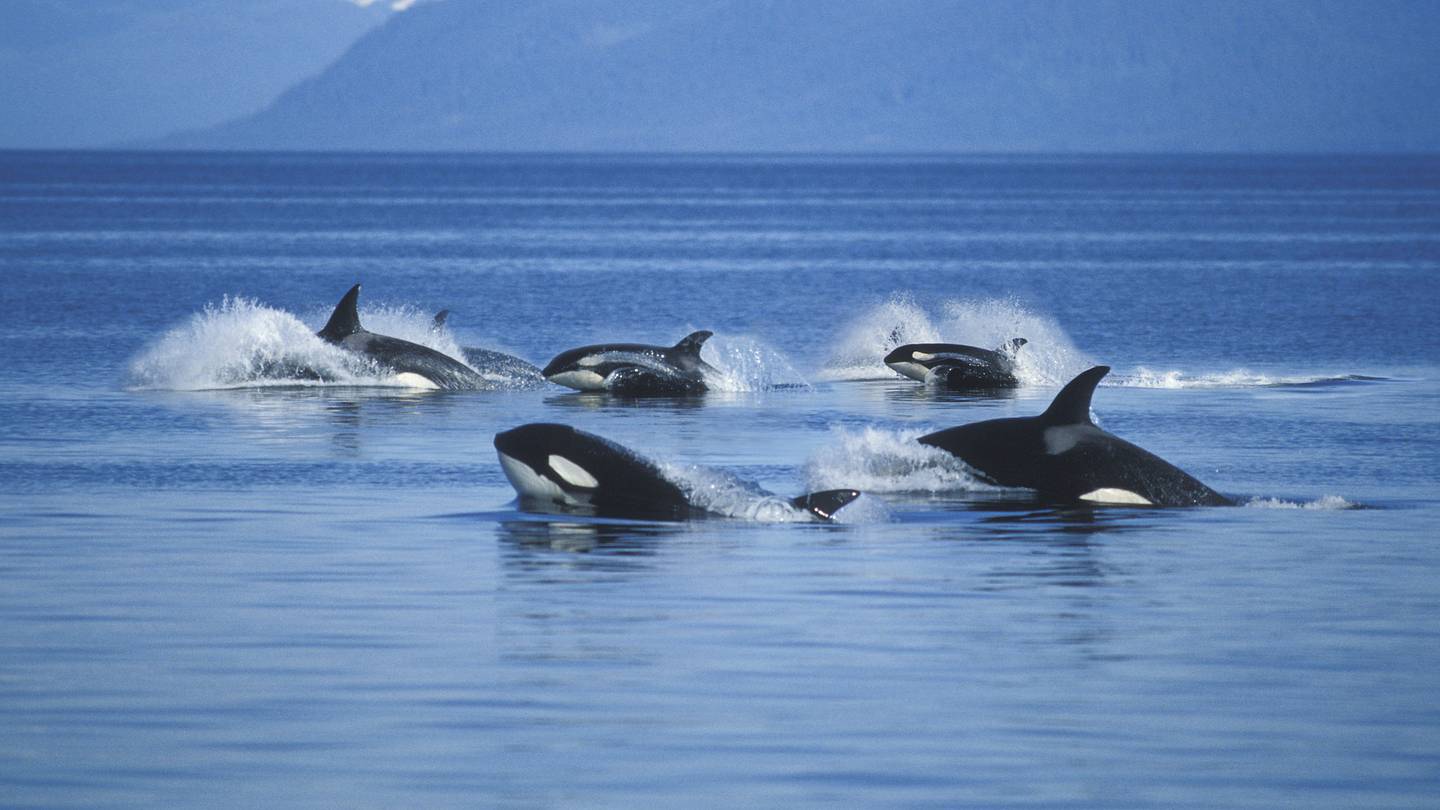
Somewhere in the Salish Sea, between Washington State and British Columbia, an orca grabs a piece of bull kelp, trims it with its teeth, presses it against another orca, and the two begin rolling it between their bodies like a floating spa roller. No cucumber water. No whale-sized robe. Just two apex predators calmly turning seaweed into what looks suspiciously like a marine massage tool.
This newly documented behavior, now widely known as allokelping, has fascinated marine biologists because it combines several things orcas are famous for: intelligence, culture, social closeness, and an almost unfair talent for surprising humans. Researchers studying Southern Resident killer whales observed the animals using pieces of bull kelp during close physical contact, possibly to exfoliate dead skin, improve skin health, and strengthen social bonds.
Yes, the ocean’s most iconic black-and-white predator may also be a skincare enthusiast. Nature, once again, has decided to be both brilliant and slightly funnier than expected.
What Exactly Did Scientists See?
The behavior was observed among Southern Resident killer whales, a small and endangered population that travels through the Salish Sea and nearby Pacific Northwest waters. Using high-resolution drone footage, researchers saw orcas bite off pieces of bull kelp and position the seaweed between their bodies and a partner’s body. The whales then moved together, rolling and rubbing the kelp between them for extended periods.
This was not a random case of “oops, I got seaweed on my face.” Orcas are no strangers to playing with kelp, draping it over their bodies, or pushing it around. But this was more deliberate. The whales appeared to modify the kelp into usable pieces, place it carefully, and maintain contact with another whale while the kelp moved between them.
Researchers named the behavior allokelping. The “allo” part refers to another individual, similar to terms like allogrooming, which describes grooming between animals. In simple English: one orca helps another orca get a kelp rubdown, and both may benefit. It is “you scratch my back, I scratch yours,” except the scratcher is seaweed and everyone involved weighs several tons.
Why This Orca Kelp Massage Is Such a Big Deal
Animal tool use always grabs scientific attention, but this case is especially exciting because it involves marine mammals using a modified natural object in a cooperative social setting. Many famous examples of tool use involve food. Chimpanzees use sticks to fish for termites. Sea otters use rocks to crack shells. Some dolphins use marine sponges to protect their snouts while foraging on the seafloor.
The orca kelp massage is different. The kelp does not appear to help the whales catch prey. Instead, it seems connected to grooming, touch, comfort, and social bonding. That makes it rare. Tool use for social care is far less common than tool use for eating, hunting, or defense.
Even more interesting, the orcas are not simply grabbing a ready-made object. They appear to bite and shape pieces of bull kelp before using them. That detail matters because “tool manufacture” suggests planning and purposeful modification. In other words, the whales are not just bumping into ocean salad. They are making the ocean salad useful.
Meet the Southern Resident Killer Whales
The orcas seen giving each other kelp massages belong to the Southern Resident killer whale population. These whales are famous in the Pacific Northwest and are among the most studied orcas in the world. They live in tight family groups known as pods, communicate with distinctive calls, and rely heavily on salmon, especially Chinook salmon.
Southern Resident orcas are not the same as Bigg’s killer whales, also called transient orcas, which often hunt marine mammals. Southern Residents are fish-eating specialists with deep family bonds and cultural behaviors passed through generations. Their society is built around matrilines, meaning family groups are organized around mothers, grandmothers, and related descendants.
That social structure is important when thinking about allokelping. The kelp massage behavior was often seen between close relatives or whales of similar age. This suggests that the behavior may help maintain relationships inside the pod. For orcas, touch is not just touch. It can be communication, reassurance, play, trust, and maybe a polite way of saying, “You have some old skin right there. I got you.”
Is It Really Exfoliation?
Scientists are careful with claims. They do not say, “Case closed: orcas invented the spa day.” Instead, they suggest several possible functions. One leading idea is that rubbing with kelp may help remove dead skin. Whales and dolphins regularly shed skin, and different species use different methods to manage it. Some whales rub against rocks, gravel, or the seafloor. Others appear to interact with seaweed in ways that may help loosen dead skin or parasites.
Bull kelp has a firm, flexible stalk, making it a surprisingly practical natural scrubber. Imagine a long, buoyant, ocean-grown massage roller. It is sturdy enough to create friction but soft enough not to damage the skin. For an animal without hands, that combination is useful.
Researchers also noticed that whales with more visible skin peeling seemed more likely to participate in allokelping. That does not prove the behavior is purely about skincare, but it supports the idea that exfoliation may be part of the story. The kelp could help loosen dead skin, clean the surface, or provide a soothing tactile sensation.
The Social Side of Orca “Spa Treatments”
Grooming in animals is rarely just about hygiene. In primates, grooming can reduce tension, build alliances, and reinforce social bonds. A monkey picking through another monkey’s fur may be doing pest control, but it is also strengthening a relationship. The same principle may apply here, although with fewer fingers and more seaweed.
Orcas live in complex societies where cooperation matters. They hunt together, travel together, care for young, and learn from older relatives. Physical contact can support those relationships. When two orcas coordinate their bodies to keep a strip of kelp rolling between them, they are doing something that requires attention, trust, and shared movement.
That is what makes allokelping so charming. It is not just one whale using a tool alone. It is two whales participating in a shared activity. The kelp becomes a social object, a floating bridge between bodies. If orcas had appointment books, this might be filed under “family bonding, light exfoliation, bring your own seaweed.”
Why Bull Kelp?
Bull kelp, known scientifically as Nereocystis luetkeana, is common in parts of the Pacific Northwest. It grows in underwater forests that provide habitat for fish, invertebrates, seabirds, and marine mammals. Unlike tiny algae, bull kelp can grow into long, strong stalks with floating bulbs and blades near the surface.
For an orca, bull kelp has several convenient features. It is flexible, buoyant, available near the surface, and tough enough to hold together during rubbing. It can be bitten into shorter sections, moved with the mouth, and trapped between two large bodies. Basically, it is the ocean’s version of a foam roller, except it photosynthesizes.
Kelp forests are also ecologically important. They slow currents, provide shelter, support food webs, and create structure in coastal waters. Protecting kelp habitat is not only good for seaweed. It supports entire marine neighborhoods, from small fish to the top predators that depend on healthy coastal ecosystems.
What Allokelping Reveals About Orca Intelligence
Orcas have long been recognized as highly intelligent animals. They use sophisticated vocalizations, learn from one another, and develop population-specific hunting techniques. Some groups intentionally beach themselves to catch seals. Others create waves to knock prey from ice. Some specialize in fish, others in marine mammals, and some have behaviors so specific they feel almost like family traditions.
Allokelping adds another layer to that intelligence. It shows flexibility, object manipulation, social learning, and cooperation. The behavior may also be cultural, meaning it could be learned and shared within this particular population rather than being hardwired into every orca everywhere.
That matters because animal culture is fragile. If a population disappears, its learned behaviors can disappear too. A species is not only a collection of genes. It is also a living library of habits, calls, techniques, relationships, and local knowledge. Losing a group of orcas could mean losing unique traditions no other whales practice.
Could Other Orcas Do This Too?
Possibly, but scientists do not yet know. The ocean is enormous, and orcas spend most of their lives underwater, where humans are terrible witnesses. Drone technology has opened a new window into whale behavior by allowing researchers to observe from above without crowding the animals from boats.
It is possible that allokelping has been happening for years and humans simply missed it. It is also possible that this is a newer or more localized behavior within Southern Resident orcas. Researchers will need more observations, more seasons, and comparisons with other populations to understand how widespread it is.
One thing is already clear: the more carefully scientists watch orcas, the more complicated they become. Every time humans think we have a neat summary of whale behavior, the whales seem to add a footnote, a plot twist, and occasionally a decorative salmon hat.
The Conservation Message Behind the Cute Headline
The headline is delightful: orcas give each other kelp massages. But behind the charm is a serious conservation story. Southern Resident killer whales are endangered and face multiple pressures, including reduced salmon availability, vessel noise, contaminants, and habitat changes. Their survival depends on healthy marine ecosystems, abundant prey, and thoughtful protection from human disturbance.
Allokelping reminds us that conservation is about more than keeping animals alive as numbers on a chart. It is about preserving full lives. These whales are not interchangeable ocean decorations. They are individuals with families, habits, preferences, and learned behaviors. They may have traditions that scientists are only beginning to recognize.
When a whale population declines, the risk is not only biological. It is cultural. A behavior like kelp grooming could vanish if the community that practices it cannot recover. That is a sobering thought wrapped inside a wonderfully weird discovery.
Why People Love This Story
Stories about animal intelligence capture attention because they shrink the emotional distance between humans and other species. We recognize something familiar in allokelping: touch, care, relaxation, cooperation, and the universal desire to get that one itchy spot handled properly.
Of course, orcas are not humans in wetsuits. We should avoid turning them into cartoon characters with spa memberships and gossip magazines. But we can appreciate the similarity without flattening the science. The best interpretation is not “orcas are just like us.” It is better: “orcas are complex in their own orca way, and we are lucky when we get a glimpse.”
That glimpse is powerful. A whale using kelp to groom another whale is funny, beautiful, and scientifically important at the same time. It makes people smile, then think, then maybe care a little more about the waters where these animals live.
Experience Section: What This Orca Kelp Massage Story Feels Like From a Human Perspective
Imagine standing on the shoreline of the Pacific Northwest on a gray morning, the kind where the air smells like salt, rain, and evergreen trees. The water looks calm at first, then a black dorsal fin cuts through the surface. Another appears behind it. Suddenly, the quiet sea feels alive in a way that makes everyone nearby lower their voices without being asked.
That is the setting where a story like allokelping becomes more than a science headline. Watching orcas, even from a respectful distance, can feel like seeing a family pass through its own neighborhood. They are not performing. They are traveling, feeding, breathing, touching, and communicating in a world that existed long before humans started naming everything.
Now add the kelp. At first, you might think the whale is playing. A strip of seaweed floats near its face, then disappears between two moving bodies. The whales roll together, adjusting their positions with smooth, practiced control. There is no rush. No drama. No “killer whale” soundtrack needed. It looks almost gentle, which is funny because these are apex predators capable of breathtaking power.
That contrast is part of the magic. Orcas can be fierce hunters and tender social partners. They can be strategic, playful, curious, and careful. The kelp massage behavior gives people a new emotional doorway into understanding them. It is easier to care about an animal when you can picture it doing something intimate and specific, not just swimming through a documentary voiceover.
For many ocean lovers, this discovery also changes how kelp looks. Before, bull kelp might have seemed like slippery beach clutter, the kind of thing that wraps around ankles and makes swimmers do an awkward little panic dance. After learning about allokelping, kelp becomes part of a larger story. It is habitat, shelter, food-web support, and now possibly a grooming tool in orca culture.
The experience also invites humility. Humans often assume that if a behavior is important, we would have noticed it already. But the ocean keeps secrets easily. A behavior can happen for generations just below the surface, hidden by glare, waves, distance, and our own lack of imagination. Drone footage did not make orcas smarter; it simply made humans better witnesses.
There is also a personal lesson tucked into the seaweed. Allokelping is cooperative. One whale cannot fully do it alone in the same way. It requires a partner, pressure, movement, and trust. That makes it a surprisingly good symbol for social health. Even in the ocean, care may be something shared. Sometimes the most advanced tool is not the kelp itself, but the relationship that makes the kelp useful.
So when people laugh at the idea of orca whales giving each other exfoliating kelp massages, they should laugh. It is funny. Nature deserves its jokes. But after the laugh, there is room for awe. These whales are showing us that intelligence can be physical, social, cultural, and quiet. It can look like two dark backs rolling through cold water with a strip of kelp between them, turning a simple plant into a moment of care.
Conclusion
The discovery of orca whales giving each other exfoliating kelp massages is one of those rare science stories that feels almost too delightful to be real. Yet it is real, and it opens a serious window into the lives of Southern Resident killer whales. Allokelping may help remove dead skin, support skin health, and strengthen bonds among relatives and peers. It also expands what scientists know about tool use, cooperation, and culture in marine mammals.
Most of all, this behavior reminds us that orcas are not just powerful predators. They are social, inventive, and deeply connected animals living in ecosystems that need protection. The kelp massage may look like a spa trend, but beneath the humor is a bigger message: when we protect whales, salmon, kelp forests, and quiet coastal waters, we protect the living cultures of the sea.