Note: The 0.637-second performance discussed here was a historic robot record. Guinness World Records now lists a 0.103-second robot solve achieved in April 2025. This article revisits the earlier milestone and why it remains important in robotics.
A Rubik’s Cube is supposed to humble people. It sits on a desk, looking cheerful and harmless, then spends the next hour turning a perfectly reasonable adult into someone whispering “one more algorithm” at a coffee mug.
That is why the 0.637-second solve by Sub1 Reloaded felt so ridiculous in the best possible way. The robot did not merely beat human speed. It made the word “speed” feel slightly underqualified.
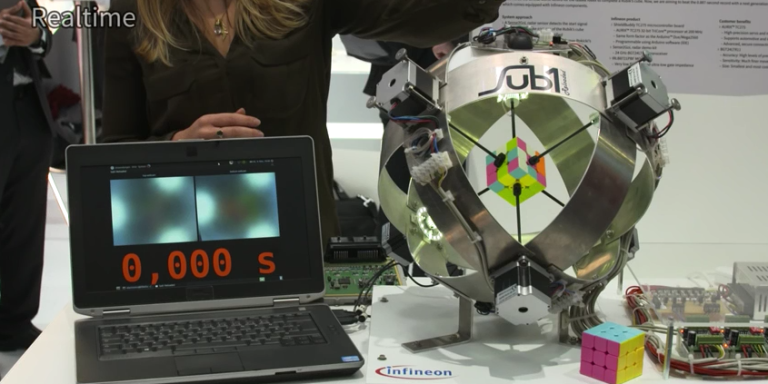
Sub1 Reloaded, built by German engineer Albert Beer, recorded a Guinness-recognized solve of a scrambled 3×3×3 Rubik’s Cube in just 0.637 seconds. From the moment the system could see the cube to the final aligned faces, it had barely enough time to make a person blink, let alone say, “Wait, what just happened?”
The record eventually fell, as records are contractually required to do, but the achievement remains a landmark in robotics, computer vision, control systems, and the proud global tradition of making toys work far harder than toys ever asked to.
Why the 0.637-Second Rubik’s Cube Robot Record Still Matters
The number is not just a party trick with excellent lighting. Sub1 Reloaded showed what happens when several engineering disciplines stop being polite strangers and start working as one fast, slightly terrifying team.
A robot cube solve has four essential jobs: inspect the scrambled colors, identify the cube’s exact state, calculate a solution, and physically execute every turn without turning the cube into expensive confetti.
Any one of those stages can create delay. Cameras need exposure time. Software needs data. Motors need to accelerate, decelerate, and land in the correct position. A cube needs to survive abrupt directional changes. At ordinary speeds, those details are manageable. At sub-second speeds, they become the whole story.
Sub1 Reloaded worked because it attacked delays across the entire chain. It did not wait for a leisurely computer-vision pipeline, a long decision process, and then a cautious mechanical routine. The machine was designed as a coordinated system.
The camera data, solver, microcontroller, and six actuators were all expected to move with the urgency of someone trying to board a subway train as the doors close.
Meet Sub1 Reloaded: Six Arms and No Patience
The robot’s name, Sub1 Reloaded, was a promise: solve the cube in less than one second, then prove it under official record conditions. Albert Beer had already built an earlier version, Sub1, which posted a 0.887-second solve. The reworked machine added an Infineon processor platform and pushed the result to 0.637 seconds.
Its physical layout was wonderfully direct. Six mechanical arms connected to the six faces of the cube. That arrangement matters. A human turns one or two layers with fingers and wrists; a robot with an actuator on every face can coordinate multiple directions without needing to regrip.
The cube is no longer a handheld puzzle. It becomes a compact motion-control problem with stickers.
The machine used two images to read the cube’s colors, then calculated a solution with a fast implementation of Herbert Kociemba’s Two-Phase Algorithm. The chosen sequence was passed to an Arduino-compatible Infineon AURIX microcontroller board, which coordinated six high-performance stepper motors.
The solve required 21 moves. That detail is useful because it reveals a key lesson: the mathematically shortest sequence is not automatically the physically fastest one.
In robotics, a turn that can overlap cleanly with another turn may beat a theoretically elegant sequence that makes the hardware hesitate.
How a Robot Sees a Scrambled Rubik’s Cube
A Rubik’s Cube robot cannot solve what it has not correctly recognized. Before a motor can spin, the system must determine where all 54 colored stickers or tiles are located. That sounds easy until the clock starts treating every millisecond like an unpaid bill.
Sub1 Reloaded relied on cameras and color recognition to translate the cube’s visible faces into a digital state. The solver then needed to distinguish a valid scramble from an impossible arrangement.
A physical cube follows strict rules: pieces cannot simply teleport, one corner cannot rotate alone, and every permutation has constraints. Good cube-solving software does more than chase matching colors; it understands the legal structure of the puzzle.
The image-processing stage is often the hidden drama of speed robotics. People watching a record video naturally focus on the blur of spinning faces. Engineers tend to stare at what happens just before the blur: camera exposure, color classification, data transfer, solver selection, and timing synchronization.
A tiny inefficiency there can erase the advantage of a very fast motor. The fastest machine is not always the one with the most powerful individual part. It is the one that wastes the fewest moments between parts.
The Math Behind the Blur
Rubik’s Cube math is famous for turning a lunch-break puzzle into a group-theory rabbit hole. A standard 3×3×3 cube has more than 43 quintillion reachable positions. Fortunately, no robot has to panic and try them one by one, preferably before the afternoon meeting.
Researchers proved that every valid 3×3×3 position can be solved in 20 moves or fewer under the half-turn metric. That ceiling is widely known as God’s Number.
It does not mean every fast robot uses exactly 20 moves, or even that it should. Record robots optimize elapsed time, not mathematical elegance alone. Their algorithms must account for actuator layout, simultaneous moves, acceleration, braking, and the risk that a particularly ambitious turn will send a corner piece on an unauthorized flight path.
Kociemba’s Two-Phase Algorithm became popular because it produces short, fast-to-find solutions without requiring exhaustive search for guaranteed optimality in every case. For a practical machine, that tradeoff is smart.
A solution that arrives immediately and executes reliably can be better than a theoretically perfect solution that consumes extra computation or creates awkward motor choreography.
The Real Enemy Is Physics
At a glance, a record-setting cube robot seems like an algorithm victory. In reality, physics keeps showing up with a clipboard.
Motors must deliver enough torque to twist each face quickly, yet their motion must be controlled precisely enough to stop at 90 or 180 degrees. The cube’s internal mechanism has friction, backlash, and tolerances. A fast turn can make layers overshoot. A sudden reversal can cause binding.
A slightly misaligned face can make the next move impossible. At extreme speeds, the cube does not care that your software is brilliant; it cares whether plastic, springs, and axles can survive the next fraction of a second.
That is why the best Rubik’s Cube robots are miniature laboratories for industrial automation. They demonstrate high-speed motor control, mechanical stiffness, sensor reliability, timing synchronization, and fault management in a form that almost anyone can understand.
A factory robot arm may be more useful at work, but a Rubik’s Cube robot has better color coordination and fewer meetings.
From 0.637 Seconds to the Current Robot Record
Sub1 Reloaded was an important point on a fast-moving timeline. It improved Albert Beer’s previous 0.887-second mark. In 2018, MIT students Ben Katz and Jared Di Carlo lowered the benchmark to 0.38 seconds with a system that used a motor for each cube face, custom electronics, webcams, and dedicated vision software.
In 2024, Mitsubishi Electric reported a 0.305-second record with TOKUFASTbot, built around high-speed factory-automation hardware. Its rotation mechanism could complete a 90-degree turn in only 0.009 second.
Then, in April 2025, Purdue University students Matthew Patrohay, Junpei Ota, Aden Hurd, and Alex Berta set the current Guinness mark of 0.103 seconds with Purdubik’s Cube.
Their achievement is a useful reminder that progress was not simply about ordering faster motors. The Purdue system paired high-speed, low-resolution machine vision with tightly customized cube hardware, a robot-aware solver, carefully shaped motor motion, and overlapping “corner-cutting” turns.
At that point, the puzzle itself became a limiting factor. The cube needs to be strong enough to tolerate acceleration that would make a desk drawer reconsider its career.
For perspective, the official human single-solve world record is 3.05 seconds, set by Xuanyi Geng in 2025. Human speedcubing and robot cubing are not the same sport wearing different shoes.
People rely on inspection, dexterity, practiced finger tricks, and real-time adaptation. Robots rely on sensors, algorithms, motors, and a very unfair number of arms. Both are impressive, but they are impressive for different reasons.
What Sub1 Reloaded Taught Engineers
The enduring lesson of the 0.637-second Rubik’s Cube robot is system-level optimization. It is tempting to hunt for a single miracle component: a faster chip, a stronger motor, a cleverer algorithm, or a sharper camera.
Those ingredients matter, but records usually fall when the connections among them improve as well.
Consider a real-world automation task, such as sorting components, inspecting products, or positioning a tool in a manufacturing line. The work is rarely limited by one device. A camera may see a part quickly but send data too slowly. A controller may calculate a trajectory quickly but wait for a motor to settle.
A motor may be powerful but create vibrations that reduce sensor accuracy. The solution is not one superhero part. It is coordination.
Sub1 Reloaded translated that idea into a memorable demonstration. It recognized, planned, and executed so rapidly that the boundaries between “thinking” and “moving” nearly disappeared.
That is the real magic trick. The cube was colorful; the engineering was the rabbit in the hat.
Why Rubik’s Cube Robots Are More Than Viral Videos
Record robots earn clicks because they look impossible. They also teach valuable habits: define the task clearly, measure every stage, identify bottlenecks, test failure modes, and improve the whole system instead of admiring one shiny component.
Students and hobbyists can learn a great deal from the project without building a sub-second machine. Even a slower cube robot can introduce programming, mechanical design, image recognition, electronics, and data-driven debugging.
The record also offers a healthy correction to the idea that advanced technology has to look mysterious. A Rubik’s Cube is familiar. Anyone can understand the goal: mixed colors go in, solved faces come out.
That clarity makes it easy to see why camera latency, motor timing, and structural durability matter. In an age of black-box buzzwords, a robot that solves a cube very, very quickly is refreshingly honest.
It cannot bluff. Either the faces line up, or they do not.
The next record will probably demand not just faster hardware but tougher puzzle materials, smarter motion planning, and even more careful synchronization. Yet the 0.637-second milestone will remain a crucial chapter in the story.
It turned a sub-one-second goal into an official accomplishment and made the world briefly wonder whether a small plastic cube had just lost an argument with microelectronics.
Experiences: What Watching a 0.637-Second Solve Feels Like
The first experience is confusion. You press play, see a scrambled cube, and then your brain receives the ending before it has fully registered the beginning. One instant there is a familiar mess of colors. The next instant, every face is solved and your eyes are left buffering like an old internet connection.
The natural response is to replay the clip. The second response is to replay it in slow motion. The third is to suspect that your own hands have quietly entered an era of underperformance.
For a casual viewer, the robot changes a childhood object into a tiny science-fiction prop. Most people have memories of a Rubik’s Cube: one completed face, two accidental rows, and a final stage where the cube gets placed in a drawer “for later.”
Seeing a machine solve it in 0.637 seconds creates an oddly satisfying contrast. The same puzzle that can absorb an afternoon becomes a precise burst of sensing, calculation, and motion.
For a speedcuber, the reaction may be more complicated and more interesting. The robot does not replace the thrill of a human solve. It exposes a different form of mastery.
Human cubers develop finger tricks, recognition skills, calm under pressure, and the ability to turn a cube without staring at it as though it owes them money. A robot has no nerves, no shaky hands, and no need to remember a last-layer algorithm after a bad night’s sleep.
But it also does not experience the satisfaction of finally hitting a personal best. The machine wins the stopwatch contest; the person keeps the story.
For a student interested in engineering, the experience can be motivating. The robot is proof that a dramatic result can emerge from ordinary building blocks used exceptionally well: cameras, processors, motors, code, brackets, fasteners, and a willingness to repeat a test after something jams.
Its glamour comes from refinement. Somewhere behind the polished record attempt are misread colors, loose couplings, mistimed turns, and cubes that did not survive their audition.
That hidden history is encouraging because it makes the final result feel earned rather than magical.
For teachers and parents, the robot is a neat doorway into bigger ideas. One short video can lead to questions about algorithms, matrices, mechanics, material strength, computer vision, or why “faster” sometimes makes a system less reliable.
It can also spark a useful discussion about teamwork. No single specialty explains the whole achievement. The software needs mechanics. The mechanics need electronics. The electronics need timing. The timing needs testing. The cube, apparently, needs nerves of steel.
And for anyone simply watching at home, there is a small moment of joy in it. A humble puzzle made from colored squares becomes a stage for imagination. The record lasts less than one second, but the urge to understand it can last much longer.
That may be the most impressive outcome of all: not that a robot solved a Rubik’s Cube almost instantly, but that it made people pause, rewind, and wonder what else careful engineering can make possible.
Conclusion
Sub1 Reloaded’s 0.637-second Rubik’s Cube solve was a historic record, a gleefully fast engineering demo, and a lesson in how major gains come from connecting small improvements.
Its cameras, solver, microcontroller, six motors, and carefully managed cube mechanics worked as one system rather than as a pile of impressive parts.
Newer robots have pushed the official record far lower, but the 2017 milestone still matters. It showed that milliseconds can be designed, measured, and earned.
More importantly, it turned a familiar puzzle into a public lesson about robotics: the fastest solution is not only about thinking faster. It is about seeing faster, deciding faster, moving faster, and keeping the puzzle intact long enough to celebrate.