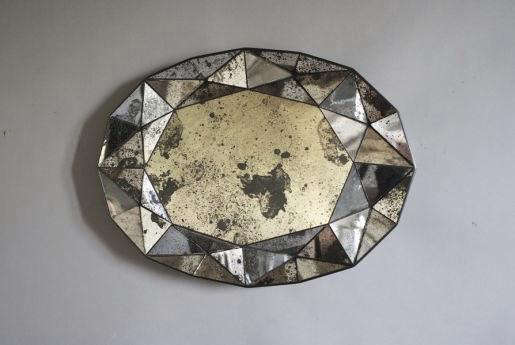
Sam Orlando Miller – Untitled Mirror 2 is not the kind of mirror that politely waits by the doorway so you can check your hair. It is a compact, sculptural, light-bending object that turns the simple act of looking into a small design event. Described in marketplace records as a convex faceted mirror made from antiqued mirror, signed by the artist, and unique, the piece sits somewhere between collectible design, wall sculpture, and a very stylish optical trick.
That is the magic of Sam Orlando Miller’s mirror work: it reflects, but not passively. It interrupts the room, catches glints of light, fragments the surrounding space, and reminds viewers that a mirror does not have to be a flat, obedient rectangle from the bathroom aisle. Sometimes, a mirror can behave more like a poem with edges.
What Is Sam Orlando Miller – Untitled Mirror 2?
Untitled Mirror 2 by Sam Orlando Miller is a small-scale, convex, faceted mirror made with antiqued mirrored material. Published listing information describes it as signed, unique, and measuring approximately 15.75 inches high, 23.5 inches wide, and 2 inches deep. The work has appeared through 1stDibs-related listings and design product archives, where it was categorized among contemporary Italian convex mirrors and marked as sold.
Those facts may sound simple, but the object itself is anything but ordinary. Its convex shape means the reflective surface curves outward, subtly altering what it captures. Its faceted construction breaks reflection into angled fragments. Its antiqued surface adds age, atmosphere, and visual texture. In plain English: it does not just show you the room. It edits the room like a moody cinematographer.
The title, Untitled Mirror 2, also matters. Miller often uses restrained titles that allow the work to stay open-ended. Instead of telling the viewer exactly what to feel, the title steps aside. The mirror becomes less about a fixed subject and more about experience: light, movement, distortion, patina, and the small surprise of seeing familiar surroundings rearranged.
Who Is Sam Orlando Miller?
Sam Orlando Miller is a British artist and designer born in London in 1966. His practice is strongly associated with sculptural mirror works, metal, handmade surfaces, faceted oval forms, and poetic experiments with reflection. Gallery FUMI describes him as an artist known for sculptural works in mirror and metal, with a distinctive use of materials and faceted oval forms.
Miller’s background helps explain why his mirrors feel so carefully made. He grew up around the family silversmithing business, where reflective metal was not an abstract luxury but a material to be handled, understood, shaped, and respected. His official biography notes that his early life around silver created a lasting connection to reflection, craft, and the visual behavior of lustrous surfaces.
That history gives his mirror works a deeper foundation. They are not decorative objects that randomly decided to be expensive. They come from a maker who understands that reflection is not just shine; it is a relationship between material, light, room, and viewer. A good Miller mirror does not simply hang on a wall. It negotiates with the wall, the window, the daylight, the lamp, the person walking past, and occasionally your sense of balance.
The Design Language of Untitled Mirror 2
Convex Form
The convex shape is one of the most important features of Untitled Mirror 2. A flat mirror gives a relatively direct reflection. A convex mirror expands and bends the view, pulling in more of the room while making the image feel distant, curved, and slightly dreamlike. This turns the piece into a small architectural device. It can make a corner feel deeper, a hallway more animated, or a blank wall suddenly aware of everything around it.
Faceted Surface
The faceting adds another layer of complexity. Each angled section catches light differently, so the surface shifts as the viewer moves. In one position, the mirror may look dark and smoky. From another angle, it may flash with silver, bronze, or warm antique tones. This quality connects Untitled Mirror 2 to Miller’s broader practice, where mirrors often resist a single stable reading.
Antiqued Mirror Material
The antiqued mirror surface gives the work its character. Instead of crisp, showroom-perfect reflection, the patina softens the image. It introduces irregularity, history, and a hint of mystery. The surface looks as if it has already lived a life, heard several secrets, and decided not to repeat them. This is why antiqued mirror can be so powerful in interiors: it reflects light without shouting, and it adds depth without demanding theatrical lighting.
Why Untitled Mirror 2 Feels More Like Art Than Furniture
There is a practical side to Untitled Mirror 2: yes, it is still a mirror. But calling it only a mirror would be like calling a cello “a wooden box with strings.” Technically true, emotionally useless.
Miller’s work belongs to the category often called collectible design, where objects may retain some functional reference while operating as artworks. His mirrors are wall-mounted pieces, but their real function is perceptual. They ask viewers to notice how light behaves, how rooms change throughout the day, and how reflection can become atmosphere rather than mere utility.
This is where Untitled Mirror 2 becomes especially interesting for collectors and interior designers. It is modest in scale but rich in effect. At under two feet wide, it does not need a mansion-sized wall to make an impression. It can work in an entry, above a console, beside a reading chair, in a dining room, or in a layered gallery wall. But wherever it goes, it brings movement. It makes a wall less flat and a room less predictable.
Sam Orlando Miller’s Broader Mirror Practice
Miller’s mirror works did not appear out of nowhere. His early sculptural mirrors emerged after he moved to central Italy, where his surroundings, materials, and studio practice began to merge. Several art and design sources describe how his first mirror pieces developed from his knowledge of painting, three-dimensional form, and reflected light. His practice expanded into wall sculptures, lighting, tables, and other objects that use mirror and metal as expressive materials.
His well-known Untitled Mirrors series includes works in different shapes, sizes, tones, and reflective qualities. Some pieces use blue, green, amber, silver, bronze, or obsidian-like mirror. Others explore concave or convex surfaces, faceted construction, hand-cut glass, and patinated finishes. Across the series, Miller returns again and again to the same big question: what happens when a mirror stops trying to be invisible and starts acting like the main character?
The answer is visible in Untitled Mirror 2. It does not disappear into the room. It participates. The piece captures its surroundings, alters them, and sends them back in a new form. In this way, it becomes both object and image, both surface and space.
How Untitled Mirror 2 Fits Into Contemporary Interiors
One reason designers are drawn to Sam Orlando Miller mirrors is that they offer a rare balance: they are visually sophisticated, but they do not feel cold. Some contemporary design objects look as if they might judge your sofa. Miller’s mirrors, by contrast, feel handmade, atmospheric, and quietly alive.
Untitled Mirror 2 works especially well in interiors that value texture. Think plaster walls, aged wood, linen upholstery, stone floors, bronze hardware, or warm modern lighting. Its antiqued surface can bridge traditional and contemporary spaces. In a minimalist room, it adds complexity. In a layered room, it adds sparkle and structure. In a moody room, it doubles down on the drama without turning the space into a haunted castleunless that is your design brief, in which case, congratulations.
Best Placement Ideas
Because of its compact dimensions and convex form, Untitled Mirror 2 can be used as a focal accent rather than a full-size looking glass. It would be especially effective above a narrow console, between two sconces, on a dark accent wall, or in a hallway where its curved surface can catch movement. It could also work in a dining area, where candlelight or pendant lighting would animate the faceted surface.
The key is to give it something interesting to reflect. A Miller mirror rewards thoughtful placement. Put it across from a window, and it may catch shifting daylight. Place it near plants, and it will fracture leaves into painterly fragments. Hang it near art, and it will create a subtle conversation between surfaces. Hang it opposite a pile of laundry, and it will still be artbut perhaps art with questions.
Why Collectors Care About Signed, Unique Works
The listing description for Untitled Mirror 2 notes that the work is signed and unique. For collectors, those words matter. “Signed” connects the object directly to the artist’s hand and studio. “Unique” means the piece is not one interchangeable unit in a large production run. It carries individual variation, which is especially important in a practice based on patina, hand-cut surfaces, and material behavior.
In collectible design, uniqueness can influence emotional and market value. A unique mirror by a recognized artist is not just purchased for reflection. It is acquired as a specific object with its own surface, proportions, marks, and history. The fact that Untitled Mirror 2 has been listed as sold also adds a layer of scarcity. Interested buyers may need to look for related works, similar Untitled Mirror pieces, or future available works through galleries and secondary marketplaces.
Comparing Untitled Mirror 2 With Other Miller Mirrors
Compared with larger Miller works, Untitled Mirror 2 feels intimate. Some of his later or larger mirrors explore dramatic color fields, elaborate patinas, or expansive wall presence. Others incorporate emerald greens, midnight blues, amber tones, bronze frames, or sculptural formats that approach furniture and installation. Untitled Mirror 2, by contrast, is concise. It is like a short poem that somehow contains weather.
Its size also makes it practical for collectors who appreciate Miller’s language but do not have room for a major installation. The piece carries core elements of his vocabulary: antiqued mirror, faceting, curved form, and a sculptural approach to reflection. It is a strong example of how a small work can still hold a complete artistic idea.
The Emotional Appeal of Antiqued Reflection
Modern life is full of perfect screens. Phones, tablets, laptops, and glossy appliances reflect us with exhausting clarity. Antiqued mirror offers something gentler. It does not shout every detail back at us. It blurs, warms, dims, and transforms. That is part of the charm of Untitled Mirror 2.
Instead of functioning as a tool for self-inspection, it becomes a tool for atmosphere. You do not look into it only to see yourself; you look into it to see how the room feels. That shift is subtle but powerful. It changes the mirror from a vanity object into a spatial object. It turns reflection into mood.
This is also why Miller’s works have aged well in design conversations. They are not tied to a trend that expires after one social media season. They belong to a slower tradition of craft, material experimentation, and sculptural thinking. In a world obsessed with the new, an antiqued mirror that looks deliberately time-worn feels oddly refreshing.
Experience Section: Living With a Work Like Sam Orlando Miller – Untitled Mirror 2
Imagine encountering Sam Orlando Miller – Untitled Mirror 2 in a real home rather than on a product page. At first, you might not know what you are looking at. It is not a conventional mirror, and it is not quite a painting. From across the room, it might read as a luminous object, a small silvered landscape, or a mysterious wall jewel. You walk closer, and the room begins to break into pieces.
The first experience is usually visual curiosity. The convex form pulls the eye because it behaves differently from the flat surfaces around it. A wall is still. A framed print is still. A cabinet is still. But this mirror seems to move even when it is fixed in place. As you shift your weight, the reflections shift too. Light crosses one facet, disappears into another, and returns in a softer tone. It feels almost cinematic, like the room is being edited in real time.
In the morning, the piece might catch pale daylight and look cool, quiet, and architectural. Around noon, it may become brighter and more graphic, revealing the structure of its faceted surface. In the evening, when lamps replace sunlight, the antiqued mirror may turn warmer and more mysterious. Candlelight would make it especially beautiful, because small flames would multiply across the angled surface without becoming harsh. It is easy to imagine the mirror above a console with a ceramic bowl beneath it, or in a dining room where it catches the glow of glassware and conversation.
There is also a personal experience in looking at a mirror that refuses to behave like a normal mirror. Most mirrors invite judgment: How do I look? Is my shirt wrinkled? Why is my hair making independent decisions? Untitled Mirror 2 shifts the question. It is less concerned with grooming and more concerned with perception. The viewer becomes part of the surface, but not in a literal, unforgiving way. Your reflection is softened, divided, and absorbed into the larger image of the room. That can feel surprisingly freeing.
For interior designers, living with a piece like this teaches an important lesson: reflective objects are not only for making rooms look bigger. They can make rooms feel deeper, stranger, warmer, and more layered. A standard mirror can expand a space; a sculptural mirror can give it personality. Untitled Mirror 2 would be especially effective in a room that already values material honestywood grain, plaster texture, handmade ceramics, linen, stone, and bronze. It would not need to dominate. It would simply keep changing, quietly, throughout the day.
For collectors, the experience is more intimate. Because the piece is described as unique, it carries the appeal of specificity. This is not just “a Sam Orlando Miller-style mirror.” It is one particular work with its own proportions, surface, and reflective behavior. Over time, that uniqueness becomes part of daily life. You begin to know how it looks in winter light, how it changes when guests walk past, how it responds when flowers are placed nearby, and how it turns an ordinary wall into a small event. That is the pleasure of collectible design at its best: it does not sit in the room like a trophy. It becomes part of how the room lives.
Conclusion
Sam Orlando Miller – Untitled Mirror 2 is a compact but compelling example of how a mirror can become sculpture. Its convex form, faceted surface, antiqued material, signed uniqueness, and connection to Miller’s larger practice make it far more than a decorative accessory. It is a study in reflection, distortion, craft, and atmosphere.
For collectors, it offers the appeal of a unique work by an artist deeply associated with mirror and metal. For designers, it offers a flexible but expressive object that can bring depth, light, and visual intrigue to a room. For anyone tired of mirrors that simply report the facts, Untitled Mirror 2 offers something better: a reflection with imagination.