Note: This article is based on real scientific reporting and peer-reviewed research about Dogor, the frozen Siberian canid specimen. Early reports described the animal as a mysterious “wolf-dog” because initial DNA tests could not clearly classify it; later genomic work identified Dogor as an ancient wolf, while still leaving major questions about dog domestication wide open.
A Puppy From the Ice Age Walks Into Modern Science
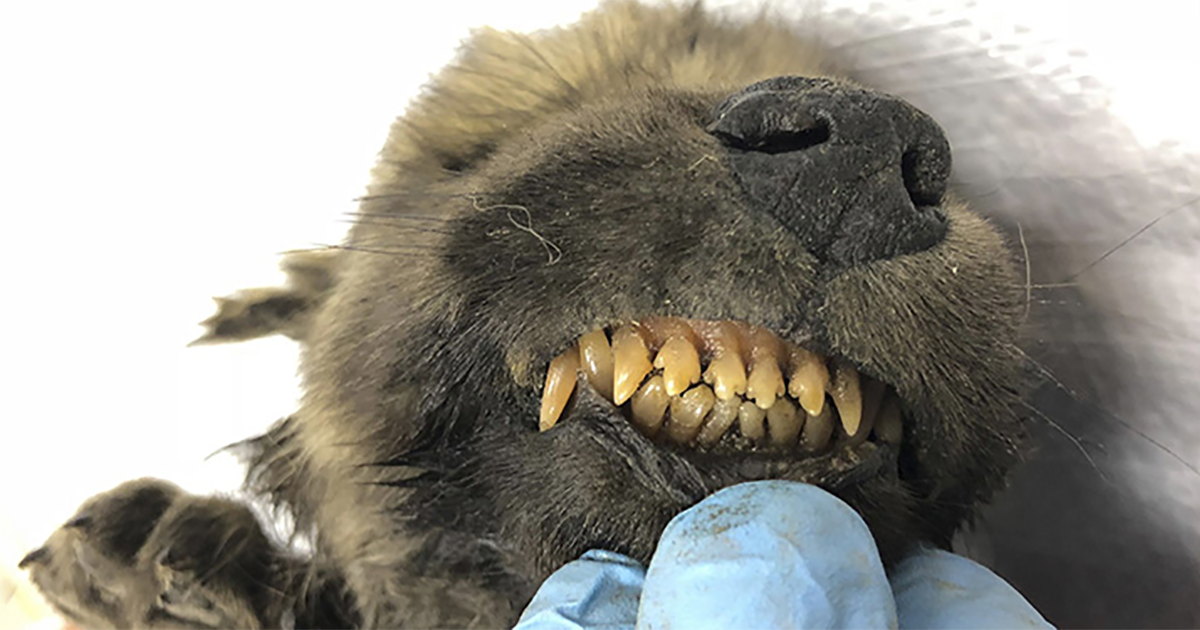
Every so often, the frozen ground of Siberia opens like nature’s most dramatic filing cabinet and hands scientists a document nobody expected to read. In 2018, that “document” was not a bone shard, a tooth, or a dusty fossil. It was a small, furry puppy with a black nose, tiny teeth, whiskers, eyelashes, and the kind of face that makes even serious researchers say, “Okay, that is unfairly adorable.”
The specimen was found in eastern Siberia, near Yakutsk, preserved in permafrost for roughly 18,000 years. Scientists named him Dogor, a word that means “friend” in the local Yakut language. The name also carries a playful English pun: dog or wolf? That question quickly became the heart of the mystery.
At first, Dogor seemed to sit in a biological gray zone. He looked like a puppy. He was about two months old when he died. His remains were astonishingly complete. But when researchers began studying his DNA, the answer was not as simple as “dog” or “wolf.” For a while, the ancient canine seemed to be wagging his tail from the edge of evolution itself, right where wolves may have been turning into the first dogs.
Why Dogor Looked Like a Scientific Time Capsule
Most ancient animal discoveries are fragmentary. A jaw here. A femur there. Maybe a tooth if luck is feeling generous. Dogor was different. Because he had been locked in permafrost, much of his soft tissue survived. His fur remained visible. His whiskers and eyelashes were still there. His teeth were intact enough to help estimate his age. He was not just a fossil; he was a preserved individual.
That distinction matters. Bones can reveal size, age, injury, and evolutionary relationships, but soft tissue can preserve details about appearance, development, diet, health, and genetics. Dogor gave researchers something rare: a chance to look at an Ice Age canid almost as a whole animal rather than as a scattered set of clues.
Radiocarbon dating placed him at about 18,000 years old, near the end of the last Ice Age. That period was a turning point for many species. Mammoths, woolly rhinoceroses, cave lions, ancient wolves, and early human groups shared vast cold landscapes. Somewhere in that deep past, a relationship began between humans and wolves that eventually gave rise to domestic dogs.
The Big Question: Was Dogor a Dog, a Wolf, or Something Between?
When Dogor first made headlines, scientists could not confidently determine whether he was a dog or a wolf. That was surprising because DNA analysis usually handles this type of question better than eyeballing skulls or comparing teeth. Modern dogs and wolves are closely related, but their genomes contain patterns that often allow researchers to separate one from the other.
Dogor complicated the situation. Initial genetic results did not clearly match modern dogs or modern wolves. One possible explanation was that he came from an ancient population close to the common ancestry of both. Another possibility was that researchers were looking at a wolf lineage that no longer exists and therefore had no perfect modern reference for comparison.
That second point is important. Evolution is not a tidy family tree drawn with a ruler. It is more like a tangled holiday string light situation, except the lights are wolves, dogs, extinct populations, migration routes, interbreeding, bottlenecks, and thousands of years of climate change. Good luck getting that untangled before dinner.
Later Research Changed the Headlinebut Not the Importance
Further genomic research eventually identified Dogor as an ancient wolf. That does not make the discovery less exciting. In fact, it makes it more scientifically useful. Dogor was not simply “the world’s oldest dog,” as some early speculation suggested. He was part of a vanished Ice Age wolf world that can help scientists understand where dogs came from, which wolf populations contributed to them, and why the origin of domestic dogs remains so hard to pin down.
A major 2022 study analyzed dozens of ancient wolf genomes from Europe, Siberia, and North America across roughly 100,000 years. The research showed that Ice Age wolf populations were highly connected across large regions and that modern and ancient dogs are generally more closely related to ancient wolves from eastern Eurasia than to those from western Eurasia. However, the study also found signs of complex ancestry, including possible contributions from different wolf-related populations.
In simple terms: Dogor may not be a dog, but he still belongs to the neighborhood where the dog-origin story was happening. He is a beautifully preserved clue from a time when wolves were widespread, people were mobile hunter-gatherers, and the first dogs may already have been emerging somewhere in Eurasia.
Why Dog Domestication Is So Difficult to Solve
People often imagine domestication as a single cozy moment: an ancient human tosses a bone to a friendly wolf, the wolf wags its tail, and boomgolden retriever. Unfortunately, science rarely hands us a story that simple. Dog domestication likely unfolded over thousands of years, involving repeated contact between humans and wolves, natural selection for less fearful animals, and eventually human preference for useful or sociable traits.
Early dogs may have helped humans hunt, guard camps, clean up scraps, or provide warmth and companionship. But unlike cattle, sheep, or goats, dogs may not have entered human life through a single obvious economic role. Their value was flexible. They were partners, alarms, scavengers, trackers, sled-pullers, and, let’s be honest, probably emotional support specialists long before anyone had a clipboard.
Genetics adds more complexity. Dogs did not descend from the wolves living today in a straightforward way. Research suggests they came from ancient wolf populations that may be extinct or poorly represented in the modern genetic record. That means comparing an Ice Age specimen to modern wolves can be misleading. If the original source population disappeared, scientists must reconstruct the story from ancient DNA, archaeological context, and statistical modeling.
Permafrost: Nature’s Freezer With a Complicated Warranty
Dogor survived because of permafrost, ground that remains frozen for at least two consecutive years. In Arctic and sub-Arctic regions, permafrost can preserve organic material for astonishing lengths of time. It can hold plant matter, bones, hair, skin, stomach contents, and sometimes entire animals.
Think of permafrost as a freezer with no owner’s manual and no consistent temperature setting. When conditions are stable, it can preserve animals with remarkable detail. When climate warms and the ground thaws, it can expose those preserved remains to erosion, decay, and human discovery. That is why Siberia has produced mammoths, cave lion cubs, ancient horses, wolves, and other Ice Age animals that seem to step out of the past wearing their original fur coats.
There is a serious side to this freezer metaphor. Thawing permafrost is not just a treasure chest for paleontology. It is also a climate concern because frozen ground stores vast amounts of organic carbon. As it thaws, microbes can break down long-frozen material and release carbon dioxide and methane. So while Dogor’s discovery is thrilling, it also reminds us that the Arctic is changing quickly.
What Dogor Reveals About Ice Age Siberia
Dogor lived in a world very different from modern Siberia. During the Late Pleistocene, parts of northern Eurasia were covered by cold, dry grassland ecosystems often called mammoth steppe. These landscapes supported large herbivores such as mammoths, horses, bison, and woolly rhinoceroses, along with predators and scavengers including wolves, cave lions, and humans.
A young wolf pup like Dogor would have depended on a den, a mother, and possibly a pack structure. At around two months old, he would have been at a vulnerable stage: old enough to show teeth and begin exploring, but still young enough to need protection. Scientists do not know exactly how he died. The absence of an obvious answer is part of the mystery. A den collapse, sudden burial, exposure, illness, or another accident could all be possible, but the evidence has not delivered a final verdict.
His preservation, however, suggests that he was buried or frozen quickly enough to slow decomposition. That quick natural refrigeration turned a brief Ice Age life into a long scientific afterlife.
Dogor and Other Frozen Canine Discoveries
Dogor is not the only ancient canid to emerge from frozen ground. Siberia has yielded other mummified wolf pups, including the famous Tumat puppies, which were also once discussed as possible early dogs before genetic studies pointed toward wolf identities. In Canada’s Yukon, a remarkably preserved 57,000-year-old wolf pup named Zhur helped scientists study ancient wolf migration and vanished populations.
These discoveries show that ancient canids were diverse, mobile, and deeply tied to Ice Age ecosystems. They also demonstrate why scientists must be cautious. A cute frozen puppy can look dog-like without being a domestic dog. Early wolves and early dogs were physically similar, especially before humans began strongly shaping dog bodies through selective breeding.
That is why DNA matters. A skull may whisper “dog,” but a genome can say, “Actually, let’s not get ahead of ourselves.”
The Modern Dog Connection
Modern dogs are the first animals known to have been domesticated by humans. Long before farms, cities, writing, or tiny sweaters for Chihuahuas, humans and canids were building a relationship. Recent ancient DNA studies suggest that by around 15,000 to 16,000 years ago, dogs were already living with hunter-gatherers in parts of western Eurasia. Other research shows that by 11,000 years ago, multiple major dog lineages had already developed.
That timeline makes Dogor especially fascinating. At 18,000 years old, he lived close to the window in which scientists believe dogs and wolves were becoming genetically and socially distinct. Even though he is now understood as a wolf, he belongs to the broader evolutionary landscape that produced dogs.
In other words, Dogor is not the family dog. He may be more like the mysterious ancient cousin whose photo appears in the family album and makes everyone argue at Thanksgiving.
Why Scientists Were Right to Be Baffled
The word “baffled” can sound like science failed, but that is not what happened. In science, confusion is often the start of progress. Dogor was puzzling because he came from a time and population that modern reference samples could not easily explain. The uncertainty pushed researchers to gather more data, compare more ancient genomes, and refine the question.
That is how science works at its best. Early claims are tested. Better methods arrive. New evidence changes the story. The headline evolves from “Is this a dog or wolf?” to “This ancient wolf helps explain why dog origins are so complicated.” That is not a downgrade. That is a plot twist with footnotes.
What Dogor Teaches Us About Our Oldest Animal Companions
Dogor’s importance is not limited to taxonomy. He helps us appreciate the deep timeline behind every modern dog. The Labrador sleeping on the couch, the husky howling at a leaf, the beagle following a sandwich with religious devotionall of them are connected to ancient wolf populations that lived through Ice Age pressures, human contact, migrations, and genetic change.
Dogor also reminds us that domestication was not an overnight transformation. The first dogs probably did not look wildly different from wolves. They may have been slightly less fearful, more tolerant of human camps, or better adapted to scavenging near people. Over generations, those small differences became meaningful. Eventually, humans and dogs formed one of the most successful cross-species partnerships in history.
Experience Section: What Dogor’s Story Feels Like From a Human Point of View
There is something strangely emotional about seeing a preserved Ice Age puppy. A mammoth skeleton can impress us. A stone tool can fascinate us. But a puppywith fur, whiskers, and a small nosedoes something else. It closes the emotional distance between then and now. Suddenly, 18,000 years does not feel like an abstract number. It feels like a small animal that once breathed, slept, nursed, shivered, and maybe tumbled awkwardly around a den.
For anyone who has lived with dogs, Dogor’s face can feel familiar in a way that is almost uncomfortable. You may know that he was a wolf pup, not a pet. You may understand that he lived in a harsh Ice Age ecosystem, not beside a fireplace with a chew toy shaped like a taco. Still, the preserved details invite connection. The eyelashes, the muzzle, the tiny teeththese are not just scientific features. They are reminders that ancient life was made of individuals.
That is one reason stories like Dogor’s travel so widely online. People are drawn to mysteries, yes, but they are also drawn to recognizable emotion. The phrase “18,000-year-old puppy” combines two things the internet cannot resist: deep time and cute animals. It is basically paleontology wearing a puppy filter.
From a learning perspective, Dogor is a perfect doorway into bigger questions. A child who sees his photo might ask, “Was he a dog?” That question leads to DNA, evolution, climate, archaeology, ancient humans, migration, and extinction. A simple image becomes a science lesson with paws.
Dogor’s story also changes how we think about modern pets. Dogs often feel like ordinary parts of daily life: barking at delivery drivers, stealing socks, staring dramatically at empty food bowls. But behind that everyday comedy is a profound evolutionary history. Dogs are not just animals humans trained. They are descendants of a long, complex relationship between two social species that learned to read each other.
Imagine a hunter-gatherer camp at the edge of the Ice Age. Food is scarce. Nights are cold. Wolves circle at a distance, wary but curious. Some keep their space. Others come closer. Over generations, the boldest but least aggressive animals may have found opportunity near humans. Humans, in turn, may have noticed that certain canids warned of danger, helped track prey, or simply made camp life feel less lonely. No one needed to announce the invention of “the dog.” The relationship may have formed slowly, like a path in snow made by many footsteps.
Dogor did not walk that path as a confirmed domestic dog, but he stood near its beginning. That is why the discovery matters. He gives modern readers a face for a scientific mystery that is usually hidden in genetic charts and archaeological tables. He makes the origin of dogs feel alive.
The experience of reading about Dogor should also encourage humility. Science did not know exactly what he was at first. Then it learned more. That is not weakness; it is the process. The best discoveries do not always answer one question neatly. Sometimes they reveal that the original question was too small. Dogor began as “dog or wolf?” He became part of a much larger story about ancient wolves, human survival, changing climates, and the first sparks of companionship between species.
Conclusion: A Frozen Puppy, a Living Mystery
Dogor’s story is charming, strange, and scientifically valuable. Found frozen in Siberian permafrost after roughly 18,000 years, the tiny canid first baffled researchers because his DNA did not easily fit modern categories. Later genomic analysis identified him as an ancient wolf, but the larger mystery remains: when, where, and how did wolves become dogs?
The answer is still unfolding. Dogor may not be the missing link in a simple chain, because there probably was no simple chain. Instead, he is a rare and beautifully preserved glimpse into the Ice Age world where that transformation was taking shape. He reminds us that every dog curled up beside a human today carries a history older than agriculture, older than cities, and older than most of the stories we tell about ourselves.
In the end, Dogor’s greatest gift may not be a final answer. It may be the questions he keeps alive. And for a puppy who slept in the Siberian ice for 18,000 years, that is a pretty impressive comeback.