Pluto has always been good at making a dramatic entrance. It arrived in astronomy as a mysterious ninth planet, was later reclassified as a dwarf planet, and then became the target of NASA’s historic New Horizons flyby. The 2015 encounter revealed mountains, glaciers, haze layers, giant pits, and a canyon system large enough to make Arizona’s Grand Canyon look surprisingly modest.
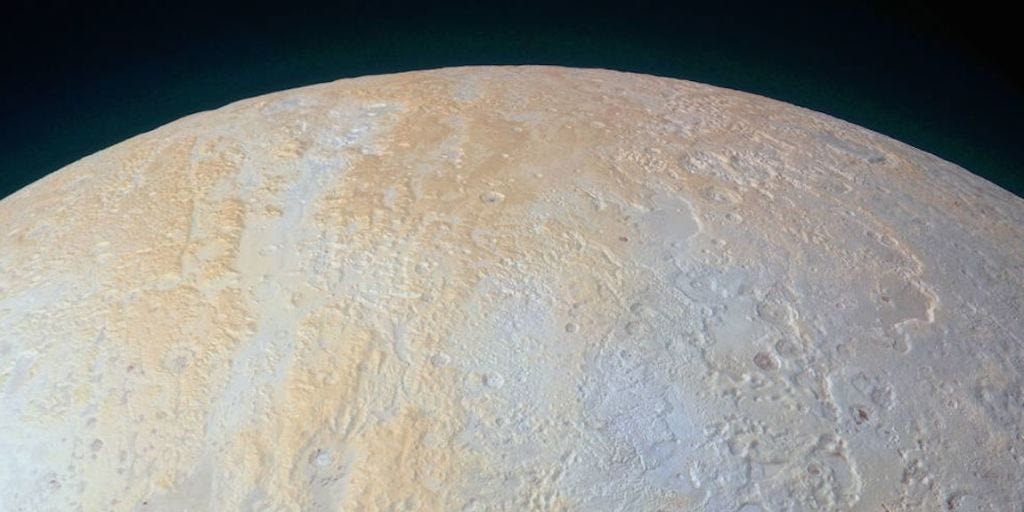
The most arresting view came from Pluto’s far northern terrain, a region called Lowell Regio. There, long fractures cut through an icy landscape near the north pole. The broadest canyon spans about 45 miles, while nearby irregular pits descend roughly 2.5 miles. That combination inspired the popular description of a “45-miles-wide, 2-miles-deep Grand Canyon,” although the canyon and deepest pits are technically separate features within the same remarkable scene. Either way, Pluto clearly misunderstood the assignment to be small and boring.
What New Horizons Actually Saw on Pluto
Before New Horizons, even the best images of Pluto looked like a few blurry pixels wearing a reddish sweater. The spacecraft changed that on July 14, 2015, when it became the first mission to examine Pluto up close. After traveling for more than nine years, it passed within about 7,800 miles of the dwarf planet and collected detailed images, color maps, infrared measurements, atmospheric data, and topographic clues. The flyby transformed Pluto from a distant dot into a complicated world with a long geological biography.
A Canyon Wider Than Many Cities
The enhanced-color north-polar image shows a dominant canyon running close to Pluto’s north pole. At approximately 45 miles across, it is wider than the distance many commuters would tolerate without filing an emotional complaint. Roughly parallel subsidiary canyons lie to the east and west, each about 6 miles wide. A shallow, winding valley follows the floor of the main canyon, adding another layer to the landscape’s complicated structure.
The “2-Mile-Deep” Detail Needs a Scientific Footnote
Popular descriptions often package the width and depth into a single super-canyon. NASA’s annotated interpretation is more precise. The 45-mile measurement belongs to the widest canyon, while the greatest quoted depthabout 2.5 milesbelongs to large, irregular pits elsewhere in the same image. Those pits also reach roughly 45 miles across.
The distinction does not make the scene less impressive; it makes it more interesting. Pluto’s polar surface is not dominated by one oversized trench but by an entire neighborhood of tectonic fractures, valleys, collapsed depressions, and chemically distinct ice.
Where Is Pluto’s Giant Canyon?
The canyon system lies in Lowell Regio, a broad northern region named for Percival Lowell. Lowell founded Lowell Observatory in Flagstaff, Arizona, and promoted the search for a planet beyond Neptune. Clyde Tombaugh later discovered Pluto at the observatory in 1930.
When NASA released the canyon image in 2016, Lowell Regio was still described as an informal name. The International Astronomical Union approved it in 2019, so the designation is now official rather than merely a mission-team nickname.
That northern location matters. Pluto’s axis is tilted dramatically, producing extreme seasonal patterns over its 248-year orbit around the Sun. Different latitudes can spend long periods under very different lighting and temperature conditions. Over millions of years, those cycles help move volatile ices between the surface and atmosphere, alter frost deposits, and reshape the visible landscape.
Pluto does not have Earth-like weather, but it does have climateand its climate operates with the patience of a glacier and the scheduling habits of a government committee.
How Does Pluto’s Canyon Compare With the Grand Canyon?
Arizona’s Grand Canyon is about 277 miles long, reaches up to roughly 18 miles across, and averages about a mile deep. Pluto’s main polar canyon is not necessarily longer, and its depth has not been tied to the popular 2.5-mile figure as neatly as some headlines imply. Yet its 45-mile width is extraordinaryabout two and a half times the Grand Canyon’s maximum width.
The comparison also hides a more fundamental difference. Earth’s Grand Canyon was carved largely by running water, weathering, gravity, and the uplift of the Colorado Plateau. Pluto’s canyon formed in a world where surface temperatures can fall to around minus 400 degrees Fahrenheit, water ice behaves like bedrock, and more volatile ices such as nitrogen and methane can migrate, flow, frost over terrain, or sublimate directly into gas.
Calling the feature Pluto’s Grand Canyon is useful for scale, but geologically it is closer to a gigantic fracture in a frozen planetary crust than to a river-cut desert gorge.
What Could Have Formed the Frozen Canyons?
Ancient Tectonics Is the Leading Clue
The canyon walls look degraded and softened compared with sharper canyon systems elsewhere on Pluto. Mission scientists interpret that worn appearance as evidence that the polar canyons are old, possibly formed from weaker material and later modified by long-term erosion, frost movement, sublimation, or collapse.
Their roughly parallel arrangement points toward extensional tectonics: the crust was pulled apart, producing large fractures and sunken blocks.
Pluto’s geology shows that a small world can preserve ancient terrain while also supporting much younger activity. New Horizons found old, heavily cratered regions alongside flowing glaciers, convecting nitrogen ice, fractured crust, possible cryovolcanoes, and surfaces so young that they contain few or no visible impact craters.
The canyon system in Lowell Regio may be a surviving record of an early phase when Pluto’s interior and crust were adjusting, cooling, expanding, or reorganizing.
Could a Hidden Ocean Be Involved?
Models of Pluto’s interior allow for the possibility of a deep liquid-water layer beneath a thick shell of water ice. Such an ocean has not been directly detected, and the north-polar canyons are not proof that it exists. Still, an interior that remained warm enough for liquid water would help explain how Pluto generated large-scale tectonic stress.
Freezing water expands, internal layers cool at different rates, and planetary shells respond by cracking, stretching, and shifting. Pluto may look like a snowball, but it could have the structural history of a slowly flexing ice vault.
The Strange Colors of Lowell Regio
The published image is enhanced color, not a literal view through human eyes. Scientists stretched color differences to reveal variations in composition, elevation, age, and surface processing. Lower areas appear bluish gray, while higher northern terrain takes on a yellowish tone that stands out from most of Pluto.
Infrared measurements indicate that Lowell Regio contains abundant methane ice but relatively little nitrogen ice. Researchers proposed that the yellow terrain may represent older methane deposits altered by prolonged solar and particle radiation, while bluer surfaces could be younger or less processed.
The colors therefore act like a rough chemical history book: yellow may mark ice that has spent longer under space radiation, while blue-gray material may record different deposits or exposure conditions. It is not a cheerful paint palette, exactly, but planetary geologists are not known for demanding cheerful paint palettes.
Pluto’s broader surface includes nitrogen, methane, carbon monoxide, water ice, and reddish organic compounds. At Pluto’s extremely low temperatures, water ice forms the strong crustal framework, while nitrogen and methane can behave more like mobile geological materials.
This contrast helps explain how the dwarf planet can support hard mountains, soft glaciers, collapsing pits, and volatile frost cycles within the same global landscape.
Why the Giant Pits May Be as Important as the Canyon
The irregular depressions near the canyon system are not shaped like ordinary impact craters. Some are approximately 45 miles across and about 2.5 miles deep. Their uneven outlines led researchers to consider collapse rather than impact as a possible origin.
One idea is that subsurface ice was removed, melted, or redistributed, leaving unsupported ground to cave inward. Sublimationice changing directly into gascan also excavate and weaken landscapes over long timescales.
That interpretation remains cautious because New Horizons performed a fast flyby rather than entering orbit. Scientists obtained a spectacular snapshot, but they could not repeatedly image the same terrain under changing light or watch the pits evolve. A future Pluto orbiter could test these ideas with repeated topographic, compositional, and seasonal measurements.
How New Horizons Captured the View
New Horizons took the north-polar image about 45 minutes before closest approach, from roughly 21,000 miles away. Its Long Range Reconnaissance Imager supplied detailed black-and-white structure, while the Ralph instrument’s Multispectral Visible Imaging Camera and infrared spectrometer helped map color and composition.
Combining those data allowed researchers to distinguish canyon walls, subsidiary fractures, pits, valleys, and compositional zones that would have remained invisible in ordinary telescope images.
The accomplishment is easy to underestimate. Mission controllers aimed a compact spacecraft across billions of miles, timed a high-speed encounter with a moving world, gathered data during a brief flyby, and transmitted the results across a radio link that took hours to span the solar system. Meanwhile, many of us struggle to send a photo from the far end of the backyard without losing Wi-Fi.
Why Pluto’s Canyon Changed the Way We See Dwarf Planets
Pluto’s canyon is valuable not merely because it is huge. It demonstrates that size alone does not determine geological complexity. Before the flyby, many scientists expected Pluto to be cold, ancient, and comparatively inactive.
Instead, New Horizons revealed terrain shaped by tectonics, glacial flow, convection, volatile transport, erosion, possible cryovolcanism, and atmospheric chemistry. The world contains surfaces spanning billions of years in age, sometimes separated by surprisingly short distances.
Lowell Regio adds an especially useful chapter. Its softened canyon walls may preserve evidence of ancient crustal deformation, while its methane-rich colors record long-term surface processing. Nearby pits suggest collapse or volatile loss. Pluto’s north pole has been fractured, coated, irradiated, and alterednot simply frozen in place since the solar system formed.
A Virtual Expedition to Pluto’s Grand Canyon
No human or lander has reached Pluto; New Horizons remains the only mission to explore it up close. The closest available experience is a virtual field trip through the spacecraft’s imagery. Start with the enhanced-color frame and resist treating it like an ordinary photograph. Its stretched colors expose subtle differences in terrain and compositionessentially a geological map wearing dramatic lighting.
First, Establish the Scale
Find the broad canyon near the left side of the polar view. Then imagine placing a major metropolitan area across its width. A 45-mile span could swallow a long urban commute and several neighboring communities. Even the parallel 6-mile-wide canyons would be major landforms on Earth.
This is the moment when Pluto stops feeling like a tiny classroom diagram and starts feeling like a world. Pause over the scale bar; it turns an attractive image into a map of genuinely enormous distances.
Next, Read the Landscape Like a Detective
Trace the softened edges of the main canyon. Rounded, degraded walls suggest age, weak material, or prolonged modification. Follow the winding valley along the floor, then shift attention toward the irregular pits. Their outlines are less tidy than impact craters, raising a key question: did the ground collapse after buried ice disappeared?
Now compare high yellow terrain with lower blue-gray areas. Older methane-rich deposits may have spent ages under radiation, while other surfaces may be younger or made from a different mixture of ice. You are not merely seeing “yellow ground” and “blue ground.” You are reading clues about exposure, chemistry, and climate.
Imagine the Physical EnvironmentCarefully
A real visit would be brutally hostile. Pluto’s gravity is only a small fraction of Earth’s, its atmosphere is extremely thin, and its surface is colder than any natural environment experienced by humans. An astronaut could not casually hike the rim with a thermos and a confident attitude.
Every movement would depend on a pressurized suit, thermal protection, navigation systems, and a vehicle designed for brittle and volatile ices. The low gravity might make steps feel light, but a fall near a multi-mile depression would remain an exceptionally bad scheduling choice.
Finish With the Spacecraft’s Perspective
Zoom back out and remember that New Horizons did not hover. It raced past Pluto during a precisely choreographed encounter. The canyon image is less like a leisurely aerial survey and more like a perfectly timed photograph taken through the window of an express train crossing the outer solar system.
That is the most rewarding experience the image offers: a shift in perspective. Pluto is no longer merely the object that lost a label in 2006. It is a layered planet-scale environment with ancient fractures, mobile ice, chemical weathering, and unanswered questions.
The canyon invites awe, but the deeper thrill comes from realizing that one fast flyby exposed only part of the story. Somewhere beyond the mapped terrain, more cliffs, pits, glaciers, and tectonic scars are waiting in darkness for another spacecraftand probably enjoying the privacy.
Conclusion: Pluto’s North Pole Is a Geological Time Capsule
Pluto’s 45-mile-wide polar canyon is one of the most dramatic landforms revealed by New Horizons. Its breadth exceeds Arizona’s Grand Canyon by a wide margin, while nearby pits descend about 2.5 miles into methane-rich Lowell Regio. The scene records ancient tectonic stretching, prolonged surface alteration, volatile-ice chemistry, and possible collapse.
The popular “Pluto Grand Canyon” nickname is not a perfect geological description, but it communicates scale. This is not a decorative crack on a small frozen ball. It belongs to a vast canyon-and-pit system on a world with mountains, glaciers, haze, possible ice volcanoes, and perhaps a buried ocean.
Pluto may be a dwarf planet, but its geology has no interest in behaving modestly.