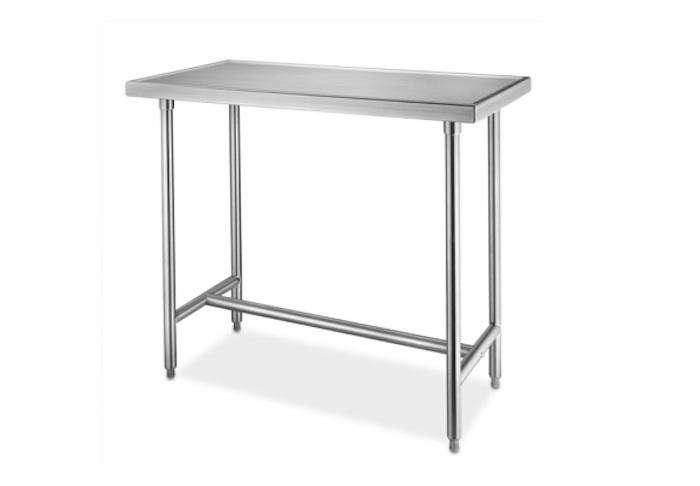
A stainless-steel chef’s table rarely receives the applause given to a roaring range, a gleaming espresso machine, or a refrigerator large enough to qualify as studio housing. Yet this plain-looking workhorse may be the most frequently used piece of equipment in the kitchen. It holds cutting boards, mixing bowls, countertop appliances, sheet pans, ingredients, and occasionally a tired cook reconsidering every life choice made before dinner service.
Also called a stainless steel prep table, commercial kitchen work table, or food preparation station, a chef’s table creates a durable surface for chopping, assembling, portioning, plating, and organizing. It can serve as a central island in a home kitchen, a production station in a bakery, an equipment stand in a restaurant, or a mobile serving table at an outdoor event.
The best model is not necessarily the largest, shiniest, or most expensive. It is the one with the right steel grade, thickness, dimensions, storage configuration, and mobility for the work being performed. This guide explains how to choose one without becoming trapped in a late-night argument about metal gauges.
What Is a Stainless-Steel Chef’s Table?
A stainless-steel chef’s table is a freestanding work surface designed for food preparation and kitchen equipment. Commercial models commonly include tubular legs, adjustable feet, an undershelf, cross bracing, a backsplash, or locking casters. Some are delivered as knock-down units that require assembly, while premium models may arrive fully welded for greater rigidity.
Stainless steel is widely used in food-handling environments because it can provide a smooth, durable, corrosion-resistant, and cleanable surface. FDA guidance emphasizes that reusable food-contact materials should be safe, nonabsorbent, sufficiently durable, and resistant to damage such as pitting, cracking, and chipping. NSF/ANSI 2 also covers sanitation and construction requirements for commercial tables, counters, shelves, sinks, and related food equipment.
That does not mean every silver-colored table is automatically appropriate for direct food contact. Steel type, surface condition, construction quality, certification, and local health requirements all matter. A suspiciously cheap table that wobbles when someone dices a tomato is not a bargain. It is a future percussion instrument.
Why Stainless Steel Works So Well in Kitchens
It Is Durable Enough for Daily Use
A properly selected commercial kitchen work table can tolerate repeated prep, hot cookware, heavy containers, small appliances, and frequent cleaning. Thicker models are especially useful in butcher shops, institutional kitchens, bakeries, and high-volume restaurants where the surface receives more physical punishment than a chopping board in a cooking competition.
Food-equipment research describes stainless steel as a preferred material because it combines corrosion resistance, strength, durability, fabrication flexibility, and cleanability. Its protective chromium-rich surface layer helps resist ordinary corrosion, although no grade is magically indestructible under every chemical or environmental condition.
It Supports Hygienic Workflows
A smooth stainless steel surface does not have the same absorbency concerns as unfinished wood or porous materials. Spills remain on the surface, where they can be removed through an appropriate cleaning and sanitizing routine.
Cleaning and sanitizing are related but different steps. Cleaning removes grease, food residue, and organic matter with water and detergent. Sanitizing then reduces bacteria on the cleaned surface with an approved product or process. Spraying sanitizer onto dried sauce and hoping for the best is not sanitation; it is optimistic seasoning.
It Fits Commercial and Residential Kitchens
Restaurants use stainless steel prep tables because they are practical and easy to integrate into production lines. Home cooks increasingly use them as freestanding islands, baking stations, coffee bars, grilling carts, and appliance stands. A stainless surface can add an industrial character to a residential kitchen, particularly when balanced with wood, brick, warm paint, or softer lighting so the room does not resemble a very stylish laboratory.
Understanding Stainless Steel Grades
Type 304 Stainless Steel
Type 304 is a common choice for commercial food-preparation tables. It offers strong resistance to corrosion and is generally better suited to humid kitchens, frequent washing, wet ingredients, and demanding food-service environments. For restaurants, catering kitchens, seafood preparation areas, and other moisture-heavy settings, a 304 stainless steel table is usually the safer long-term investment.
Look closely at the product description. A table may have a 304 stainless steel top but use galvanized steel for its legs or undershelf. That construction can be perfectly reasonable, but it is not the same as an all-stainless unit.
Type 430 Stainless Steel
Type 430 stainless steel is typically more economical. It can work well for light prep, dry storage, packaging, and less demanding home applications. However, it generally provides less corrosion resistance than 304 steel, making it a weaker choice for consistently damp, salty, or acidic environments.
For a table used mainly to hold a mixer, wrap sandwiches, or organize dry ingredients, 430 steel may be sufficient. For a seafood station that is repeatedly exposed to brine, water, and aggressive cleaning, saving money on the steel grade may prove expensive later.
Choosing the Right Steel Gauge
Gauge refers to the thickness of the sheet metal. The numbering is delightfully counterintuitive: a lower gauge number generally means thicker steel. Commercial work tables are commonly sold in 18-, 16-, and 14-gauge configurations.
18-Gauge Tables for Light-Duty Work
An 18-gauge stainless steel prep table is lighter and usually less expensive. It is suitable for assembling salads, preparing sandwiches, decorating baked goods, sorting supplies, or holding lightweight equipment.
The trade-off is reduced resistance to dents, vibration, and heavy impact. It may be an excellent table for arranging cupcakes, but it is not the ideal place to repeatedly introduce a meat cleaver to a rack of ribs.
16-Gauge Tables for Everyday Versatility
Sixteen-gauge steel offers a practical balance of strength, weight, and cost. It is a strong general-purpose option for busy home kitchens, cafés, food trucks, catering operations, and restaurants performing ordinary prep throughout the day.
When the intended use includes a countertop mixer, slicer, microwave, food processor, or stacks of full pans, a well-braced 16-gauge table is often a sensible starting point. Manufacturer specifications also show that commercial 16-gauge tables may include box-channel reinforcement, welded bracing, sound-deadening material, and adjustable feet for greater stability.
14-Gauge Tables for Heavy-Duty Production
Fourteen-gauge tables use thicker steel and are designed for demanding applications. They are commonly selected for meat processing, high-volume prep, heavy equipment, and tasks involving repeated pounding or chopping.
They cost more and weigh more, but the extra rigidity can reduce flexing and vibration. In a professional kitchen, a table that remains steady during a chaotic dinner rush is not merely convenient. It is one less object attempting to join the chaos.
Size, Height, and Kitchen Clearance
Before shopping, measure the available space rather than relying on the ancient interior-design technique known as “that looks about right.” Record the maximum width, depth, and height, along with doorways, hallways, elevator openings, appliance doors, electrical outlets, plumbing, and ventilation equipment.
Common work-table depths include 18, 24, and 30 inches, while widths may range from compact two-foot models to tables exceeding eight feet. A deeper surface provides more working room but can make items at the back harder to reach. A narrow table fits a small galley kitchen but may not safely support large cutting boards or appliances.
Most kitchen work surfaces are approximately counter height, although exact dimensions vary. Adjustable bullet feet help level a table on uneven floors. For a mobile table, include the casters when calculating the final working height. A table that looked perfect on the product page can become an ergonomic surprise after four-inch wheels are added.
In residential kitchens, preserve enough clearance for people to pass and for refrigerator, oven, and dishwasher doors to open fully. Kitchen-planning guidance commonly recommends mapping the footprint with painter’s tape before purchasing a cart or island. This simple test can reveal whether the dream table will improve workflow or become a stainless steel traffic barricade.
Important Features to Compare
Backsplash
A backsplash helps prevent ingredients, grease, and utensils from slipping behind a table positioned against a wall. Low backsplashes provide basic containment, while taller versions offer more wall protection in messy prep areas. A flat-top table without a backsplash is often preferable when it will be used as a central island or positioned flush against another work surface.
Undershelf or Open Base
An adjustable undershelf keeps containers, bowls, cutting boards, and small appliances within reach. It also improves organization in kitchens where every square foot is fighting for employment.
An open base provides space for rolling ingredient bins, trash containers, stools, or unusually large equipment. It is also easier to clean beneath. The better choice depends on whether storage density or open floor access matters more.
Casters
Locking casters turn a stationary prep table into a flexible workstation. They are useful for catering, outdoor cooking, cleaning, and kitchens where the layout changes throughout the day. Check the total load rating, wheel material, brake design, and whether the table is approved for caster installation.
At least two wheels should lock securely, and all four locking is even better for prep involving force. Chopping onions on a moving table is an excellent way to add suspense to an otherwise ordinary recipe.
Edges and Corners
Rounded front edges are more comfortable in freestanding locations and reduce the likelihood of painful hip-level collisions. Square edges can create a cleaner fit when several tables or appliances are installed side by side.
Reinforcement and Sound Control
Quality tables may include hat channels, welded supports, cross rails, or sound-deadening material beneath the top. These features reduce movement, vibration, and metallic booming. They become especially valuable when the table supports a mixer, slicer, grinder, or other vibrating appliance.
NSF Certification
For commercial food service, check whether the exact model is certified to the applicable NSF standard and accepted by the local regulatory authority. NSF/ANSI 2 addresses the materials, design, fabrication, construction, and performance of food-handling equipment, including tables and counters. Certification can simplify purchasing decisions, but operators should still verify local health-code requirements before installation.
How to Clean and Maintain the Table
Remove equipment, scrape away food debris, and wash the top with warm water and a suitable detergent. Rinse away loosened soil, apply a food-contact-safe sanitizer according to its label, allow the required contact time, and let the surface air-dry when instructed.
Use soft cloths, non-scratching pads, and cleaning tools approved for stainless steel. Avoid ordinary steel wool because fragments can become embedded in the surface and create rust-colored contamination. Wipe in the direction of the visible grain when possible, especially on brushed finishes.
Do not leave salty brines, concentrated acids, wet metal tools, or harsh chlorinated chemicals sitting on the surface longer than necessary. Follow the table manufacturer’s instructions and the sanitizer label. After cleaning, inspect welded seams, corners, fasteners, feet, shelves, and the underside of the top. FDA guidance warns that cracks, pits, and similar imperfections can make food-contact surfaces harder to clean and may provide areas where microorganisms can attach.
Common Buying Mistakes
One common mistake is buying solely by price. An inexpensive 18-gauge table may be excellent for light assembly but disappointing beneath a heavy mixer. Another is assuming the entire unit is made from the same steel grade as the top. Read the specifications for the legs, undershelf, fasteners, and cross bracing.
Buyers also forget to verify weight capacity, measure doorways, account for caster height, or check whether a backsplash will block an outlet. Some choose an undershelf and later discover that it prevents rolling bins from fitting below. Others order a fully welded table and then learn that the kitchen doorway is narrower than their optimism.
Finally, do not confuse a chef’s work table with a refrigerated prep table, steam table, equipment stand, baker’s table, or cutting table. These products may look similar but are engineered for different jobs.
Real-World Experience: Living With a Stainless-Steel Chef’s Table
The following experience-based scenario combines common setup lessons and practical observations from commercial and residential use. Imagine a serious home cook installing a 60-by-30-inch, 16-gauge, 304 stainless steel table with an adjustable undershelf and four locking casters.
Delivery and Assembly
The first lesson arrives before the table reaches the kitchen: stainless steel equipment is larger in real life than it appears on a screen. The shipping box occupies most of the entryway, and the tabletop has the aerodynamic properties of a small garage door. Measuring the doorway in advance prevents the memorable experience of rotating a metal rectangle through the house while issuing increasingly creative instructions to a family member.
Assembly is simple in theory. Attach the legs, position the undershelf, install the casters, level the table, and tighten everything. In practice, leaving all fasteners slightly loose until the frame is square makes the process easier. Tightening one corner completely at the beginning can pull the table out of alignment and create a wobble that no amount of angry staring will repair.
The First Prep Session
Once installed, the extra work surface changes the kitchen immediately. Vegetables can be washed and organized on one side, while a large cutting board occupies the center and sheet pans wait on the other. Instead of repeatedly moving bowls from the counter to the stove and back again, ingredients remain arranged in the order they will be used.
The adjustable undershelf proves more valuable than expected. Heavy mixing bowls, a Dutch oven, a food processor, and stacks of sheet pans move off the main counter. Frequently used tools stay visible rather than disappearing into a cabinet where they apparently begin new lives under assumed names.
The 30-inch depth feels generous during bread shaping and batch cooking, although it requires access from both sides when the table is used as an island. The rounded front edge is comfortable against the body, and the locking casters remain stable during ordinary slicing and kneading. For aggressive chopping, all four wheels need to be fully locked and the table should be checked for level.
What Becomes Annoying
Stainless steel displays fingerprints, water spots, flour, and crumbs with impressive honesty. It does not politely conceal evidence. A quick wipe keeps it presentable, while a final dry cloth prevents mineral spots and restores an even finish.
The table also produces more sound than a wood island. A metal bowl placed down enthusiastically can announce itself to the entire house. A commercial model with sound-deadening reinforcement is quieter, but silicone mats beneath appliances and bowls can further reduce vibration.
Mobility is useful until the undershelf is overloaded. A table that rolls effortlessly when empty becomes much less cooperative after receiving a mixer, cast-iron cookware, twenty sheet pans, and a heroic quantity of canned tomatoes. Weight should be distributed evenly, and heavy equipment should remain low and centered.
Cleaning After a Large Meal
The most convincing advantage appears after preparing a large dinner. Flour, vegetable scraps, oil, and sauce can be removed without worrying about penetrating an unfinished surface. The table is cleared, washed with detergent, rinsed, sanitized when appropriate, and dried. The open construction also makes it easy to inspect the legs and floor.
However, the undershelf must not become a forgotten basement. Crumbs and splashes collect around containers, especially when stored items are packed tightly together. Leaving a little space between bins improves cleaning access and makes it easier to spot leaks.
The Long-Term Verdict
After several weeks, the chef’s table stops looking like optional furniture and starts functioning as part of the kitchen’s workflow. It becomes a baking station in the morning, a meal-prep surface in the afternoon, a buffet during parties, and a temporary home for groceries after shopping.
The biggest lesson is that specifications shape the experience. A smaller table would provide insufficient workspace. An 18-gauge top might flex beneath heavy appliances. A fixed unit would be harder to move for cleaning, while an open base would sacrifice the storage that makes the station so efficient.
Minor scratches gradually appear, especially on a brushed surface. Rather than ruining the table, they create the working patina associated with professional kitchens. Stainless steel is not purchased to remain untouched. It is purchased to do a job repeatedly without requiring emotional support.
Conclusion
A stainless-steel chef’s table can transform an awkward kitchen corner into a productive food prep station. Choose 304 steel for stronger corrosion resistance in demanding or damp environments, and consider 430 steel for lighter, budget-conscious applications. Match the gauge to the workload: 18 gauge for light use, 16 gauge for versatile everyday prep, and 14 gauge for heavy-duty production.
Measure the room, doorway, and appliance clearances carefully. Decide whether a backsplash, undershelf, open base, adjustable feet, or locking casters will improve the workflow. For commercial use, verify NSF certification and local regulatory requirements. Most importantly, buy for the work the table must performnot merely for the suspiciously attractive price displayed beside the “Add to Cart” button.