Your bedroom can have gorgeous bedding, a nice rug, and a lamp that looks like it belongs in a design magazine, but if your nightstand is holding three tangled chargers, two dusty water glasses, a rogue sock, and a bracelet that’s been “living there temporarily” since February, the whole room can still feel oddly chaotic.
That is the sneaky power of the nightstand. It is small, but it is mighty. It sits right in your line of sight when you wake up and when you go to bed. In other words, it functions like the bedroom’s emotional support table. When it looks calm, the room feels calmer. When it looks like a tiny yard sale, your brain notices that too.
The good news is that you do not need a weekend, a label maker, or a dramatic life transformation to fix it. You need 10 minutes, a little honesty, and a willingness to admit that no, you do not need five lip balms within arm’s reach at 11:30 p.m.
This quick nightstand refresh works because it targets the exact place where clutter, routine, and rest collide. It helps your bedroom feel more intentional, more breathable, and frankly less annoying. And once that visual noise disappears, the entire room starts to feel like a place where sleep might actually happen on purpose.
Why a Tiny Nightstand Has Such a Big Effect on Bedroom Calm
Most people do not think of the nightstand as the center of the bedroom universe, but it often acts like mission control. It holds the last things you touch before sleep and the first things you see in the morning. That makes it practical, yes, but also psychological.
A crowded nightstand creates visual clutter in one of the most personal areas of your home. Even when the rest of the room is reasonably tidy, that messy bedside surface can make the whole space feel unfinished. It sends the subtle message that your bedroom is still working, still storing, still collecting, still buzzing. Not exactly the vibe of a restful retreat.
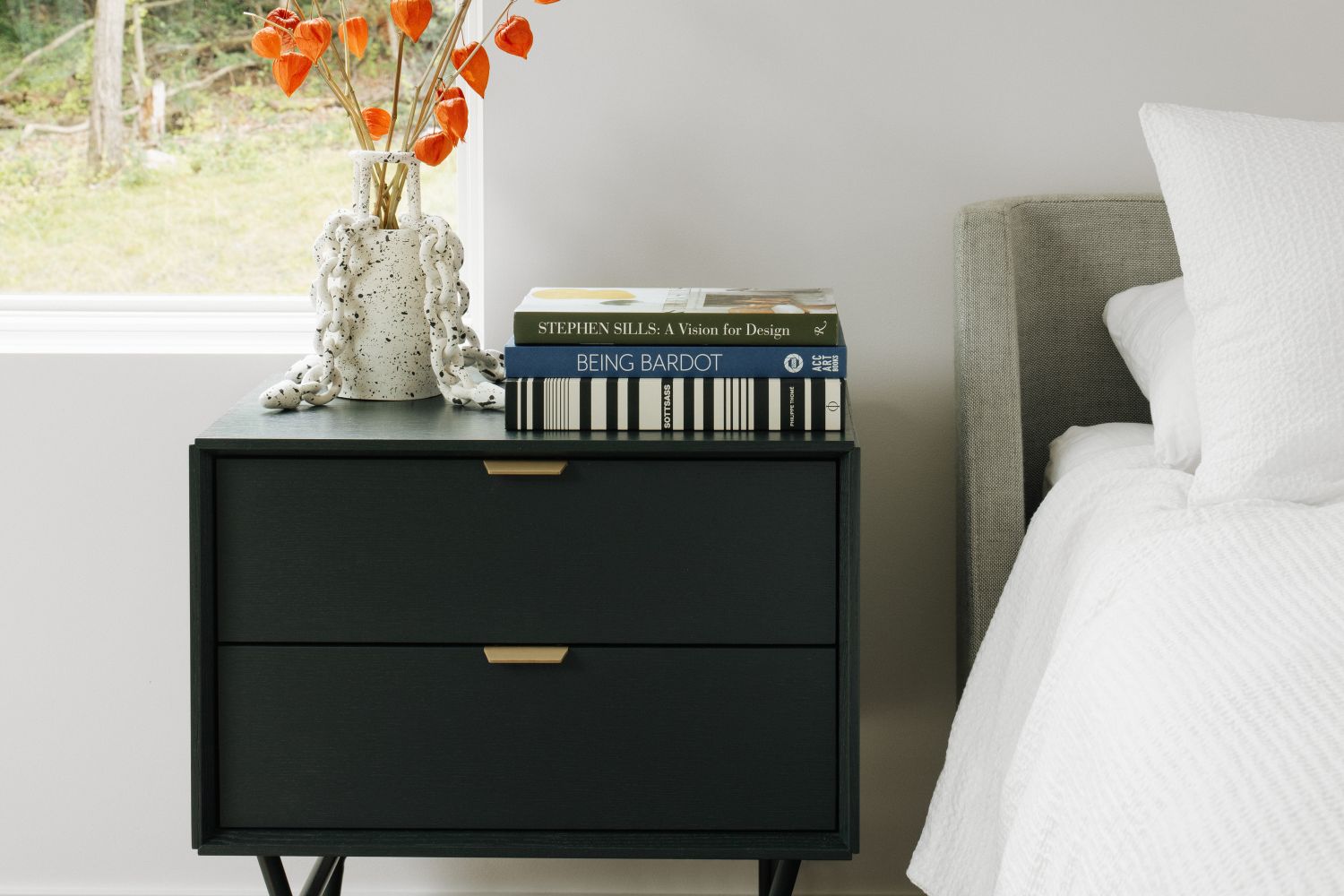
On the other hand, a clear bedside surface communicates something very different: this room has a purpose, and that purpose is rest. A lamp, a current book, a glass or bottle of water, maybe a small dish for earrings, maybe tissues. That is a nightstand that understands the assignment.
It also makes your routine easier. You stop hunting for your sleep mask under a pile of receipts. You stop knocking over a mug at 2 a.m. You stop charging your phone in a nest of cords that looks one spark away from becoming a life lesson.
What Actually Belongs on a Calm Nightstand
A good rule is simple: if it helps you wind down, sleep, or wake up more peacefully, it can stay. If it belongs in another room, reminds you of work, or creates visual chaos, it should go.
Keep these bedside essentials
- A lamp with soft, warm light
- One book or journal you are actually using
- A water bottle or neat glass of water
- A small dish for jewelry, if you remove it at night
- Tissues, lip balm, or hand cream if you genuinely use them
- Necessary nighttime medication, if part of your routine
- An eye mask or earplugs, ideally tucked into a drawer
Things that should leave the bedside immediately
- Old receipts and loose change
- Stacks of half-read books with strong “aspirational reader” energy
- Food wrappers, mugs, or yesterday’s tea cup
- Work papers, planners, and anything shouting “reply all”
- Tangled chargers and extra tech you do not need overnight
- Random beauty products that migrated there for no good reason
- Decorative clutter that looks pretty but eats all your usable space
The goal is not to make your nightstand sterile. It is to make it useful, clean, and quiet. Think edited, not empty.
The 10-Minute Nightstand Refresh, Step by Step
Set a timer for 10 minutes. This is important. A timer keeps the project brisk and prevents you from suddenly deciding that tonight is the night you reorganize your entire closet, repaint the trim, and become a minimalist monk.
Minute 1: Clear the surface completely
Remove everything from the top of the nightstand. All of it. Put it on the bed or a nearby chair. A blank surface gives you a clean visual reset and makes it easier to decide what deserves to come back.
Minute 2: Toss the obvious trash
Wrappers, tissues, receipts, old water cups, broken hair ties, expired cough drops, mystery paper scraps. Out. This is the easiest win, and it creates immediate momentum.
Minute 3: Relocate the nonsense
Take out anything that clearly belongs somewhere else: jewelry to the dresser, pens to the desk, chargers to a cable organizer, skincare to the bathroom, books to a shelf, spare glasses to their proper home. If the item is useful but not bedside-useful, evict it kindly.
Minute 4: Wipe the surface
Use a microfiber cloth or a gentle cleaner. Dust loves the bedroom. It settles on lamps, table edges, and drawer pulls with the enthusiasm of an overcommitted houseguest. A quick wipe instantly makes the space feel fresher.
Minute 5: Open the drawer and edit ruthlessly
If your nightstand has a drawer, treat it like prime real estate, not a hiding spot for chaos. Keep only items that serve your bedtime or morning routine. Think sleep mask, hand cream, reading glasses, tissues, maybe a small notepad. That random deck of cards and three dead batteries? They can pursue opportunities elsewhere.
Minute 6: Add small organizers
If your drawer tends to become a junk cave, use a small tray, bowl, or divider. This is one of those low-effort tricks that makes you seem much more organized than you feel. Tiny categories create boundaries. Boundaries keep the lip balm from becoming roommates with paper clips.
Minute 7: Put back only the essentials
Return the few items that genuinely earn a spot on top. For most people, that means a lamp, a current book, water, and maybe one attractive, functional extra such as a small dish or candle.
Minute 8: Tame cords and tech
If you charge your phone by the bed, keep the setup as tidy as possible. Use one cord, not a spaghetti festival. Better yet, move unnecessary devices away from the bed. A calmer nightstand usually looks less like a help desk and more like a sleep zone.
Minute 9: Check the floor and the area around the nightstand
A calm bedside area is not just about the tabletop. Pick up anything living on the floor nearby, especially cords, clothes, books, or slippers that somehow formed their own neighborhood. Vacuum quickly if needed.
Minute 10: Finish with one calming touch
Add a final detail that makes the area feel intentional. A neat carafe, a linen coaster, a small candle, or a tiny vase with a clipped stem can do the trick. Just do not turn “one calming touch” into “seven decorative objects and a ceramic bird collection.” Restraint is the whole point.
How to Make It Look Stylish Without Creating More Clutter
There is a fine line between styled and stuffed. A well-styled nightstand feels effortless. A badly styled one looks like a boutique display collided with your bedtime routine.
To keep it chic and calm, use the rule of three: one practical item, one comfort item, and one decorative item. For example:
- Practical: lamp
- Comfort: book or water bottle
- Decorative: small dish, bud vase, or candle
Choose pieces with soft visual impact. Warm wood, ceramic, linen, glass, and muted colors tend to feel restful. If your bedroom already has a lot going on with patterns, color, or texture, the nightstand should be quieter, not louder.
And if you love decorative accessories, wonderful. Just let them audition. Not every cute object gets a permanent role in the bedroom.
Small-Space Fixes That Make a Huge Difference
If your bedroom is short on square footage, your nightstand has to work harder. The trick is not to cram more onto it. The trick is to choose smarter storage.
Best options for small bedrooms
- A nightstand with drawers instead of an open shelf
- A wall-mounted shelf if floor space is tight
- A small lidded basket under the nightstand
- A tray inside the drawer for tiny essentials
- A single floating sconce to free up surface space
Even a tiny bedside shelf can feel calm if it is purposeful. Small rooms do not require less beauty. They require less random stuff.
Common Nightstand Mistakes That Make a Bedroom Feel Busy
- Too many books: One current read is relaxing. A leaning tower of guilt is not.
- Visible clutter in every category: lotion, glasses, cords, coins, tissues, jewelry, meds, and receipts should not all live on the surface together.
- Bright screens at bedtime: the glowing phone is not exactly whispering “rest now.”
- Decor that blocks function: if a sculpture prevents you from setting down a glass of water, the sculpture is doing too much.
- No storage plan: if your drawer is chaos and your surface is overflow, the table is not working for your life.
How to Keep the Calm Going All Week
The best nightstand refresh is the one you can maintain without turning into a nightly cleaning crusader. You do not need a perfect reset every evening. You need a tiny habit.
Try this 60-second bedtime reset:
- Put one item back where it belongs.
- Throw away one obvious piece of trash.
- Place your bedtime essentials neatly back in position.
That is it. One minute. Tiny effort, surprisingly elegant result.
You can also do a deeper reset once a week. Wipe the surface, empty the drawer, shake out the dust, and ask the key question: does this still deserve to be bedside? If the answer is no, remove it. Your nightstand does not need to be sentimental about clutter. Neither should you.
Why This 10-Minute Refresh Works Better Than a Full Bedroom Overhaul
Big makeovers are fun in theory. In real life, they are exhausting. That is why the nightstand refresh works so well. It is small enough to finish, visible enough to matter, and practical enough to improve your routine immediately.
It gives you the emotional payoff of a tidier room without requiring a shopping spree or an existential conversation with your storage bins. You get a cleaner visual field, a more peaceful bedside routine, and a bedroom that feels more intentional almost instantly.
That is the magic. Not perfection. Not minimalism for sport. Just a tiny area edited with enough care that the whole room exhales.
Experiences That Show Why This Nightstand Refresh Feels So Effective
One of the reasons this simple refresh sticks with people is that the results feel immediate. You do not have to wait weeks to notice a difference. You see it the same night, usually when you climb into bed and realize your room is not visually yelling at you anymore.
Picture the classic small-apartment bedroom. The nightstand has become a backup desk, snack station, charging hub, and jewelry drop zone. There is a water ring on the wood, a book you swear you are reading, two pens that do not work, and a charger wrapped around the lamp like it is trying to strangle it. After a 10-minute reset, the top holds only a lamp, one book, and a bottle of water. Suddenly, the room does not feel cramped. It feels edited. That mental shift is huge. Same square footage, completely different mood.
Or think about a busy parent’s room, where the bedside table often becomes a holding area for everything that did not get put away during the day. Hair ties, receipts, a child’s sock, a mug, a hand cream, a random toy dinosaur for reasons no one can explain. The refresh does not just remove clutter. It restores a boundary. It says, “This part of the room is for me to rest.” That can feel surprisingly luxurious, even if the rest of the house is still doing its usual beautiful chaos routine.
Students and late-night workers often notice another change: less friction. When the bedside area is clean, they stop wasting tiny bits of energy looking for their glasses, moving things around to place a phone down, or knocking over items in the dark. A calm nightstand reduces those micro-annoyances that make bedtime feel disorganized. It is not dramatic, but it is deeply satisfying. And honestly, satisfaction is underrated home decor.
There is also a sensory difference. A wiped-down table, dust-free lamp, neatly folded sleep mask, and untangled charger simply make the room feel cared for. The bedroom starts to read as soft, intentional, and easier to settle into. Even people who are not naturally tidy tend to respond well to this because the task is finite. It does not ask them to become a different person. It asks them to clear one surface and be done with it.
Another common experience is that one refresh leads to a chain reaction. You clear the nightstand, then you want to fluff the pillow. You straighten the duvet. You put the half-clean sweatshirt in a basket instead of on the chair. None of that feels forced. The cleaner bedside area simply raises the standard for the rest of the room. In a nice way, not in a judgmental gym-trainer way.
What people often love most is how calm the room feels the next morning. Instead of waking up to clutter, cords, and a visual to-do list, they wake up to open space. That matters. The room feels less like a storage unit and more like a place designed for actual living. Or at least for actual sleeping, which is the dream.
So yes, it is only a nightstand. But it is also your last view before sleep and one of your first views in the morning. Making that spot calmer is not a tiny design move. It is a quality-of-life upgrade disguised as a 10-minute cleanup.
Final Thoughts
If your bedroom has been feeling a little off, a little busy, or a little less restful than you want, do not start with a giant makeover. Start with the nightstand. Ten focused minutes can change the entire tone of the room.
Clear the surface. Keep the essentials. Hide the overflow. Tame the cords. Wipe away the dust. Add one soft finishing touch. That is all. No dramatic before-and-after reveal required. Just a quieter bedside zone that makes your whole bedroom feel more peaceful, more functional, and a lot more sleep-friendly.
Sometimes calm does not come from adding more. Sometimes it comes from removing the one weird pile of stuff sitting right next to your pillow.