Small kitchens have a cruel sense of humor. They give you enough counter space for either a coffee maker or the mug you plan to fill, then ask why you look stressed before breakfast. That is why the idea behind the ultimate compact kitchen appliance remains so appealing: combine the tools people use every morning, organize them into one neat system, and stop the countertop from looking like an appliance yard sale.
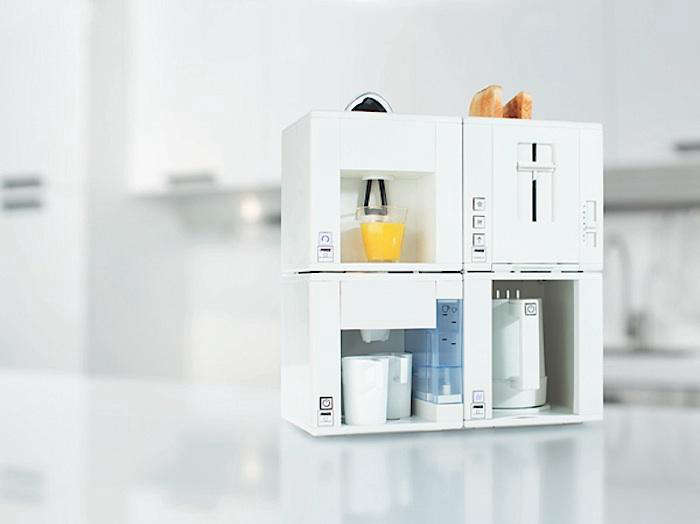
One of the smartest examples is the Compact4All breakfast set, created for Princess Household Appliances with Dutch designer Jan des Bouvrie. Instead of squeezing several functions into one complicated machine, the system uses four matching cubes: a toaster, coffee maker, electric kettle, and citrus juicer. Each appliance works independently, yet the pieces can be arranged side by side, stacked vertically, or grouped into a larger “breakfast cube.” It is a simple idea, but it addresses a problem that has only become more familiar as apartments, studios, dorm rooms, accessory dwelling units, and tiny homes have grown more popular.
What Makes This Compact Kitchen Appliance Different?
Most multipurpose appliances ask one cooking chamber to do several jobs. The Compact4All takes another route: it keeps four dedicated appliances separate, then gives them a common shape, footprint, and visual language.
Each unit measures roughly 8 by 8 by 8 inches. That cube geometry matters because square shapes use shelves and corners more efficiently than a collection of rounded machines with handles, bulging bases, and cords wandering around like confused spaghetti. The modules can be lined up on a long counter, stacked to use vertical space, or arranged two by two. The juicer serves as the power hub, with sockets on the back that allow the other appliances to connect through one central outlet.
The system earned an iF Design Award in 2013. It did not merely shrink four appliances; it created a modular household system with flexible arrangements and a consistent look.
Inside the Four-Piece Breakfast Station
The Two-Slice Toaster
The toaster is the most familiar member of the set and probably the one least interested in explaining itself. It handles two slices, offers adjustable browning levels, and includes warming, defrost, and cancel functions. A removable crumb tray makes routine cleaning easier, while an extra-high lift helps retrieve smaller pieces without requiring a breakfast-time rescue operation involving a fork. Please do not use a fork.
Its 750-watt rating and two-slice capacity are intended for one or two people rather than a family brunch line.
The Two-Cup Coffee Maker
The compact coffee maker brews two cups and includes a removable water tank and reusable permanent filter. For a solo resident or couple, that can be more practical than a 12-cup machine that occupies half the counter and spends its life producing two cups of coffee plus ten cups of optimism.
The tradeoff is obvious: it is not designed for entertaining, oversized travel mugs, or households where “one cup” means a vessel roughly the size of a flowerpot.
The Half-Liter Electric Kettle
The cordless kettle holds approximately 0.5 liter, enough for a few cups of tea, instant oatmeal, pour-over coffee, or other small hot-water tasks. Its original specifications included a filter spout, automatic steam shutoff, and boil-dry protection. Those safety features are especially important in a compact appliance because a smaller water reservoir reaches empty sooner.
The limited capacity helps with speed and portion control but becomes inconvenient when several people want tea at once.
The Electric Citrus Juicer
The juicer uses two cone sizes and starts automatically when fruit is pressed onto the reamer. It is the most specialized module, but it completes the original breakfast ritual: toast, coffee, tea or hot water, and fresh orange or grapefruit juice.
It also houses the shared electrical connections, making it the structural heart of the systemeven for users who rarely juice.
Why the Design Still Feels Modern
It Uses Vertical Space
Countertops are two-dimensional, but kitchens are not. Stackable appliances take advantage of height, much like wall shelves, magnetic rails, and tiered organizers. In a narrow galley kitchen, recovering even a small patch of work surface can make chopping vegetables or plating dinner noticeably easier.
It Reduces Visual Clutter
Four appliances from four brands can create a noisy mix of colors, controls, materials, and cord lengths. Matching modules make a small kitchen feel calmer. That matters because clutter is not only physical; it can make a room feel busier and smaller than it is.
It Is Modular Rather Than Monolithic
When one function fails in a conventional all-in-one machine, the entire appliance may become less useful. A modular countertop appliance set allows one component to be repaired or replaced without automatically discarding the others. In theory, users can also keep only the modules they genuinely use.
It Matches Small Households
Compact appliances are most successful when their capacity matches the household. A two-cup coffee maker and half-liter kettle make sense for singles, couples, students, vacation cabins, office kitchenettes, and guest suites. Smaller is not automatically better, but oversized equipment is not automatically more capable either. Sometimes it is simply more stainless steel to wipe.
Where the Compact4All Concept Falls Short
No appliance deserves the word “ultimate” without surviving a mildly suspicious inspection. The Compact4All is excellent at organizing breakfast tools, but it does not cook eggs, sauté vegetables, heat leftovers, or prepare dinner. A modern multicooker or compact toaster oven offers a broader range of cooking functions from one footprint.
The modules are also small by design. Two slices of toast, two cups of coffee, and half a liter of water are enough for one or two users but restrictive for families. The citrus juicer may become a low-use appliance in homes that prefer whole fruit, smoothies, or bottled juice.
Availability is another concern. The original system was launched in Europe, and shoppers in the United States should not assume that an imported unit is compatible with local voltage, plug types, warranty coverage, or safety certification. Vintage and secondhand examples may also have worn cords, missing components, or unavailable replacement parts.
Finally, stacking requires common sense. Heat-producing appliances need the clearances specified by their manufacturer. A toaster should never operate while tightly enclosed or positioned beneath materials that can scorch. The safest arrangement may be compact for storage and more spread out during use.
How It Compares With Today’s Space-Saving Appliances
Compact4All vs. Air Fryer Toaster Oven
A small air fryer toaster oven can toast, bake, roast, reheat, and crisp food, offering more dinner versatility. However, many models are deeper than expected and cannot brew coffee, boil water efficiently, or juice citrus.
Compact4All vs. Multicooker
A multicooker can pressure-cook, slow-cook, steam, sauté, and prepare rice, making it stronger for full meals. It does not replace a toaster or coffee maker, and its lid and accessories still require storage.
Compact4All vs. Microwave Combination Oven
Combination microwaves may add convection baking or air frying to fast reheating, but they occupy a substantial permanent footprint. Renters who already have a microwave may gain more from truly small tools.
Compact4All vs. Separate Mini Appliances
Buying separate mini appliances can be cheaper and easier in the United States, but the pieces may not stack, share power, or create a tidy visual system. Compact4All’s innovation is that four small appliances behave like one coordinated family.
How to Choose the Best Compact Kitchen Appliance
Measure the Working Footprint, Not Just the Box
Record width, depth, and height, then add space for open lids, removable tanks, ventilation, handles, and safe heat clearance. A coffee maker that fits under a cabinet until you lift the lid does not truly fit under the cabinet. It is merely visiting.
Count the Functions You Actually Use
A 12-function appliance is not a bargain when you use two settings and need a degree in button interpretation for the other ten. Review a normal week of meals and identify repeated tasks. Frequent use matters more than feature count.
Check Capacity Against Household Size
Small appliances save space only when they do not force constant repeat batches. A two-slice toaster is efficient for one person and tedious for five. Match coffee volume, kettle capacity, cooking surface, and basket size to the number of servings you regularly prepare.
Look for Independent Safety Certification
For products sold in the United States, look for recognized third-party safety marks and follow the manufacturer’s instructions. Inspect cords and plugs, avoid damaged vintage units, and register new appliances when registration is available so recall notices can reach you.
Respect Electrical Limits
Coffee makers, toasters, kettles, and other heat-producing appliances draw significant power. Electrical-safety guidance recommends plugging only one heat-producing appliance into a receptacle outlet at a time unless the product is specifically engineered as an integrated system. Do not improvise a shared-power tower with an overloaded power strip just because the cords happen to reach.
Prioritize Easy Cleaning
Removable crumb trays, washable filters, accessible water tanks, smooth surfaces, and dishwasher-safe parts matter more over time than a glamorous touchscreen. A compact appliance becomes countertop clutter the moment cleaning it feels like a laboratory assignment.
Consider Repair and Replacement
Modularity is valuable only when components, manuals, and replacement parts remain available. Before buying an imported, discontinued, or highly specialized appliance, check voltage, warranty service, consumables, filters, carafes, and spare parts.
Living With a Compact Breakfast Station: The Real Experience
During the first few days, the greatest pleasure would probably be visual. Instead of seeing four unrelated appliances occupying random territories, you see one deliberate object. The kitchen looks calmer before you have cleaned anything, which feels like getting organization credit without completing the assignment. In a studio apartment, that visual order can make the entire room feel more intentional because the kitchen is often visible from the bed, sofa, desk, and approximately every other square inch of the home.
The second benefit appears during an ordinary weekday morning. A full-size coffee maker may feel absurd when only one person is drinking coffee, and a large kettle encourages heating more water than necessary. With smaller reservoirs, the routine becomes naturally portioned. You fill, brew, pour, and move on. There is less leftover coffee aging sadly on a hot plate and less unused hot water cooling in the kettle.
The toaster is similarly straightforward. Two slots are enough until someone stays over. Then the limitation becomes noticeable: breakfast happens in rounds. The first pair of slices disappears while the second pair is still tanning. This is not a disaster, but it reveals an important truth about compact appliances: they save space by reducing capacity, not by discovering a loophole in physics.
The citrus juicer creates the most divided experience. On weekends, fresh juice feels luxurious and makes the whole set seem brilliantly complete. On rushed weekdays, washing and halving fruit may feel like an ambitious side quest. Users who already buy oranges regularly may love the module. Others may wish the fourth cube were a small egg cooker, blender, or induction burner. Modular design invites exactly this kind of daydreaming because the form suggests that functions could be swapped like building blocks.
Cleaning is pleasant when handled immediately. The small parts rinse quickly, the crumb tray slides out, and the matching flat surfaces wipe down easily. Delay the cleanup, however, and dried citrus pulp will remind you that “compact” is not a synonym for “self-cleaning.” The system works best for people who prefer short, frequent maintenance rather than one heroic cleaning session on Sunday night.
Storage offers another lesson. Stacking is wonderful after the appliances have cooled and dried. During use, practical owners will likely spread them out. The toaster needs open air, the coffee maker needs room for pouring and refilling, and the juicer needs elbow space. The real advantage is therefore flexible density: compact when stored, expanded when active, compact again when the counter must become a prep surface.
After several weeks, the final verdict would depend less on the design’s beauty than on breakfast habits. For a tea drinker who makes toast daily and enjoys fresh citrus, the system could earn permanent counter space. For someone who skips breakfast, drinks cold brew, and reheats last night’s pizza, a combination microwave or air fryer toaster oven would be far more useful. The ultimate compact kitchen appliance is not the machine with the most functions. It is the smallest reliable toolor coordinated set of toolsthat supports what you genuinely cook.
Conclusion
The Compact4All remains a memorable example of space-saving kitchen design because it treats appliances as a system rather than a pile of unrelated gadgets. Its four matching cubes organize the essential breakfast jobs of toasting, brewing coffee, boiling water, and juicing citrus while giving users several layout options.
It is not a complete kitchen, and it is not the best solution for every household. Large families need more capacity, serious cooks need broader cooking functions, and U.S. buyers must be cautious about voltage, certification, and support for imported or older products. Still, the design teaches a valuable lesson: compact living works best when appliances are right-sized, easy to clean, visually coordinated, and chosen around real routines. That is a much smarter standard than buying every shiny machine that promises to “change breakfast forever.”