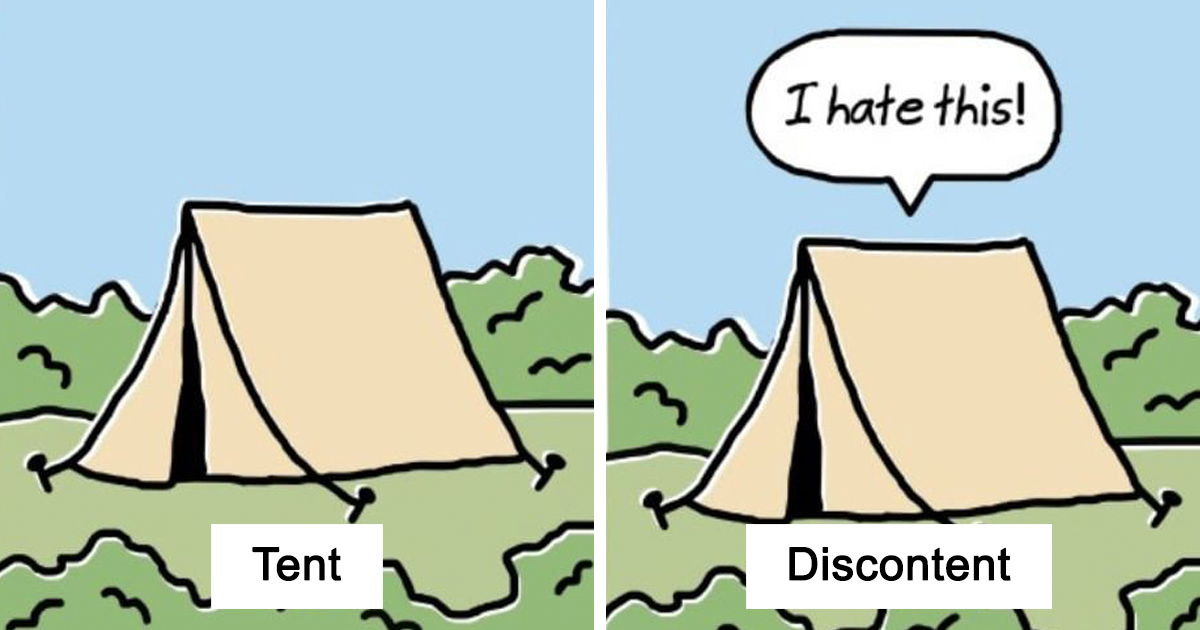
Some cartoons make you laugh instantly. Others make you stare for three seconds, remember a novel you pretended to finish in college, and then laugh loudly enough to concern the person sitting next to you. John Atkinson’s cartoons often belong to that second category.
Atkinson is the Canadian artist and humorist behind Wrong Hands, a wide-ranging cartoon series in which literature, science, history, technology, grammar, music, and everyday life are cheerfully placed on the same comedy operating table. The operation is rarely medically necessary, but the results are consistently entertaining.
This collection of 30 new cartoons demonstrates why his work appeals to devoted readers, recovering English majors, amateur scientists, professional procrastinators, and anyone who has ever noticed that modern life is much stranger when examined carefully.
Meet John Atkinson, the Artist Behind Wrong Hands
John Atkinson is an Ottawa-based cartoonist with a background in fine art and graphic design. Before Wrong Hands became known for clever visual jokes, he explored painting and worked professionally in design. Cartooning eventually gave him a format that combined drawing, language, cultural observation, and his fondness for finding absurd connections between unrelated ideas.
The name Wrong Hands has its own appropriately odd origin. Atkinson is left-handed, but when he began creating cartoons digitally, he often operated the computer mouse with his right handhis “wrong” hand. That accidental production detail became the identity of a series devoted to viewing familiar subjects from slightly incorrect angles.
His work has since appeared through major comics platforms and publications, while interviews have explored how everyday observations, language, reading, and spontaneous associations become cartoon ideas. Rather than limiting himself to one theme, Atkinson treats nearly the entire human knowledge supply as potential joke material. Anthropology, bananas, calculus, Shakespeare, smartphones, dinosaurs, and zeppelins can all wander into the studio. Nobody checks identification at the door.
Research basis:
Why These Funny Cartoons Feel So Smart
Atkinson’s cartoons are intelligent without behaving like someone who just learned the word “epistemology” and now refuses to discuss anything else. Their intelligence comes from compression. A large idea is reduced to one picture, a small amount of text, and an unexpected conclusion.
Many panels begin with something recognizable: a famous book, a scientific diagram, a historical period, a social-media habit, or a familiar expression. Atkinson then changes one element. A literary masterpiece becomes a brutally efficient summary. A scientific label develops a second meaning. A respectable cultural institution suddenly behaves like an exhausted office worker.
The result is humor built around incongruitythe collision between what readers expect and what the cartoon actually delivers. Humor researchers have long examined this gap between anticipation and surprise. The strongest jokes often contain an additional ingredient: an uncomfortable or unspoken truth that the audience recognizes immediately.
That describes the Wrong Hands formula rather well. The punchline is funny because it is unexpected, but it is memorable because some part of it feels suspiciously accurate.
Research basis:
Literature Gets the Fastestand FunniestStudy Guide
Literature is one of Atkinson’s richest sources of inspiration. Classic novels arrive with famous characters, recognizable plots, grand themes, and enough emotional suffering to power a small Victorian city. They are practically begging for abridgment.
Turning Long Books Into Tiny Punchlines
Atkinson became especially well known for condensing major works of literature into extremely short summaries. His book, Abridged Classics: Brief Summaries of Books You Were Supposed to Read but Probably Didn’t, applies this treatment to celebrated writers and works ranging from Shakespeare and Jane Austen to Tolstoy, Melville, Joyce, Brontë, Tolkien, and Margaret Atwood.
The comedy does not depend on dismissing literature as boring. In fact, the jokes work best when the artist understands the source material. A successful parody identifies the central conflict, recurring behavior, or cultural reputation of a book and shrinks it into a line that feels both unfair and completely correct.
It is the literary equivalent of fitting an entire sofa into a carry-on bag. Something important will probably be crushed, but the efficiency is magnificent.
Research basis:
Jokes for Readers at Every Level
Some literary cartoons reward people who know the original work in detail. Others remain accessible because the joke relies on a familiar title, author, genre, or schoolroom memory. You do not need a doctorate in comparative literature. Remembering that Moby-Dick involves a whale and an alarming level of commitment will usually get you through the door.
This layered accessibility gives the cartoons replay value. One reader notices the obvious pun. Another recognizes a reference to the plot. A third remembers an essay deadline from 2007 and experiences a brief but educational shiver.
Science Cartoons Without the Laboratory Homework
Science humor can become inaccessible when the punchline requires six equations, three graduate degrees, and a close personal relationship with a particle accelerator. Atkinson usually takes a friendlier route.
His science cartoons often use familiar formats such as diagrams, classifications, timelines, evolutionary sequences, anatomical labels, and textbook-style illustrations. These visual structures look official, so readers initially expect information. The joke arrives when the categories become ridiculous, literal, or surprisingly human.
When Diagrams Develop Personalities
A diagram is designed to organize complexity. A cartoonist can therefore create comedy by using that orderly format to explain something chaotic, trivial, or emotionally irrational. The contrast between presentation and subject becomes the punchline.
A solemn scientific chart explaining procrastination, dating, household behavior, or internet habits is funny because it gives nonsense the posture of scholarship. The chart appears ready for peer review, even though one of its findings may essentially be, “People are weird before coffee.”
Curiosity Comes Before Expertise
The strongest science cartoons do not ridicule knowledge. They celebrate curiosity while teasing the way humans explain, classify, and occasionally misunderstand the universe. Readers can enjoy the visual joke without knowing every scientific detail, while those who recognize a deeper reference receive an additional reward.
This balance helps the collection appeal to a broad audience. The cartoons are brainy, but they do not stand at the entrance demanding academic credentials.
Pop Culture Becomes a Shared Comedy Language
Pop culture gives cartoonists a large collection of shortcuts. Movies, celebrities, songs, fictional characters, advertising slogans, and internet trends already carry meaning. A cartoon can activate an entire cultural memory with one recognizable detail.
Atkinson frequently combines these shared references with older material. A historical figure may encounter modern technology. A literary character may behave like a social-media user. A familiar movie title may be bent into a pun involving food, grammar, or philosophy.
These collisions are effective because the subjects normally occupy separate mental shelves. Pop culture belongs near the television. Shakespeare belongs in the classroom. Science belongs in the laboratory. Atkinson cheerfully removes the shelves and watches everything fall together.
The approach also reveals how quickly popular culture becomes a kind of modern mythology. Famous characters and catchphrases can function like fairy-tale figures: readers recognize them instantly, understand their typical behavior, and know when the cartoonist has placed them somewhere they absolutely should not be.
Wordplay Is the Engine Under the Hood
Even when an illustration gets the first laugh, language is often doing the mechanical work. Atkinson uses homophones, idioms, double meanings, altered titles, literal interpretations, and unexpected definitions. A phrase that normally passes unnoticed is stopped, searched, and questioned by cartoon security.
Literal Meanings Create Absurd Pictures
English is packed with expressions that make no visual sense when interpreted literally. People “spill the beans,” “break the ice,” “hit the books,” and “bite the bullet” without creating the scenes those phrases technically describe.
For a cartoonist, that gap is an endless supply cabinet. Illustrating the literal version of an idiom exposes how strange ordinary language can be. The reader knows the intended meaning, sees the impossible interpretation, and enjoys the collision.
The Best Puns Are Efficient
A good visual pun does not need a paragraph of explanation. The image and text should connect fast enough that the reader experiences the discovery personally. That tiny moment of participation matters. We are not merely being told a joke; we are finishing it.
Of course, not every pun inspires universal admiration. Some produce laughter. Some produce groaning. The elite specimens produce both at once, which is essentially the gold medal of wordplay.
The Minimalist Style Keeps the Joke in Charge
Atkinson’s visual language is clean and economical. Characters, props, labels, and settings are simplified enough to communicate quickly. The drawings support the concept rather than competing with it.
This restraint is especially important in single-panel cartoons. Readers need to identify the situation, process the wording, recognize the reference, and reach the punchline in a compact space. Unnecessary detail can slow that sequence.
The simplicity should not be confused with carelessness. Minimal cartooning requires careful decisions about expression, posture, composition, and timing. A raised eyebrow or slightly delayed reaction can perform work that would require several sentences in prose.
Cartoon traditions have long used visual compression to express opinions, expose contradictions, puncture pomposity, and translate complicated subjects into memorable images. Museums and archival collections preserve centuries of caricature and satire, demonstrating that a small drawing can become a remarkably durable form of cultural commentary.
Research basis:
30 Cartoons, Many Different Ways to Laugh
A collection of 30 images creates room for several kinds of comedy rather than repeating one successful formula until it requests overtime pay. Readers may encounter literary reductions, scientific classifications, musical jokes, historical mashups, grammar humor, observations about technology, and playful attacks on everyday logic.
Some cartoons land immediately. Others require a second look because an important detail is hiding in a label, title, or visual arrangement. A few may depend on references outside a reader’s personal knowledge. That variety is part of the pleasure.
No audience member will necessarily choose the same favorite. Book lovers may gravitate toward the literary jokes. Teachers may enjoy the educational parodies. Designers may appreciate the clean compositions. Scientists may be delightedor professionally offendedby a diagram. Both reactions count as engagement.
The collection also invites sharing. A reader sees one cartoon and immediately thinks of a friend, coworker, professor, sibling, librarian, or aggressively enthusiastic fan of classic novels. The cartoon becomes more than a joke; it becomes a small social message meaning, “This reminded me of you, and I refuse to explain whether that is flattering.”
Why Wrong Hands Works So Well Online
Single-panel cartoons are naturally suited to digital reading. They can communicate an idea quickly on a phone screen, yet a strong panel still rewards close attention. Unlike humor that depends entirely on breaking news, Atkinson’s broader themes often remain understandable long after publication.
Books continue to be long. Language continues to be strange. Technology continues to promise convenience before requesting another password. Human beings continue to develop complicated systems and then use them to watch videos of animals falling off furniture.
That combination of timeliness and durability helps Wrong Hands travel across websites, comics platforms, social feeds, and print. The official series has continued publishing new work, showing how many unexplored jokes remain hidden inside language, history, culture, and ordinary life.
Research basis:
What Aspiring Cartoonists Can Learn From John Atkinson
Start With an Observation, Not a Decoration
The central idea should be strong enough to describe in a sentence. An elaborate drawing cannot rescue a joke with no destination. Atkinson’s work repeatedly demonstrates that a clear concept and a precise twist are more valuable than visual noise.
Explore More Than One Subject
A broad curiosity creates unusual combinations. Reading literature, following scientific ideas, noticing language, studying history, and observing popular culture produce a larger creative toolbox. The most memorable concepts frequently appear when two unrelated drawers are opened at once.
Cut Everything the Joke Does Not Need
Cartooning is an exercise in removal. Extra words delay the punchline. Extra objects weaken the composition. Extra explanation makes the audience feel as though the joke has arrived with assembly instructions.
Good editing lets the reader make the final connection. That small act of discovery is one reason a compact cartoon can feel more satisfying than a much longer explanation.
The Experience of Spending Time With These 30 Cartoons
Opening a large collection of Wrong Hands cartoons feels less like entering a traditional gallery and more like wandering into a library after the books, diagrams, historical portraits, and movie posters have been left unsupervised overnight.
The first cartoon may seem simple. You identify the subject, read the text, and understand the joke. Then the second panel asks you to remember a literary title. The third transforms an ordinary phrase into an absurd image. By the fifth, your brain has stopped expecting any two ideas to remain politely separated.
That unpredictability changes the reading rhythm. Instead of scrolling mechanically, you begin inspecting each panel. Is the joke in the caption? Is a label slightly wrong? Is the character behaving strangely, or is the entire concept based on a reference you should remember from high school?
Occasionally, recognition arrives late. You move past a cartoon, pause, scroll back, and finally see the connection. That delayed laugh can be even more satisfying than an immediate punchline because it feels earned. For several seconds, you were not merely a reader. You were an underqualified detective investigating suspicious wordplay.
The literary cartoons create a special mixture of nostalgia and embarrassment. A title may remind you of a novel you loved, a novel you disliked, or a novel whose first 40 pages you read with tremendous sincerity before consulting a summary. Atkinson’s compressed interpretations turn that shared cultural guilt into comedy. The joke does not ask whether you completed the book. It simply welcomes you to the support group.
The science-themed panels produce a different experience. Their diagrams and labels trigger the serious visual language of textbooks, instruction manuals, and classroom walls. You prepare to learn something. Then the information takes an absurd turn, and the formal presentation becomes part of the joke. It is as though a respected professor has completed an important lecture and concluded by drawing a mustache on the periodic table.
Pop-culture references create quick flashes of recognition. A movie, song, celebrity, or familiar character appears in an unexpected context, allowing the cartoon to use years of audience knowledge without explaining it. The strongest combinations feel surprising and inevitable at the same time. After seeing them, you wonder why nobody had made the connection earlier.
Sharing the cartoons adds another layer. Different people reveal different knowledge through the jokes they understand fastest. One friend catches every literary reference. Another recognizes the science immediately. Someone else laughs only at the grammar panels and begins correcting everyone’s messages for the rest of the afternoon.
By the end of the 30-image collection, the most memorable experience is not one specific subject but the artist’s way of looking. Ordinary language becomes suspicious. Familiar titles seem ready to transform into puns. Charts, categories, and diagrams no longer appear entirely trustworthy.
That altered perspective is the best souvenir a humorous cartoon can provide. The laugh lasts a moment, but the habit of noticing absurdity remains. Later, when a confusing instruction, overcomplicated app, dramatic headline, or strangely worded sign appears, part of your brain may begin arranging it into a Wrong Hands panel.
At that point, the cartoon collection has done more than entertain you. It has quietly installed a comedy filter over daily lifeand unlike most digital upgrades, this one does not require a monthly subscription.
Conclusion: A Clever Tour Through Everything Humans Take Seriously
John Atkinson’s Wrong Hands cartoons succeed because they are curious, concise, and willing to interfere with almost any respectable subject. Science becomes playful. Literature loses several hundred pages. Pop culture meets history. Language is forced to explain what it has been doing all these years.
The 30 cartoons in this collection offer more than a sequence of punchlines. Together, they demonstrate how much humor can be produced by observing familiar things carefully and connecting ideas that normally remain apart.
Atkinson does not need elaborate scenes or lengthy setups. A simple drawing, a sharp phrase, and one unexpected shift are often enough. That economy makes his work easy to enjoy but difficult to imitate. The panels look effortless because the unnecessary parts have already been removed.
Whether you arrive as a reader, science enthusiast, pop-culture fan, wordplay addict, or person avoiding a productive task, this collection provides an intelligent excuse to keep scrolling. Consider it cultural researchjust with better punchlines and significantly fewer footnotes.