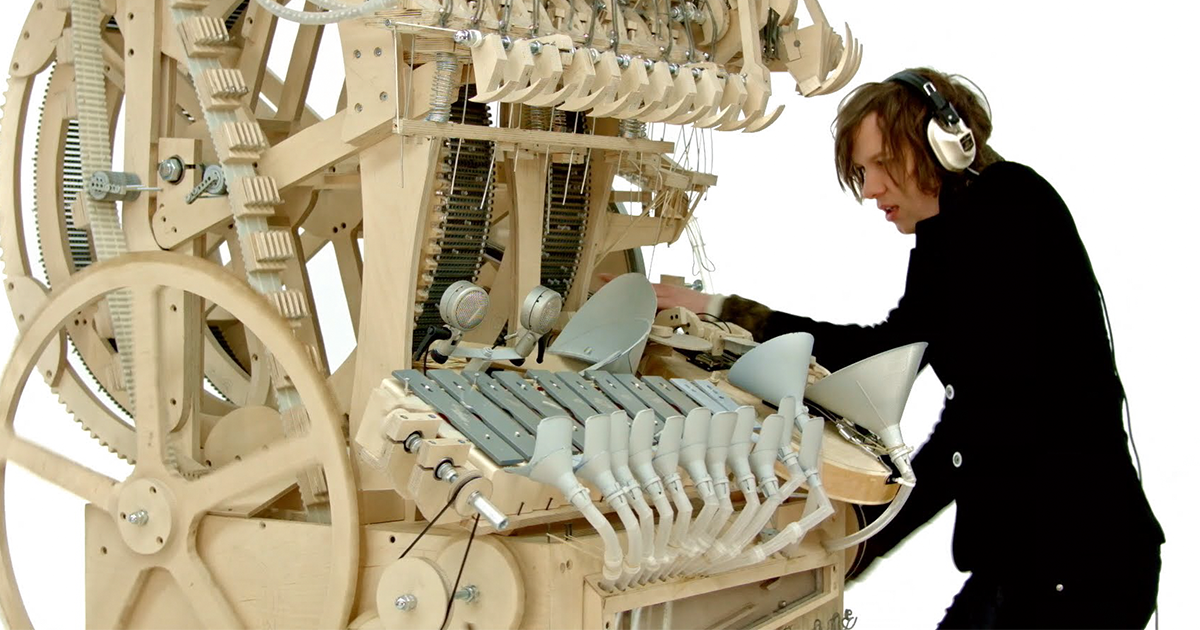
Some musical instruments arrive with polished wood, shiny brass, and a dignified little velvet case. Others arrive looking as if a music box, a pinball machine, a Rube Goldberg contraption, and a very determined carpenter held a secret meeting in a workshop. The Wintergatan Marble Machine belongs firmly in the second category, and that is exactly why the internet fell in love with it.
Created by Swedish musician Martin Molin of the band Wintergatan, this handmade musical instrument uses roughly 2,000 steel marbles to play an original composition. Yes, marbles. Not MIDI files. Not invisible software magic. Actual metal balls roll, drop, bounce, and strike instruments to create rhythm and melody. It is charming, ridiculous, precise, chaotic, and somehow elegant all at once.
The machine became a viral sensation because it feels like a childhood daydream that escaped into the adult world and demanded a workbench. It is part music box, part kinetic sculpture, part engineering puzzle, and part proof that musicians should occasionally be supervised around power tools. But behind the visual spectacle is a surprisingly thoughtful design: programmable wheels, hand-cranked motion, marble lifters, funnels, pulleys, gears, and a carefully arranged set of acoustic and amplified instruments.
What Is the Wintergatan Marble Machine?
The Wintergatan Marble Machine is a hand-built mechanical musical instrument that plays music by releasing steel marbles onto different sound-making parts. Instead of pressing piano keys or strumming strings directly, Martin Molin designed a system where marbles become the performers. They fall onto a vibraphone, trigger percussion sounds, activate bass notes, and create a layered groove that feels both mechanical and deeply human.
The result is not random clattering. The Marble Machine is programmable, meaning the rhythm and melody are controlled by mechanical patterns rather than left to marble anarchy. Think of it as a giant analog sequencer. In modern music software, a producer might click notes into a grid. In Molin’s workshop version, physical pins and wheels tell the machine when to release marbles. It is like Ableton Live joined a woodworking club.
The instrument uses around 2,000 steel marbles and thousands of handmade parts. Reports on the build describe materials such as birch plywood, Lego Technic components, gears, pulleys, tracks, funnels, and custom wooden mechanisms. The visible beauty of the machine comes from the fact that you can watch the music happen. Every note has a tiny journey. Every beat has a little steel passenger.
How 2,000 Marbles Become Music
At first glance, the Marble Machine looks like musical chaos with good lighting. But its operation follows a clear chain of events. A hand crank powers the system. As the crank turns, the machine lifts marbles upward and sends them into channels. Those channels route the marbles toward release gates. When a programmed mechanism opens at the right moment, a marble drops onto a target instrument.
The Hand Crank: Human Power at the Center
The original Marble Machine is powered by a hand crank, which gives it a wonderful old-world quality. The player is not simply standing there while a machine performs. Molin becomes part of the mechanism, feeding energy into the system like a street organ player or the operator of an antique music box.
This matters because it keeps the performance alive. The crank creates motion, but the human performer still manages timing, expression, and transitions. Watching the machine is mesmerizing because it is not just automation. It is collaboration between a musician and a very dramatic pile of hardware.
The Programming Wheel: A Mechanical Music Grid
One of the smartest parts of the Marble Machine is its programming system. The machine uses rotating wheels fitted with adjustable triggers. These triggers determine when marbles are released, which notes are played, and how the rhythm unfolds. The concept is similar to older music boxes, barrel organs, and player pianos, where physical patterns store musical information.
That is the real genius of the design. The Marble Machine is not merely a sculpture that makes interesting noises. It can play a planned composition. The wheels act like a mechanical score, turning musical ideas into physical movement. Instead of digital instructions, the machine reads bumps, pins, and levers.
The Instruments Inside the Machine
The marbles do not all hit the same object. They are routed to different sound sources, creating a small mechanical band. The machine includes melodic and percussive elements such as a vibraphone-like section, bass guitar notes, cymbal hits, snare-like sounds, hi-hat textures, and kick-drum-style thumps. Contact microphones help capture and amplify some of these sounds, giving the final performance a polished musical quality rather than the audio equivalent of a hardware drawer falling down the stairs.
The vibraphone tones give the piece its dreamy sparkle. The bass adds weight. The percussion gives it a groove. Together, the parts produce a sound that feels playful but surprisingly complete. It is not just impressive because it works; it is impressive because it actually sounds good.
Why the Marble Machine Went Viral
The Marble Machine became internet-famous because it hits several irresistible buttons at once. It is visual, musical, handmade, complicated, and easy to understand at a basic level. You do not need a degree in mechanical engineering to appreciate a marble dropping onto an instrument and making a note. You simply watch it happen and think, “Well, there goes my afternoon.”
Its viral appeal also comes from the satisfying contrast between complexity and clarity. The full machine is wildly complex, but each small action is understandable. A marble rises. A gate opens. The marble falls. A note rings. The viewer can follow the cause and effect. That makes the performance feel magical without being mysterious.
Another reason people love it is that it feels refreshingly physical in a digital age. Most modern music production happens inside software, where notes can be copied, quantized, stretched, and edited without any visible movement. The Marble Machine does the opposite. It makes every musical decision visible. The beat has weight. The melody has gravity. The arrangement has tiny steel marbles doing the commute.
The Long Road From Idea to Instrument
Martin Molin began building the Marble Machine after becoming fascinated with mechanical music and marble machine culture. The project took far longer than a simple weekend experiment. What started as an ambitious idea turned into many months of design, cutting, testing, rebuilding, and solving problems that only exist when you decide marbles should behave like trained orchestra members.
One of the most important lessons from the build is that small mechanical errors become big musical problems. If two marbles drop when only one should, the rhythm changes. If a marble bounces unpredictably, the note may be late, too loud, or missing. If the lifting system jams, the whole performance can fall apart. Digital music has bugs; marble music has escape attempts.
The machine’s rough handmade charm is part of its personality. It was not created in a huge industrial lab with unlimited resources. It was shaped by trial and error, woodworking tools, clever improvisation, and a musician’s stubborn belief that the impossible might only need one more adjustment.
Mechanical Music Has a Long History
Although the Marble Machine feels futuristic, it also belongs to a very old tradition. Mechanical music has existed for centuries in the form of music boxes, clockwork instruments, barrel organs, player pianos, and automated carillons. These inventions stored songs in physical patterns long before computers stored music as data.
The Marble Machine updates that tradition for the internet era. It borrows the logic of a music box but expands it into a full performance machine. It also adds the visual thrill of marble runs, a format many people associate with toys, science museums, and hypnotic online videos. The result bridges past and present: an antique idea presented with modern maker culture energy.
This blend explains why the instrument feels both nostalgic and new. It reminds viewers of childhood toys, old clocks, arcade machines, and hand-cranked street music. At the same time, its composition, filming, and online build documentation make it feel perfectly suited to YouTube culture.
From Marble Machine to Marble Machine X
After the original Marble Machine exploded online, Molin began working on a more advanced successor known as Marble Machine X. The goal was to build a version reliable enough for recording, performance, and possibly touring. That was a much harder challenge than creating a single viral machine.
A workshop instrument can be delicate. A touring instrument must survive transportation, repeated setup, stage vibration, changing environments, and human schedules. In other words, it must work even when reality starts throwing drumsticks at it. The original machine was brilliant, but it was not designed like a road-ready piece of professional equipment.
The Marble Machine X project became a public engineering journey. Molin documented the process in detailed videos, and a community of viewers, engineers, makers, and fans followed along. The project revealed an important truth about invention: the second version is not always easier. When the goal changes from “make it work once beautifully” to “make it work reliably every time,” the difficulty level rises dramatically.
Why This Instrument Still Matters
The Wintergatan Marble Machine matters because it shows what happens when art and engineering stop pretending they are separate fields. The instrument is musical, but it is also mechanical design. It is sculpture, but it is also a sequencer. It is entertainment, but it is also a case study in problem-solving.
For musicians, the machine is a reminder that sound can come from almost anything if the system is designed carefully. For engineers, it shows that precision has emotional power. For makers, it is proof that curiosity can become a full-scale invention. For everyone else, it is a delightful excuse to say, “I am researching kinetic musical instruments,” while watching marbles bounce around for twenty minutes.
The machine also encourages a healthier view of creativity. It did not appear fully formed. It required failed tests, redesigns, frustration, and patience. That is comforting. Great ideas often begin as slightly unreasonable questions. In this case, the question was: “Can I make 2,000 marbles play music?” The answer was yes, but only after a great deal of sawdust.
Specific Examples of the Marble Machine’s Clever Design
1. Marble Recycling
The marbles do not simply fall once and disappear. After striking instruments, they are caught, redirected, and lifted back into the system. This closed-loop design is essential. Without it, every performance would require someone standing nearby with a bucket, which is less “innovative music technology” and more “confused gym class.”
2. Mechanical Sequencing
The programming wheel lets the player control patterns in a tactile way. By changing the physical layout of triggers, the machine can alter musical timing and note placement. This makes the instrument closer to a mechanical synthesizer or drum machine than a novelty toy.
3. Acoustic and Amplified Sound
The machine combines visible acoustic actions with captured sound. A falling marble produces a real impact, but microphones help translate that impact into a polished mix. This hybrid approach preserves the charm of physical sound while making the music listenable in a modern recording.
4. Visual Performance
The Marble Machine is not only heard; it is watched. The audience sees the composition unfold in real time. That visual transparency turns the machine into a performance object. It is music with a built-in explanation.
What Creators Can Learn From the Marble Machine
The Marble Machine offers several lessons for artists, makers, and content creators. First, originality often comes from combining familiar things in unfamiliar ways. Marbles are not new. Music boxes are not new. Gears are not new. But putting them together at this scale created something that felt astonishing.
Second, process can be as interesting as the final product. Molin’s build videos helped people understand the struggle behind the spectacle. Viewers did not just see a finished instrument; they saw the obsession, testing, and problem-solving that made it possible.
Third, a strong idea does not have to be easy to explain technically. “A machine that uses 2,000 marbles to make music” is instantly understandable. That simple hook helped the project travel across blogs, news sites, social media, classrooms, and maker communities.
Extra Experience Section: What It Feels Like to Discover a Marble-Powered Instrument
The first experience many people have with the Marble Machine is not exactly calm. You click play expecting a quirky gadget, and within seconds your brain starts making little emergency announcements. There are marbles everywhere. There are gears turning. There is a bass line. A cymbal appears. Something wooden spins. Somehow, none of it collapses. It feels like watching a tiny factory decide to become a band.
What makes the experience special is the way it turns listening into active observation. With a normal song, you hear the finished sound and maybe imagine the musician playing it. With the Marble Machine, the performance is exposed. You can see the rhythm being manufactured. A marble drops, a note rings, and your mind connects the two instantly. The machine rewards attention. The more closely you watch, the more little design decisions you notice.
There is also a childlike joy in it. Many people grew up building marble runs, domino chains, Lego machines, or elaborate little traps that served no purpose except to be satisfying. The Marble Machine feels like the grown-up version of that impulse. It says the urge to make complicated contraptions was not a waste of time. It was training.
The instrument also changes how you think about precision. A song usually feels emotional, while engineering feels practical. Here, precision becomes part of the emotion. Every correct marble drop feels like a tiny victory. Every moving part suggests patience. Even if you are not a maker, you can sense the effort behind the smoothness. The machine looks whimsical, but whimsy at this level requires discipline.
For musicians, the Marble Machine can be oddly inspiring. It challenges the idea that instruments must fit established categories. A guitar is a guitar. A piano is a piano. A drum kit is a drum kit. But this machine asks a more interesting question: what if an instrument is a whole ecosystem? What if composition includes not only notes and rhythm, but also gravity, timing, material, routing, and mechanical behavior?
For viewers, the lasting feeling is wonder. Not the vague kind of wonder that comes from special effects, but the grounded kind that comes from seeing real objects do real things. The marbles are not pretending. The wheels are not decorative. The timing is not imaginary. The sound comes from physical events arranged with musical intent.
That is why the Marble Machine continues to fascinate people years after its first viral moment. It is not merely a clever video. It is a reminder that creativity can be playful and serious at the same time. It proves that a strange idea, pursued deeply enough, can become an object that makes millions of people smile, listen, and maybe look at a bag of marbles with dangerous new ambition.
Conclusion
The Wintergatan Marble Machine is one of the most unforgettable DIY musical instruments ever shared online. Built by Martin Molin, it transforms 2,000 steel marbles into melody, rhythm, and visual wonder. It combines the charm of a music box, the logic of a sequencer, the spectacle of a kinetic sculpture, and the stubborn optimism of a maker who clearly looked at gravity and thought, “I can work with this.”
Its magic is not just that it uses marbles. The real magic is that the machine makes complexity feel joyful. It turns engineering into performance and music into motion. Whether you see it as an instrument, an artwork, a mechanical puzzle, or the most ambitious marble run ever invited into a recording session, one thing is certain: this crazy instrument earned every bit of its internet fame.