Some childhood stories sound so unbelievably charming that they feel like they escaped from a picture book, put on tiny slippers, and waddled straight into real life. The story of Clark Neily and a stuffed aardvark named Clark is exactly that kind of tale: part school-report enthusiasm, part old-fashioned customer service, and part “wait, companies used to answer letters like this?” magic.
When Neily was in second grade, he became fascinated with aardvarks after writing a school report about them. Not casually interested. Not “I saw one in an encyclopedia and moved on.” He became the kind of kid who could explain, with scholarly confidence and adorable urgency, why an aardvark is not the same animal as an anteater. That distinction mattered. So did the ears, tail, snout, and general aardvark dignity.
After discovering that Possum Trot, a Kentucky-based stuffed-animal company, made plush animals he admired but apparently did not offer an aardvark, young Clark did what any determined second grader with a pencil, a favorite animal, and zero fear of corporate silence would do: he wrote the company a letter.
Months later, Possum Trot replied. Not with a coupon. Not with a form letter. Not with a “thank you for your feedback, tiny consumer.” The company sent him one of the first stuffed aardvarks it had produced and told him it had named the plushie “Clark.” That is not merely customer service. That is customer service wearing a cape and carrying a juice box.
The Childhood Letter That Started It All
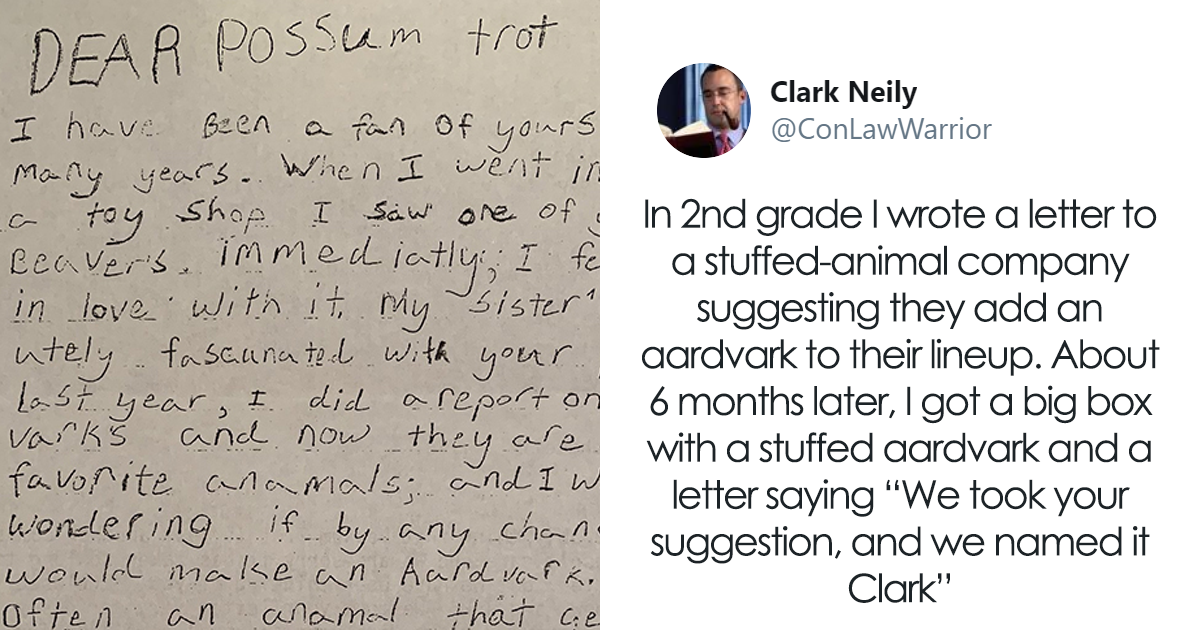
The heart of this stuffed aardvark story is the letter itself. Young Clark wrote to Possum Trot as a sincere fan. He mentioned seeing one of the company’s beavers in a toy shop and falling in love with it immediately. His sister, he added, was fascinated by the company’s possum. Then came the business proposal, delivered with the seriousness of a boardroom presentation and the spelling energy of a second grader doing his absolute best.
He explained that he had done a report on aardvarks the previous year and that they had become his favorite animals. He asked whether Possum Trot might make an aardvark. Importantly, he did not simply say, “Please make one because I want it.” He provided market education. He pointed out that aardvarks are often confused with anteaters and explained that there really is a difference. Anteaters, he wrote, have shaggy tails, longer snouts, and shorter ears.
Then came the masterpiece: “I’ll draw you a picture.”
That little promise transformed the letter from a request into a pitch deck. Clark was not just asking for a toy; he was helping the company avoid biological embarrassment. In a postscript, he even warned Possum Trot not to “get mixed up.” In another, he asked the company to write back and tell him its decision. The tone was polite, enthusiastic, and wonderfully direct. In other words, it was better than many emails adults send today.
Possum Trot’s Reply Was Pure Wholesome Genius
Possum Trot took the letter seriously. According to the widely shared account, about six months later Clark received a box containing a stuffed aardvark and a company letter. The reply acknowledged that he might have thought the company did not care, apologized for taking so long, and explained that it had been thinking of him. Inside the box was the new aardvark, and the company hoped it met with his approval.
Even better, Possum Trot told him the aardvark would be in stores for Christmas, but the company wanted him to have one of the first produced. Then came the sentence that made the story internet-famous decades later: the company had named the aardvark “Clark.”
There are many ways to win over a customer, but naming a new plush toy after a child who suggested it is difficult to beat. That is the kind of gesture that sticks for a lifetime. It also proves that small acts of listening can become larger than any advertising campaign. A child asked. A company listened. A stuffed aardvark became a legend.
Who Is Clark Neily?
Clark Neily is now known far beyond his childhood aardvark enthusiasm. He is a legal scholar and senior vice president for legal studies at the Cato Institute, with work focused on constitutional law, criminal justice, overcriminalization, plea bargaining, police accountability, and civil liberties. That makes the story even funnier in hindsight: before he was making legal arguments, he was making a case for aardvark representation in the plush-toy market.
And honestly, the childhood skills were already there. He identified a gap in the market. He supplied evidence. He anticipated confusion between similar animals. He included visual aids. He requested a response. If second-grade Clark had worn a tiny suit and carried a briefcase full of crayons, nobody would have been surprised.
Why Aardvarks Are Perfect Plush Toy Material
At first glance, an aardvark might not seem like the obvious choice for a stuffed animal. Bears, dogs, cats, rabbits, and elephants have long dominated toy shelves. Aardvarks, meanwhile, look like nature assembled a pig, rabbit, kangaroo, and vacuum cleaner after misreading the instructions. But that is exactly why they are wonderful.
Aardvarks are nocturnal mammals native to Africa. Their name comes from Afrikaans and is often translated as “earth pig,” which is delightfully accurate and slightly unfair. They use their long snouts and strong sense of smell to find ants and termites, then use powerful claws to dig into insect mounds. Their ears are large, their bodies are sturdy, and their look is unmistakably odd in the best possible way.
They are also not anteaters, despite the common mix-up. Aardvarks belong to their own unusual lineage, while anteaters are a different group of animals native to Central and South America. Aardvarks have teeth, long rabbit-like ears, and a burrowing lifestyle. Anteaters have their own dramatic features, including long claws and very long tongues. To a child who had just completed a school report, this difference was not a minor technicality. It was justice.
The Power of Being Heard as a Kid
One reason the Clark the Aardvark story resonates is that it captures a rare childhood feeling: an adult institution actually listened. Kids are often told to wait, be quiet, color inside the lines, and stop asking whether clouds have feelings. So when a child writes to a company and the company responds with real attention, it becomes more than a product story. It becomes proof that curiosity matters.
That matters because children often form deep attachments to objects, especially soft toys. Child-development experts often call blankets, plush animals, and similar beloved items “transitional objects.” These objects can help children feel secure, cope with change, and carry a sense of comfort into unfamiliar places. A stuffed animal is rarely just a stuffed animal to the child who loves it. It is a companion, co-pilot, pillow, emotional-support intern, and silent witness to countless bedtime negotiations.
In Clark’s case, the aardvark carried an added layer of meaning. It was not simply bought off a shelf. It was connected to his own voice. His letter helped bring it into existence. That made the toy personal in a way no ordinary purchase could match.
A Small Company With a Big Lesson in Customer Service
Possum Trot’s response feels almost mythical now because modern customers are used to automated replies, chatbots, ticket numbers, and emails that begin with “We value your feedback” before proving they may not have read it. Possum Trot did something far more powerful: it responded like human beings were on both sides of the exchange.
The company did not have to create an aardvark. It did not have to send one to Clark. It certainly did not have to name the toy after him. But by doing so, it created a story that survived for decades. That is the business lesson hiding under all the fluff: memorable brands are often built through emotional moments, not just polished messaging.
Research on consumer trust has long shown that word-of-mouth recommendations are powerful because people trust stories from other people. A paid ad can tell you a company cares. A story like this shows it. There is a big difference. One is a slogan; the other is a second grader opening a box and discovering that a company took him seriously.
Why This Story Went Viral Years Later
Clark later shared the story on social media in response to a prompt asking people to tell a true story about themselves that sounded made up. The aardvark story fit perfectly. It has all the ingredients the internet loves: an earnest child, a forgotten toy company, a rare animal, handwritten letters, an unexpectedly kind corporate response, and a plushie with a name worthy of a children’s book.
It also arrived in a digital world hungry for wholesome proof that people can be good to each other. The internet is very skilled at delivering arguments, outrage, and photos of food nobody asked to see. So when a story appears that is simply sweet, people grab it like emotional bubble wrap.
The details make it even better. The six-month wait adds suspense. The company letter adds warmth. The fact that the toy was named Clark gives the story a perfect final beat. And the aardvark itselfan animal rarely invited to the plush-toy popularity contestadds just enough weirdness to make the whole thing unforgettable.
What Brands Can Learn From Clark the Aardvark
1. Listen Beyond the Obvious Customer
Many companies focus on adults with purchasing power, but children often drive emotional decisions around toys, books, games, and family products. Clark did not have a corporate title or a marketing budget, but he had enthusiasm. Possum Trot recognized that enthusiasm as valuable.
2. Turn Feedback Into a Story
Customer feedback is often treated as data. That is useful, but feedback can also be treated as a relationship. Possum Trot did not merely process Clark’s suggestion; it turned the suggestion into a product story. The company created a memory, not just merchandise.
3. Personalization Can Be Powerful
Naming the aardvark Clark was a small act with huge emotional value. Personalization does not always require advanced technology. Sometimes it is as simple as remembering the person who cared enough to write.
4. Kindness Has a Long Shelf Life
Products come and go. Companies open, evolve, or disappear. But a meaningful gesture can remain vivid for decades. The Clark the Aardvark story shows that kindness is not soft or weak. It is durable. In this case, it was durable enough to outlive catalogs, retail seasons, and probably several questionable shag carpets from the 1970s.
The Nostalgia Factor: Why Old Toy Stories Hit So Hard
Stories about vintage toys often unlock a special kind of nostalgia. They remind people of a time when toys felt less like content extensions and more like companions. A plush animal did not need an app, a subscription plan, or a cinematic universe. It needed softness, personality, and maybe one slightly crooked eye that made it look emotionally wise.
Vintage stuffed animals also tend to carry evidence of love. Their fur becomes flattened. Their tags fade. Their seams survive heroic levels of squeezing. Parents may see a worn-out plush toy and think, “This thing has been through a lot.” Children see a loyal friend with excellent battle scars.
That is why Clark’s aardvark matters. It was not just a novelty toy. It was a physical reminder of curiosity rewarded. It represented a moment when a child’s specific, nerdy, beautifully sincere interest was not dismissed. It was celebrated.
Experiences Related to This Story: Why One Stuffed Animal Can Mean Everything
Almost everyone has, or knows someone who has, a version of “Clark the Aardvark” in their own life. Maybe it was a teddy bear with one eye missing, a rabbit whose ears had been chewed during teething years, a dinosaur that went on every family road trip, or a stuffed dog that had to be “introduced” to guests before dinner. These toys often become part of family folklore. Years later, people may forget the brand, price, or store, but they remember the feeling.
That feeling is what makes Clark’s story so relatable. A child’s favorite animal can become a whole universe. One week it is a school report. The next week it is library books, drawings, facts recited at dinner, and a parent quietly wondering how many times one household can hear the word “aardvark” before breakfast. Children do not love mildly. They love in full volume. When they care about something, they often care with the focus of a tiny scientist and the emotional intensity of a theater kid on opening night.
Writing to a company also used to feel like sending a message into a mysterious castle. You put your words in an envelope, trusted the mail, and waited. There was no tracking number for hope. No instant notification. No “seen” receipt. That made the reply even more magical. Imagine being a kid and receiving a package from a toy company months after sending a letter. The box alone would feel like treasure. Then you open it and find the animal you asked for, plus a letter saying the company named it after you. That is the childhood equivalent of winning an Oscar, a science fair, and unlimited dessert in the same afternoon.
For parents, teachers, and adults who work with children, the story is a reminder to take young interests seriously. Not every obsession becomes a career, and not every letter changes a product line. But encouragement teaches children that their ideas can enter the world. A child who is heard may become more willing to ask, research, create, and advocate. Clark’s letter was funny and sweet, but it also showed confidence. He believed his suggestion deserved consideration.
For companies, the experience points toward a truth that modern branding sometimes overcomplicates: people remember how you made them feel. A small company in Kentucky created a lifelong memory because it treated a child’s request with respect. That act became more powerful than a billboard. The plushie became a story. The story became a shareable piece of joy. And decades later, people are still smiling at the image of a second grader successfully lobbying for aardvark representation.
Maybe that is the biggest lesson. The world does not always need grand gestures. Sometimes it needs someone to open the mail, read a child’s careful argument about anteater tails, and decide, “You know what? Let’s make the aardvark.”
Conclusion
The story of Clark Neily and the stuffed aardvark named Clark is more than a cute internet moment. It is a tiny case study in curiosity, confidence, customer service, and the emotional power of being taken seriously. A second grader wrote a letter because he loved aardvarks. Possum Trot answered because someone at the company understood that a child’s enthusiasm was worth honoring. The result was a plush toy with a name, a memory that lasted decades, and a story that still makes people smile.
In a world full of automated responses and forgettable brand interactions, Clark the Aardvark stands out because it feels human. It reminds us that listening can create loyalty, kindness can become legacy, and even the oddest animal on the toy shelf might be exactly what someone has been waiting for.
Note: This HTML includes only the body content, article structure:, added experience section, and SEO tags in JSON format for easy publishing.