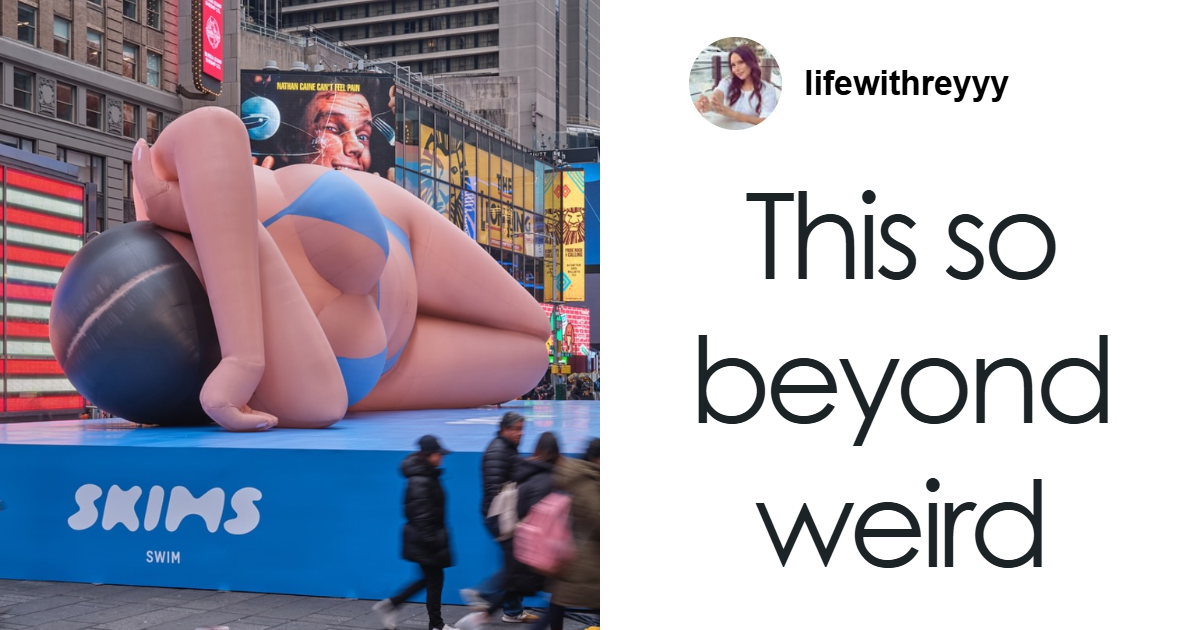
Only Kim Kardashian could launch a swimwear collection by making Times Square look like it had been invaded by a luxury beach-club fever dream. In March 2025, SKIMS promoted its latest swim drop with a 60-foot-long inflatable figure resembling Kardashian, stretched out in a blue bikini in the middle of one of the busiest public spaces in America. It was big. It was glossy. It was impossible to ignore. And, naturally, the internet behaved like someone had handed it a microphone and a double espresso.
The massive installation was designed to promote SKIMS Swim, a collection built around bikinis, cover-ups, bright colors, animal prints, and the brand’s signature confidence-first messaging. But while the campaign succeeded at doing what modern celebrity marketing often tries to dostop traffic, dominate feeds, and turn a product launch into a cultural eventit also sparked a wave of criticism. Social media users called the display “tone-deaf,” “egocentric,” “obnoxious,” and “terrifying.” Others laughed, snapped selfies, and admitted that, whether they loved it or hated it, they were absolutely talking about it.
That is the strange genius and headache of Kardashian-era branding: the line between smart spectacle and public-space overkill is thinner than a string bikini bottom. This story is not just about a giant blow-up doll in Times Square. It is about celebrity worship, body image, viral advertising, public taste, and the modern marketing rule that says if people are arguing about your campaign, your campaign may already be winning.
The 60-Foot SKIMS Balloon That Took Over Times Square
The inflatable appeared in New York City’s Times Square on March 4, 2025, as part of the lead-up to the SKIMS Swim launch. The figure wore a blue bikini matching the color and styling of Kardashian’s beach campaign imagery. It lay across a branded blue platform, transforming the tourist-packed plaza into a surreal pop-up stage for one of the most recognizable women in entertainment and fashion.
Times Square is not exactly known for subtlety. This is a place where LED billboards shout, mascots hustle, tourists spin in circles with their phones out, and every brand seems to be competing in the unofficial Olympics of “Look at me!” Even so, a 60-foot bikini-clad celebrity balloon managed to raise eyebrows. That alone is impressive. In Times Square, you have to work hard to be the loudest object in the room, especially when the room is basically made of flashing advertisements.
Photos and videos of the installation quickly spread across Instagram, TikTok, Reddit, entertainment sites, and celebrity news pages. Some pedestrians treated it like a landmark. Others looked genuinely confused. Several online commenters wondered who approved the display, whether it was appropriate for a family-heavy public square, and what it said about a culture that keeps making women’s bodies larger than lifesometimes literally.
Why SKIMS Chose a Giant Kim Kardashian Inflatable
From a pure marketing perspective, the stunt made sense. SKIMS is not just selling swimwear; it is selling a visual universe. The brand’s identity is built around curves, confidence, minimalism, neutral tones, body-conscious silhouettes, and Kardashian’s own image as both founder and living billboard. A traditional ad campaign might have shown models on a beach. SKIMS took that beach fantasy, inflated it to absurd scale, and dropped it into Midtown Manhattan like a fashion alien had crash-landed for spring break.
The campaign also connected directly to the swimwear shoot Kardashian had shared before the collection launch. The SKIMS Swim line featured bikinis, cover-ups, poolside accessories, bright shades, animal prints, and vacation-ready styling. The Times Square figure mirrored the campaign’s blue bikini look, making the transition from Instagram image to public installation feel intentional and instantly recognizable.
In other words, the balloon was not random. It was a physical version of the social media feed: polished, exaggerated, highly shareable, and designed to create debate. That is why the stunt worked even when people criticized it. No one writes 800 comments about a boring banner ad. A massive inflatable Kardashian in a bikini? That is chum in the water for the internet.
Why People Called It “Tone-Deaf” and “Egocentric”
The backlash came from several directions. Some people saw the inflatable as another example of celebrity self-mythologizing: a famous person’s image made enormous, placed in a public space, and presented as something everyone should stop to admire. To critics, it felt less like a fashion campaign and more like a monument to personal branding. Mount Rushmore, but make it shapewear.
Others focused on the body image conversation. Kardashian’s figure has been discussed, copied, criticized, and commercialized for years. A 60-foot version of that figure in a tiny bikini brought those debates back in an especially literal way. For some viewers, the installation reinforced unrealistic beauty standards. For others, it was campy, self-aware advertising from a brand that has always leaned into the body as a marketing canvas.
There was also the public-space argument. Times Square is crowded with tourists, commuters, workers, families, school groups, and people who are simply trying to cross the street without being swallowed by Elmo. Critics argued that a giant bikini-clad figure in such a visible public area felt inappropriate, especially because children and families were likely to pass by. Supporters countered that Times Square has always been commercial, chaotic, provocative, and occasionally ridiculous. If a giant bikini balloon is shocking, they argued, perhaps Times Square has been wearing a fake mustache of innocence this whole time.
Marketing Genius or Too Much?
The answer depends on what you think advertising is supposed to do. If the goal is to quietly inform shoppers that a new swim collection exists, the campaign was excessive. If the goal is to generate headlines, social shares, street-level attention, and free debate, it was wildly efficient.
Modern fashion marketing is not only about products. It is about moments. A moment is easier to remember than a product description, and it travels faster than a press release. SKIMS could have bought digital billboards showing the new bikinis. Instead, it created a spectacle people photographed from every angle. The installation became content for the public, content for publishers, content for critics, and content for fans. It did not simply advertise the collection; it created a mini news cycle around it.
That does not mean the criticism was meaningless. In fact, the criticism is part of the cultural value of the campaign. People were not merely reacting to a balloon. They were reacting to Kardashian’s long-running role in shaping beauty ideals, celebrity entrepreneurship, and the commercialization of identity. The inflatable became a symbol, and symbols attract arguments the way Times Square attracts people dressed as Spider-Man.
The Kardashian Formula: Make the Product Impossible to Separate From the Person
Kim Kardashian’s business power has always come from her ability to turn personal visibility into commercial value. SKIMS began as a shapewear brand and expanded into underwear, loungewear, swimwear, menswear, and activewear partnerships. The brand’s success is tied not only to product quality or sizing strategy, but also to the fact that Kardashian herself functions as a global distribution channel.
That is why the Times Square stunt felt so on-brand. SKIMS does not hide its founder behind corporate language. It puts her at the center. Her body, taste, celebrity network, and social media presence are part of the product ecosystem. In traditional fashion, a founder might appear in interviews. In Kardashian fashion, the founder becomes a 60-foot inflatable in America’s loudest advertising district.
This approach has obvious advantages. It creates instant recognition. It makes campaigns feel personal. It gives fans the sense that they are buying into a world, not just a swimsuit. But it also brings risk. When the founder’s image is everywhere, criticism of the campaign becomes criticism of the person. If the display feels excessive, the founder may be called excessive. If the image feels unrealistic, the founder becomes part of the body-standard debate. That is the cost of being both CEO and mascot.
Why Times Square Was the Perfectand Most DangerousStage
Times Square is one of the few places where advertising is treated almost like architecture. The district’s screens, billboards, pop-ups, and branded experiences are not background noise; they are part of the attraction. Brands go there because the audience is massive, international, camera-ready, and already expecting spectacle.
But that same visibility can turn a campaign into a public referendum. In a mall, a swimwear ad is simply a swimwear ad. In Times Square, it becomes a statement. The scale changes the meaning. A bikini image on a phone screen is private and optional. A 60-foot figure in a public plaza is shared space. You do not scroll past it; you walk around it.
That is where SKIMS invited both fascination and frustration. The installation was successful because it could not be ignored. It was criticized for the exact same reason.
Public Reaction: Mockery, Selfies, and the Internet’s Favorite Hobby
Online reactions ranged from amused disbelief to sharp criticism. Some users joked that the inflatable looked embarrassed to be there. Others called the stunt unhinged, embarrassing, or bizarre. A few questioned whether the city should have approved such a display in a heavily trafficked public area. The tone was classic internet: one part cultural analysis, two parts roast battle, with a sprinkle of moral panic for garnish.
At street level, however, the response was more complicated. Many people stopped to take photos. Some smiled. Some looked confused. Some treated it like any other strange Times Square attraction. That split matters because social media outrage and real-world behavior do not always match. People may criticize a spectacle while still participating in it. In fact, criticism often makes participation more tempting. Nobody wants to miss the thing everyone is complaining about.
That is the uncomfortable truth behind viral marketing: outrage can function like oxygen. Every complaint can extend the life of a campaign. Every mocking post can push the image into another feed. Every “Who thought this was a good idea?” can become proof that, from a visibility standpoint, someone did.
Body Image, Beauty Standards, and the 60-Foot Question
The deeper issue is not simply whether the inflatable was tasteful. It is what happens when a celebrity body becomes a recurring advertising object. Kardashian’s shape has influenced fashion, beauty, fitness, cosmetic trends, and online aesthetics for more than a decade. The SKIMS balloon magnified that influenceliterallyand forced viewers to confront the relationship between aspiration and absurdity.
SKIMS often markets itself around confidence and inclusivity, offering a broad range of sizes and products designed to fit different bodies. That message has helped the brand connect with consumers who want stylish basics beyond traditional lingerie sizing. Yet the Times Square display centered a highly specific, highly stylized version of the female body. For critics, that tension was hard to ignore.
Supporters might argue that fashion has always used fantasy. Runways, fragrance ads, magazine covers, and luxury campaigns are rarely realistic. They are designed to exaggerate. But in 2025, audiences are less willing to accept fantasy without commentary. People now ask who is represented, who is excluded, what the image normalizes, and whether empowerment is still empowerment when it is packaged as a product drop.
What Brands Can Learn From the SKIMS Backlash
1. Scale Creates Meaning
A campaign does not become neutral just because it is promotional. When a brand makes something 60 feet long and puts it in a major public space, it becomes a cultural message whether the brand intends that or not. Size turns an ad into a statement.
2. Controversy Can Help, But It Has a Price
SKIMS received enormous attention, but attention is not always affection. A campaign can be successful in reach while still damaging perceptions among certain audiences. The smartest brands measure not only how many people talked, but how they felt after talking.
3. Public Space Is Not the Same as Social Media
On Instagram, users can scroll away. In Times Square, the audience includes everyone who happens to be there. That makes public installations more powerfuland more vulnerable to criticism.
4. Humor Helps, But Context Matters
The inflatable had a campy, absurd quality that many people found funny. But humor lands differently depending on the viewer. One person’s cheeky stunt is another person’s “please explain this to my child before we get on the subway.”
Experience-Based Reflections: What This Moment Feels Like in the Real World
The most interesting way to understand this controversy is to imagine the experience of encountering the inflatable without warning. You are walking through Times Square, already surrounded by flashing screens, honking traffic, costumed characters, food carts, tourists, theater ads, and the general feeling that New York has turned the volume up to 14. Then you look over and see a 60-foot bikini-clad figure resembling Kim Kardashian reclining across the plaza like a luxury pool float that escaped from a billionaire’s vacation.
Your first reaction probably would not be calm media analysis. It would be something closer to, “Wait, is that what I think it is?” That pause is exactly what the campaign was designed to create. In marketing, interruption is gold. If a brand can interrupt your routine without making you angry enough to reject it entirely, it has won a piece of your attention. And in a city where everyone is rushing, attention is not cheap.
From a consumer’s perspective, the experience may feel funny at first. It is absurd in the way only celebrity branding can be absurd. A human being has become a product, the product has become a monument, and the monument is wearing swimwear in March. There is something almost cartoonish about it. It invites jokes because it already feels like a joke, even if the sales strategy behind it is deadly serious.
But after the laugh comes the second thought. Why is this here? Who is it for? What does it say about beauty, fame, and the way brands use women’s bodies to claim space? That is where the campaign becomes more complicated. For some viewers, it may feel empowering: a female-founded brand taking up room in a historically male-dominated advertising landscape. For others, it may feel exhausting: another reminder that women’s bodies are still treated as public property, public debate, and public decoration.
For marketers, the lesson is clear: spectacle needs self-awareness. Big ideas should not only ask, “Will people look?” They should also ask, “What will people feel after they look?” A campaign can be clever and still tone-deaf. It can be funny and still excessive. It can sell products while also feeding cultural fatigue. The SKIMS inflatable lived in all those contradictions at once, which is why people could not stop discussing it.
For everyday viewers, the experience also reveals how trained we have become to participate in marketing. Many people who criticized the balloon still shared photos of it. Many who found it ridiculous still helped it go viral. That is the modern attention economy in one image: we mock the spectacle, then we feed it, then we wonder why brands keep making bigger spectacles. The answer is standing right there, phone in hand, taking one more picture.
In the end, the 60-foot Kim Kardashian blow-up doll was not just a strange Times Square attraction. It was a mirror held up to celebrity culture, influencer capitalism, body politics, and public advertising. It showed that SKIMS understands visibility better than almost anyone. It also showed that visibility without restraint can quickly become a punchline. The campaign may have been mocked as tone-deaf and egocentric, but it did exactly what it was built to do: it made people look, talk, post, argue, and remember the brand name. In Kardashian marketing, that is not a side effect. That is the business model.
Conclusion
Kim Kardashian’s 60-foot SKIMS inflatable in Times Square was ridiculous, brilliant, uncomfortable, funny, and controversial all at the same time. It turned a swimwear launch into a public conversation about fame, advertising, body image, and the limits of spectacle. Critics called it tone-deaf and egocentric. Fans called it bold. Bystanders called it a photo opportunity. The truth is that it was probably all three.
For SKIMS, the campaign proved that the brand can still dominate attention in a crowded celebrity marketplace. For critics, it proved that Kardashian’s marketing machine can sometimes feel like too much of a good thing, dipped in self-tanner and inflated to parade-float proportions. And for everyone else, it offered one more unforgettable reminder that in modern pop culture, the line between fashion campaign and fever dream has officially packed a suitcase and moved to Times Square.
Note: This article is an original, fully rewritten editorial analysis based on publicly reported details about the March 2025 SKIMS Swim Times Square installation and the public reaction surrounding it.