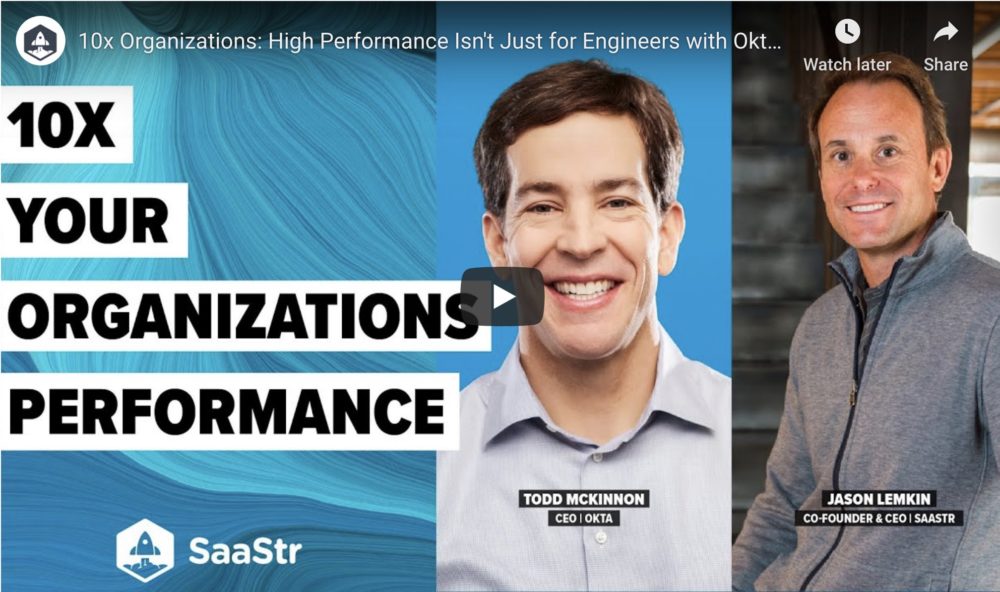
Updated perspective: What Okta’s early climb teaches founders about enterprise SaaS, category creation, customer trust, and surviving the terrifying stretch before scale starts to feel real.
Introduction: Why Okta’s First $30m ARR Still Matters
Every SaaS founder loves the clean version of the startup story: spot a problem, build a product, raise money, win customers, ring the IPO bell, and smile as if none of it required caffeine, panic, and a few thousand uncomfortable board slides. The real version is messier. Todd McKinnon, co-founder and CEO of Okta, knows that version well.
Okta did not begin as an obvious giant. When McKinnon and Frederic Kerrest started the company in 2009, cloud software was growing quickly, but identity management still sounded to many people like a technical back-office feature. Useful? Sure. Massive? Not obvious. Some investors and recruits saw “single sign-on” and thought, “Nice widget.” Okta saw the control layer for a future where every company would run on cloud applications, remote access, mobile devices, contractors, partners, customers, and eventually AI agents.
That difference in belief became the company’s wedge. Okta pushed into enterprise identity with seriousness: security, uptime, integrations, enterprise sales, and customer trust. By the time the company passed the first $30m ARR milestone, it had moved from “interesting cloud tool” to “strategic platform.” Today, Okta is a multibillion-dollar public company, and its journey offers a practical playbook for founders trying to scale annual recurring revenue without losing their minds or their login credentials.
This article breaks down the top 10 learnings from Todd McKinnon’s Okta story, especially the path to the first $30m ARR, and updates those lessons for today’s SaaS market, where AI, security, consolidation, and efficiency have changed the gamebut not the fundamentals.
1. Win the Enterprise Before You Win the Feature Checklist
One of the most important Okta lessons is surprisingly simple: in the early days, the company did not necessarily win because it had every feature. It won because it looked, behaved, and operated like the most enterprise-ready vendor in the category.
For enterprise SaaS companies, that distinction matters. Large customers do not buy software the way someone downloads a note-taking app because the icon is cute. They ask hard questions: Is it secure? Will it stay online? Can it handle our complexity? Will your support team answer when something breaks? Can our auditors understand it? Can our executives trust you?
Okta treated identity as mission-critical infrastructure from the start. That meant reliability, security, compliance, and trust were not “later” features. They were the product. For a company managing access to workplace applications, a five-minute outage is not a little oopsie; it is a digital traffic jam with executives honking in every lane.
Founder takeaway
If you sell to enterprises, do not confuse “more buttons” with “more trust.” Your first $30m ARR may depend less on having the longest roadmap and more on proving that serious customers can safely build around you.
2. Feeling Vulnerable at $30m ARR Is Normal
Many founders imagine that once they reach $10m, $20m, or $30m ARR, the anxiety fades and a choir of SaaS angels appears singing, “You have achieved product-market fit.” In reality, Todd McKinnon has described the feeling of still being vulnerable well into the tens of millions in ARR.
That is an underrated lesson. Even at meaningful scale, a startup can feel fragile. A platform shift can hurt you. A giant competitor can enter your market. A key customer can churn. A sales quarter can wobble. Your product can suddenly need five enterprise features yesterday, because apparently “urgent” means “we forgot to mention this during procurement.”
Okta faced competitive pressure from major technology companies, including Microsoft. For many founders, that kind of competition creates a cold sweat. But the lesson is not “ignore big competitors.” It is “build the kind of company that can survive them.” Okta focused on neutrality, independence, customer choice, and deep identity expertise.
Founder takeaway
Do not wait to feel safe before you execute boldly. The first $30m ARR is not a finish line; it is the stage where the company becomes real enough to attract both bigger customers and bigger threats.
3. Customers May Believe Before Investors and Recruits Do
In Okta’s early years, customers understood the pain. They were adopting more cloud applications, managing more users, and dealing with access problems that spreadsheets and hope could not solve. But not everyone outside the customer base immediately saw the market size.
This is common in category-creating SaaS. Customers feel the problem before the broader market names it. Investors may ask whether the market is too small. Potential hires may wonder whether the product is “just a feature.” Analysts may need time to catch up. Meanwhile, actual buyers are sitting in conference rooms saying, “Please make this identity chaos stop.”
For Okta, the lesson was to trust customer pull. If real customers repeatedly tell you a problem is painful, budgeted, and urgent, that is signal. Not perfect signal, but signal worth respecting. The market may look small because the old category definition is wrong.
Founder takeaway
When customers understand your value before the market does, do not panic. Educate the market. Keep selling. Keep collecting proof. A misunderstood category can become a powerful moat if you survive long enough to define it.
4. Choose a Market That Can Expand Around You
Okta started with a clear problem: helping companies manage secure access to cloud applications. But the company’s opportunity expanded as the workplace changed. More SaaS apps meant more identities. More remote work meant more access points. More customer-facing digital products meant more customer identity needs. More AI agents now means even more non-human identities to manage.
This is a major SaaS scaling lesson: your first product should solve a narrow, painful problem, but your market should have room to grow. Okta’s early wedge was specific enough to sell, but the broader identity category was large enough to support a public company.
Founders often make one of two mistakes. Some start too broad and sound like they are building “the operating system for business magic,” which is impressive until someone asks what the product actually does. Others start too narrow in a market that cannot expand. Okta found the healthier path: start with a precise use case, then follow the customer’s expanding identity needs.
Founder takeaway
The best SaaS wedges are narrow at entry and wide in destiny. Your early product should be easy to understand, but your long-term category should be big enough to reward endurance.
5. Enterprise Sales Is a Feature, Not Just a Department
Okta invested in enterprise sales early. That was not just a go-to-market choice; it shaped the company’s product, positioning, customer success motion, and internal culture. Selling to large organizations requires more than a demo and a cheerful follow-up email with three exclamation points.
Enterprise sales means security reviews, procurement cycles, executive alignment, implementation planning, legal negotiations, and deep account management. It also means learning how big customers think. Their requirements can make the product stronger, even when the process feels like trying to assemble furniture while the instructions are written by seven committees.
Okta’s early enterprise orientation helped it become credible in large accounts. It also created a growth engine that could support meaningful ARR expansion. Bigger customers meant larger contracts, higher expansion potential, and more strategic relationships.
Founder takeaway
If your product is enterprise-critical, treat sales capability as part of the product experience. A great enterprise product with a weak enterprise sales motion is like a race car with bicycle pedals: charming, but not built for the track.
6. Respect Partners, But Do Not Over-Optimize for Their Feelings
One interesting lesson from McKinnon’s story is the importanceand limitof partner sensitivity. Coming from Salesforce, he expected Salesforce to be an important partner. That history made him cautious about how Okta handled relationships, recruiting, and ecosystem dynamics.
Respect is wise. Burning bridges in enterprise software can create long-term problems. Partners can become channels, integration allies, investors, or customers. But founders can also become too careful. The market does not reward companies for being politely invisible.
Over time, some partners may become competitors. Some competitors may become partners. Some companies will be both on alternating Tuesdays. Okta’s journey shows that founders need a clear-eyed view of ecosystem strategy. Be professional, but do not let hypothetical partner discomfort stop you from building the best team, product, or customer solution.
Founder takeaway
Respect the ecosystem, but build your company. Strategic politeness is good. Strategic paralysis is not.
7. Neutrality Can Be a Competitive Advantage
One of Okta’s strongest positioning advantages has been neutrality. In a world where major platform companies often prefer their own ecosystems, Okta could position itself as independent identity infrastructure across applications, devices, users, and environments.
That matters because enterprises rarely live in one clean software universe. They use Microsoft, Google, Salesforce, ServiceNow, Workday, Slack, AWS, custom apps, legacy systems, and three tools nobody remembers buying but everyone is afraid to turn off. A neutral identity layer becomes valuable because it reduces lock-in and helps IT teams manage reality as it exists, not as a vendor slide wishes it existed.
Neutrality is not just a slogan. It has to show up in integrations, product philosophy, customer support, and roadmap decisions. Okta’s ability to work across many systems strengthened its role as a trusted identity provider.
Founder takeaway
If you compete with platform giants, look for the place where customers need independence. Neutrality can be a wedge when buyers fear being trapped inside someone else’s bundle.
8. Reliability Builds Trust Faster Than Hype
Identity software must work. That sounds obvious, but obvious things become profound when they are tied to revenue, security, and employee productivity. If people cannot log in, work stops. If access is poorly managed, risk rises. If trust breaks, the vendor relationship becomes shaky.
Okta’s early emphasis on uptime and security helped it earn enterprise credibility. In infrastructure-like SaaS, reliability is marketing. Every stable login, every successful integration, every clean audit, and every calm implementation adds to the customer’s confidence.
Startups sometimes chase buzz before operational excellence. That can work in lightweight categories, but not in security and identity. In trust-heavy markets, the best growth hack is not a clever headline. It is doing what you promised, repeatedly, under pressure.
Founder takeaway
If your product is mission-critical, reliability is not boring. Reliability is the brand. Hype may open a door, but trust keeps the contract renewing.
9. The First $30m ARR Requires Both Vision and Operational Discipline
Vision gets a startup started. Discipline gets it to $30m ARR. Okta needed a big beliefthat identity would become central to cloud security and business productivitybut it also needed execution: hiring, product development, customer success, sales operations, pricing, support, and financial management.
This is where many startups struggle. They either stay too visionary and fail to operationalize, or they become so operational that they forget the original insight. Okta’s early scale required both. The company had to sell the future while solving today’s login problems.
The first $30m ARR is often the stage where founders must professionalize without sterilizing the company. Processes become necessary. Managers arrive. Forecasting matters. Customer segmentation becomes real. The founder can no longer personally inspect every deal, ticket, and product decision, even if their calendar bravely pretends otherwise.
Founder takeaway
Scaling SaaS requires the founder to evolve from chief believer to company builder. Vision remains essential, but repeatable execution turns belief into revenue.
10. Keep Reframing the Category as Technology Changes
The Okta story did not stop at workforce single sign-on. The company expanded into broader workforce identity, customer identity, developer identity through Auth0, governance, privileged access, and now identity challenges created by AI agents.
This is the updated lesson: great SaaS companies keep translating their original mission into new technology eras. Okta’s core idea is that access must be secure, manageable, and trustworthy. That idea applied to cloud apps in 2009. It applied to customer-facing digital products in the 2020s. It now applies to AI agents that may need permissions, oversight, audit trails, and, when necessary, a big red “nope” button.
Founders should study this carefully. The product may change. The interface may change. The buyer’s urgency may change. But if the underlying mission is durable, the company can keep expanding.
Founder takeaway
Do not cling to the first expression of your product. Cling to the customer problem. Markets evolve, but durable problems create multiple waves of opportunity.
How These Lessons Apply to SaaS Founders Today
Scaling to the first $30m ARR in today’s market is not the same as it was during Okta’s early climb. Buyers are more cautious. Capital is more disciplined. AI is changing product development and customer expectations. Security reviews are tougher. Bundled competition is everywhere. But the core lessons remain highly relevant.
First, founders need sharper positioning. “We help teams work better” is too vague. Okta won by attaching itself to a painful, strategic problem: identity. Second, founders need proof of reliability earlier. Customers have less patience for immature infrastructure. Third, startups must understand that category creation is not a branding exercise. It is a long campaign of customer education, product credibility, and market timing.
Okta also shows that enterprise SaaS success does not require being the loudest company in the room. It requires being the company customers trust when the stakes are high. That kind of trust compounds slowly, then suddenly shows up in expansion revenue, bigger contracts, analyst recognition, and public-market durability.
The road to $30m ARR is not glamorous every day. It includes awkward demos, difficult hires, churn surprises, competitive fear, and the occasional spreadsheet that looks like it was assembled during a mild earthquake. But if the customer pain is real, the market is expanding, and the company keeps executing, the early vulnerability can become long-term advantage.
Additional Founder Experiences: Applying Okta’s $30m ARR Lessons in the Real World
For founders, operators, and early go-to-market teams, the Okta story becomes most useful when translated into daily decisions. The first experience-related lesson is to listen closely to customers who are already acting as if the future has arrived. In Okta’s case, cloud-forward companies were already juggling too many applications and too many access points. They did not need a futuristic lecture; they needed a working solution. In your own market, the best early customers may be the ones suffering from tomorrow’s problem today.
The second practical experience is to build trust before trying to maximize expansion. Many startups rush to upsell before the first use case is fully stable. That is risky in enterprise SaaS. A customer who does not yet trust the core workflow will not happily expand into a broader platform. Okta’s example suggests a better sequence: solve the urgent access problem, prove reliability, become embedded, then expand as the customer’s needs grow.
Third, founders should expect recruiting to be harder when the category is not obvious. A company building in a misunderstood market may need to sell the mission to candidates as carefully as it sells the product to customers. The best hires are not just looking for a salary and snacks. They want to believe the market can become huge. Founders must tell that story with evidence, not just enthusiasm. Customer logos, usage growth, renewal behavior, and market tailwinds all help turn skepticism into conviction.
Fourth, do not let big competitors define your emotional state. If a giant enters your category, panic is understandable but not productive. The practical response is to identify where your company is structurally different. Are you more neutral? Faster? More specialized? Easier to implement? Better for a specific segment? Okta’s competition with larger platforms highlights the importance of finding a durable angle that matters to customers.
Fifth, create operating rhythms before chaos forces you to. By the time a SaaS company approaches $30m ARR, informal communication starts breaking. The founder can no longer be the routing system for every decision. Weekly pipeline reviews, product prioritization frameworks, customer health scoring, implementation playbooks, and leadership accountability become essential. Process may feel less romantic than the early startup sprint, but without it, growth becomes a very expensive fog machine.
Sixth, keep updating the story without abandoning the mission. Okta’s movement from cloud identity to workforce identity, customer identity, and AI-agent identity shows how a company can modernize its narrative while staying anchored. Founders should revisit positioning every year. Not to chase buzzwords, but to make sure the company’s value is expressed in the language customers now use.
Finally, remember that the first $30m ARR is a confidence threshold, not a comfort zone. It is the stage where the company has enough evidence to matter, but not enough dominance to relax. The right mindset is disciplined ambition: stay paranoid enough to improve, but confident enough to keep building. That balance may be the most important Todd McKinnon lesson of all.
Conclusion: The Real Lesson Behind Okta’s First $30m ARR
The top learnings from Todd McKinnon and Okta’s journey are not just about identity software. They are about how serious SaaS companies are built. Okta scaled by choosing a painful enterprise problem, treating trust as a product feature, selling into large accounts with discipline, staying independent in a platform-heavy world, and continuing to expand the category as technology changed.
For founders chasing the first $30m ARR, the message is both encouraging and mildly terrifying: you may still feel vulnerable even when the numbers look impressive. That does not mean you are failing. It may mean you are finally playing in a market big enough to matter.
Okta’s story proves that a company can begin as a misunderstood “feature,” grow into a category leader, and keep reinventing itself as the world changes. The path is not easy, tidy, or free of giant competitors. But with customer conviction, enterprise trust, and operational discipline, the first $30m ARR can become the foundation for something much larger.