Death in the Middle Ages was not hidden behind hospital curtains, managed through an app, or discussed in whispers after everyone had left the room. It was public, religious, practical, political, and sometimes astonishingly strange.
Across medieval Europe, people developed detailed customs for preparing the dying, transporting important corpses, reusing crowded burial grounds, preserving saints’ remains, and helping souls through the afterlife. Some practices sound macabre to modern readers, yet they made sense within societies where faith, family, community, and the physical body were tightly connected.
The following medieval death facts focus mainly on Western European Christian traditions between roughly the ninth and fifteenth centuries. Customs varied by century, region, religion, wealth, and social rank. In other words, there was no single medieval funeral packagealthough wealthy nobles certainly tried to order the premium version.
1. Dying Was Often a Crowded Group Activity
Modern people may imagine a medieval person quietly fading away in a dark stone room. In reality, a “good death” was often expected to happen in front of an audience. Family members, neighbors, clergy, servants, and legal witnesses could gather around the bed.
The dying person might confess sins, receive Communion and anointing, forgive enemies, settle debts, dictate a will, bless children, and make charitable gifts. These actions were not merely administrative. They helped demonstrate that the person was spiritually prepared and leaving the world in an orderly state.
Deathbed scenes in medieval manuscripts regularly show beds surrounded by attendants. The room could become part chapel, part legal office, and part emotional family meeting. Privacy was not the main goal. A witnessed, properly managed death offered reassurance that the final words, religious rites, and transfer of property were legitimate.
It was the medieval version of a major group project, except the deadline was unusually firm.
Research support:
2. People Had Illustrated Instruction Manuals for Dying
By the fifteenth century, Europeans could consult works known as the Ars Moriendi, or “Art of Dying.” These texts explained how Christians should prepare for death and how companions should behave around a dying person.
The manuals addressed prayers, questions of faith, appropriate conduct, and temptations that might threaten the soul at the final moment. Illustrated editions made the drama especially vivid. Angels and demons appeared around the bed while the dying person faced spiritual tests involving despair, impatience, pride, greed, and doubt.
The Deathbed as a Spiritual Courtroom
To medieval readers, the images represented more than decorative horror. The final stage of life was imagined as a decisive struggle. A person who had behaved respectably for decades could still face dangerous thoughts at the end. Despairing of God’s mercy, for example, was considered spiritually disastrous.
The guides therefore coached both the dying and the living. Friends were instructed to encourage faith rather than argue about inheritance beside the mattress. Apparently, humanity needed that reminder even before bedside manners had an official name.
Research support:
3. One Important Person Could Receive Several Burials
Elite medieval corpses were not always buried intact. Kings, queens, bishops, crusaders, and nobles sometimes had their hearts, entrails, and remaining bodies buried in different places.
Practical concerns played a role. A ruler might die far from the family tomb, and transporting a decomposing body over hundreds of miles was difficult. Political and religious considerations also mattered. Separate burial allowed several churches, monasteries, cities, or territories to claim a physical connection with the deceased.
Richard I of England provides a famous example. After his death in 1199, his body was buried at Fontevraud Abbey, his heart was placed at Rouen, and his entrails were buried near the place where he died at Châlus. One king had effectively become a three-location memorial network.
Heart burial carried powerful symbolism. Medieval thought often associated the heart with courage, identity, devotion, and moral character. Possessing a ruler’s heart was therefore more meaningful than keeping an interesting anatomical souvenir.
Research support:
4. Some Corpses Were Boiled Before Transportation
When an important person died far from the intended burial site, mourners faced a grim logistical problem: medieval roads were slow, refrigeration did not exist, and decomposition refused to respect social rank.
One solution was a process commonly called mos Teutonicus. The body could be dismembered and heated in liquid so the flesh separated from the bones. The cleaned bones were easier to preserve and transport home for burial.
This was not an everyday treatment for ordinary villagers. It was particularly associated with nobles, warriors, and crusaders who died abroad. Even within medieval society, however, the practice could be controversial. Pope Boniface VIII condemned methods involving the cutting apart and boiling of Christian bodies around 1300, reflecting concerns about bodily integrity and proper burial.
Embalming, disembowelment, temporary burial, or local interment offered alternatives. Still, the existence of corpse-boiling procedures proves that medieval funeral planning occasionally required the skills of a surgeon, a diplomat, and someone willing to clean an extremely unfortunate pot.
Research support:
5. A Grave Might Not Be Your Permanent Address
Medieval churchyards had limited space, especially in growing towns. Generations of parishioners wanted burial in consecrated ground near the church, but the available land did not expand whenever the cemetery became full.
The solution was often grave reuse. After enough time had passed for a body to decompose, older bones could be removed when a new grave was dug. The bones were not necessarily treated as garbage. They might be carefully gathered and placed in a charnel house, crypt, bone chamber, or other consecrated structure.
Charnel Houses Were More Than Storage Sheds
Recent archaeological research suggests that the transfer of bones could involve religious rites. Some charnel buildings included chapels or altars, connecting stored remains with prayers for the dead and beliefs about bodily resurrection.
At the medieval hospital cemetery later discovered beneath St. John’s College in Cambridge, researchers identified neatly arranged burials as well as remains deposited in a charnel house. At Rothwell in England, a surviving bone collection has helped scholars understand how carefully medieval communities sometimes organized displaced remains.
Your first grave, then, might be less like a permanent home and more like a long-term lease with an unusually skeletal moving day.
Research support:
6. Churchyards Could Contain Markets and Daily Activity
A medieval burial ground was not always a silent park reserved exclusively for mourners. Churchyards stood near the center of community life. People crossed them on ordinary journeys, gathered near churches, conducted business, and sometimes held markets in or beside consecrated spaces.
Medieval religious writers complained about commercial activity in graveyards, which tells historians that the behavior occurred often enough to cause irritation. The sacred and the everyday were not separated as sharply as they frequently are today.
Imagine visiting a relative’s burial place while vendors argued over prices nearby and neighbors exchanged local gossip. To modern sensibilities, that may seem disrespectful. To medieval communities, however, the living and the dead belonged to the same social landscape.
The churchyard was simultaneously a place of memory, worship, movement, business, and community identity. Medieval cemeteries were less “peaceful memorial garden” and more “town square with significantly more bones.”
Research support:
7. Saints’ Body Parts Could Become Treasured Public Objects
Medieval Christians believed that the remains of saints could retain a powerful connection to the holy person. Bones, teeth, hair, blood, clothing, and objects associated with saints were preserved as relics.
Relics were housed in reliquaries made from precious metals, enamel, ivory, gemstones, and crystal. Some containers were shaped like the body part held inside. An arm bone might be placed in a silver arm, while a skull might be enclosed in a decorated head-shaped vessel.
These objects could stand on altars or be carried through streets in religious processions. Worshippers asked saints to intercede for healing, protection, forgiveness, or assistance. Churches with important relics attracted pilgrims, prestige, and donations, which occasionally encouraged competition over who possessed which fragment.
A saint’s body could therefore be divided among several communities, much as the bodies of rulers were divided among political and religious centers. The difference was that relics were not treated as ordinary human remains. They were precious sources of sacred presencemore valuable, according to medieval religious language, than gold or gemstones.
Research support:
8. Black Death Victims Were Not Always Dumped Carelessly Into Pits
Popular movies often depict plague workers tossing bodies into chaotic mass graves without ceremony. Mass burials certainly occurred when mortality overwhelmed communities. Archaeologists have found pits containing dozens or hundreds of victims, including the grave at Thornton Abbey and emergency burials in medieval London.
However, the evidence is more complicated than the standard horror scene. Genetic research has identified plague victims buried individually in ordinary cemeteries. Studies in and around Cambridge found that many people who died from plague received normal individual burials rather than being placed in mass pits.
Emergency Burial Did Not Always Mean Disrespect
Even some mass graves show signs of organization. Bodies could be placed in rows or arranged carefully despite the urgency. Communities facing catastrophic mortality still attempted to maintain religious and social customs whenever circumstances allowed.
This distinction matters because it restores dignity to medieval victims. The Black Death created terror, labor shortages, disrupted rituals, and staggering numbers of deaths, but it did not erase human affection overnight. Families, clergy, and burial workers continued trying to care for the deadeven when the workload had become horrifyingly impossible.
Research support:
9. Medieval Art Sometimes Made Decomposition Impossible to Ignore
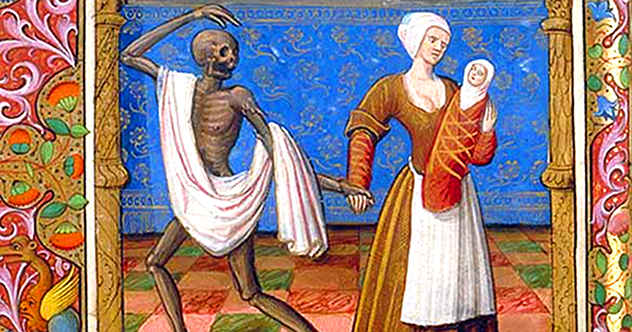
Medieval artists did not always present death as a peaceful sleeper with excellent posture. Prayer books, church art, tombs, and moral illustrations could show skeletons, exposed graves, decaying bodies, and corpses confronting fashionable members of society.
One popular theme, known as “The Three Living and the Three Dead,” showed wealthy young men unexpectedly meeting three corpses. The dead warned the living that beauty, money, and rank would not prevent decay. It was essentially a supernatural ambush with a very clear message: enjoy the horse and expensive clothing, gentlemen, but remember where this ride ends.
Books of Hours also contained the Office of the Dead, prayers intended to benefit deceased souls. Illustrations accompanying these prayers could depict funerals, open graves, deathbeds, purgatory, or frightening personifications of Death.
Such imagery was not simply evidence of a society obsessed with gloom. It encouraged moral preparation. The decomposing body demonstrated the temporary nature of wealth and physical beauty, while prayer offered a meaningful response to mortality.
Research support:
10. A Dead Pope Was Exhumed and Placed on Trial
The Cadaver Synod of 897 remains one of the strangest political and religious events of the Middle Ages. Pope Formosus had been dead for months when his successor, Pope Stephen VI, ordered his body removed from its grave.
The corpse was dressed in papal clothing, positioned in a formal court setting, and subjected to a posthumous trial. A church official answered on behalf of the deceased pope while accusations involving his authority and conduct were presented.
Formosus was declared guilty, and actions associated with his papacy were challenged or annulled. His remains were dishonored before eventually being recovered and reburied. The spectacle was not merely an outbreak of medieval weirdness. It emerged from bitter political rivalries among Roman factions competing for control of the papacy.
Even so, dressing a decomposed predecessor in official robes and prosecuting him is an unusually dramatic way to dispute workplace decisions. Most organizations settle disagreements with records, meetings, and passive-aggressive correspondence. Medieval Rome occasionally preferred corpse litigation.
Research support:
What These Medieval Death Customs Really Reveal
The strangest medieval death practices were not random acts performed by people who lacked emotions or intelligence. They followed recognizable concerns: preserving memory, securing property, maintaining political power, protecting the soul, honoring sacred bodies, and keeping burial grounds usable.
Death was physically visible and socially integrated. Most people died at home or within a religious community. Neighbors encountered funerals, church bells, graves, bones, memorial prayers, and images of mortality throughout ordinary life. The boundary between the living and the dead was not erased, but it was crossed more frequently through ritual, space, and memory.
The Middle Ages also covered about a thousand years and included many different cultures. An aristocratic funeral in thirteenth-century France cannot represent every burial in medieval Europe, much less Islamic, Jewish, Byzantine, Scandinavian, or Eastern European traditions. The surviving evidence is also uneven because wealthy people left more documents, monuments, and identifiable graves than poor laborers did.
Still, these examples show that medieval people could be practical and deeply symbolic at the same time. They worried about decomposition while debating resurrection. They reused graves while continuing to honor the bones. They divided royal corpses to create several memorials, yet condemned some forms of bodily division. Medieval death was full of apparent contradictions because medieval life was, inconveniently, human.
A Reconstructed Experience: Encountering Death in a Medieval Town
The following scene is a historically informed reconstruction rather than the description of one universal medieval custom. Details would have differed according to location, date, religion, wealth, and social status.
Hearing That Someone Is Dying
Imagine living in a European town during the late fourteenth century. A neighbor has been ill for several days, and word spreads that the end may be close. There is no hospital across town where the event can disappear from public view. The person is inside a familiar house, perhaps only a short walk from your own door.
A priest arrives carrying items needed for confession, Communion, and anointing. Relatives gather near the bed. Someone has been asked to witness the will. Another person quietly discusses unpaid obligations. The room smells of smoke, wax, herbs, bodies, damp fabric, and illness. Windows may provide little ventilation, but the emotional atmosphere feels even heavier.
The dying person is encouraged to forgive old injuries and express faith. The gathered companions may recite prayers or respond to the priest. Some watch for final gestures or words that might indicate peace, fear, confusion, or reconciliation. No one knows precisely when the last breath will come, so the gathering stretches on.
Preparing the Body
After death, family members or other attendants wash and wrap the body. The eyes and mouth may be closed, and the corpse may be dressed or enclosed in a shroud. Wealth affects every detail. A powerful household can afford candles, clergy, elaborate fabric, multiple services, and a prominent burial. A poor family relies more heavily on neighbors and parish support.
The body does not remain hidden for long. It must be carried to the church and burial ground. Bells may announce the death or funeral, prompting listeners to pray. The sound is religious, social, and practical: it tells the community that one of its members has crossed from the world of daily obligations into the uncertain condition of the dead.
Walking Through the Churchyard
As the funeral procession approaches the church, you enter a space already crowded with memories. The ground contains generations of parishioners. Some graves are marked; many are not. Beneath your feet, older burials overlap. Nearby buildings, stalls, pathways, and gathering places keep the area connected to ordinary town life.
The service emphasizes both grief and hope. The dead person needs burial, but the soul may continue to need prayers. Family members with sufficient money might fund future Masses, memorial observances, candles, or charitable gifts. Remembrance is not only emotional. It becomes an organized religious duty that may continue for years.
Meeting the Dead Again
Months later, you may hear the person’s name during a memorial service. Years later, workers digging another grave might uncover older bones. Those remains could be moved into a charnel structure rather than abandoned. In church, images of skulls, open graves, suffering souls, and triumphant saints remind you that death is never entirely absent.
You do not necessarily spend every day terrified. People still marry, trade, joke, argue, celebrate festivals, raise children, and complain about prices. Yet mortality has a visible seat at the table. Death is not a distant medical event. It is a neighbor, a ritual responsibility, a spiritual warning, and a recurring community experience.
That may be the greatest difference between modern and medieval encounters with death. Medieval people did not possess a magical immunity to grief. They simply lived in environments where the dead remained physically, socially, and religiously close to the living.
Conclusion
The weirdest facts about death and dying in the Middle Ages range from practical responses to decomposition to spectacular displays of politics and faith. Bodies were divided, transported, exhumed, stored, displayed, prayed over, painted in stages of decay, and occasionally placed on trial.
Behind every strange custom was a serious question. What happens to the soul? Who controls the deceased person’s legacy? Where should the body rest? How can a community keep honoring its dead when the cemetery is full or an epidemic is killing people faster than graves can be prepared?
Medieval answers may appear bizarre today, but they reveal societies that thought constantly about memory, salvation, identity, and the relationship between body and soul. The period’s death customs were often unsettling, sometimes surprisingly organized, and rarely boring.