Note: This article is written as an original, web-ready analysis based on publicly available SaaStr content and reputable company information. It contains no source-link blocks, no duplicate text, and no unnecessary citation placeholders.
Introduction: The SaaStr Week That Felt Like a Mini MBA for Founders
Some weekly content roundups feel like a polite pile of links tossed into your inbox like confetti. This SaaStr roundup is different. It reads more like a condensed operating manual for SaaS founders who are trying to grow revenue, survive a tougher funding market, improve retention, and build a product people actually use without needing a 14-slide explanation and a spiritual awakening.
The headline lineup is strong: Founders Fund’s sales-minded perspective, SaaStr CEO Jason Lemkin’s blunt founder advice, Loom CEO Joe Thomas’s company-building story, Insider’s retention playbook, and Divvy’s go-to-market lessons from a major exit. Together, these pieces create a timely picture of what modern SaaS leadership looks like. The old playbook of “raise a giant round, hire fast, buy growth, and hope the spreadsheet forgives you” has been replaced by something less glamorous but far more durable: efficient growth, customer obsession, sharper positioning, disciplined sales execution, and retention that does not require duct tape and motivational posters.
For founders, operators, revenue leaders, and investors, this week’s top SaaStr content offers more than inspiration. It gives a practical framework for building a better SaaS company when capital is less forgiving, customers are more selective, and every team is expected to do more with fewer resources. In other words, welcome to SaaS adulthood. There are metrics now.
Why This SaaStr Content Matters Right Now
The most useful thing about SaaStr content is that it rarely treats SaaS like a magic trick. The best discussions are grounded in the messy reality of building companies: missed quarters, confusing funnels, sales bottlenecks, customer churn, fundraising anxiety, and the occasional founder realizing that “we just need more leads” is not a strategy but a cry for help.
This week’s roundup reflects the biggest operating shift in B2B software. SaaS companies are no longer rewarded simply for looking big. They are rewarded for being resilient. Investors want cleaner metrics. Customers want faster value. Sales teams need stronger pipeline quality. Customer success teams are expected to drive expansion, not just send cheerful check-in emails. Product teams must build features that make work simpler, not just add more buttons because someone in a roadmap meeting got ambitious.
The featured sessions also show how connected the SaaS machine really is. Revenue growth depends on product clarity. Fundability depends on efficient execution. Retention depends on customer marketing, onboarding, segmentation, and expansion. Founder stories like Loom’s prove that category creation often looks painfully uncertain before it looks obvious. And exits like Divvy’s remind us that go-to-market strategy can be just as valuable as product innovation when the two are moving in the same direction.
Founders Fund and the Revenue Growth Reality Check
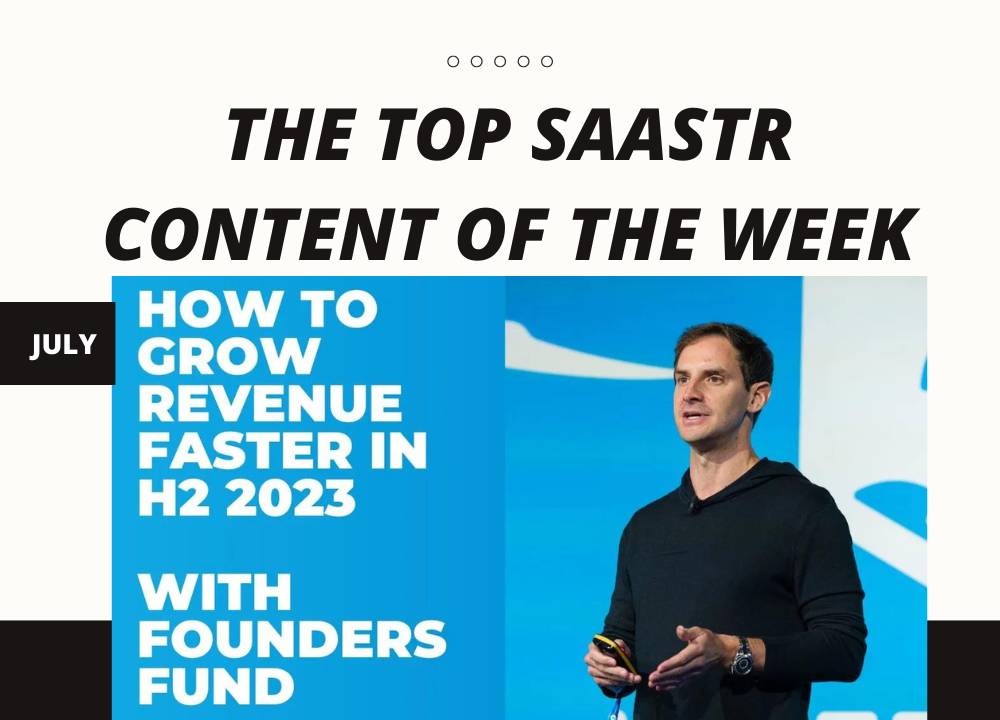
One of the most useful parts of the roundup is the CRO Confidential conversation featuring Sam Blond, known for his operator background and revenue leadership experience. The central idea is refreshingly simple: before trying to grow faster, first understand why growth is not already happening.
That sounds obvious, but many SaaS companies skip this step. They miss a revenue target and immediately blame the sales team. Or marketing. Or the website. Or Mercury being in retrograde, which is rarely accepted by the board but often emotionally satisfying. A better approach is to inspect the go-to-market funnel with surgical honesty.
Run the Numbers Before Running the Team Ragged
Revenue growth starts with questions that are boring in the best possible way. How many qualified opportunities are created each month? How many opportunities does each sales rep receive? Are conversion rates declining? Is onboarding too slow? Is implementation capacity blocking new revenue? Is the sales team losing deals, or is the company simply not creating enough real pipeline?
This distinction matters. If the true bottleneck is opportunity creation, then coaching account executives to “close harder” will not solve the problem. That is like yelling at a toaster because you forgot to buy bread. SaaS leaders need to diagnose the constraint before prescribing the cure.
The deeper lesson is that efficient growth is not about doing everything. It is about reallocating resources to the most important constraint. If demand generation is weak, fix demand. If onboarding is slow, fix implementation. If retention is fragile, fix customer value. If the ICP is muddy, fix positioning before hiring another sales rep to wander into the fog with a quota and a LinkedIn Premium account.
Jason Lemkin’s Cold, Hard Truths About Being Fundable
Jason Lemkin’s contribution to this week’s SaaStr lineup brings the classic SaaStr flavor: direct, slightly uncomfortable, and extremely useful. The core message is that many good SaaS companies can still be unfundable in a tighter market. That does not mean they are bad businesses. It means the venture bar has changed.
For founders, this is both sobering and liberating. Sobering because a decent product, happy early customers, and a passionate pitch may not be enough. Liberating because not every company needs to play the venture game the same way. Bootstrapped and capital-efficient businesses can be in a stronger position when the market stops rewarding growth at any cost.
Fundraising Is Not a Personality Contest
A founder can be charismatic, smart, and deeply committed, but investors still look for evidence. They want to see growth quality, customer pull, market size, retention, gross margins, and a credible path to scale. In 2021, some companies could raise money because their charts looked exciting if viewed quickly and from a distance. In a tougher environment, the same charts need to survive close inspection.
The lesson is not “never raise money.” The lesson is to earn optionality. A SaaS company with improving retention, disciplined burn, a clear ICP, and a repeatable sales motion has choices. It can raise from strength, grow with less dilution, or remain independent longer. A company that depends on the next round to cover weak fundamentals is not scaling; it is sprinting across a bridge while hoping someone finishes building the other side.
Loom’s CEO and the Founder Playbook from Near-Death to Category Leadership
The Loom story adds the emotional center to this SaaStr roundup. Loom’s rise from a fragile early-stage startup to a widely recognized async video platform is the kind of founder journey that sounds neat in hindsight and probably felt like being chased by a bear while holding a laptop at the time.
Loom solved a real workplace communication problem: sometimes a short video is faster, clearer, and more human than another meeting or a 900-word Slack message that begins with “quick question.” As distributed and hybrid work became normal, async communication moved from nice-to-have to operational necessity. Loom’s product fit that shift because it made recording, sharing, and watching work videos simple enough for everyday teams.
Why Async Video Became a SaaS Lesson
Loom’s success is not just about video. It is about reducing friction. The product allowed users to explain bugs, share updates, walk through designs, onboard teammates, and replace unnecessary meetings. That is a powerful SaaS pattern: the best products often win by removing a familiar irritation, not by inventing a completely new behavior from scratch.
The company’s later acquisition by Atlassian also reinforces the strategic value of workflow-native communication. Async video becomes more valuable when it lives close to where work already happens: product planning, engineering tickets, documentation, sales updates, and internal knowledge sharing. In that sense, Loom is a case study in product-led adoption, category timing, and the compounding effect of solving a daily pain point.
Insider’s 140% NRR Lesson: Retention Is the New Growth Engine
Another standout from the roundup is the discussion with Insider’s CEO and CMO about boosting net revenue retention. NRR is one of the most important SaaS metrics because it reveals whether existing customers expand, contract, or quietly escape through the side door while your team is celebrating new logo wins.
The big takeaway is that customer marketing deserves a much larger seat at the revenue table. Acquisition gets the spotlight, but expansion often drives the most efficient growth. When customer acquisition costs rise, existing customers become even more valuable. They already trust the company. They understand the product. They have internal use cases. The opportunity is to help them get more value, adopt more deeply, and expand naturally.
Segmentation Beats Generic Customer Emails
The difference between average retention and great retention often comes down to relevance. Generic messages rarely create urgency. Strong customer marketing segments by persona, maturity, use case, lifecycle stage, and expansion potential. A CFO does not need the same message as a product manager. A power user does not need the same onboarding as a hesitant new team. A mature enterprise account should not receive the same “getting started” content as a brand-new customer unless the company enjoys looking confused in public.
Insider’s retention message is especially useful because it treats customers as people, not just renewal dates. Experiences, education, community, personalized outreach, and thoughtful expansion paths all matter. In modern SaaS, customer success is not a department. It is a company-wide operating system.
Divvy’s $2.5 Billion Exit and the Power of Clear Go-To-Market Strategy
The Divvy story adds another practical angle: a strong go-to-market motion can turn a useful product into a highly valuable business. Divvy combined expense management software with smart corporate cards, giving finance teams better visibility and control over company spend. The value proposition was clear, measurable, and easy to understand: manage spend smarter, reduce manual work, and give teams a better way to handle budgets.
That clarity matters. Many SaaS companies struggle not because the product is weak, but because the message is mushy. Customers should quickly understand who the product is for, what painful problem it solves, and why it is better than the old way. Divvy’s positioning spoke directly to finance and operations leaders who were tired of stitched-together systems and after-the-fact expense chaos.
The Exit Lesson for SaaS Founders
Great exits rarely come from product alone. They come from product, market timing, distribution, customer trust, and strategic fit. Divvy’s acquisition by BILL showed how complementary products can create a stronger platform. For founders, the lesson is not to build only for acquisition. The lesson is to build something strategically useful enough that customers, partners, and potential acquirers can clearly see where it fits.
The Common Thread: Efficient Growth Beats Loud Growth
Across Founders Fund, SaaStr’s CEO, Loom’s CEO, Insider, and Divvy, the shared theme is efficient growth. Not timid growth. Not boring growth. Efficient growth. The kind built on strong fundamentals, focused execution, customer love, and a team that understands the difference between motion and progress.
Modern SaaS leaders need to ask sharper questions. Are we creating enough qualified pipeline? Are we selling to the right customers? Are our best customers expanding? Is our product easy to adopt? Are we fundable because our fundamentals are strong, or are we hoping the pitch deck has enough gradients to distract everyone?
The strongest SaaS companies are learning machines. They study every lost deal, every churned account, every expansion, every onboarding delay, and every support ticket. Then they turn those lessons into better positioning, better product, better sales process, and better customer outcomes.
Practical Takeaways for SaaS Founders and Operators
1. Diagnose Before You Hire
Hiring more salespeople before fixing pipeline quality, onboarding speed, or ICP clarity can make problems more expensive. Find the constraint first.
2. Treat Fundability as a Byproduct
Do not build only to impress investors. Build a business with strong retention, efficient acquisition, and credible growth. Funding becomes easier when the company works.
3. Make Retention a Revenue Strategy
Customer success, product adoption, customer marketing, and expansion should operate together. NRR improves when customers repeatedly experience value.
4. Reduce Friction Like Loom
If your product saves time, simplifies work, or replaces an annoying workflow, make that value obvious. The less explanation required, the faster adoption can spread.
5. Build a Clear Strategic Narrative
Divvy’s lesson is that customers and markets reward clarity. If buyers cannot explain your product after one conversation, your positioning needs work.
Experience Notes: What This SaaStr Week Teaches in Real Operating Life
In real SaaS operating life, the lessons from this roundup show up in small, repetitive moments. A founder reviews the pipeline and realizes the team does not have a closing problem; it has a qualified-opportunity problem. A customer success leader notices that the biggest accounts are not expanding because nobody has mapped product usage to business outcomes. A marketing team discovers that its best campaign is not the clever one with the pun-filled headline, but the plain-language webinar that answers a painful buyer question. SaaS has a funny way of humbling our fanciest ideas.
One of the most valuable experiences related to this topic is learning that growth problems are rarely solved by one heroic move. They are solved by a sequence of precise improvements. For example, a startup may begin by cleaning up its ICP. That improves outbound targeting. Better targeting improves demo quality. Better demos improve close rates. Stronger-fit customers onboard faster. Faster onboarding improves activation. Better activation improves retention. Better retention improves fundraising conversations. Suddenly, the company looks smarter, but really it became more disciplined.
The Loom lesson also appears often in product work. Teams sometimes assume customers want more features, when what they actually want is less effort. A simple workflow that saves five minutes every day can be more powerful than a complex dashboard nobody opens. The best SaaS products often feel obvious after they work. Before that, they can look too narrow, too simple, or too strange. Founders need enough conviction to stay close to the pain they are solving, even when the market has not yet given them applause.
The retention lesson is equally practical. Many companies celebrate the sale too early. The real relationship begins after the contract is signed. Customers need onboarding, education, internal champions, usage milestones, and proof that the product is helping them win. A renewal should not feel like a surprise exam. It should feel like the natural continuation of a relationship where value has been visible all year.
Finally, Jason Lemkin’s funding advice is useful because it reminds founders to control what they can control. Markets change. Valuation multiples change. Investor appetite changes. But founders can still improve burn, retention, product quality, customer focus, and sales execution. In tougher markets, discipline is not a punishment. It is a competitive advantage. The companies that learn this early tend to emerge stronger, calmer, and much less dependent on lucky timing. And yes, they also tend to have cleaner board meetings, which is one of the underrated joys of SaaS life.
Conclusion: The SaaStr Roundup Is Really a Founder Survival Guide
This week’s top SaaStr content is valuable because it does not offer one-size-fits-all advice. Instead, it gives founders and operators a set of lenses. Sam Blond’s revenue framework pushes teams to diagnose bottlenecks. Jason Lemkin’s fundraising perspective forces founders to face the market honestly. Loom’s story shows the power of timing, simplicity, and product-led behavior. Insider’s NRR strategy proves that customer marketing and retention can become growth engines. Divvy’s exit demonstrates the value of clear positioning and a strong go-to-market machine.
For SaaS leaders, the message is clear: growth is still possible, but sloppy growth is expensive. The companies that win will understand their numbers, serve the right customers, build products that reduce friction, expand existing accounts, and stay honest about what is working. That may sound less glamorous than the old “raise big and conquer the world by Tuesday” playbook, but it is far more durable. Also, it involves fewer emergency all-hands meetings, which everyone can agree is progress.