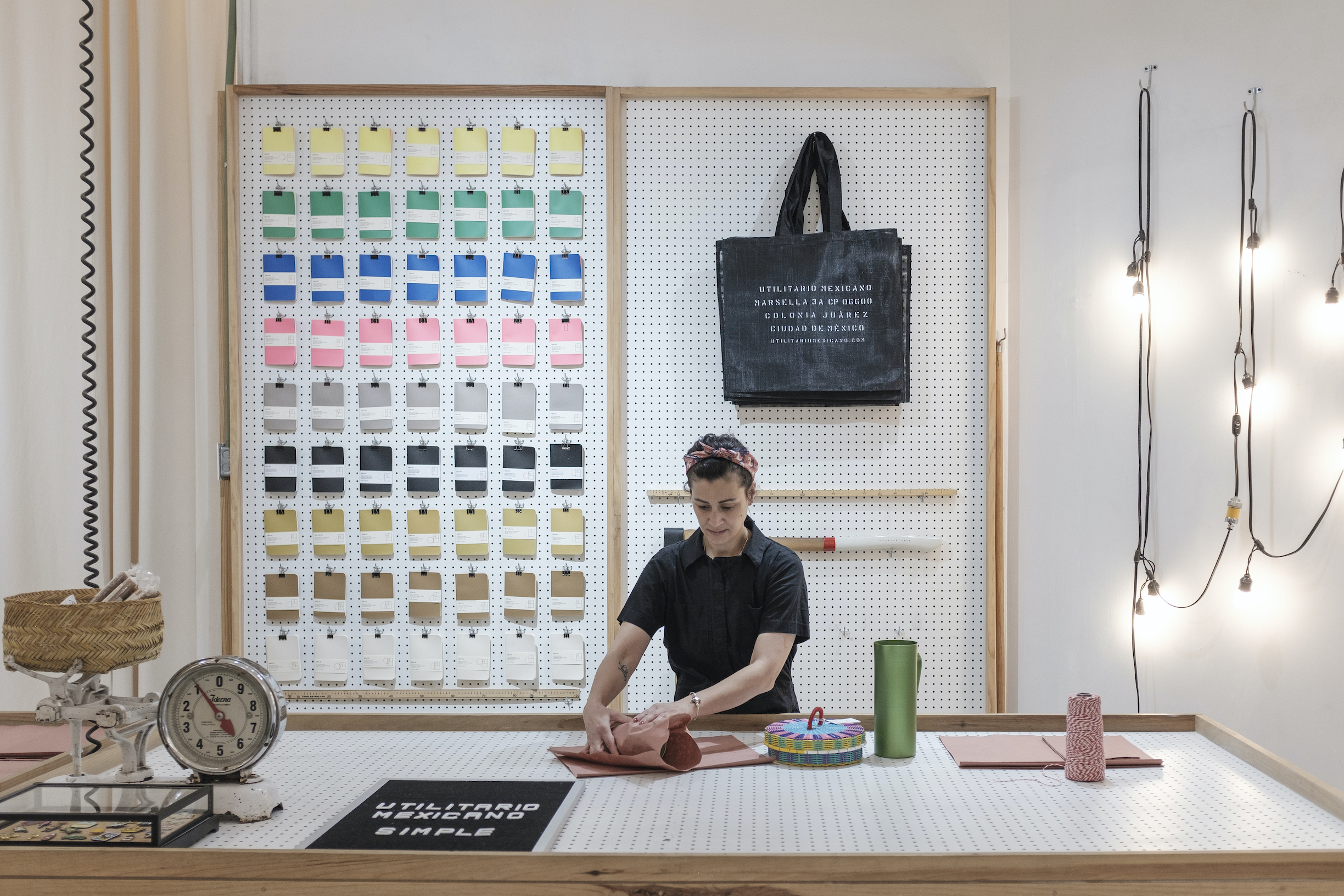
Some stores try to seduce you with marble floors, dramatic lighting, and objects so delicate that touching them feels like a misdemeanor. Utilitario Mexicano in Mexico City takes a different approach. It fills its shelves with funnels, enamel mugs, tortilla presses, woven baskets, scrub brushes, pitchers, notebooks, bottle openers, and other practical objects that appear ready to start working immediately.
Located in Colonia Juárez, this distinctive Mexico City design shop celebrates classic household wares made in Mexico. Its guiding philosophy can be summarized in two words: useful only. That does not mean the products are dull. Quite the opposite. By concentrating on honest materials, proven shapes, vivid colors, and uncomplicated construction, Utilitario Mexicano demonstrates how beautiful ordinary tools can become when nobody forces them to audition as luxury décor.
The shop is part hardware store, part kitchen-supply depot, part design archive, and part exceptionally organized treasure hunt. It preserves familiar objects from Mexican homes while presenting them to a new generation of cooks, decorators, designers, travelers, and people who suddenly realize that their lives have been tragically incomplete without a coral-colored enamel ladle.
A Store Built Around Usefulness
Utilitario Mexicano was founded by creative partners Libia Moreno and Enrique Arellano. Their project grew from an interest in the practical objects they encountered in neighborhood markets, traditional shops, workshops, and the busy commercial streets of Mexico City.
Rather than searching only for prestigious design names, Moreno and Arellano became what they have described as street curators. They looked closely at things many shoppers barely noticed: aluminum cups, inexpensive brushes, metal scoops, wooden stools, simple lamps, enamel bowls, and kitchen tools that had performed the same jobs for decades.
The original idea emerged through an unexpected opportunity to create a temporary retail space. What could have remained a small pop-up developed into a much larger collection devoted to the material culture of everyday Mexican life. Today, the Utilitario Mexicano catalog contains more than 1,500 objects selected primarily because they work, last, and tell a story about how people cook, clean, organize, repair, serve, store, and live.
Why “Useful Only” Is More Interesting Than It Sounds
The phrase “useful only” might suggest a shop full of gray storage bins and aggressively sensible mops. In practice, it creates an unexpectedly colorful environment. When unnecessary ornament is removed, the details that remain become more visible: the curve of a handle, the speckled finish of enamelware, the shine of spun aluminum, the grain of turned wood, or the woven pattern of a natural-fiber basket.
Utilitario Mexicano is not selling minimalism in the familiar sense of empty white rooms containing one chair that nobody is permitted to sit on. Its version of simplicity is active, domestic, and generous. These are objects intended to be held, stacked, stained, washed, repaired, and returned to the shelf for another day’s work.
Everyday Objects as a Mexican Design Archive
The shop describes its collection as occupying a space between industrial manufacturing and artisanal production. That middle ground is central to its identity. Many products are made in small workshops using repeatable processes, but the marks of human labor remain visible. A bowl may belong to a series while still displaying minor differences in its finish. A wooden handle may be turned to a standard shape, yet its grain ensures that no two pieces look exactly alike.
This combination challenges the assumption that an object must be either factory-perfect or entirely handmade. Mexican household wares often emerge from production systems in which machines, workshop tools, inherited skills, local materials, and manual finishing coexist. The result is practical design with personality.
Some items are discovered in markets or traditional commercial districts. Others are sourced directly from makers. When an especially useful object becomes difficult to find, Utilitario Mexicano may collaborate with workshops or factories to reproduce it, occasionally introducing new finishes or custom colors while protecting the original function.
Rescuing “Objects in Danger of Extinction”
One of the store’s most compelling ideas is that certain utensils are in danger of extinction. This does not mean scientists must establish a protected breeding program for tortilla presses. It means that durable, low-tech tools can disappear when manufacturers close, consumer habits change, or disposable replacements become more profitable.
An old-fashioned tool may look unremarkable until it is no longer available. Then people discover that the lightweight replacement bends, the electronic version requires three passwords, and the “smart” model refuses to operate because the kitchen Wi-Fi is feeling emotional.
By collecting, documenting, commissioning, and selling these objects, Utilitario Mexicano functions as a living archive. Unlike a museum display, however, the artifacts remain in circulation. Customers can take them home, put them to work, and continue the histories embedded in their materials and forms.
What You Can Find at Utilitario Mexicano
The inventory extends far beyond decorative home accessories. The current catalog is organized across categories such as kitchen and tableware, cleaning tools, bedding, rugs, office supplies, lighting, books, toys, personal-care goods, clothing, groceries, art, and music. Products are also grouped by materials including aluminum, enamelware, ceramics, paper, textiles, wood, iron, synthetic materials, and plant fibers.
Enamelware for Kitchens That Actually Cook
Enamelware, often called peltre in Mexico, is among the shop’s signature offerings. Mugs, bowls, plates, pots, spoons, and pitchers combine metal strength with a smooth enameled surface. Traditional versions may feature white interiors, dark rims, speckled patterns, or bold exterior colors.
These pieces have a familiar domestic character. They belong in kitchens where coffee is poured generously, sauces bubble enthusiastically, and the cookware may eventually acquire a chip that becomes part of the family mythology. Utilitario Mexicano has worked with Mexican manufacturers to produce enamel pieces in specially selected colors, giving a familiar material a contemporary visual identity without robbing it of its practical purpose.
Aluminum, Copper, Iron, and Honest Metal
Metal objects form another major part of the collection. Shoppers may encounter aluminum pitchers, juicers, funnels, scoops, cups, strainers, and serving tools. There are also cast-iron implements, copper vessels, wire fruit baskets, scales, grinders, and bottle openers.
The appeal lies partly in visual directness. A funnel looks like a funnel. A citrus press does not pretend to be abstract sculpture, although arranged on the wall it may accidentally become one. The materials are familiar, the construction is readable, and the object usually explains how to use it before anyone reaches for an instruction manual.
Tortilla Presses and Tools With Cultural Memory
Few objects represent the relationship between daily function and food culture as clearly as the tortilla press. Its two plates, hinge, and lever perform a straightforward task, but that task connects the tool to corn, kitchens, family meals, regional recipes, and generations of practiced hands.
At Utilitario Mexicano, the tortilla press is not isolated as a picturesque souvenir. It appears among other working utensils, where it belongs. This context matters. The shop presents traditional Mexican utensils as living equipment rather than theatrical props for a vaguely “rustic” kitchen.
Cleaning Tools That Deserve Better Public Relations
Most design shops discreetly hide the cleaning department, perhaps fearing that a scrub brush will ruin the mood. Utilitario Mexicano allows brushes, buckets, brooms, dusters, scouring tools, and aprons to participate fully in the visual conversation.
It turns out that a well-made fiber brush can be beautiful. So can a sturdy bucket. Their shapes are refined by repeated use rather than by trend forecasting. They also provide a refreshing reminder that a home is not merely photographed; it must occasionally be cleaned, ideally before the mysterious kitchen substance achieves legal independence.
Notebooks, Maps, Lamps, and Small Surprises
The shop’s range includes notebooks, pencils, rulers, sharpeners, wrapping paper, maps, desk bells, extension cords, light bulbs, lamps, toys, textiles, hats, tote bags, and records. This broad selection prevents the store from feeling like a conventional kitchen boutique.
A visitor may arrive intending to buy one enamel cup and leave carrying a wooden toy, three notebooks, a woven potholder, a map, and a light bulb in a color previously associated only with tropical fruit. Such events should not be described as a loss of self-control. They are interdisciplinary research.
The Store Design: Organized Clutter With a Point
Utilitario Mexicano’s interior reinforces its curatorial approach. Shelves, walls, boxes, tables, and repurposed metal fixtures hold dense arrangements of merchandise. Similar objects may be grouped by material, color, function, period, or what the owners call subjective harmony.
This creates the pleasure of abundance without the chaos of a random flea market. Rows of pitchers reveal subtle variations in profile. Stacked bowls turn ordinary colors into graphic compositions. Brushes become studies in fiber and form. Hanging tools create silhouettes that would make a modernist poster jealous.
The larger Colonia Juárez shop occupies the ground floor of an older apartment building. During its transformation, salvaged metal elements were incorporated into displays, allowing recycling to become part of the interior rather than a decorative slogan pasted near the cash register.
The atmosphere has been described as warm, dimly illuminated, and home-like. That mood helps prevent the inventory from becoming sterile. Objects are carefully presented, but they retain a sense of readiness. Nothing appears shocked by the idea that a customer might actually use it.
Why Colonia Juárez Is the Right Home for the Shop
Utilitario Mexicano’s location in Colonia Juárez places it within one of Mexico City’s most layered neighborhoods. Juárez sits close to Paseo de la Reforma and has experienced several dramatic identities. It developed as an affluent residential district, later went through periods of decline and reinvention, and eventually attracted artists, independent businesses, restaurants, bars, galleries, and design studios.
The neighborhood’s architecture reflects that history. Grand older houses, Art Deco buildings, modest commercial spaces, contemporary renovations, and busy street life coexist within a relatively compact area. Utilitario Mexicano fits naturally into this environment because its products also connect different eras without becoming trapped in any one of them.
A classic pitcher can sit comfortably in an old apartment, a modern loft, a neighborhood café, or a carefully designed hotel. It does not require a matching historical set. Its strength is adaptability, which is also one of Mexico City’s defining design characteristics.
More Than a Souvenir Shop
Visitors searching for Mexican-made home goods can easily fall into two extremes. At one end are generic souvenirs designed mainly for quick recognition. At the other are collectible design pieces priced and displayed more like gallery works than household equipment.
Utilitario Mexicano occupies a more democratic middle ground. The shop includes special pieces and products at varied price levels, but many objects remain accessible, compact, and genuinely useful. A traveler can bring home a cup, spoon, notebook, brush, or kitchen cloth that becomes part of an everyday routine rather than another object condemned to gather dust beside the airport snow globe.
The store also avoids reducing Mexican design to a single visual stereotype. Its collection includes bright colors, but also natural fibers, plain metals, black iron, white enamel, brown wood, and restrained industrial forms. Mexico appears not as one pattern or palette, but as a network of homes, workshops, materials, regional practices, factories, and practical inventions.
Why Utilitario Mexicano Matters in a Disposable Age
Modern retail frequently encourages people to replace functional objects simply because a new color, feature, or seasonal variation has appeared. Utilitario Mexicano proposes a quieter model. Its best products are designed to stay in use until wear gives them character rather than making them unfashionable.
Durability alone does not make an object environmentally perfect. Materials, manufacturing, transportation, and labor all matter. Still, choosing a repairable, long-lasting tool can reduce the cycle of buying, breaking, discarding, and buying again. A manual citrus press does not need software support. A metal funnel will not become incompatible with next year’s bottle. A woven basket never asks permission to install an update.
The store’s approach also supports knowledge that can disappear with the products themselves. When a workshop continues producing a familiar utensil, it preserves techniques, supplier relationships, tooling, and skilled labor. Buying the object can therefore support more than an individual maker; it can help maintain a small production ecosystem.
How to Shop the Collection Thoughtfully
The most rewarding way to explore Utilitario Mexicano is to begin with a task rather than a decorative theme. Consider what your kitchen, desk, entryway, or cleaning cabinet actually needs. Then examine how different objects solve that problem.
Look at weight, balance, handles, joints, edges, and finishes. Ask how an item should be cleaned and whether its material suits the intended use. Enamelware may develop chips over time. Copper requires particular care. Natural fibers behave differently from synthetic brushes. Wooden utensils should not be abandoned in a sink like tiny domestic shipwrecks.
Travelers should also think about luggage space and customs restrictions. Small textiles, stationery, cups, utensils, and flat-packed items are generally easier to transport than large pottery, blades, liquids, or unusually shaped metal objects. Nobody wants to explain an industrial-size citrus press during a hurried airport inspection.
Because inventory, prices, opening hours, and individual products can change, visitors should check the shop’s official information before making a special trip. The current official address is listed on Calle Marsella in Colonia Juárez.
The Broader Lesson: Good Design May Already Be in the Cupboard
Utilitario Mexicano encourages visitors to reconsider how design is recognized. A famous signature can make an object culturally important, but so can decades of successful use. Many household tools are anonymous because their forms evolved through collective experience rather than one dramatic creative gesture.
The angle of a handle, depth of a bowl, width of a basket, or leverage of a press may represent countless adjustments made by manufacturers, craftspeople, sellers, and users. The final design appears obvious because the difficult thinking has been absorbed into the object.
This is why the shop feels richer than a room full of attractive merchandise. It teaches visitors how to look. After browsing its shelves, the ordinary objects in a market stall, restaurant kitchen, neighborhood hardware store, or relative’s cupboard may suddenly appear more interesting. The humble spoon has been waiting patiently for this recognition.
A Shopper’s Experience at Utilitario Mexicano
Visiting Utilitario Mexicano is best approached without a rigid shopping list. You may have one, of course. You may even have written “one mug” in large, responsible letters. The store will respect your optimism while quietly presenting several hundred reasons to reconsider.
The first impression is usually not of a conventional boutique but of an exceptionally thoughtful storeroom. Objects cover the walls, fill shelves, hang from hooks, and gather in material-based families. The density slows you down. Instead of scanning one display table and moving on, you begin comparing details.
One enamel mug may have a dark rim and a pale body. Another may be saturated with color. Nearby, aluminum pitchers reflect the light differently depending on their finish. A line of brushes reveals variations in handle length and fiber stiffness that were invisible five minutes earlier, back when you believed all brushes were spiritually identical.
The experience becomes tactile even before anything is touched. You imagine the cool weight of a metal cup, the resistance of a tortilla-press lever, the texture of a woven mat, or the satisfying ring of a desk bell. These products communicate through familiar shapes. They invite use rather than demanding interpretation.
A practical strategy is to complete one slow circuit before buying. During the first pass, notice whatever attracts you instinctively. During the second, ask whether each object would have a real job at home. This protects you from buying twelve funnels while still allowing room for one entirely unnecessary but emotionally essential pink light bulb.
Kitchen items make especially meaningful purchases because they can enter daily routines immediately. A serving spoon may appear at family dinners. A pitcher may become the default vessel for water, flowers, or iced tea. A tortilla press may inspire experimentation with fresh masa. Even a small enamel cup can accumulate memories through repeated use.
Stationery and textiles offer easier options for travelers with limited luggage space. Notebooks, towels, potholders, maps, aprons, and tote bags pack more comfortably than cast iron. Small items also make thoughtful gifts because they are culturally specific without being purely decorative.
The shop rewards curiosity. Ask about where something was made, what material it uses, or whether it was found, commissioned, or reissued. The answer may reveal a connection to a workshop, traditional market, regional craft, or manufacturing process. That background turns a modest object into a compact lesson about Mexican production and domestic history.
After leaving, continue walking through Colonia Juárez. The surrounding neighborhood provides a useful extension of the visit, with old façades, independent businesses, cafés, galleries, and renovated interiors illustrating how Mexico City constantly layers new creative activity over existing structures.
The most lasting part of the experience may arrive later, once the purchase is home and functioning. A good souvenir reminds you where it came from. A good utilitarian object does that while opening a bottle, holding fruit, serving coffee, illuminating a desk, or scrubbing a stubborn pan. Utilitario Mexicano excels at objects that earn their shelf space.
Conclusion
Utilitario Mexicano in Mexico City proves that household essentials do not need luxury materials, complicated technology, or celebrity designers to deserve attention. A well-proportioned pitcher, durable enamel bowl, woven basket, wooden stool, or reliable brush can express the history of its material, the intelligence of its maker, and the routines of the homes that use it.
By preserving traditional Mexican utensils, collaborating with workshops, and celebrating the territory between industrial and artisanal production, the shop gives ordinary objects unusual visibility. It is a destination for design enthusiasts, but it is equally valuable for cooks, homemakers, travelers, and anyone who prefers possessions that can do more than sit attractively near a stack of unread books.
In a retail culture obsessed with novelty, Utilitario Mexicano offers a cheerfully stubborn alternative: buy something simple, use it often, and keep it for a long time. Radical? Perhaps. Useful? Absolutely.