Note: HTML body only, source links omitted by request, and unnecessary citation artifacts removed for web publishing.
Some tech stories are impressive because they are big. This one is impressive because it is wonderfully, gloriously small. The Intel 8080 is a chip from the mid-1970s, back when memory was tight, switches were serious business, and “user-friendly” often meant “the smoke stayed inside the case.” Yet here we are, watching this vintage processor run alongside a modern FPGA, proving that old silicon still has a few tricks left in its tiny ceramic sleeve.
If that sounds like a weird mash-up of museum hardware and programmable logic, that is exactly why it is fun. The story of a vintage Intel 8080 running on a modern FPGA is not just about retro computing nostalgia. It is about preserving computer history, learning how early systems really worked, and showing that modern tools can breathe new life into hardware that helped launch personal computing. It is also a gentle reminder that progress in computing is not a straight line. Sometimes the future looks best when it is holding hands with 1974.
Why the Intel 8080 Still Matters
The Intel 8080 occupies a special place in computing history because it helped turn microprocessors from clever engineering experiments into the beating heart of real, usable computers. Earlier chips had hinted at what was possible, but the 8080 made the idea practical enough for broader adoption. It offered an 8-bit architecture, a 16-bit address space, and enough flexibility to support more ambitious software and systems than many of its predecessors.
That mattered for one very simple reason: people could build around it. The 8080 became closely associated with the wave of early hobbyist and personal machines that pushed computing out of large institutions and into garages, workshops, bedrooms, and small businesses. Its role in machines like the Altair 8800 made it part of the mythology of personal computing. This was the era when enthusiasts were not just users. They were assemblers, debuggers, solderers, and occasional accidental creators of smoke.
The 8080 also became important because software finally had room to grow up a little. Systems based on the chip helped support early versions of Microsoft BASIC and contributed to the environment in which CP/M became a widely influential operating system. That software ecosystem mattered just as much as the hardware itself. A processor is impressive, sure, but a processor with useful tools, languages, and operating systems is how you get from blinking lights to actual computing culture.
The 8080 Was Not Just a Chip. It Was a Platform.
One reason the Intel 8080 continues to fascinate engineers is that it sat at the intersection of simplicity and possibility. The design was limited enough to understand at a human scale, yet capable enough to power software that changed the industry. You can study it without drowning in layers of abstraction. That is a rare luxury in modern computing, where one “simple” platform can involve millions of gates, deep toolchains, multiple firmware layers, and the emotional support of three documentation tabs and a strong cup of coffee.
Because the 8080 is understandable, it has become an ideal target for reimplementation, emulation, and preservation. It is old enough to feel historic, but structured enough to remain educational. For students, hobbyists, and retrocomputing fans, it offers a kind of hands-on clarity that modern processors simply do not. No one casually recreates a cutting-edge multicore desktop CPU over a weekend. An 8080, though? That feels audacious in exactly the right way.
What It Means to Run a Vintage CPU on a Modern FPGA
To understand why this project is so compelling, it helps to understand what an FPGA actually does. A field-programmable gate array is a reconfigurable chip that lets designers implement digital logic in programmable fabric. In plain English, it is a box of highly organized electronic possibility. Rather than buying a fixed-purpose chip, you define hardware behavior using design tools and then load that behavior into the FPGA.
That makes an FPGA a perfect bridge between eras. You can use it to recreate timing logic, interface circuitry, memory controllers, buses, and even complete processors. In retrocomputing projects, that means you can emulate or support functions that originally required piles of period-correct chips, hard-to-find components, or increasingly expensive vintage hardware. It is like replacing a garage full of fragile old parts with a single modern assistant that never complains, never loses a screw, and is happy to do exactly what the logic says.
When people say a vintage Intel 8080 runs on a modern FPGA, that can mean a few different things. In some projects, the FPGA hosts a soft-core recreation of the 8080 itself. In others, the original physical 8080 chip stays in the circuit while the FPGA handles the glue logic around it: clocks, memory, bus control, address decoding, peripheral behavior, and other support functions. Either way, the FPGA becomes the modern translator between old-school CPU expectations and new-school development convenience.
Why This Combination Makes So Much Sense
The vintage 8080 and the modern FPGA complement each other beautifully. The 8080 brings historical authenticity and architectural charm. The FPGA brings flexibility, reliability, and the ability to replace many support chips with one programmable device. Together, they make it possible to build a working system that respects the original processor while removing some of the pain that once came standard with early microcomputer design.
This is especially helpful because the 8080 came from an era with power requirements and signal expectations that do not map neatly to today’s typical hobby electronics. The chip wanted its world arranged a certain way. Modern parts politely disagree. The FPGA steps in as the diplomat, the fixer, and occasionally the therapist.
From Archive Piece to Living Machine
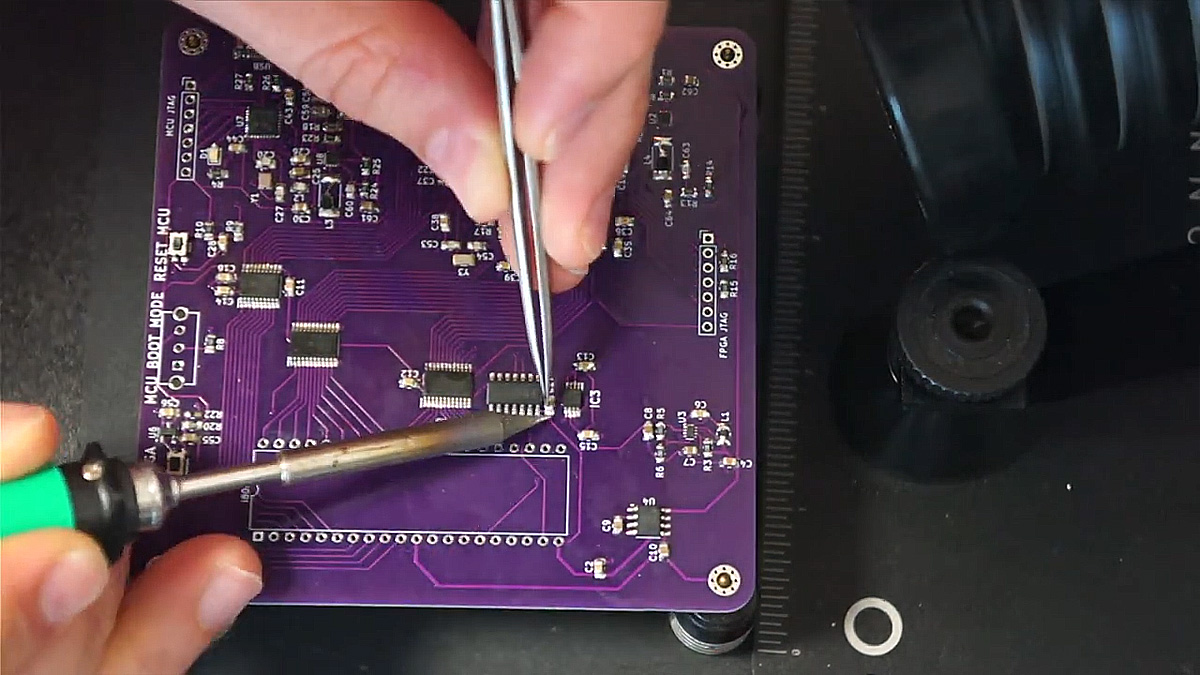
The modern build that inspired renewed attention does more than merely simulate an old processor in software. It takes a genuine Intel 8080A-1 and gives it a contemporary support system. Reporting on the project describes a custom system board built around the vintage CPU, with a modern Microchip FPGA supplying critical system behavior. The design also uses modern interfacing so the machine can interact with a present-day computer more conveniently.
That is what makes the project especially interesting. This is not a museum restoration where every part must be period-correct down to the last connector. It is not a pure emulator either, where the vintage chip disappears into software. Instead, it is a practical hybrid. The original CPU stays central, while the FPGA handles the parts of the job that are tedious, fragile, or difficult to source in traditional form.
In public descriptions of the build, the board supplies the old voltage rails the 8080 expects, handles clocking and memory interfacing, and uses level shifting so different generations of electronics can coexist without starting an argument in the traces. The project reportedly pushes the 8080A-1 to 3.125 MHz, which is a lovely detail because it makes the whole thing feel less like a nostalgic shelf ornament and more like a purposeful machine.
Even better, the build has been praised for using open-source methods rather than leaning on locked-down proprietary workflows. That matters. Retrocomputing is partly about preservation, and preservation works best when tools are accessible. If future builders can understand, modify, and rebuild the project without negotiating with a maze of closed ecosystems, the work becomes more durable and more educational.
This Is Preservation Through Use, Not Just Display
There is a major difference between keeping old hardware in a box and making it do something meaningful today. A working system reveals design choices that photos never can. It shows how much effort early engineers spent on timing, power, buses, and memory. It shows how software was shaped by hardware limits. It shows why older code often seems lean, direct, and just a little smug about fitting into impossibly small memory.
When a vintage Intel 8080 runs with help from a modern FPGA, history stops being abstract. It becomes active. You are not just admiring the chip. You are collaborating with it across five decades.
Why Engineers and Makers Love This Kind of Project
Retro CPU projects attract attention because they combine several satisfying ideas at once. First, they are deeply educational. Anyone who builds or studies such a system quickly learns about buses, registers, clocks, memory maps, and the awkward truth that “simple” hardware often becomes simple only after someone else spent weeks making it look that way.
Second, they are excellent demonstrations of engineering continuity. The tools have changed. The clock speeds have exploded. The transistor counts have gone from modest to absurd. But the core logic of computing still makes sense across generations. Fetch, decode, execute. Store, branch, compare. Blink an LED for morale.
Third, projects like this are emotionally satisfying because they reclaim agency from black-box computing. Modern hardware can feel distant. The systems are powerful, but often opaque. An 8080-based project is the opposite. You can see what is happening. You can reason about the machine. You can trace signals, inspect state, and understand the consequences of a change. That level of visibility is catnip for curious minds.
Finally, this kind of build proves that retrocomputing is not merely nostalgia cosplay. It is productive curiosity. It is a way to test tools, document knowledge, preserve architecture, and teach new generations of developers how much computing can be accomplished with modest resources and clear thinking.
The Real Challenges Behind the Cool Factor
Of course, none of this happens by magic. Getting a 1970s CPU to cooperate with a modern board is not just a matter of dropping a chip into a socket and hoping for the best. The Intel 8080 is old enough to have very specific electrical needs, including multiple voltage rails that are uncommon in many present-day hobby projects. Supporting that safely takes careful design.
Then there is timing. Vintage processors can be surprisingly picky about clocks, control signals, wait states, and memory interactions. A modern FPGA can help solve those problems, but only if the designer understands both sides of the handshake. It is one thing to write clever HDL. It is another to make a real chip from the disco era accept your invitation to dance.
Public descriptions of the featured build mention issues such as incorrect footprints, misrouted gate drivers, and thermal trouble in the clock section. That is not a bug in the story. That is the story. Hardware development is rarely a clean sprint from idea to success. It is more like detective work performed by someone holding a multimeter and muttering at a board under bright light.
Those bumps make the finished system more impressive, not less. They show that the project is grounded in real engineering rather than wishful nostalgia. The result matters because it was hard enough to teach something along the way.
What This Says About the Future of Retro Computing
The phrase “Vintage Intel 8080 runs on a modern FPGA” sounds like a novelty headline, but it hints at a much larger trend. Retro computing has matured. It is no longer only about restoring original systems or collecting rare boards. It is also about reconstruction, reinterpretation, and long-term accessibility.
Modern programmable logic gives builders more options than earlier preservation communities ever had. A dead support chip can be replaced in logic. Hard-to-find timing circuits can be recreated. Peripheral behavior can be modeled. Entire classes of fragile hardware can be documented in ways that are reproducible and sharable. That does not replace authentic hardware, but it does make the surrounding ecosystem more resilient.
This is especially important for educational use. A classroom or workshop can learn a lot from an 8080-style platform without needing a full stack of original boards, power supplies, and era-correct parts. FPGAs lower the barrier to entry while still preserving the logic and feel of the original architecture. They let history stay hands-on rather than becoming something that only well-funded collectors can touch.
And there is a philosophical lesson here too. New technology does not always erase the old. Sometimes it gives the old a better stage. That is exactly what a modern FPGA does for the 8080. It does not steal the spotlight. It runs the lighting, cues the stage, and makes sure the veteran performer can still deliver.
The Experience of Bringing an 8080 Into the FPGA Age
What does this kind of project feel like in practice? It feels equal parts archaeology, engineering, and stubborn optimism. At first, the task sounds almost tidy: take a vintage Intel 8080, build the supporting logic with a modern FPGA, and make the system usable from a contemporary computer. In reality, the process quickly becomes an intimate conversation with the assumptions of 1970s hardware.
The early moments are deceptively simple. You power the board, check the rails, confirm the clock, and watch for signs that the processor is at least alive. This stage often has a dramatic quality that modern computing has mostly lost. There is no glossy boot animation and no polished startup chime. Instead, the thrill comes from seeing address lines advance, control signals behave, and the machine prove that it still remembers how to be a machine. It is primitive, but in the best possible way.
Then the real work begins. A vintage CPU does not care that your laptop is elegant, fanless, and emotionally attached to USB-C. The 8080 wants correct timing, proper voltage support, and a system around it that behaves like home. The FPGA becomes the negotiator. It can generate clocks, simulate memory behavior, manage buses, and help glue together a world that no longer exists in off-the-shelf form. When it all works, it feels less like emulation and more like time travel with good signal integrity.
There is also a strange emotional rhythm to the process. Debugging modern software can feel abstract and slippery. Debugging hardware around an 8080 is more tactile. You inspect traces. You review logic. You question pinouts. You discover that a tiny routing mistake can undo an entire afternoon. Then you fix one issue and the board suddenly springs to life in a new way, and that tiny success feels wildly disproportionate. A blinking response, a clean serial interaction, or a stable test loop can feel like winning a small engineering lottery.
The experience also sharpens your appreciation for early programmers. Once you start thinking in 8080-sized terms, software stops feeling infinite. Memory matters again. Every routine has weight. Every byte pulls its own shift. It becomes obvious why early code often feels so disciplined. Those programmers were not being poetic minimalists. They were surviving.
Perhaps the most rewarding part is how these projects compress history into direct experience. You stop seeing the Intel 8080 as a museum label and start seeing it as a living design. You understand why it mattered, why it was difficult, and why it inspired so much software and hardware creativity. The FPGA does not erase that past. It lets you touch it more clearly.
By the end, the project leaves you with a peculiar but satisfying conclusion: computing has changed enormously, yet the joy of making a machine obey is still the same. Whether the logic lives in a 1970s processor package or a modern programmable fabric, the delight comes from the moment a pile of parts becomes a working system. That moment never gets old, even when the chip absolutely is.
Conclusion
The story of a vintage Intel 8080 running on a modern FPGA is more than a clever retro build. It is a compact history lesson about where personal computing came from, a practical lesson in digital design, and a reminder that good ideas do not expire just because the packaging ages. The 8080 helped make early personal computing real. The FPGA helps make that reality understandable again.
That is why this project resonates so strongly. It respects the past without getting trapped in it. It uses modern hardware not to replace the 8080, but to support it, clarify it, and keep it useful. In a field obsessed with whatever comes next, there is something refreshingly grounded about watching an old chip keep working with a little help from programmable logic. The future, it turns out, is perfectly capable of being polite to its ancestors.