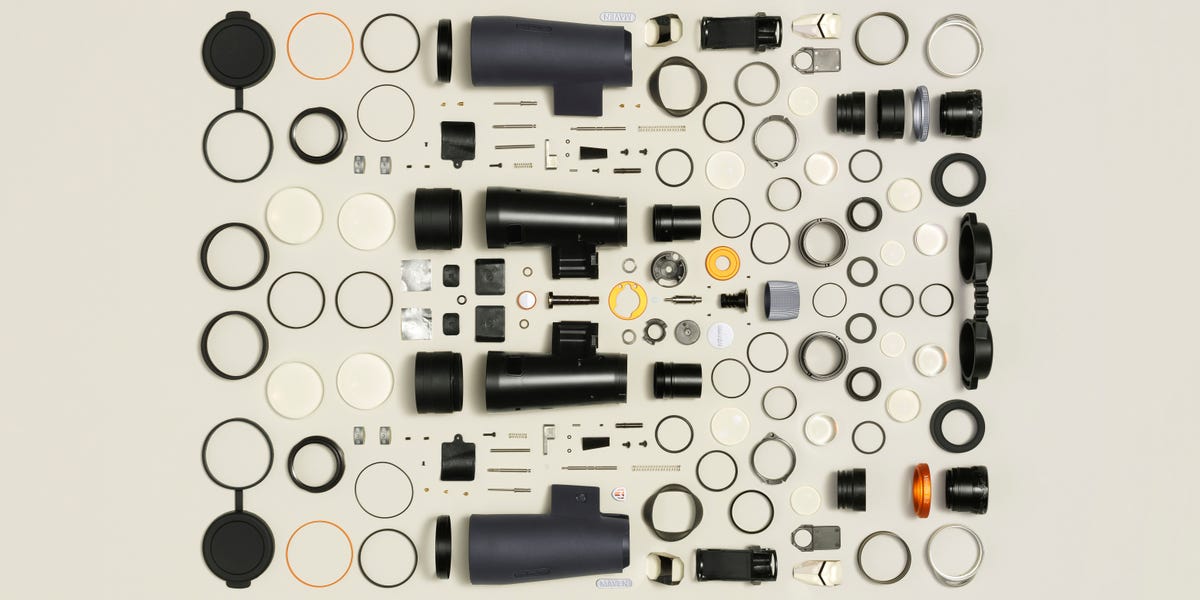
There are two kinds of people in the world: people who look through binoculars and say, “Wow, that bird is closer,” and people who look at binoculars and wonder, “How many tiny screws, lenses, prisms, seals, hinges, rings, and mysterious little washers are hiding inside this thing?” This article is for the second groupthe curious tinkerers, optics nerds, repair-table philosophers, and anyone who has ever held a pair of binoculars and felt the dangerous itch to take them apart.
The headline sounds dramatic, but the real surprise is not that a pair of binoculars can be disassembled into 172 parts. The surprise is that those parts work together so quietly. A good binocular does not shout about its engineering. It simply brings a faraway hawk, stadium seat, sailboat, mountain ridge, or lunar crater into view while pretending to be a simple handheld gadget. Inside, however, it is a carefully aligned optical machine with the personality of a Swiss watch and the patience of a physics professor.
Disassembled binoculars reveal a lot about how everyday optical devices are built. Objective lenses collect light. Prisms flip and correct the image. Eyepieces magnify what the objective system forms. Focus wheels shift internal elements by fractions of a millimeter. Diopter rings compensate for differences between your eyes. Rubber armor, O-rings, seals, purging gas, and coatings all fight the enemies of sharp vision: water, dust, glare, fog, vibration, and accidental abuse by humans who drop expensive things at exactly the wrong angle.
So let’s put the binoculars on the bench, metaphorically loosen the screws, and explore what happens when a compact viewing tool becomes a tiny exploded universe of glass, metal, plastic, grease, and precision.
What We Learned From Disassembled Binoculars
A pair of binoculars is basically two small telescopes joined by a bridge, but that description is like saying a smartphone is “a rectangle that beeps.” True, but not exactly generous. Binoculars must do several difficult things at once. They need to magnify distant objects, keep the image upright, keep both optical barrels aligned with each other, focus smoothly, survive outdoor weather, and remain comfortable enough to hold for long periods.
When binoculars are disassembled into dozensor even 172separate components, several families of parts appear. There are optical components such as objective lenses, eyepiece lens groups, prisms, and sometimes extra correcting elements. There are mechanical components such as the hinge, focus shaft, bridge, barrels, lens retainers, threaded rings, springs, and screws. There are comfort and protection parts such as eyecups, rubber armor, caps, seals, and strap lugs. Finally, there are adjustment parts: diopter mechanisms, eccentric rings, prism seats, shims, and collimation screws.
The magic is not in any one part. A single prism on a workbench is just a shiny chunk of glass with suspiciously sharp corners. A focus wheel by itself is just a knob. But once all the parts are aligned, secured, sealed, and tuned, the system becomes a portable instrument that can make a bird at 100 yards look close enough to judge its mood.
The Objective Lenses: Where the Light Comes In
The objective lenses are the large lenses at the front of the binoculars. Their job is to gather light from the scene and begin forming the image. This is why binoculars are described with numbers such as 8×42, 10×42, or 7×50. The first number tells you the magnification power. The second number tells you the objective lens diameter in millimeters.
For example, a 10×42 binocular magnifies the view ten times and uses 42 mm objective lenses. Larger objective lenses can collect more light, which is useful at dawn, dusk, under forest canopy, or while stargazing. Of course, there is a trade-off. Bigger lenses often mean more weight, more bulk, and a greater chance that your “quick birdwatching walk” turns into an upper-body workout.
In modern binoculars, the objective lens is rarely just one simple piece of glass. It may use multiple elements, often combining convex and concave shapes to control distortion and reduce chromatic aberration. Chromatic aberration is the color fringing you sometimes see around high-contrast objects, such as a dark branch against a bright sky. Better lens designs reduce that purple-green glow and produce a cleaner, more natural image.
The Prisms: The Secret Image-Flipping Wizards
If binoculars used only lenses, the image would appear upside down and reversed. That is inconvenient unless your hobby is watching birds while standing on your head. Prisms solve the problem. They bend, reflect, and correct the light path so the final view looks upright and natural.
Porro Prism Binoculars
Porro prism binoculars are easy to recognize because their barrels have a classic zigzag shape. The objective lenses sit wider apart than the eyepieces, giving the binoculars a chunkier profile. This design often provides a strong sense of depth because the objectives are spaced farther apart. Porro binoculars can also deliver bright, sharp views at a relatively friendly price because their prism system is less demanding to manufacture at high quality than some roof prism designs.
The downside is size. Porro prism binoculars can be bulkier, less streamlined, and harder to waterproof in a compact body. They look charmingly old-school, like they belong around the neck of an explorer who says “By Jove!” without irony.
Roof Prism Binoculars
Roof prism binoculars look sleeker because the objective lenses and eyepieces line up in a straighter tube. Many birders, hikers, hunters, travelers, and outdoor users like them because they are compact, comfortable, and easier to carry. However, roof prism designs are optically demanding. They often need phase-correction coatings and precise prism alignment to preserve contrast and fine detail.
When you see a premium roof prism binocular with fully multi-coated lenses, dielectric prism coatings, phase correction, waterproofing, and gas purging, you are looking at a device that is trying very hard to make complicated physics feel effortless.
Eyepieces, Eye Relief, and Eyecups
The eyepieces are the lens systems closest to your eyes. They magnify the image formed by the objective lenses and prism assembly. If the objective lenses are the front door, the eyepieces are the final handshake. Their design affects field of view, edge sharpness, comfort, and whether you can see the full image while wearing glasses.
Eye relief is the distance between your eye and the eyepiece where you can still see the complete field of view. Long eye relief is especially helpful for eyeglass wearers. Twist-up eyecups or fold-down rubber eyecups help position the eyes correctly. During disassembly, eyecups may seem like simple comfort parts, but they are part of the viewing experience. A great optical system with uncomfortable eyecups is like a luxury car with a park bench for a seat.
The Focus System: Tiny Movements, Huge Difference
The focus wheel is one of the most touched parts of any binocular. It looks simple, but inside it often drives a threaded shaft, cam, bridge, or internal focusing mechanism. Depending on the design, turning the wheel may move eyepiece assemblies, internal lens groups, or focusing elements. The movement is small, but the effect is dramatic. A fraction of mechanical travel can move the image from fuzzy soup to crisp feather detail.
Smooth focusing is not just a luxury. For birding, sports, wildlife viewing, and general outdoor use, fast and accurate focus matters. If the focus mechanism is too stiff, you miss the action. If it is too loose, you overshoot the target. If it has play or backlash, you begin bargaining with the universe: “Please, just one sharp second before the owl leaves.”
The Diopter Adjustment: Because Your Eyes Are Not Twins
Most people do not have perfectly identical vision in both eyes. The diopter adjustment lets you fine-tune one barrel, usually the right side, so both eyes see a sharp image at the same focus setting. This small ring is one of the most underappreciated parts of binocular design.
During disassembly, the diopter system may include a ring, threads, detents, markings, seals, and sometimes locking mechanisms. It is a small feature that solves a big problem: human biology. Your eyes may cooperate most of the time, but binoculars are not interested in “most of the time.” They need both optical channels to agree.
Coatings: Invisible Layers That Change Everything
Lens and prism coatings are among the most important invisible technologies inside binoculars. Without coatings, light reflects off glass surfaces, reducing brightness and contrast. With modern anti-reflective coatings, more light passes through the optical system and reaches your eyes.
Terms such as “coated,” “multi-coated,” and “fully multi-coated” are not just marketing confetti. A fully multi-coated binocular has multiple anti-reflective coatings on all air-to-glass surfaces. In premium binoculars, prism coatings may also improve reflectivity and contrast. Roof prism binoculars often use phase-correction coatings to improve resolution and fine detail.
Some binoculars also use hydrophobic exterior coatings that help water bead off the lenses. This is especially useful in rain, sea spray, snow, or any situation where nature decides your optics need a bath.
Seals, Gas Purging, and Weather Protection
Outdoor binoculars face a long list of enemies: rain, humidity, dust, sand, sweat, temperature changes, and the mysterious sticky substances found in backpacks. Waterproof and fogproof binoculars use seals, O-rings, and internal gas purgingcommonly nitrogen or argonto reduce internal fogging and moisture problems.
Once sealed binoculars are opened, that protection can be compromised. This is why disassembly should not be treated as a casual weekend repair unless the binoculars are already broken, inexpensive, or intended for educational teardown. Opening a sealed binocular may release its internal gas, disturb its waterproofing, contaminate optical surfaces, and create a new hobby called “Why Is There Dust Inside My View?”
Collimation: The Alignment That Saves Your Eyes
Collimation is the precise alignment of the two optical barrels so both eyes receive images that merge comfortably. Poor collimation can cause eye strain, headaches, double images, and general annoyance. In a disassembled binocular, collimation hardware may appear as tiny adjustment screws, prism mounts, eccentric rings, or shims.
This is where binocular repair becomes more than “put the screws back.” The two barrels must not only focus; they must agree with each other. A binocular with excellent glass but poor collimation is like two talented musicians playing different songs in the same elevator.
Why 172 Parts Is Not Overkill
At first, 172 parts sounds excessive. Do binoculars really need that many pieces? In a quality model, the answer is yes. Precision requires support. Lenses need retaining rings. Prisms need seats. Focus mechanisms need shafts and guides. Waterproofing needs seals. Eyecups need movement. The hinge needs strength and friction. The housing needs protection. Every screw, washer, ring, and spacer has a job, even if that job is extremely tiny and easy to lose on a carpet.
The larger lesson is that binoculars are not merely optical products. They are mechanical products. The best view depends on both glass and structure. If the housing flexes, the alignment suffers. If the focusing system wobbles, sharpness feels inconsistent. If the prism seats are not stable, the image may drift out of alignment. If the seals fail, the interior can fog. The humble parts list is really a story about precision under real-world abuse.
What Disassembly Reveals About Quality
Taking binoculars apart reveals quality in ways a product page cannot. You can see whether the housing is robust, whether the internal parts are cleanly finished, whether the focus mechanism is well-supported, whether the seals are thoughtfully placed, and whether the optical elements are secured without sloppy shortcuts.
Premium binoculars often feel better because internal tolerances are tighter. The focus wheel turns smoothly because the mechanism is carefully machined and lubricated. The hinge holds position because friction is controlled. The eyecups click into place because the detents are deliberate. The view looks sharp because the optical elements, coatings, and alignment are working together.
Budget binoculars can still be useful, but disassembly often shows where costs are saved: simpler coatings, more plastic parts, looser tolerances, less precise focusing, weaker seals, or less sophisticated prism treatment. None of that means cheap binoculars are useless. It means price differences often reflect real engineering choices, not just fancy logos.
Disassembled Binoculars and the Beauty of Repair Culture
There is something deeply satisfying about seeing a familiar object broken down into its components. Disassembly turns a black-box gadget into a map of decisions. It shows how designers solved problems, where compromises were made, and why a product feels the way it feels.
With binoculars, that lesson is especially vivid. A pair may look simple from the outside: two barrels, a hinge, a focus knob, and some rubber armor. Inside, it becomes a layered system of optics, mechanics, sealing, ergonomics, and alignment. Every part is there to protect the view. Every part exists because light is picky.
Should You Disassemble Your Own Binoculars?
For most people, the answer is noat least not if the binoculars are valuable, sealed, or still under warranty. Disassembling binoculars can void warranties, damage coatings, disturb collimation, introduce dust, ruin waterproofing, and turn a functioning instrument into a decorative desk puzzle. If you need repair, professional service is usually the smarter path.
However, if you have an old, broken, low-cost pair and want to learn, a careful teardown can be educational. The key is to treat the project as exploration, not guaranteed repair. Work slowly, photograph each stage, keep small parts organized, avoid touching glass surfaces, and accept that reassembly may not restore factory performance. In other words: proceed with curiosity, humility, and a tray that prevents screws from achieving freedom.
Real-World Experiences: What It Feels Like to Tear Down Binoculars
The first experience related to disassembled binoculars is surprise. Not mild surprise, either. More like “How did all this fit inside that?” surprise. When the rubber armor comes off, the device stops looking like outdoor gear and starts looking like a miniature optical machine. The smooth black exterior hides screws, rings, seals, and lens retainers that were never meant to be noticed by casual users.
The second experience is respect. Before opening binoculars, it is easy to think of them as simple tools. After seeing the internal structure, you begin to understand why good binoculars cost real money. The focus mechanism alone can be a tiny mechanical negotiation between smooth movement, weather sealing, durability, and accuracy. The prism housings must hold glass firmly without stressing it. The eyepiece assemblies must remain aligned while still allowing adjustment. Nothing is random.
The third experience is fear, but the productive kind. Once the optical parts are exposed, every dust speck suddenly feels like a villain. A fingerprint on a lens is no longer just a smudge; it is a personal failure with consequences. Coated glass is beautiful, but it demands care. You quickly learn why repair technicians use clean benches, proper tools, lens-safe cleaning methods, and patience. A rushed teardown is how small mistakes become permanent souvenirs.
The fourth experience is confusion. Even with photos and careful notes, some parts look almost identical. A thin washer may have a specific orientation. A retaining ring may sit at a precise depth. A shim may look like scrap but actually help maintain alignment. The most dangerous sentence in any teardown is, “I’ll remember where this goes.” No, you will not. Future you is tired, surrounded by parts, and silently judging past you.
The fifth experience is admiration for optical alignment. Reassembling a binocular is not like rebuilding a toy car. The parts may physically go back together, but the image may not. One barrel might be sharp while the other is slightly off. The view may feel uncomfortable. The focus may no longer track evenly. This teaches an important lesson: assembly is not the same as calibration. Factory-built binoculars are not merely screwed together; they are aligned, tested, and adjusted.
The sixth experience is a strange kind of joy. Disassembled binoculars make invisible engineering visible. You see how light travels through glass, how prisms reshape the path, how mechanical parts protect optical precision, and how small design decisions shape the user experience. Even if the binoculars never return to perfect condition, the teardown changes how you see every pair afterward. The focus wheel feels more impressive. The hinge feels more intentional. The view through the eyepiece feels less like magic and more like disciplined magic, which is honestly even cooler.
The final experience is restraint. After one teardown, you may be tempted to open every optical device in sight. Resist. Not every binocular wants to become a science lesson. Some binoculars deserve to remain sealed, aligned, and peacefully boring. The best outcome of exploring disassembled binoculars is not reckless tinkering; it is smarter appreciation. You learn what makes binoculars work, what makes them fail, and why the best ones feel like simple tools only because so much complexity is hiding inside.
Conclusion
Disassembled binoculars tell a story that a finished product cannot. Behind the clean exterior are objective lenses, eyepieces, prisms, coatings, seals, focus mechanisms, diopter adjustments, hinge systems, and dozens of tiny supporting parts. A 172-part teardown may look chaotic at first, but it reveals the opposite: careful order. Every component helps gather light, preserve alignment, improve comfort, resist weather, or protect the final image.
The next time you lift binoculars to your eyes, take a moment to appreciate the hidden engineering. That sharp view of a bird, boat, mountain, concert stage, or moon crater is not happening by accident. It is the result of glass shaped with purpose, prisms aligned with care, coatings measured in invisible layers, and mechanics tuned so smoothly that you barely notice them. Good binoculars make distance feel smaller. Disassembled binoculars make engineering feel bigger.