Note: This article is written as an original SEO-friendly editorial feature based on publicly available information about Flóra Borsi’s career, visual style, and major creative series.
Some artists use Photoshop the way most of us use the “undo” button: cautiously, nervously, and usually because a coffee mug has wandered into the corner of a photo like an unpaid extra. Flóra Borsi uses it differently. For the Hungarian fine art photographer and digital artist, Photoshop is not a quick cosmetic tool; it is a doorway, a mirror, a time machine, a psychological x-ray, and occasionally a very stylish conversation with a swan.
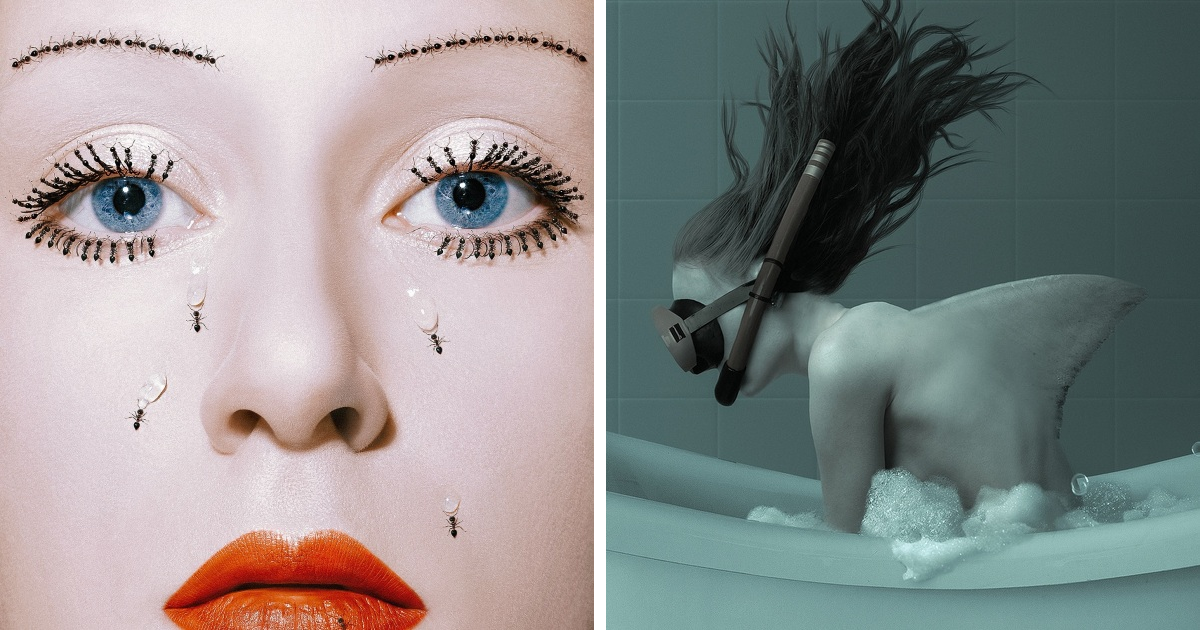
Borsi is widely known for surreal self-portraits that combine photography, meticulous photo manipulation, and conceptual storytelling. Her work often circles around identity, relationships, emotions, dreams, and the fragile strangeness of being humantopics that sound heavy until you realize she can express them with a single eye, a bird wing, or a portrait that looks like it escaped from a dream and politely asked for gallery lighting. Her official portfolio describes her practice as surreal fine art photography and visual art, while galleries and artist profiles consistently highlight her use of photo manipulation to explore identity, emotion, dreams, and the human psyche.
Who Is Flóra Borsi?
Flóra Borsi is a fine art photographer from Budapest, Hungary, born in 1993. She began working with photo editing very young; Adobe’s profile notes that she received Photoshop from her sister at age 11 and later began creating her own photographs as a teenager. That early relationship with digital tools matters because Borsi’s art never feels like photography with effects sprinkled on top. It feels like a complete visual languageone where the camera captures the body, and Photoshop reveals the thought behind the body.
Her career has traveled far beyond the small glowing rectangle of the internet. She has exhibited internationally, including in Europe and the United States, and artist profiles note connections to exhibitions at major venues such as the Louvre and Saatchi Gallery. Her artwork was also associated with Adobe Photoshop in 2014 and Adobe Creative Cloud in 2019, a detail that makes perfect sense: few contemporary artists have turned digital editing into such an emotionally recognizable signature.
Why “28 Times” Matters: A Gallery Of Inner Worlds
The title “28 Times Flóra Borsi Used Photoshop To Explore Identity, Dreams, And The Unseen” sounds like a listicle, but it points to something richer than a simple image roundup. Across her best-known projects, Borsi returns again and again to the same artistic question: what would the invisible parts of the self look like if they could pose for a portrait?
That question is why her images stay with viewers. They are not surreal just for the pleasure of being strange. They are strange in the way dreams are strange: emotionally accurate, even when they are physically impossible. A face merges with an animal. A woman appears beside long-dead icons. A historical photograph becomes a personal encounter. A portrait hides as much as it reveals. The result is digital surrealism with a pulse.
The Power Of The Eye In Borsi’s Photoshop Art
One of Borsi’s most famous bodies of work is Animeyed, an ongoing self-portrait series in which she pairs her own face with animals so that one of her eyes visually aligns with the animal’s eye. On her official project page, Borsi describes the series as an exploration of the intimate connection between humans and animals, blurring the line between human and non-human identity.
At first glance, the images are visually delightful. They are crisp, elegant, and instantly shareable. A dove, rabbit, fish, dog, beetle, or swan becomes part of the artist’s face, and the match is so seamless that the brain accepts the impossibility before it has time to object. Then the second reaction arrives: these are not just clever animal portraits. They ask viewers to consider empathy, instinct, beauty, vulnerability, and kinship with other living beings.
In the world of SEO keywords, we might call this “surreal Photoshop portrait photography.” In the world of normal human feeling, we might call it “that moment when a picture makes you stare at a bird and question your entire personality.” Both descriptions are useful. Only one is likely to fit on a gallery wall label.
Identity As Something Fluid, Not Fixed
Borsi’s work is especially powerful because identity in her images is never nailed to the floor. It moves. It borrows. It hides. It becomes animal, memory, myth, celebrity, shadow, or historical echo. In many traditional portraits, identity is presented as a stable fact: this is the person, this is the face, this is the name. Borsi’s portraits argue the opposite. They suggest that the self is layered, symbolic, and sometimes wearing feathers.
This is where Photoshop becomes more than software. In Borsi’s hands, digital manipulation becomes a philosophical tool. She uses it to visualize what ordinary photography cannot easily capture: inner contradiction, private longing, spiritual overlap, and the theatrical weirdness of self-perception. The images do not say, “Here is what I look like.” They say, “Here is what it feels like to be seen, unseen, split, disguised, remembered, or transformed.”
Dreams, Surrealism, And The Beautifully Impossible
Borsi’s dreamlike style places her within a long tradition of surreal art, but her work feels distinctly contemporary. Instead of melting clocks or impossible architecture, she uses the visual grammar of the digital age: selfies, beauty photography, clean studio lighting, cinematic color, and seamless compositing. The result is surrealism that does not feel dusty or academic. It feels alive, polished, and ready to haunt your phone screen at 2:00 a.m.
Her Selfie series offers a playful example. On her official project page, Borsi explains that she imagined going back in time and taking selfies with famous historical figures, artists, scientists, and Hollywood icons. The idea is humorous, but it also reflects a deeper wish: to stand beside the people whose ideas still shape the present.
This is what makes Borsi’s dream logic so effective. She does not simply ask, “What if this impossible thing happened?” She asks, “What emotional truth would this impossible thing reveal?” In Selfie, the joke is time travel. The deeper feeling is admiration, longing, and the human desire to belong to a larger story.
The Unseen: What Borsi Reveals By Hiding
Some of Borsi’s strongest images are built around concealment. A face may be partially covered, replaced, masked, or merged with another form. This visual hiding is not a gimmick. It is a way of talking about the unseen: the emotions, memories, fears, and identities that do not always appear in a normal portrait.
In a culture obsessed with visibility, Borsi’s work reminds us that being visible is not the same as being understood. A photograph can show a face and still miss the person. By altering the face, Borsi paradoxically gets closer to the inner subject. She turns the portrait into a psychological landscape, where a feather, shadow, animal eye, or impossible gesture may reveal more than a straightforward smile ever could.
Photoshop As Craft, Not Shortcut
It is tempting to look at digital art and mutter, “Well, the computer did it,” which is the same energy as watching a chef cook dinner and saying, “Well, the oven helped.” Borsi’s images require planning, photography, styling, lighting, makeup, composition, retouching, color control, and hours of detailed editing. In an earlier description of her Animeyed process, Borsi noted that the photoshoot could be quick, but the manipulation could take up to 20 hours per image.
That detail matters. The seamlessness of her work is not automatic. It is earned. The animal eye has to align with the human face. The skin tone, texture, shadow, gaze, and expression have to feel believable inside an unbelievable idea. The image has to be strange enough to startle, but refined enough to invite trust. Too little polish and the concept collapses. Too much polish and the emotion disappears under a glossy surface. Borsi often finds the narrow bridge between both.
28 Visual Lessons From Flóra Borsi’s Work
Across 28 memorable moments in her Photoshop-driven practice, several lessons appear again and again. First, a portrait does not need to be realistic to be honest. In fact, realism can sometimes be the least honest option. When the subject is grief, desire, alienation, wonder, or transformation, a literal image may not go far enough.
Second, the eye is a powerful symbol because it controls both seeing and being seen. Borsi’s repeated focus on eyesespecially in Animeyedturns vision into identity. The viewer is not just looking at the artwork; the artwork looks back, sometimes with a gaze that is not entirely human.
Third, humor and elegance can coexist with serious themes. Her images can be playful, even witty, without becoming shallow. A time-travel selfie may make us smile, but it also speaks to memory, influence, and historical imagination. A portrait merged with an animal may be visually charming, but it also raises questions about empathy and otherness.
Fourth, technical mastery should serve emotion. Borsi’s Photoshop skill is obvious, but the best images do not feel like software demonstrations. They feel like emotional discoveries. The editing disappears into the concept, which is exactly what good editing should do. Like excellent punctuation, it works best when nobody throws a parade for it.
Why Viewers Connect With Her Surreal Self-Portraits
Viewers connect with Borsi’s surreal self-portraits because they are visually immediate and emotionally open-ended. You do not need an art history degree to feel their impact. A viewer can admire the craft, enjoy the fantasy, interpret the symbolism, or simply think, “That is stunning, and I would like my profile picture to have even one-tenth of that confidence.”
Her images also thrive online because they are instantly recognizable. The combination of clean composition, strange concept, and emotional intensity makes them perfect for digital circulation. But unlike many viral images, they do not evaporate after the first glance. They reward slower looking. The longer you sit with them, the more they shift from spectacle to question.
Specific Examples Of Themes In Borsi’s Art
Human And Animal Connection In Animeyed
Animeyed explores the border between self and creature. By sharing an eye with an animal, Borsi creates a hybrid identity that feels tender rather than monstrous. The effect suggests that humans are not as separate from the natural world as we like to imaginedespite our impressive talent for inventing plastic packaging and ignoring houseplants until they file emotional complaints.
Time, Fame, And Memory In Selfie
In Selfie, Borsi inserts herself into imagined encounters with famous figures from the past. The series comments on celebrity culture and the modern selfie habit, but it also becomes a love letter to influence. She is not only standing beside icons; she is acknowledging the creative ancestors who continue to shape imagination.
History And Empathy In The Forgotten Dream
Another project, The Forgotten Dream, was reportedly sparked by a visit to Ellis Island and imagines immigrant histories through staged, digitally constructed images. The project shows how Borsi’s surreal approach can move beyond personal identity into collective memory and empathy.
What Artists And Content Creators Can Learn From Borsi
For photographers, designers, bloggers, and digital artists, Borsi’s work offers a practical lesson: originality often comes from combining a strong personal question with a disciplined visual method. Her question might be about identity, dreams, animals, time, or hidden emotion. Her method involves photography, styling, and Photoshop craft. The magic happens where the two meet.
Her work also shows that a strong concept can make digital art memorable. Many people can learn tools. Fewer people know what to say with them. Borsi’s images are technically impressive, but their staying power comes from meaning. The software helps build the door. The concept decides where the door opens.
Of Experience: Looking At Borsi’s Art As A Viewer And Creator
Spending time with Flóra Borsi’s work feels a little like walking through a museum where every mirror has learned to dream. At first, the experience is visual: the colors, the smooth editing, the precise lighting, the face that seems human and not-human at once. But after a while, the images start poking at bigger questions. How much of identity is chosen? How much is inherited? How much of the self is visible, and how much is quietly hiding behind the expression we use for passport photos, office meetings, and pretending we understood the ending of a complicated film?
For anyone who has tried to create visual content, Borsi’s art is both inspiring and mildly intimidating. Inspiring because it proves that digital tools can be poetic. Intimidating because it reminds us that “I’ll fix it in Photoshop” is not a creative strategy unless you actually have a vision. Her best images do not feel like accidents rescued by editing. They feel imagined from the inside out. The makeup, pose, lighting, animal pairing, background, and final manipulation all work together like instruments in a tiny surreal orchestra.
One useful experience from looking closely at her work is learning to slow down. Online, we often consume images like snacks: scroll, like, move on, forget. Borsi’s portraits resist that habit. The first glance gives you the hook, but the second and third glance reveal the emotional architecture. Why this animal? Why this eye? Why this color palette? Why does the face look calm when the concept feels impossible? Those questions turn a picture into an experience.
Another lesson is that personal art does not have to be messy to be honest. Some people assume emotional work must look raw or unfinished. Borsi proves that precision can also be intimate. Her polished surfaces do not erase feeling; they contain it. The elegance gives the emotion a sharper edge. It is like a beautifully wrapped gift box that may or may not contain a small existential crisis. Either way, you are opening it.
For writers, bloggers, and SEO content creators, Borsi’s career offers a surprisingly useful reminder: strong visual identity matters. Her work is recognizable because it has a consistent emotional world. The themes vary, but the atmosphere remains distinct. That is exactly what good web publishing tries to achieve, too. Whether the medium is a photograph or an article, audiences remember work that has a clear voice, a clear point of view, and enough originality to make them pause.
Finally, there is the emotional experience of seeing the self as flexible. Borsi’s portraits do not trap identity in one face or one mood. They suggest that people are part animal, part memory, part dream, part performance, part secret. That idea feels especially relevant in a digital culture where we are constantly asked to present ourselves clearly, quickly, and attractively. Borsi’s art whispers a more interesting possibility: maybe the self is not a profile. Maybe it is a whole invisible weather system.
Conclusion: The Seen, The Dreamed, And The Digitally Revealed
Flóra Borsi’s Photoshop art succeeds because it treats digital manipulation as a language of inner reality. Her surreal self-portraits do not simply decorate the face; they question it. They explore identity as something fluid, dreams as something visually alive, and the unseen as something that can be felt even when it cannot be photographed directly.
From Animeyed to Selfie and beyond, Borsi demonstrates that Photoshop can be more than a retouching tool. It can become a stage for emotion, a bridge between species, a playful time machine, and a lens pointed at the hidden rooms of the psyche. Twenty-eight times, or two hundred times, the pattern remains clear: her best work invites us to look againnot only at the image, but at the strange, layered creature looking back from inside ourselves.