Victorian London is often packaged as a tidy historical gift basket: elegant carriages, fog curling around gas lamps, impressive mustaches, and gentlemen apparently dressed for a board meeting even while buying onions. John Thomson’s photographs from the 1870s tell a less polished story.
His camera followed the people who worked outdoors, lived close to the edge, and kept the capital functioning without receiving much recognition for it. Street vendors, shoe-shiners, flower-market laborers, traveling families, river workers, musicians, and people experiencing homelessness all appeared before his lens.
More than 140 years later, British photo colorizer Tom Marshall selected 11 of these remarkable photographs and added historically informed color. The results do not replace the original images. Instead, they offer modern viewers another doorway into them. A gray coat becomes worn brown wool. A brick wall gains warmth. Flowers suddenly look like products that somebody carried, sold, and depended upon for dinner money.
Color does something sneaky to historical distance. It removes part of the visual barrier between “those Victorians” and people who look uncomfortably familiar. The hats may have changed, but the expressions of fatigue, pride, suspicion, humor, and determination have not.
The Original Street Life in London Project
John Thomson took his camera beyond the studio
Scottish photographer John Thomson was already an experienced traveler and visual storyteller when he began documenting London’s working poor. He had spent years photographing people, architecture, landscapes, and daily activity across parts of Asia before returning to Britain.
In London, he collaborated with journalist and social activist Adolphe Smith. Their work appeared in a series of monthly installments beginning in 1877 and was later collected in book form. Each photograph was accompanied by a written account describing the subject’s occupation, income, living conditions, ambitions, or recent misfortunes.
This combination was unusually powerful. A written description could be dismissed as exaggeration. A portrait alone could be admired without context. Put the two together, however, and the reader had fewer places to hide.
These photographs were documentary, but not candid snapshots
Modern street photographers can raise a camera, press a button, and capture six pedestrians, three pigeons, and one cyclist questioning every life decision in a fraction of a second. Thomson worked with bulky equipment and long exposure times. His subjects usually had to remain still, so many scenes were carefully arranged.
That does not make them fake. The people, occupations, tools, clothing, neighborhoods, and economic pressures were real. Thomson organized the frame, but he did not invent the difficult lives inside it.
The resulting photographs are best understood as collaborative portraits of social reality. They show people presenting themselves to the camera while their surroundings reveal details they may not have intended to emphasize: broken paving stones, crowded stalls, damaged clothes, improvised equipment, and children already involved in the family economy.
Why Colorizing Victorian London Changes the Viewing Experience
Black-and-white photography has developed its own visual language. We associate it with history, seriousness, tragedy, and important documentaries narrated by someone with an excellent voice. Yet the people Thomson photographed did not inhabit a monochrome city.
London contained red brick, green-painted doors, faded advertisements, brown river water, brass fittings, muddy streets, blue work clothes, fresh flowers, and market goods arranged to catch the eye. Adding plausible color reminds us that these were living commercial environments rather than museum exhibits waiting patiently to become old.
Marshall has explained that color can persuade viewers to pause in a world crowded with digital images. That pause matters. It encourages us to study a seller’s merchandise, the condition of a worker’s shoes, or the wary glance of a woman holding her child.
Of course, colorization involves interpretation. Unless a surviving record identifies a garment or painted surface, no artist can know every original shade. Responsible colorization therefore combines research with clearly labeled judgment. It should invite investigation, not pretend to be a time machine with flawless factory settings.
Eleven Colorized Windows Into Victorian Street Life
1. The dealer in fancy goods
One photograph shows a barrow crowded with inexpensive ornaments and decorative items. The trade was sometimes called “swag-selling,” though it had nothing to do with conference tote bags or branded water bottles.
The seller explained that earnings had declined as competition increased. His wife often watched the barrow, and the family’s income had to cover rent, food, fuel, and clothing. Smith noted the irony that customers living in poverty still purchased earrings, combs, and small luxuries.
Yet perhaps that is not ironic at all. People do not stop wanting beauty because money is scarce. A cheap ornament may offer identity, pleasure, or dignity when almost everything else is practical and exhausting.
2. A traveling family in Battersea
The image commonly associated with the “London nomads” shows a family gathered around a caravan on vacant land in Battersea. They traveled between city districts, rural harvests, fairs, and seasonal work, selling inexpensive goods or operating games.
Color brings attention to the caravan as a home rather than a picturesque prop. Its painted panels, steps, cooking arrangements, and cramped interior suggest a complete domestic world built for movement.
The original account records the family patriarch’s suspicion of formal education, providing a revealing glimpse of tension between compulsory schooling, traditional occupations, and an itinerant lifestyle. Victorian social reform looked admirable from a government office. It became considerably more complicated when the school bell was miles away from the next temporary campsite.
3. The wall workers
Another scene features men involved in a low-cost advertising system. Boards carrying printed notices were hung on available walls or fences each morning and removed at night. Some represented paying advertisers, while others were decorative “dummies” used to make the display appear more impressive.
In modern terms, this was outdoor advertising inventory with questionable reporting metrics. A Victorian marketing manager might have called it strong visibility. A suspicious client might have asked how many boards were actually generating revenue.
The photograph reveals how even blank urban surfaces could become income-producing assets. Walls were not merely boundaries; they were media platforms operated by people whose earnings depended on trade conditions they could not control.
4. The secondhand furniture dealer
At Church Lane in Holborn, a dealer pushed much of his furniture and household stock onto the street whenever the weather cooperated. Chairs, cookware, tools, textiles, and other used objects transformed the pavement into an extension of the shop.
The scene illustrates the blurred line between private and public space in poorer districts. Residents worked, shopped, socialized, negotiated, and displayed goods outdoors. The street was a market, workplace, meeting room, delivery route, and neighborhood news service.
Smith also described redevelopment that displaced many residents to less convenient areas. Urban improvement may produce cleaner maps and wider roads, but the people removed from those maps still need somewhere to live and work.
5. The unlicensed shoe-black
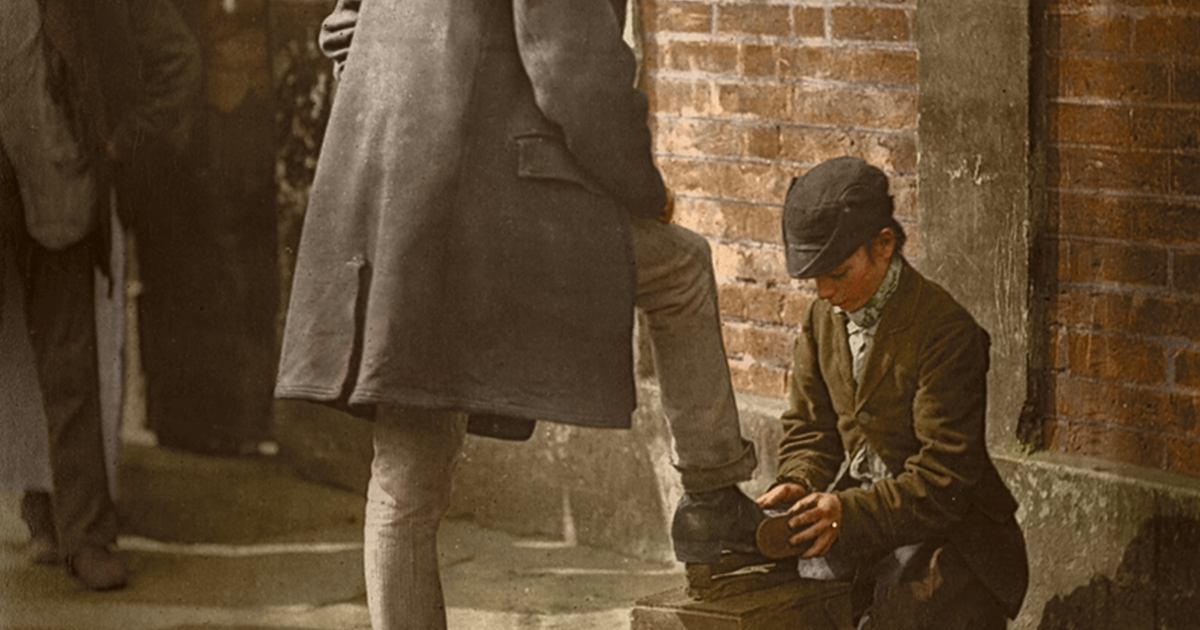
A young shoe-shiner kneels beside a customer, concentrating on a boot while the adult towers above him. The photograph captures both the intimacy and imbalance of service work. The customer receives a polish; the worker remains at pavement level.
Authorities attempted to regulate or remove unlicensed shoe-blacks, but neighborhood shopkeepers sometimes defended familiar workers. A shoe-shiner might also deliver messages, help close shutters, watch property, or perform errands.
The image therefore documents more than child labor or informal trade. It shows how working relationships could become embedded in a local community, providing modest protection where official systems offered little security.
6. Covent Garden’s flower laborers
In one of the most visually rewarding colorizations, workers carry baskets and handle plants at the Covent Garden flower market. Green leaves and bright blossoms transform the composition, but the beauty should not distract from the physical labor involved.
Flowers passed through a large network of growers, transporters, wholesalers, porters, stallholders, and street sellers. Much of the activity began before most Londoners had finished arguing with their blankets.
The workers’ clothing, baskets, and tired postures reveal the machinery behind a decorative product. Every bouquet presented in a comfortable drawing room had already experienced a complicated working-class adventure.
7. “Tickets,” the sign painter
A sign painter known as “Tickets” appears seated beside his work. His business partner searched shop windows for damaged or outdated signs, then offered merchants freshly painted replacements.
The trade required artistic skill, salesmanship, observation, and impressive confidence. Walking into a shop to announce that its sign looked dreadful was apparently a business strategy, not merely a creative way to be asked to leave.
The colorized image highlights painted lettering, flowers, and small design details. It also presents a recognizable freelance ambition: live carefully, save money, build a client list, and eventually establish a more secure business.
8. Workers on the “silent highway”
The River Thames was often described as London’s silent highway, although anyone who has heard ropes, cargo, machinery, shouting, and water striking a hull may question the adjective.
Thomson photographed river workers surrounded by barrels, ropes, pipes, and the industrial landscape of the Thames. Their work demanded strength, balance, experience, and constant exposure to weather.
Color gives the ropes different textures, separates the workers from the smoky background, and makes the river environment feel immediate. It also draws attention to the city’s dependence on labor performed beyond the fashionable streets usually featured in nostalgic views of London.
9. The cough-lozenge and ointment seller
One vendor stands beside a display advertising cough remedies and medicinal ointments. According to the accompanying account, failing eyesight forced him to leave regular employment. He later began selling a product he believed had helped restore part of his vision.
His story combines disability, medical uncertainty, entrepreneurship, and the era’s loosely regulated health market. The ointment was promoted for an ambitious list of complaints, from sore eyes to burns and chapped skin. Apparently, the Victorian cure-all industry never met a symptom it did not feel qualified to address.
Behind the humor is a serious reality: illness could destroy a household’s income. Street selling offered one of the few routes back to economic independence.
10. Italian street musicians
A group of Italian musicians, including children, gathers around a harp. Nineteenth-century London attracted migrants who performed music in streets and residential areas, sometimes saving money with the hope of eventually returning home.
The photograph raises uncomfortable questions about how migrants were described and judged. Contemporary writing often mixed sympathy with stereotypes, treating whole communities as social categories rather than individuals.
Colorization can counter part of that distance by emphasizing faces, clothing, and instruments. The group becomes less like an illustration of “foreign street life” and more like a collection of specific people standing through another working day.
11. The woman known as a “crawler”
The most haunting image shows an older woman seated alone near a doorway. Victorian observers used the harsh term “crawler” for people who remained in the streets because they lacked stable accommodation, strength, health, or employment.
Smith reported that the woman had been widowed and later left a troubled family household with her teenage son. Poverty followed a chain of bereavement, illness, conflict, and financial collapse rather than one dramatic moral failure.
Her colorized clothing appears heavy, faded, and patched. The added hues do not make the image prettier. They make her isolation harder to dismiss. She looks less like an antique symbol of poverty and more like someone we might pass today while pretending to check a message.
What the Photographs Reveal About Victorian London
Together, the 11 photographs show a city powered by unstable employment. Many workers lived from one day’s sales to the next. Weather, illness, police enforcement, redevelopment, competition, and market prices could erase an income with little warning.
They also reveal the importance of informal business. Pavements became shops. Walls became advertising space. Handcarts became mobile inventory systems. A repaired umbrella, polished shoe, painted sign, basket of flowers, or street performance could keep a household functioning.
Women and children were not merely standing beside male workers. They sold goods, maintained homes, sewed late into the night, carried merchandise, performed music, and managed stalls. Their labor was essential even when official records treated it as secondary.
Most importantly, the series gives individuality to people who might otherwise appear only as statistics. Smith’s writing sometimes reflects the assumptions and prejudices of his period, but the combination of names, voices, occupations, and photographs preserved details that conventional history often ignored.
Experience and Reflection: Spending Time With 140-Year-Old Faces
Working closely with photographs like these is a different experience from scrolling through a gallery of “amazing old pictures.” The longer one studies them, the less old they seem.
The first stage is usually visual research. A dark shape that initially looks like a coat may turn out to be an apron. A pale object may be painted wood, metal, paper, stone, or fabric. Victorian clothing references help, but poorer workers often wore repaired, faded, inherited, or secondhand garments that did not resemble pristine examples preserved in museums.
Then comes environmental research. What color was ordinary London brick after years of coal smoke? How might a hand-painted shop sign have looked? Which greens were commonly used on doors, carts, boats, or street furniture? The answer is rarely one exact digital value waiting to be discovered. Historical color work involves ranges of probability rather than magic certainty.
Skin tones require particular care. Adding too much saturation can make a face look modern and artificially healthy. Adding too little leaves the subject trapped in a tinted version of black and white. Dirt, weather exposure, age, illness, facial hair, and the limitations of the original photograph all affect the final result.
There is also an emotional challenge. Colorizing a basket or brick wall is technical. Colorizing the face of a child shoe-shiner or an exhausted woman is interpretive and personal. Small decisions influence how viewers perceive vulnerability, dignity, and character.
A successful result should not turn hardship into costume drama. Victorian poverty was not a charming lifestyle involving attractive waistcoats and artisanal carts. It meant hunger, insecurity, overcrowding, dangerous work, limited medical care, and the possibility that one illness could dismantle an entire family economy.
At the same time, the photographs should not reduce every person to misery. The fancy-goods dealer understood his customers. The sign painter had plans. The traveling family valued independence. Flower workers possessed specialized knowledge. Street musicians performed skilled labor. Even under difficult conditions, people negotiated, joked, adapted, competed, cooperated, and imagined better futures.
That balance may be the most important lesson of the colorization process. History becomes meaningful when its subjects are allowed to be complicated. They were not simply victims, colorful characters, or examples in a reform campaign. They were workers and relatives, sellers and customers, migrants and neighbors. Some were cautious. Some were optimistic. Some probably found the photographer mildly annoying.
The modern viewing experience also exposes our own habits. In black and white, poverty can feel safely historical. In color, the similarities to current urban life become more visible. Informal sellers still depend on foot traffic. Migrants still perform essential work while facing stereotypes. Families still lose housing after illness or unemployment. Redevelopment still removes communities from valuable districts while calling the process improvement.
Color therefore adds more than visual attraction. It creates a moment of recognition. The photograph stops behaving like a relic and begins behaving like evidence.
Conclusion
John Thomson and Adolphe Smith’s Street Life in London remains compelling because it looked toward people whom respectable Victorian society often looked past. The 11 colorized photographs renew that invitation to pay attention.
The added color cannot tell us the exact shade of every coat, wall, flower, or painted sign. What it can do is slow us down. It helps separate objects, reveal working environments, and restore some visual immediacy to faces photographed more than a century ago.
These Londoners lived in a city of rapid growth and enormous wealth, yet many survived through exhausting labor and fragile daily earnings. Their tools and fashions belong to another century. Their worries about rent, health, competition, migration, insecure work, and neighborhood displacement sound considerably less ancient.
Perhaps that is why the images remain so powerful. We begin by examining Victorian street life and end by recognizing parts of our own world staring back.
Editorial note: The colors in modernized historical photographs are researched interpretations, not definitive proof of the original hues. The unaltered photographs remain the primary historical record.